
15 Questions to Ask a Coach Before Hiring Them
The most useful questions to ask a coach before hiring cover five things: whether they work with people like you, how they would approach your goal, what happens between sessions, how you will both know it is working, and the terms (price, cancellations, refunds, confidentiality and how to end it). The answers matter less than how the coach gives them: a good coach is specific, admits what they do not do and is comfortable putting everything in writing. The International Coaching Federation suggests meeting at least three coaches and getting two references from each before you choose.
Below are 15 questions to take into a discovery call, with why each one matters and what a good versus a worrying answer sounds like. They work for life, career, health, relationship and most business coaching. If you are hiring for a company, our sibling lists of questions to ask a business coach and questions to ask a potential executive coach go further.
The 15 questions at a glance
| Question | A good answer sounds like | A worrying answer sounds like |
|---|---|---|
| 1. Who do you usually work with? | A specific kind of client, and who they refer elsewhere | "Everyone, really" |
| 2. How would you approach my goal? | A rough plan for the first few sessions | A pitch for their standard program |
| 3. What does a session look like? | Length, structure and who sets the agenda | "We just see where it goes" |
| 4. What happens between sessions? | Prep, check-ins, reply times | Nothing, or unlimited 24/7 access |
| 5. How will we know it is working? | Goals you set together and a review date | "You'll just feel it" |
| 6. What training do you have? | A named program, body and hours | "I'm certified" with no detail |
| 7. Who supports your own development? | A mentor, supervisor or peer group | Surprise that you asked |
| 8. What if I need therapy instead? | A calm, specific referral answer | "Coaching is better than therapy" |
| 9. What stays confidential? | What they record, and the limits | "Everything, always" or no answer |
| 10. If someone else pays, what do they hear? | Goals and progress, not content | "I'll keep them updated" |
| 11. Can I speak to past clients? | "Yes, I'll ask two to contact you" | Only screenshots |
| 12. What does it cost in total? | One clear number and what it includes | Add-ons revealed later |
| 13. What if I miss or move a session? | A written, reasonable policy | "We'll figure it out" |
| 14. How do we end it if it is not working? | A clear exit and refund rule | Locked in for the full term |
| 15. What do you need from me? | Time, honesty and action between sessions | "Just show up" |
1. "Who do you usually work with, and who don't you work with?"
Why it matters: most good coaches specialize. A coach who mostly works with career changers, new managers or people after divorce will be faster on that problem than a generalist, because they have seen the common turns before.
A good answer: a clear description of their usual clients ("mostly mid-career professionals moving into a new field") and, just as useful, who they do not work with or would refer elsewhere. A coach who can say "that's not my area, here's who I'd suggest" is showing judgment.
A worrying answer: "I work with everyone," or a list so broad it covers anyone who might pay. Our list of types of life coaching helps you name the specialty you need before you ask.
2. "How would you approach my goal?"
Why it matters: this is the closest you will get to a sample of the coaching before you pay. Describe your goal in a sentence or two first, then ask.
A good answer: the coach asks a few questions back, then sketches a plan for the first three or four sessions: what they would want to understand, what you would probably work on first and how they would tailor it. They do not promise an outcome.
A worrying answer: a description of their standard program that would be the same for anyone, delivered without asking you anything. The ICF's guide notes that a coach does not give you the answers but asks the questions that help you find your own (ICF guide for individuals), so a call with no questions is a poor sign.
3. "What does a typical session look like?"
Why it matters: you are buying a series of hours. You should know how long they are, how often they happen and how they run.
A good answer: something like "50 minutes every two weeks by video; we start with what happened since last time, you pick the topic, and we end with one or two actions you choose." The coach can describe who sets the agenda and how a session ends.
A worrying answer: "We just see where it goes" every time, or sessions so short and infrequent that little can happen. Our guide to running a first coaching session, written for coaches, shows what a well-structured first session covers.

4. "What happens between sessions?"
Why it matters: most change happens between sessions, in the experiments you try and the habits you keep. What the coach provides in that time often matters more than the session itself.
A good answer: specifics. Prep before each session, a short check-in during the week, notes you can find later, and a clear message policy: what messages are for and how fast they reply.
A worrying answer: nothing at all, or the opposite, "message me any time, day or night." Unlimited access sounds generous and usually means slow, inconsistent replies or a coach heading for burnout.

5. "How will we know it is working, and when will we check?"
Why it matters: without an agreed measure, you will judge coaching by your mood on a given day. A review point protects your money and your time.
A good answer: "We'll set two or three goals in the first session, written so we can both tell whether they happened, and review them at week six." The measure might be applications sent, a habit kept for four weeks, a conversation you finally had or a number in your business.
A worrying answer: "You'll just feel different," or a reluctance to measure anything at all. Research on goal pursuit found that monitoring progress improves goal attainment, especially when progress is recorded or shared with someone (Harkin and colleagues, 2016). A coach who will not track anything is giving up one of the tools that works.

6. "What training do you have, and can I check it?"
Why it matters: coaching is unregulated, so anyone can use the title. The Bureau of Labor Statistics describes the field as unregulated, with training and certification helping coaches stand out (BLS).
A good answer: a named training program, the accrediting body and roughly how many hours. If they hold an ICF credential, you can verify it on the ICF's site; the ACC requires 60 or more hours of coach education and 100 or more hours of coaching experience, the PCC 125 and 500 (ICF credentialing). Health coaches may hold the NBC-HWC.
A worrying answer: "I'm certified" with no detail, or irritation that you asked. Remember that a credential shows training, not fit; plenty of good coaches have other relevant backgrounds, and they can explain them.
7. "Who supports your own development as a coach?"
Why it matters: coaches who keep learning, get feedback on their work and have someone to consult when a client situation is difficult tend to notice their own blind spots.
A good answer: a mentor coach, a supervisor, a peer group or ongoing training. ICF credentials require mentor coaching as part of the process, and many experienced coaches keep some form of supervision afterwards.
A worrying answer: surprise at the question, or a sense that they have nothing left to learn. This is a quieter question than most on the list, and the answer tells you a lot about how seriously they take the work.
8. "What do you do if a client needs therapy or medical help instead?"
Why it matters: coaching is not treatment. Some clients arrive with anxiety, depression, trauma or a medical issue that needs a licensed professional, and a good coach recognizes it.
A good answer: calm and specific. "If I see signs that therapy would help more, I'll say so, suggest you see someone, and we'll decide together whether to pause coaching or continue alongside." The ICF Code of Ethics asks coaches to stay alert to signs that a client would benefit from a different professional or resource (ICF Code of Ethics).
A worrying answer: "Coaching works better than therapy," or an offer to treat anxiety or trauma themselves. Our guide to life coach vs therapist explains where the line sits.
9. "What stays confidential, and what are the exceptions?"
Why it matters: you will say personal things. You should know what is recorded, where it is kept, who can see it and when, if ever, it would be shared.
A good answer: the coach explains what notes they keep, that nothing is shared without your permission, and the narrow exceptions, such as a risk of serious harm or a legal requirement. The ICF Code of Ethics expects coaches to agree in advance what confidential information might have to be disclosed and when.
A worrying answer: "Everything is completely confidential, always," with no mention of limits, or no clear answer at all. Another bad sign: a social feed full of screenshots of other clients' messages.

10. "If someone else is paying, what will they hear?"
Why it matters: when an employer or a family member pays, there is a third party with expectations. Who hears what needs to be settled before the first session.
A good answer: "Your sponsor hears the goals we agree and whether we are making progress, not what you say in sessions," ideally agreed in a short meeting with all parties. The ICF's client guide notes that conversations remain private even when an employer pays.
A worrying answer: "I'll keep your manager updated," with no detail on what that means. If you are paying yourself, this question still matters if your partner or parent is involved.
11. "Can I speak to one or two past clients?"
Why it matters: testimonials on a website are chosen by the coach and may not be typical. The FTC warns that success stories may not be true or typical and that positive reviews can come from made-up profiles (FTC consumer alert).
A good answer: "Yes, I'll ask two clients who worked on similar goals if they're happy to speak with you." Confidentiality means they will ask permission first, which is itself a good sign. The ICF recommends getting two references from each coach you consider.
A worrying answer: only anonymous screenshots, or a refusal with no explanation. A brand-new coach may have few references; an honest one will say so and may offer a lower rate or a trial session instead.
12. "What does it cost in total, and what is included?"
Why it matters: some coaching sells a starter package and then reveals that the real results come from a more expensive tier. The FTC's guidance on coaching programs says that if a coach asks you to pay even more money to succeed, you should stop (FTC).
A good answer: one clear total, how it is paid and what it includes: number and length of sessions, messaging, worksheets, any assessments. For comparison, Coachful's 2026 Coaching Business Report puts a typical life coaching session at $75 to $200 and a three-month, eight-session package at $1,200 to $2,500.
A worrying answer: a price that changes depending on how keen you seem, or a "special rate" that expires at the end of the call.

13. "What happens if I miss or need to move a session?"
Why it matters: life happens. You want a fair policy you know about before it matters, not a dispute afterwards.
A good answer: a written rule, for example "Reschedule with 24 hours' notice at no charge; late cancellations count as a session." Many coaches are flexible the first time.
A worrying answer: "We'll figure it out," which usually means it will be figured out in the coach's favor, or a rule so strict that one missed call loses you money with no discussion.
14. "How do we end it if it is not working?"
Why it matters: not every coach and client fit, and that is nobody's fault. You should be able to leave without a fight.
A good answer: a clear exit: notice period, what happens to unused sessions and how refunds work, all in the written agreement. Some coaches build in a review after the first month specifically so either side can stop. The ICF Code of Ethics expects coaches to agree roles, responsibilities, confidentiality and financial arrangements before coaching begins.
A worrying answer: a long contract with no exit, no refunds under any circumstances, or a payment plan that keeps billing after you stop.

15. "What do you need from me for this to work?"
Why it matters: coaching is a two-way commitment. The answer tells you what you are signing up for and whether you can give it right now.
A good answer: honest expectations, such as "an hour or two a week to try what we agree, honesty about what didn't happen, and telling me when something isn't working for you."
A worrying answer: "Just show up and trust the process." It sounds easy, and it hides the fact that the results depend on what you do between sessions.
How to use these questions on a discovery call
- Before the call, write one or two sentences about what you want to be different in three months. Coachful's "Am I ready for a coach?" quiz is a quick self-check if you are not sure.
- Pick five or six questions from the list; you will not get through all 15 in a short call. Questions 2, 4, 5, 8 and 12 are a strong core set.
- Notice the call itself. Did you talk more than the coach? Did they ask at least one question that made you think? Did you feel pressured?
- Ask for the agreement in writing before you pay, and read it.
- Compare at least two or three coaches using a simple scorecard like the one below.
| Compare | Coach A | Coach B | Coach C |
|---|---|---|---|
| Works with people like me | |||
| Clear first-month plan | |||
| Support between sessions | |||
| Review point agreed | |||
| Training I could verify | |||
| Clear therapy referral answer | |||
| Total cost and terms in writing | |||
| How I felt on the call |
That last row deserves weight. A meta-analysis of 27 samples covering 3,563 coaching processes found the quality of the working relationship between coach and client was consistently linked to results (Graßmann, Schölmerich and Schermuly). If the answers were good and the call felt flat, keep looking. For the warning signs to listen for, see our sibling guide to the red flags when hiring a coach.
See a licensed professional first when...
- Low mood, anxiety, panic, trauma, an eating disorder or an addiction is making daily life hard. A therapist or doctor is the right first call; a coach can come later or alongside.
- You think you may have a condition such as ADHD or depression and want it assessed. Coaches cannot diagnose.
- You have thoughts of harming yourself. In the US, call or text 988 to reach the 988 Suicide and Crisis Lifeline (US Office for Victims of Crime); elsewhere, call your local emergency number.
Find a coach to ask on Coachful
Coachful's Find a Coach directory is public, so you can browse without an account. Search a topic such as "career change", "confidence" or "burnout", or browse a category such as Mindset, Lifestyle or Relationships. Profiles show each coach's background, credentials and method, programs and prices, so you can arrive at the call with some of these questions already answered.
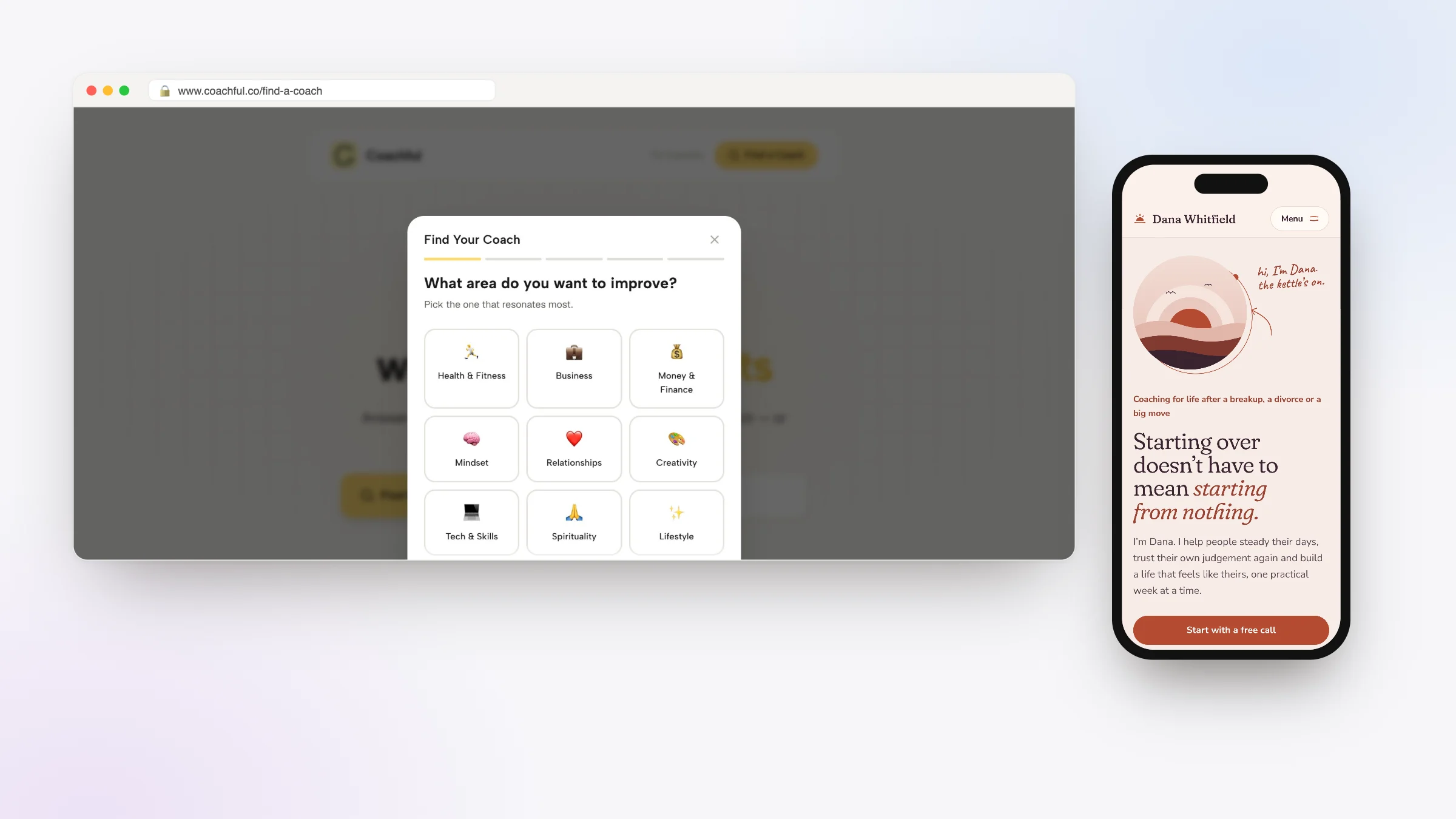
The Find My Coach quiz asks what you want to improve, where you are right now, your email, your preferred coaching style and your monthly budget, then suggests coaches you can book a discovery call with or message from their profile. Our guide on how to find a life coach covers the rest of the search.


Are you a coach?
These are the questions careful clients bring to your discovery call, and many of them can be answered on your website before the call begins: who you work with, how sessions run, what happens between them, your training and your terms. Our guides to the coaching website FAQ and turning discovery call questions into website content show how. If your site does not answer them yet, the Coachful team will build it in your account at no extra cost through the free white-glove service; see what Coachful offers life coaches.

The bottom line
The best questions to ask a coach before hiring are the ones that reveal how they actually work: who they help, what they would do first, what happens between sessions, how you will measure progress, where coaching stops and what the terms are. Good coaches answer specifically, put it in writing and give you time to decide. Ask five or six of these on each call, compare at least two coaches, and choose the one whose answers were clear and whose questions made you think.
Frequently asked questions
What questions should I ask a life coach before hiring them?
Ask who they usually work with, how they would approach your goal, what happens between sessions, how you will both know it is working, what training they have, what they do if you need therapy, what it costs in total and how you can end the engagement if it is not working.
How many coaches should I talk to before choosing one?
The ICF recommends meeting at least three coaches and getting two references from each. In practice, two or three discovery calls are usually enough to see the difference between a good fit and an average one.
What is a discovery call with a coach?
A short first conversation to see whether you and the coach are a fit. You describe your goal, the coach asks questions and explains how they work, and you ask the questions on this list.
What should a good coach ask me on the first call?
What you want to change, why now, what you have already tried, what might get in the way, and what success would look like in a few months. A coach who asks little about you on the first call is unlikely to listen more later.
Should I ask a coach about their credentials?
Yes. Coaching is unregulated, so ask which program trained them and which body accredited it. If they claim an ICF credential, you can verify it on the ICF's site. Credentials show training, not fit, so ask the other questions too.
Is it rude to ask a coach for references?
No. It is normal and recommended. A good coach will ask past clients for permission before passing on contact details, which shows they take confidentiality seriously.
What answers should make me walk away from a coach?
Guaranteed results, pressure to pay on the call, vague credentials, an offer to treat anxiety or trauma, no written agreement, extra costs revealed later and a refusal to explain confidentiality are all reasons to keep looking.












