
Life Coach vs Therapist: Which One Do You Need?
Life coach vs therapist, in short: a therapist (a licensed counselor, psychologist, clinical social worker or marriage and family therapist) is a licensed health professional who can assess, diagnose and treat mental health conditions. A life coach is not licensed and does not treat anything; a coach helps people who are generally doing all right set goals, make changes and follow through. See a therapist when your mood, anxiety, trauma, an addiction or your relationships are making daily life hard. See a coach when you are functioning but want direction, a change or someone to keep you moving. If you are not sure which applies to you, start with a therapist.
The two can look alike from the outside: both involve talking to a trained person, often weekly, often on video. The differences are in training, licensing, what each is allowed and qualified to do, who pays, and what happens when things get hard. This guide covers all of it, including the kinds of counselors and therapists, warning signs that you need clinical care, how to use both at once, and how to find each.
Life coach vs therapist at a glance
| Life coach | Therapist or counselor | |
|---|---|---|
| Main job | Helps you set and reach goals and change habits | Assesses, diagnoses and treats mental, emotional and behavioral conditions |
| License | None required; the field is unregulated | Required in every US state for counselors, psychologists, marriage and family therapists and clinical social workers |
| Training | Voluntary; anything from a weekend course to an ICF-credentialed program | Usually a master's or doctoral degree, supervised clinical experience and a licensing exam |
| Can diagnose | No | Yes |
| Focus | The present and the future: what you want and how to get there | Symptoms, healing, patterns, and the past where it matters |
| Insurance | Not covered as health care; paid by you or an employer | Often covered as a health benefit, depending on your plan |
| Confidentiality | Set by your agreement and voluntary ethics codes | Set by professional rules and health privacy laws |
| Typical session | 30 to 90 minutes, often with tasks between sessions | Varies by approach and setting |
Sources: BLS Career Outlook on life coaches; BLS Occupational Outlook Handbook pages for counselors, psychologists, marriage and family therapists, social workers and physicians, including psychiatrists.
The kinds of therapists and counselors
"Therapist" is an umbrella word. These are the main licensed professions you will meet in the US, as the Bureau of Labor Statistics describes them:
| Professional | Typical education | Licensing | What they do |
|---|---|---|---|
| Mental health counselor (often LPC or LMHC) | Master's degree with a supervised internship | Required in all states: a national exam and supervised clinical work | Works with individuals, couples, families and groups on anxiety, depression, grief, stress and more |
| Substance use and behavioral disorder counselor | Bachelor's to master's, depending on role and state | Required in private practice; varies elsewhere | Assessment, treatment plans and recovery skills for addiction and related problems |
| Marriage and family therapist (LMFT) | Master's degree | Required in all states: supervised postdegree hours and an exam | Diagnoses and treats disorders in the context of relationships |
| Clinical social worker (often LCSW) | Master's in social work | Supervised clinical experience, then a clinical exam | Diagnoses and treats mental, behavioral and emotional problems |
| Clinical or counseling psychologist | Doctorate (PhD or PsyD) with an internship | Licensed in every state | Assesses, diagnoses and treats mental, emotional and behavioral disorders; some states allow prescribing |
| Psychiatrist | Medical degree and residency | Licensed as a physician in every state | Diagnoses and treats mental illness; can prescribe medication |
"Counselor" and "therapist" overlap: a licensed mental health counselor provides therapy, and many people use the words interchangeably. What matters is the license, which you can usually check on your state licensing board's website. Note that "counselor" is also used for roles outside mental health, such as career counselors and financial counselors.
Life coaches, by contrast, face no formal entry requirements. The BLS describes the field as unregulated and says training and certification may help a coach stand out (BLS Career Outlook). The best-known credentials come from the International Coaching Federation: the ACC requires at least 60 hours of coach training and 100 hours of coaching, the PCC 125 and 500, and the MCC 200 and 2,500 (ICF requirements). They show training and practice. They are not a license to treat.

When to see a therapist instead of a life coach
See a licensed professional, not a coach, when...
- Low mood, worry, panic or numbness is affecting your sleep, eating, work or relationships most days, or has gone on for weeks.
- You are dealing with trauma, abuse, an eating disorder, an addiction, or grief that is not easing.
- You have thoughts of harming yourself or ending your life. In the US, call or text 988 to reach the 988 Suicide and Crisis Lifeline, any time (listed by the US Office for Victims of Crime). Elsewhere, call your local emergency number.
- You feel unsafe at home. The National Domestic Violence Hotline is 800-799-7233, or text START to 88788.
- You think you may have a condition such as ADHD, depression or bipolar disorder and want it assessed. Coaches cannot diagnose.
- Someone you trust keeps telling you they are worried about you.
The International Coaching Federation's own guide for clients describes therapy as the place to heal, recover from past traumas, emotional pain or dysfunctional patterns, and sums up the difference as therapy often focusing on "why" and coaching on "how" (ICF guide for individuals).
When a life coach is the better fit
- You are basically okay, and you want something specific to change: a career move, a habit, a business goal, a relationship pattern you understand and want to act on.
- You know what to do and keep not doing it, and you want structure and accountability.
- You have finished a course of therapy and want help putting what you learned into action, with your therapist's agreement.
- You want a thinking partner for a decision, not treatment.
For a fuller picture of the coaching side, see what life coaches do and the types of life coaching. Our guides to mindset coaching and relationship coaching cover two specialties that sit closest to therapy and explain where each one stops.

The same problem, two different approaches
Say you keep putting off important work until the night before.
| With a therapist | With a life coach | |
|---|---|---|
| First questions | How long has this happened? How is your mood, sleep and anxiety? What happens in your body before you avoid a task? | What are you trying to get done, by when, and what have you tried? |
| What they look for | Whether something such as anxiety, depression or ADHD is driving it, and patterns from your history | The gap between your plan and your week, and what gets in the way |
| What they might do | Assess, possibly diagnose, offer treatment such as a structured therapy, or refer for medication assessment | Break the work into scheduled steps, set check-ins, design if-then plans for the moment you usually stall |
| What success looks like | Symptoms ease; you understand and change the pattern | The work gets done on time, consistently |
If a coach starts asking the questions in the left-hand column and offering the answers in it too, they have stepped outside their role.
Can you see a life coach and a therapist at the same time?
Yes, and many people do. It works best when:
- Both know about the other. Tell your coach you are in therapy and your therapist that you are seeing a coach.
- The roles stay separate. Therapy for healing and symptoms; coaching for goals and follow-through.
- The coach knows when to step back. The ICF Code of Ethics asks coaches to stay alert to signs that a client would get more value from a different coach, professional or resource (ICF Code of Ethics, standard 4.3).
A good coach will put this in writing at the start: what coaching covers, what it does not, and what they will do if therapy looks more appropriate.

What the research does and does not show
Research on coaching has mostly been done with working adults who are not in treatment. In that group, meta-analyses find coaching improves well-being, coping and goal-directed self-regulation (Theeboom, Beersma and van Vianen, 2014), and randomized trials with physicians found that six professional coaching sessions reduced emotional exhaustion and burnout symptoms (Dyrbye and colleagues, 2019). Those results do not make coaching a treatment for mental illness. They support coaching for what it is designed for: people who are coping and want to do better, including at work.
Cost and insurance
Therapy is a health service. In the US, all Health Insurance Marketplace plans cover mental health and substance use services as essential health benefits, including behavioral health treatment such as psychotherapy and counseling, and limits on that care cannot be more restrictive than limits on medical care, though exact benefits vary by state and plan (HealthCare.gov). Check your own plan for copays and in-network providers.
Coaching is not health care and is not covered by health insurance as treatment. You pay, or sometimes an employer does. Coachful's 2026 Coaching Business Report puts a typical life coaching session at $75 to $200 (PayScale and practitioner reports), with three-month packages of eight sessions at $1,200 to $2,500. More detail is on coachingrates.com, and our guide to whether a life coach is worth it helps you weigh it up.
How to find a therapist or a life coach
Finding a therapist or counselor
- Your health insurer's directory of in-network providers.
- Your doctor, who can refer you and rule out physical causes.
- FindTreatment.gov, SAMHSA's confidential and anonymous locator for mental health and substance use treatment in the US.
- Your state licensing board, to check that a therapist's license is current.
Finding a life coach
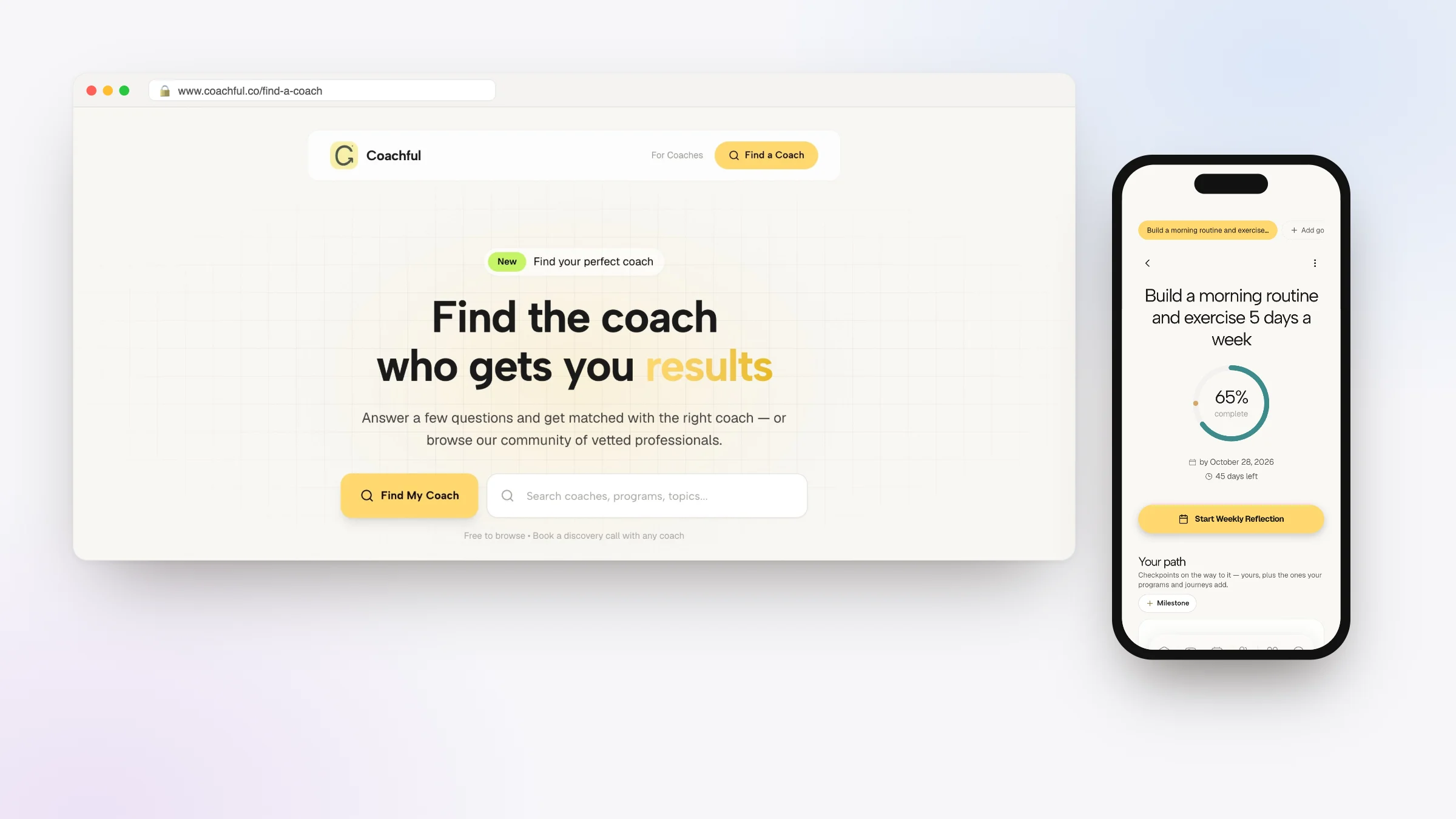
Coachful's Find a Coach directory is public, so you can browse without creating an account. Search a topic such as "career change", "confidence" or "habits", or browse categories such as Mindset and Lifestyle. The Find My Coach quiz asks what you want to improve, where you are now, your preferred style and your monthly budget, then suggests coaches. On a discovery call, ask every coach what they do when a client needs therapy instead. Our guide on how to find a life coach has the full list of questions.


Are you a coach, or a therapist who also coaches?
Scope is the thing that protects your clients and you. Put it in your coaching agreement, screen for warning signs at intake, and keep a short list of local therapists to refer to. If you hold a clinical license and also coach, keep the two services separate; our guide to keeping therapy and coaching separate explains how, and trauma-informed coaching covers working safely with clients who have a trauma history. If you want to specialize, the sibling guides on how to become a mental health coach and mental health coach certification cover training and scope, and our page for life coaches shows how Coachful supports a coaching practice. And if your website does not yet say clearly what you do and do not offer, the Coachful team will build it for you at no extra cost through the free white-glove service.

Frequently asked questions
What is the main difference between a life coach and a therapist?
A therapist is a licensed health professional who can diagnose and treat mental health conditions. A life coach is unlicensed and helps people who are generally doing well set goals, make changes and follow through. Therapy often focuses on healing; coaching on what you do next.
Should I see a therapist or a life coach?
See a therapist if low mood, anxiety, trauma, an addiction or relationship distress is affecting daily life, or if you think you may have a condition that needs assessing. See a coach if you are functioning and want direction, change or accountability. If unsure, start with a therapist.
Is a counselor the same as a therapist?
Often, yes. Licensed mental health counselors provide therapy, and the words are used interchangeably. What matters is the license: counselors, marriage and family therapists, clinical social workers and psychologists all require one in every US state.
Can a life coach diagnose anxiety, depression or ADHD?
No. Diagnosing mental health conditions requires a license. A life coach can help you build routines or work toward goals alongside treatment, but an assessment must come from a licensed clinician or physician.
Does insurance cover life coaching?
No, coaching is not covered as health care. Therapy is: all US Marketplace plans include mental health services such as psychotherapy and counseling as essential health benefits, though costs and providers vary by plan. Some employers pay for coaching separately.
Is a life coach cheaper than therapy?
Not necessarily. A typical life coaching session costs $75 to $200, paid out of pocket. With insurance, therapy may cost you only a copay. Compare your plan's costs before assuming either is cheaper.
Can I see a life coach and a therapist at the same time?
Yes. Tell each about the other, keep therapy for symptoms and healing and coaching for goals and follow-through, and choose a coach who will step back if therapy is the better tool for something that comes up.
What should a life coach do if a client needs therapy?
Say so kindly and clearly, suggest seeing a licensed professional, pause or adjust coaching if needed, and follow any agreement made at the start. The ICF Code of Ethics asks coaches to stay alert to when a different professional or resource would serve the client better.












