Trauma Informed Coaching: Principles, Boundaries and Practice

Coachful

Trauma informed coaching is coaching built on the assumption that some of your clients carry the effects of past trauma, and designed so the work stays safe for them without anyone having to disclose it. It does not diagnose, treat or revisit traumatic experiences. It changes how you contract, question, pace, take notes and refer, so a client who becomes overwhelmed is noticed, slowed down and, when they need it, pointed to a licensed clinician.
Many coaches come to this topic after a session that tilted. You asked a fair question about a difficult manager, the client went quiet in a way that felt different from thinking, and you did not know whether to keep going or stop.
This guide covers that moment and the setup that makes it rarer, from principles and referral to intake, notes and certification.
What is trauma informed coaching?
Trauma informed coaching applies an idea from public health to the coaching relationship. Because trauma is common and often invisible, you make every client's experience safe by default instead of waiting to hear their history.
The idea comes largely from SAMHSA, the US Substance Abuse and Mental Health Services Administration. Its 2014 guidance, SAMHSA's Concept of Trauma and Guidance for a Trauma-Informed Approach, describes trauma in three parts: an event or set of circumstances, how the person experienced it, and lasting effects on how they function.
That middle part matters for coaches: two people can live through the same event and only one may carry it forward. The guidance also asks a service to build what it knows about trauma into its everyday practices, which for a solo coach means the agreement, intake form, session structure, notes and referral list.
How common is trauma among coaching clients?
Common enough to plan for. A CDC analysis published in June 2023, using US survey data from 2011 to 2020, found that 63.9% of adults reported at least one adverse childhood experience, such as abuse or growing up with violence or substance use at home, and 17.3% reported four or more.
A population figure says nothing about the person in front of you. It does say that a practice of 20 clients almost certainly includes some it applies to.
How is trauma aware coaching different from trauma informed coaching?
Trauma aware usually means you understand what trauma is and how it can show up. Trauma informed means that understanding has changed how your practice runs, from what you put in writing to how you respond when a session shifts.
What are the principles of trauma informed coaching?
The most widely used set is SAMHSA's six principles from the same 2014 guidance. Some coaching courses teach an earlier five-value version from Roger Fallot and Maxine Harris (safety, trustworthiness, choice, collaboration and empowerment), which covers the same ground.
| Principle | What it looks like in a coaching practice |
|---|---|
| Safety | The same session structure every time, a private setting, permission before going deeper |
| Trustworthiness and transparency | A plain-language agreement, a clear notes and recording policy, no surprises mid-session |
| Peer support | Asking about other support at intake, so coaching is not the client's only support |
| Collaboration and mutuality | Agendas set together; the client decides what to explore and how far |
| Empowerment, voice and choice | "Pass" is always allowed, homework can be changed, and choice is offered all the way through |
| Cultural, historical and gender issues | Not reframing discrimination as a mindset problem; asking how the client wants their context held |
Read the right-hand column as a to-do list. Most of it is settled before a client ever books, which is what keeps it in place when a session gets tense.
Is trauma informed coaching the same as therapy?
No. Trauma informed coaching works on the client's present and future and stays out of trauma treatment. Therapy for trauma is clinical care from a licensed professional and can include assessment, diagnosis and structured work with traumatic memories.
| Trauma informed coaching | Trauma therapy | |
|---|---|---|
| Main aim | Progress on goals the client chooses | Treatment of distress and its effects |
| Who provides it | A coach, within their training and agreement | A licensed clinician, such as a psychologist or clinical social worker |
| Use of the past | Only as it shows up in present patterns, while the client is steady | May be explored in depth as part of treatment |
| Diagnosis | Never | Part of clinical assessment where relevant |
| When distress rises | Slow down, steady, narrow the scope, refer if needed | Work with it inside a clinical framework |
What is a coach's scope of practice with trauma?
Your scope of practice is what your training, your agreement and the law allow you to do. With trauma, you can notice, slow down, offer choice, help a client steady enough to continue or stop, and help them find clinical support.
You do not diagnose, interpret symptoms or guide a client back through what happened. Titles such as psychotherapist are protected in many places, so check the local rules.
A quick boundary test: if the work needs the client to relive or work through a traumatic experience, it has moved past coaching.
Licensed clinicians who also coach should read our guide to keeping therapy and coaching separate. For clients unsure which they need, send what life coaches do.
When should a coach refer a client to a therapist?
Refer when the client's goal or wellbeing needs clinical care, and do it early, before a crisis forces it. Framed well, a referral makes a client feel looked after.
- The goal is the trauma. The client wants to recover from a specific event rather than move toward something now.
- Sessions keep tipping into overwhelm. They regularly go numb, panic or lose track of the present, and it is not easing.
- Daily life is slipping. They describe weeks of poor sleep, missed work or staying in the house.
- They mention a condition that is not being treated. You do not evaluate it; you ask whether they have support.
- You feel out of your depth. Take that to supervision or a trusted peer before the next session.
One situation is different. If a client says they are thinking about harming themselves or someone else, or is in danger, stop coaching and follow your emergency plan. In the US and Canada that includes calling or texting 988; elsewhere, keep the local crisis line ready.
How do you suggest therapy without the client feeling rejected?
Frame the referral around fit, so the client hears care:
"What you're describing deserves support built for it, and that's a therapist's training, not mine. I'd like to help you find someone, and we can keep coaching alongside it if you want."
Then send two or three names, ask next session whether they found someone, and note that you offered the referral.
How do you build a referral network before you need it?
Build it before your first client, because a list made in a hurry after a hard session is a list of whoever ranked first in a search. Aim for three to five licensed clinicians you have checked, plus crisis contacts.
- Check the license in the licensing board's public register for their state or country.
- Note the fit: specialty, approach, languages and where they are licensed, since many therapists can only see clients there, even online.
- Note the practical details: fees, insurance and the waitlist. A four-month wait does not help a client this week.
- Have a short call about how they like referrals to arrive.
- Review the list twice a year, because therapists close their books, move and retire.
If a client wants you to talk to their therapist, get written consent first and share less than you think.
What should a trauma informed coaching agreement include?
Your agreement is where transparency stops being an intention. It should say in plain language what coaching is, what it is not, and what happens if something comes up that coaching should not hold.
- Scope: coaching is not therapy or medical care, and you will suggest other support if the work needs it.
- The right to pass: the client can decline any question, exercise or topic without explaining why.
- Pausing: either of you can pause or end a session early; say what happens to that session.
- Confidentiality and its limits: what stays private, and when you would break it, such as a risk of serious harm.
- Notes and recordings: what you keep, who sees it, for how long, and how to ask for deletion.
- Contact between sessions: your channels, reply times, and that messages are not watched for emergencies.
Walk through it on the first call instead of sending it to sign in silence. Our coaching agreement template lists 12 clauses you can adapt, and coaching contracts in Coachful shows how one goes out for e-signature.

What intake questions respect a client's boundaries?
Ask what helps you coach well and keep the client safe, and nothing that requires them to tell you their history. A detailed trauma questionnaire before trust exists asks for disclosure with no relationship to hold it, and coaching has no use for the answers.
| Ask this | Instead of | Why it works |
|---|---|---|
| "Are you working with a therapist or other support right now?" | "Do you have any mental health diagnoses?" | Shows their support without medical detail |
| "Are there topics you'd like us to approach slowly, or leave out?" | "Have you experienced trauma or abuse?" | Lets the client set limits without saying why |
| "When stress rises, what helps you feel steady?" | "What are your triggers?" | Gives you something to offer in a hard moment |
| "If a session gets heavy, should I slow down, check in, or carry on unless you say?" | Assuming you know | Agrees the response while the client is calm |
Mark sensitive questions as optional, say who will see the answers, and let clients change an answer later.
See our guide to coaching intake forms for more. In Coachful, intake questions attach to the booking, can show a consent notice, and land on the client record.
How do you pace a coaching session with consent?
Ask before you go deeper, every time, and treat "not today" as a useful answer. Consent in trauma informed coaching is ongoing and lives in small check-ins all through the session.
A permission question can be as simple as: "Would you like to look at that now, or another day?"

Which signs show a client is leaving the window of tolerance?
Watch for a sudden change in how present the client is. Psychiatrist Dan Siegel calls the zone where someone can feel strong emotion and still think clearly the window of tolerance.
- They lose the thread or answer a different question.
- Their speech speeds up sharply or slows almost to a stop.
- They become suddenly agreeable, apologetic, or irritated by a neutral question.
- They tell a painful story in a flat voice, as if it happened to someone else.
A stretched client is different: uncomfortable, but still able to pause and choose what to say next.
What should a coach do when a session shifts?
Slow down first, then offer the client a choice:
- Slow down. Lower your own pace, use shorter sentences and leave more silence.
- Name it lightly. "I'm noticing something shifted just then."
- Offer a choice. "We can pause, change topic or stop here. What would help?"
- Invite them back to the present. Suggest they notice the chair under them or a few things in the room, as an invitation they can decline.
- Decide the next step together. Carry on lightly, move to something practical, or end early and talk about support.
The common mistake is pushing for insight: "Stay with that. What's underneath it?" If the client cannot get back to a reflective state, end the session well and follow up in writing within 24 hours.
Coaches who practice the levels of listening tend to catch these shifts earlier.
How do you design sessions and programs that stay safe?
Make the structure predictable and the content optional, so the client has less to brace against.
- Same shape every time: a short check-in, an agenda the client chooses, the work, and five minutes to close.
- Preparation before the call: a short pre-session worksheet lets the client pick the focus at their own pace.
- Homework that looks forward: what they want next and what they will try, never exercises that ask them to relive painful memories alone.
- Light check-ins between sessions: a few gentle questions, with no guilt for a skipped day.
- Clear message rules: our guide to between-session support boundaries has wording you can borrow.


Groups need one more rule: nobody has to share, and what is shared stays in the group. Our guide to group coaching confidentiality covers the wording.
What should a coach write down, and who can see it?
Write down what you observed and what you agreed, in plain words, and keep interpretation out. A client may one day ask to read your notes.
- Write: "Paused twice when talking about her manager. Agreed to return to it only if she raises it. Offered three therapist names."
- Avoid: "Clearly has trauma from her father. Probably PTSD."
The second is a diagnosis you are not qualified to make.
Keep private notes separate from the shared summary the client reads, and write both as if the client might see them. Our guides to session notes and record retention and deletion cover how long to keep each.

Recording needs its own consent, and some clients speak less freely on a recorded call. Make "no recording" an easy choice, and if you use AI summaries, read our guide to AI session notes and informed consent.
What does Coachful do and not do for a trauma informed coaching practice?
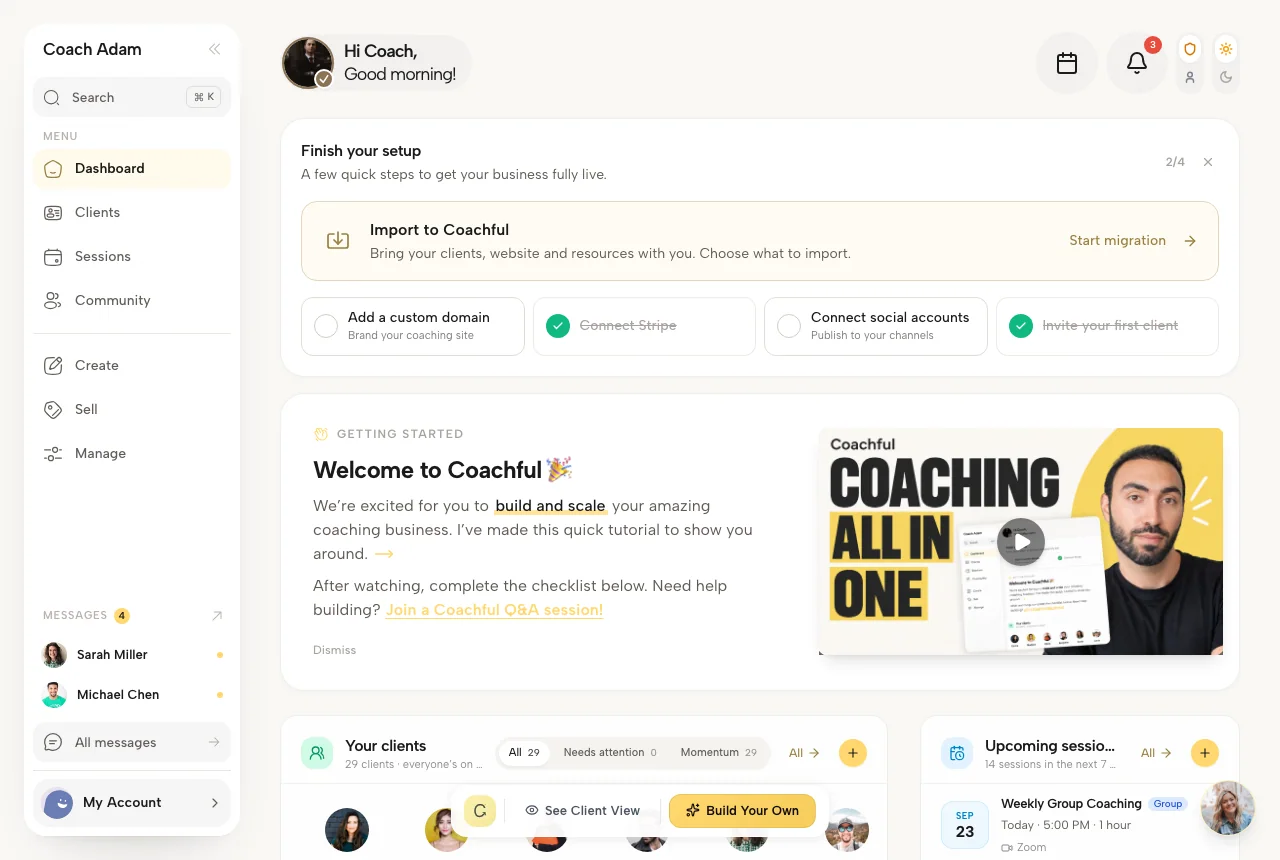
Coachful is a coaching platform that keeps the structure this guide describes on one client record. It makes no clinical judgments.
What Coachful does:
- Attaches intake questions to any bookable session type, with a consent notice if you need one.
- Sends agreements for e-signature before the first call and stores them on the client record.
- Keeps private notes and shared session notes as separate records.
- Requires a pre-session worksheet before a chosen session type, with answers visible to both of you.
- Runs morning, evening and weekly check-in flows that you write, on the days and times you set.
- Exports all client data as a ZIP, including notes, check-ins and form responses. Data stays until you ask for deletion.
What Coachful does not do:
- It is not HIPAA-certified. It is GDPR-ready with full data export. Clinical therapy records belong in a clinical system.
- Its questionnaire scoring is not a validated clinical instrument, so do not use it to screen for trauma or assess risk.
- It does not assess mental health. Client insights show who is drifting from activity and engagement, which is a reason to reach out and nothing more.
For cost, see the plan and client allowance shown to you on the pricing page. Coachful has a 7-day free trial, card required, no charge during the trial, cancel in one click.
What should you look for in a trauma informed coaching certification?
Look for training that teaches scope and referral as seriously as technique, with clinicians on the faculty. Coaching is not a regulated profession in most countries, so "certified" alone tells you little, and no coaching certificate qualifies you to treat trauma.
| Look for | Be wary of |
|---|---|
| Licensed mental health clinicians on the faculty | Courses with no clinical input at all |
| A full module on scope of practice and referral | Promises that you will heal or resolve clients' trauma |
| Observed practice with feedback, plus supervision | A certificate after a few hours of video |
| Continuing education recognized by a coaching body, such as ICF Continuing Coach Education units | Techniques for working through traumatic memories, taught to non-clinicians |
Check any claim of recognition on the body's own website; the ICF has a public search of the programs it accredits. Our comparison of ACC, PCC and MCC explains its credential levels.
Look after your own steadiness too, with regular supervision or peer consultation and a cap on intense sessions per day.
Summary: what trauma informed coaching asks of you
Trauma informed coaching asks for structure more than heroics. You assume trauma may be present, put scope and choice in writing, ask before going deeper, refer early and write notes the client could read.
None of it requires you to become a therapist. Start this week with two changes: add a pacing question to your intake form, and put three vetted therapist names on a list.
Frequently asked questions
What is trauma informed coaching in simple terms?
It is coaching designed to be safe for clients who may carry the effects of trauma, without asking anyone to disclose it. Safety, choice and clear boundaries are built into the agreement, intake, pacing and referral, and the coach never treats trauma.
Is trauma informed coaching the same as therapy?
No. Therapy for trauma is clinical care from a licensed professional and can include diagnosis and work with traumatic memories. Trauma informed coaching works on present goals and refers clients to a clinician when they need more.
Can a life coach work with clients who have experienced trauma?
Yes, if the coaching stays on present goals and within scope. Ask at intake about other support, agree how you will respond if a session gets heavy, and refer if the trauma itself becomes the work.
What are the principles of trauma informed coaching?
Most coaches use SAMHSA's six principles from 2014: safety; trustworthiness and transparency; peer support; collaboration and mutuality; empowerment, voice and choice; and cultural, historical and gender issues. In practice they mean a clear agreement, permission before depth and the right to pass.
Do I need a certification to be a trauma informed coach?
In most countries coaching is not regulated, so no certification is legally required. A good course still helps, ideally with clinicians on the faculty, a full module on scope and referral, and observed practice.
What should I do if a client becomes overwhelmed in a session?
Slow down, name the shift gently and offer a choice to pause, change topic or stop. If they cannot get back to a reflective state, end the session gently, check they are okay and follow up in writing within 24 hours.
Should my intake form ask about trauma history?
No. Ask about current support, topics to approach slowly, what helps the client feel steady and how they want you to respond if a session gets heavy. Make sensitive questions optional.
Is Coachful suitable for a trauma informed coaching practice?
For coaching, yes. Coachful keeps signed agreements, intake answers, worksheets, and private and shared notes on one client record, with full data export. It is not HIPAA-certified and is not built for clinical therapy records; see the plan and client allowance shown to you on the pricing page.