
The Levels of Listening: A Guide for Impactful Coaching

Coachful
A client is talking. You're nodding. Your face says, “I'm with you.”
Meanwhile your mind is doing laps.
What's the right question here? Am I missing the goal? I need to remember what they said earlier about their manager. We only have a few minutes left. Should I challenge this or stay with it?
If you've ever had that split-screen experience in a coaching session, nothing has gone wrong. You're not a bad coach. You're having the same internal battle nearly every coach has, especially when you care, want to help, and feel responsible for creating value in the hour.
The problem isn't that your mind speaks up. The problem is when your mind becomes the loudest voice in the room.
That's why the levels of listening matter so much. They give you a practical way to notice where your attention is, what your client is receiving from you, and how to deepen your presence on purpose. In coaching, this is the secret weapon. Not better scripts. Not a bigger toolbox. Listening.
Are You Hearing or Truly Listening
A newer coach often thinks the session is won by asking a brilliant question. An experienced coach knows the question usually arrives on its own when the listening is clean.
That distinction shows up in ordinary moments. A client says, “I'm frustrated with my team.” If you're in your head, you'll start sorting the statement. Is this about delegation? Conflict? Boundaries? Accountability? Your brain wants a category so it can produce the next move.
But the client might not need your category. They might need your attention.
The moment coaches drift inward
Here's what internal drift sounds like in real sessions:
- Performance pressure: “I need to sound insightful.”
- Process pressure: “I should bring this back to the goal.”
- Time pressure: “We can't stay here too long.”
- Rescue pressure: “I think I know what they should do.”
None of those thoughts make you unethical or unskilled. They make you human. But they do pull you away from what the client is revealing.
Most coaching errors don't begin with a bad intention. They begin with divided attention.
A client might say they're “fine” while their jaw tightens and their speech speeds up. They might say they want a promotion while their energy drops every time they describe the role. They might say they're angry, but what's underneath is grief, shame, or fear. If you only hear the headline, you'll coach the surface.
Listening is a skill, not a personality trait
Many coaches secretly assume listening is something you either have or you don't. That belief keeps people stuck. Listening is trainable because attention is trainable.
The useful question isn't, “Am I a good listener?” The useful question is, “Where did my attention go in that moment?”
That's the frame that makes the levels of listening so valuable. They don't shame you. They help you diagnose. Once you can name your default pattern, you can change it.
The Three Levels of Listening in Coaching
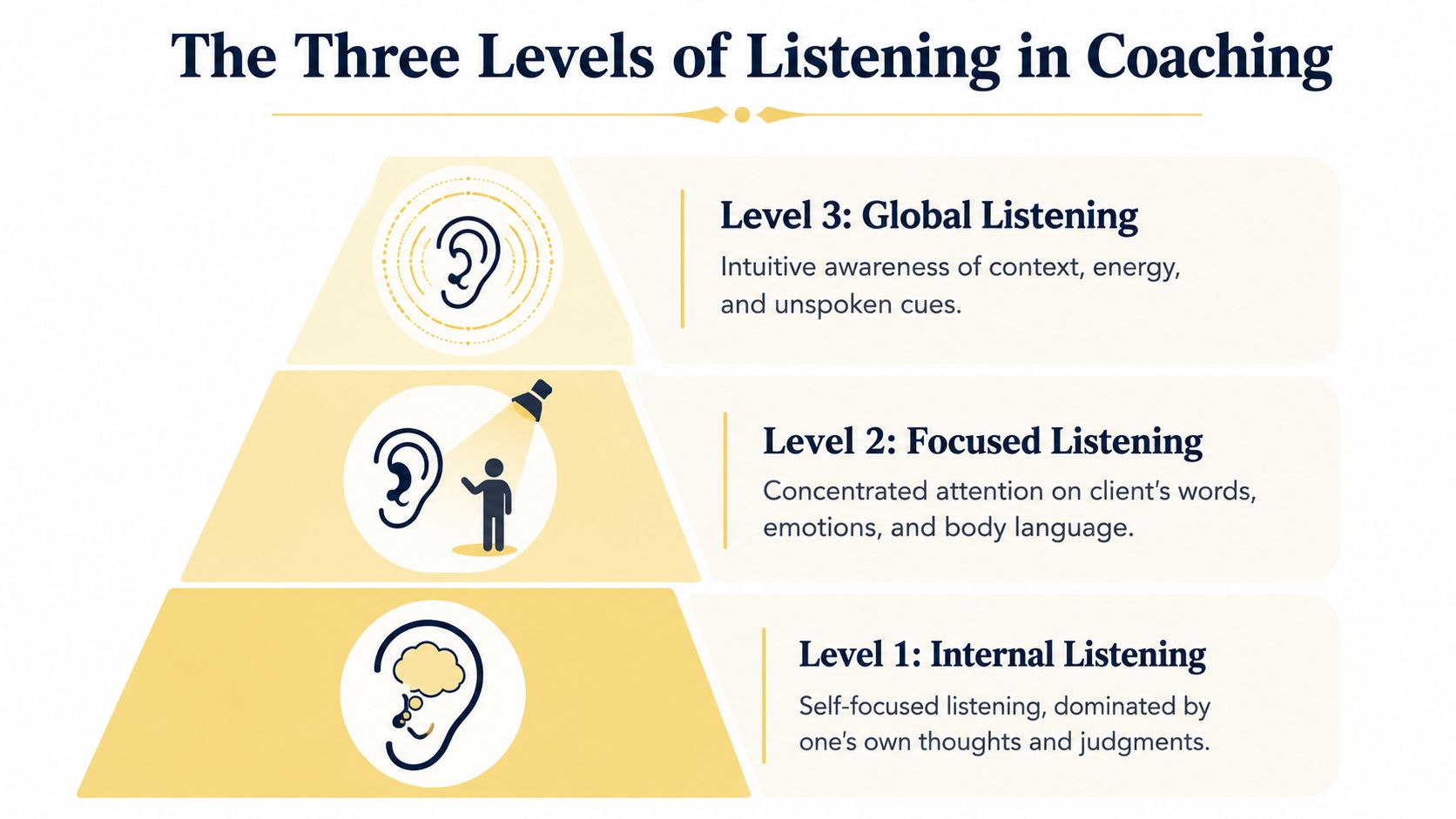
The Co-Active Training Institute describes three levels of listening: Level 1 is listening to your own thoughts, Level 2 is focusing intensely on the other person's words, and Level 3 extends attention to tone, body language, and the wider context in the interaction, a model that became influential because it maps listening to observable coaching behaviors in a practical developmental ladder, as outlined in Co-Active's overview of the three listening levels.
Level 1 on the Me channel
Level 1 is internal listening. I call it the Me channel because your attention stays mostly with your own reactions, ideas, judgments, and plans.
What it sounds like in your head:
- Question planning: “What should I ask next?”
- Self-checking: “Am I doing this right?”
- Meaning making: “This sounds like impostor syndrome.”
- Comparing: “I've heard this before.”
Level 1 isn't evil. It's useful when you're making decisions, evaluating risk, or reflecting on your own experience. It can even help a coach form a hypothesis. The problem is staying there too long.
A coaching example: your client says, “I'm thinking about leaving my role.” You instantly start building a map. Career values. Burnout. Exit plan. That internal activity may feel productive, but your client experiences it as subtle distance.
Level 2 on the You channel
Level 2 is focused listening. This is the You channel. Your attention rests with the client's words and immediate meaning. You're not just hearing content. You're tracking language, sequence, emotional emphasis, and what matters to them.
What it sounds like in your head:
- “What are they really saying?”
- “What word did they repeat?”
- “Where is the tension in their story?”
- “What matters most to them right now?”
A coaching example: your client says, “I'm exhausted, but I can't slow down.” In Level 2, you don't rush to fix. You stay with the phrase. “You can't slow down. What makes slowing down feel impossible?” That question emerges from the client's language, not from your favorite framework.
If you support founders, leaders, or independent professionals, it helps to study how different coaches present themselves and position their work. Women Listed's guide to women business coaches in India is useful for that. Not because it teaches listening directly, but because it shows how varied coaching contexts can be. And context changes what you need to hear.
Level 3 on the We or World channel
Level 3 is global listening. I think of it as the We channel or World channel. You're aware of the client, yourself, and the wider field at once. You notice tone, pauses, body language, rhythm, emotional shifts, and what the room feels like.
What it sounds like in your head is quieter. Often it's less verbal and more observational:
- “Their energy dropped just now.”
- “They laughed, but their shoulders collapsed.”
- “Something changed when they mentioned their father.”
- “This feels more tender than the words suggest.”
A coaching example: the client says, “My boss is supportive,” then takes a sharp inhale and looks away. Level 2 hears the statement. Level 3 notices the mismatch. The coach might say, “You said your boss is supportive, and I also noticed your breath catch when you said it. What happened there?”
Non-negotiable standard: If your question could have been asked without listening to this exact client in this exact moment, it probably came from Level 1.
The practical trade-off
Here's the trade-off coaches need to accept. Level 1 feels safer because you're in control. Level 2 and Level 3 feel riskier because you're following the client rather than your plan.
But that's where coaching gets powerful. The best questions usually don't come from cleverness. They come from attention.
Why Mastering Listening Levels Transforms Your Coaching
A client says, “I'm ready to make a change,” and any trained coach can respond with a competent question. The coaches who create movement hear more than the sentence. They catch the hesitation before “ready,” the flat tone on “change,” the quick smile that doesn't match the words. That difference shapes the whole session.

Clients rarely judge our listening by how politely we wait our turn. They judge it by whether our next question fits the moment so precisely that they stop, breathe, and say, “Yes. That's it.” In remote and hybrid coaching, that standard gets harder to meet because part of the signal is compressed through a screen, a headset, or a lagging connection. That is exactly why listening needs to be trained, observed, and tracked, not treated as a personality trait.
Better listening improves the precision of your coaching
When coaches strengthen their listening across levels, their questions become more accurate and more useful.
Instead of asking:
- “What's the obstacle?”
- “What would success look like?”
- “What's one action step?”
They ask:
- “You sped up when you described the promotion and slowed down when you described the team. What are you already sensing?”
- “You keep saying ‘should.’ Whose standard is in the room with us?”
- “Part of you sounds committed, and part of you sounds tired. Which part has been making the decisions this week?”
That shift matters because generic questions produce generic reflection. Specific listening produces specific awareness, and specific awareness is what clients can act on.
I tell developing coaches to use a simple quality check inside their coaching platform after each session: Was my best question tied to the client's exact language, energy, or behavior? If the answer is no, the listening probably stayed too close to method and too far from the client. That kind of review gives you a way to measure growth across remote sessions instead of relying on vague self-ratings.
For a broader foundation that connects listening with presence, clarity, and response style, Coachful's article on communication skills in coaching is a useful companion.
Better listening changes what the client is willing to say
Mastering listening levels does more than improve question quality. It changes the climate of the conversation.
Clients speak differently when they feel managed. They edit. They perform. They give you the acceptable version.
Clients speak differently when they feel accurately met. They risk more truth.
That is the transformation coaches care about. Better listening creates conditions for trust, candor, and pattern recognition. You hear the conflict under the goal, the fear hidden inside ambition, the loyalty driving procrastination, the grief sitting beneath “lack of motivation.” Once that material is named, the session stops orbiting the surface.
There is a trade-off. Listening at this depth can slow the pace. You may cover fewer agenda items. You may leave a tidy action plan with less polish than you expected. In return, you get work that is more likely to matter a week later.
Listening is a skill you can diagnose and improve
Strong listeners do not rely on instinct alone. They review recordings, score moments, and look for patterns.
In practice, I recommend tracking three things after a session inside your notes or coaching software:
- The moment the client shifted emotionally or energetically
- The exact cue you noticed
- The question or reflection you used in response
Over time, that log shows whether you mainly catch content, whether you can detect incongruence, and whether your interventions deepen the client's thinking. For remote coaching, this record is especially valuable because it helps you compensate for reduced physical presence by becoming more disciplined about vocal tone, pacing, facial shifts, and silence.
Research on active listening in early interactions also suggests a useful caution. Listening methods are not magic on their own, and context affects how people respond, as discussed earlier in the article. That lines up with what experienced coaches already know. Technique matters less than accurate attunement in the moment.
For coaches supporting couples, families, or clients whose goals keep colliding with relational stress, this holistic relationship guidance is worth reading because it shows how communication patterns shape the emotional conditions people live and work inside.
The conversation below adds another perspective on why attention changes growth.
How to Diagnose Your Current Listening Habits
Most coaches don't need more theory. They need a mirror.
If you want to improve your listening, stop judging yourself in general terms. Review actual moments. What were you thinking while the client was speaking? What did you ask next? How did the client's body change after your response? Those details tell the truth.
Listening Level Diagnostic Tool
| Level | Your Inner Dialogue | Outward Behavior & Questions | The Client's Experience |
|---|---|---|---|
| Level 1 | “What's the solution here?” “I need a strong question.” “We're running out of time.” | You interrupt more, redirect quickly, summarize too soon, or ask questions that fit your framework better than the client's language. | The client may feel managed, analyzed, or subtly rushed. |
| Level 2 | “What are they saying exactly?” “What matters most in this sentence?” | You reflect key words, ask clean follow-up questions, and stay close to the client's meaning. | The client feels heard and can deepen their thinking. |
| Level 3 | “What's happening beneath the words?” “What changed in their energy?” | You notice pauses, contradictions, breath shifts, posture, rhythm, and emotional undertones. Your questions often name what's implicit. | The client feels seen more fully and often reaches material they hadn't planned to discuss. |
What to review after a session
A strong diagnostic habit is simple. Right after the session, capture a few lines while the interaction is fresh.
Use prompts like these:
- Attention check: Where did I get lost in my own thoughts?
- Language check: Which exact client phrase deserved more exploration?
- Signal check: What nonverbal cue changed my understanding?
- Impact check: When did the client become more open, and what had I just done?
- Repair check: Where did I oversteer, and how could I have returned to curiosity?
If you can't name the moment you left the client and entered your own agenda, you can't reliably improve your listening.
Patterns that show up in remote coaching
Remote and hybrid coaching add their own traps. On Zoom, coaches often narrow their listening to the face and voice on screen while missing the wider field. They also get seduced by logistics. Chat notifications, clock-watching, internet lag, note-taking, and platform controls all compete for attention.
That's why many coaches benefit from a structured self-review process after sessions. Tools like this coaching style assessment can help surface your natural tendencies, especially if your default style leans directive, analytical, or highly relational.
A useful rule in remote sessions is this: if your notes are excellent but your memory of the client's energy is vague, you probably stayed too low in the listening stack.
Practical Exercises to Develop Each Listening Level
Listening improves the same way other coaching muscles improve. Through repetition, constraint, and feedback.
You don't need mystical talent. You need drills.
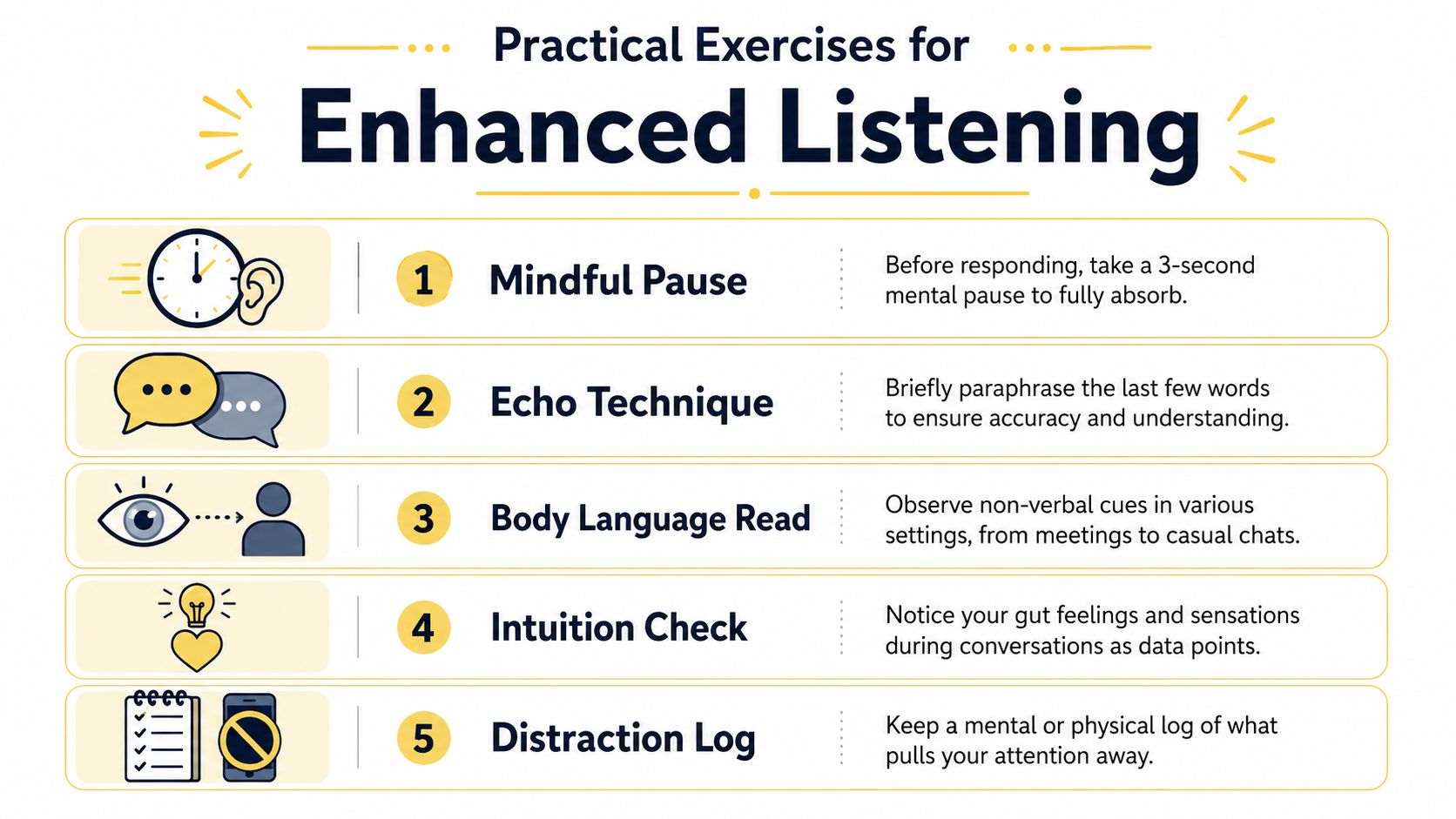
Exercises for managing Level 1
Pre-session intention reset
Before a session, take one minute and finish these sentences privately:
- My job today is: to notice, not to perform.
- I need to set down: my urge to fix.
- If I get lost in my head: I'll return to the client's last exact words.
That short script helps because Level 1 often hijacks coaches before the session even begins.
The distraction log
For one week, track what pulls you out of presence. Common entries include: time anxiety, proving competence, thinking ahead, drafting advice, and reacting to the client's choices. Don't try to eliminate these immediately. First learn your pattern.
Exercises for strengthening Level 2
The Five-Minute Reporter
Ask a colleague to speak for five minutes about a current challenge. Your only task is to summarize their message accurately at the end, with no interpretation and no advice.
If you say, “So what I hear is you're avoiding conflict because of your childhood,” you failed the assignment. If you say, “You're torn between protecting harmony and saying what you need,” and they respond, “Yes, that's it,” you're getting sharper.
Echo and deepen
Use this sequence:
- Echo a key phrase. “You said, ‘I feel invisible in that room.’”
- Stay close to meaning. “What does invisible mean there?”
- Follow the live thread. “When do you first notice that feeling begin?”
This is one of the simplest ways to stop overcoaching. If you want more session-level communication habits to practice between appointments, these client communication best practices are useful because they reinforce consistency, clarity, and responsiveness outside the formal coaching hour.
Exercises for strengthening Level 3
Listen for the music
Have someone speak for two minutes while you pay less attention to the content and more attention to pace, tone, hesitation, breath, and emotional temperature. Then reflect what you noticed without overclaiming.
For example: “As you talked, your words stayed steady but your voice softened when you mentioned your brother.” That's cleaner than, “You're clearly grieving your childhood.”
The camera-off drill
In audio-only practice, remove visual cues and listen for rhythm, silence, emphasis, and energetic changes. In video-based practice, do the opposite. Watch posture and facial shifts while saying less. Both drills build different parts of global listening.
Practice cue: Name what you notice. Don't diagnose what it means too early.
What doesn't work
A few habits slow development:
- Over-relying on paraphrasing: Reflection helps, but too much of it can sound mechanical.
- Chasing intuition without evidence: If you sense something, offer it lightly. Don't declare it as truth.
- Trying to stay in Level 3 all the time: That usually creates strain. Good coaches shift fluidly.
The goal isn't to become theatrically perceptive. The goal is to become more accurate.
Advancing to Generative Listening for Breakthroughs
Some listening helps a client feel understood. Generative listening helps a client think something new.
A more advanced model describes four levels of listening: downloading, factual listening, empathic listening, and generative listening. In that progression, generative listening goes beyond understanding the speaker's present reality and improves the quality of the speaker's own thinking, enabling novel insight and future-oriented problem solving, which is why it's especially relevant in coaching and facilitation, as described in this overview of Otto Scharmer's four levels of listening.
What makes it different
Level 3 notices the field. Generative listening notices what might be emerging from the field.
That can sound abstract, so bring it down to session level. A client says, “I'm tired of leading this way.” In Level 3, you might notice the weight in their tone and ask about the cost of their current style. In generative listening, you may sense an unformed future trying to come into language and ask, “When you say you're tired of leading this way, what kind of leader is trying to appear now?”
That question doesn't force a solution. It opens possibility.
How breakthroughs actually happen
Breakthroughs rarely come because a coach produced a dazzling insight. They come because the coach held attention steadily enough for the client's own thinking to reorganize.
Here are signs you're near generative listening:
- The client slows down and starts searching for language they haven't used before.
- The conversation shifts from analysis to creation.
- A new identity, decision, or direction begins to take shape.
Stay long enough with the edge of the client's knowing, and new thinking often arrives on its own.
This is the level many coaches hunger for. Not because it makes you look brilliant, but because it lets the client become more fully themselves.
Integrating Listening Practice into Your Coaching Workflow
The challenge with listening frameworks isn't understanding them. It's turning them into observable behavior, especially in remote work. As noted in this discussion of the challenge in tracking listening development in digital settings, most guidance stays qualitative and doesn't show coaches how to observe, coach, and track improvement in real meetings.
That's why your workflow matters more than your intentions.
A simple rhythm that works
Pre-session
Pick one listening target. Not five. One. Examples: “Stay with the client's language,” “Notice breath shifts,” or “Catch my urge to advise.”
During session
Use a tiny reset phrase when your mind races. “Come back.” Then return to the client's last sentence, last word, or last emotional shift.
Post-session
Write a short reflection note with prompts such as:
- Dominant listening level today
- One moment I dropped into Level 1
- One Level 3 cue I noticed
- One question that emerged from listening rather than technique
If you coach remotely, that reflection habit becomes even more important. Hybrid work rewards coaches who can review patterns, not just remember impressions. A private digital note system, consistent templates, and a regular review cadence will do more for your listening development than consuming another batch of theory.
Coachful gives coaches one place to run that practice with more discipline. If you want a cleaner system for session notes, client progress, structured reflections, and the day-to-day workflows that support stronger coaching, explore Coachful.