Communication Skills in Coaching: 9 Skills With Examples

Coachful
Communication skills in coaching are the specific things a coach does with attention and language so that a client thinks more clearly than they would alone. Most coaches can name them from their training. Far fewer can use them when a client goes vague, changes the subject or says "I'm fine" with a tight jaw.
This guide covers nine of them: active listening, powerful questions, reflecting, silence, direct communication, feedback, contracting the conversation, written communication between sessions and communicating boundaries. Each one comes with a short exchange you can borrow or adapt.
If you only have time to work on two, start with listening and silence. Almost everything else on the list depends on them.
What are communication skills in coaching?
They are the listening, questioning and speaking habits that keep the client doing the thinking. In ordinary conversation both people want to be understood; in coaching, your job is to help the other person understand themselves.
A friendly coach who fills every pause and offers a fix at the first sign of struggle runs pleasant sessions where nothing changes. Many traits in our guide to the characteristics of a good coach turn out to be communication habits.
The International Coaching Federation's Core Competencies, updated in 2019, file most of this work under Cultivates Trust and Safety, Maintains Presence, Listens Actively and Evokes Awareness. Contracting sits under Establishes and Maintains Agreements.
| Coaching communication skill | What it sounds like | ICF competency it supports |
|---|---|---|
| 1. Active listening | "You've said 'should' three times about that job." | Listens Actively |
| 2. Powerful questions | "What would make this decision easier?" | Evokes Awareness |
| 3. Reflecting | "So the plan is clear, and starting is the hard part?" | Listens Actively |
| 4. Silence | A full pause, held until the client speaks | Maintains Presence |
| 5. Direct communication | "Can I name something I'm noticing?" | Evokes Awareness |
| 6. Feedback | "You sound certain about the goal and unsure about the date." | Evokes Awareness |
| 7. Contracting the conversation | "What do you want to leave with today?" | Establishes and Maintains Agreements |
| 8. Writing between sessions | A three-line recap after the call | Facilitates Client Growth |
| 9. Communicating boundaries | "I reply to messages within one working day." | Establishes and Maintains Agreements |
Competency names from the ICF Core Competencies (2019). The mapping is our own reading.
How does active listening work in coaching?
Active listening in coaching means hearing what the client says, how they say it and what they keep coming back to, then showing them you heard it. The evidence is your next sentence, which should only make sense if you were paying close attention.
You are tracking four things at once:
- The words: the situation and the obstacle the client names.
- The delivery: pace and tone. A client who suddenly turns vague is telling you something.
- The repeats: words like "should" and "behind" that show up week after week usually point to a belief.
- The gaps: the part of the story that gets skipped, which is often the part that matters most.
Client: "Work's fine. Busy. I got the promotion, so that's done, and now I'm planning the team offsite."
Coach (following the topic): "Congratulations! How's the offsite coming along?"
Coach (following the client): "You went past the promotion very quickly. What has it been like?"
Client: "Honestly? I'm not sure I wanted it."
The first reply keeps the conversation on logistics. The second notices a gap and gives the client room to say something they had not said out loud. Our guide to the levels of listening goes deeper.
What makes a question powerful in coaching?
A powerful question is short and open, and it makes the client think before they answer. You can usually tell by the pause it produces: if the client answers instantly, you asked for something they already knew.
Questions that work tend to:
- Come one at a time. Stack three in one breath and the client answers the easiest.
- Start with "what" or "how" more often than "why", which can sound like a demand for justification.
- Hide no answer inside. "Have you thought about delegating?" is advice with a question mark.
| Instead of | Try |
|---|---|
| "Why did you do that?" | "What were you hoping would happen?" |
| "Have you thought about delegating?" | "What options can you see from here?" |
| "Don't you think you're avoiding it?" | "What makes this one hard to start?" |
| "How was the week, did you do the reading, and what got in the way?" | "What stood out from the week?" |
Client: "I keep saying I'll launch the group program, and then I find reasons not to."
Coach: "What would have to be true for you to launch it next month?"
Client: (after a long pause) "I'd have to be OK with only four people signing up."
That answer is worth more than a launch checklist, because now the session can be about the real obstacle. Our list of coaching techniques that work in real sessions pairs each method with the question behind it.
How do you reflect back without parroting the client?
Reflecting means giving the client a short version of what they said so they can hear it fresh, then checking you got it right. Parroting repeats their words; a useful reflection picks out the part that matters.
- Paraphrase: the content in fewer words.
- Feeling: the emotion under it. "You sound more tired than frustrated."
- Summary: several threads pulled together before you move on.
- Pattern: something repeated across sessions. "This is the third deadline that slipped right after a client praised your work."
Client: "My manager changed the brief again, my partner thinks I should quit, and I'm the one who has to make it all work."
Coach: "It sounds like everyone has an opinion about your job except you. Is that close?"
Client: "That's exactly it. I haven't asked myself what I want."
End a reflection with a check such as "is that close?" so the client can correct you. Being slightly wrong is fine, because the correction is often where the real answer sits.
How long should a coach stay silent after a question?
Longer than feels comfortable. After a real question, wait until the client speaks, even if it takes ten seconds, because the thinking you asked for happens in that gap.
Coaches break silence because it feels awkward, so they rephrase or half-answer the question themselves, and the thinking goes back to the coach.
- Count two slow breaths before you say anything after a question.
- Do not rephrase unless the client asks.
- If the client says "I don't know", try "And if you did know?" or wait again.
- On video calls, tell the client early that you sometimes pause on purpose. Lag makes silence feel longer on screen.
Coach: "What do you fear would happen if this worked?"
(Eight seconds pass. The coach waits.)
Client: "That I'd have no excuse left for not doing the bigger thing."
What does direct communication sound like in coaching?
Direct communication means saying what you notice in plain words, once, without padding it until it disappears. It stays respectful when you ask permission first and leave the meaning to the client.
You need it most when the client tells the same story for the third week running, when the session drifts from what they asked for, or when their words and tone do not match.
Coach: "Can I stop you for a second? This is the third session about your co-founder, and each time we end up on your calendar. What would you talk about if the calendar were sorted?"
Client: (laughs) "Probably whether I still want to run this company with him."
Interrupting can feel rude. In coaching it is often the most useful thing you do, as long as you say why and hand the floor straight back.
How should a coach give feedback a client can use?
Coaching feedback is a specific observation the client can check against their own experience, followed by a question that hands the meaning back. Unlike advice, it leaves the client to decide what the observation means.
Coach: "Can I share something I noticed? When you talk about your priorities, you sound clear. When you talk about your calendar, your sentences get longer and vaguer."
Client: "Yes. The calendar is where everyone else lives."
Coach: "What do you make of that?"
That exchange follows a sequence you can reuse:
- Observation: something you saw or heard, without interpretation.
- Check: "Does that match how it feels from the inside?"
- Meaning: "What do you make of that?"
- Choice: "What would you like to do with it this week?"
The advice version, "You need to stop saying yes to everything," may be correct. But the client now has your conclusion to argue with instead of their own to act on.
Timing matters too. Named too early, a pattern can feel like being caught out, so ask during contracting how direct the client wants you to be.
What does contracting the conversation mean in coaching?
Contracting the conversation means agreeing at the start of each session what the client wants from it and how you will both know you got there. It takes two or three minutes and stops the next fifty from drifting.
It is separate from your coaching agreement, which covers fees, confidentiality and the goals of the whole engagement. Our coaching agreement template covers that document.
Coach: "What do you want to leave with today?"
Client: "I need to decide about the job offer."
Coach: "By the end of the hour, would a decision be the goal, or knowing what the decision really depends on?"
Client: "The second one. I can work out what I'm actually weighing."
Re-contract halfway if the conversation shifts, then close by asking what they found. The first stage of the GROW model does the same job, as our guide to coaching models every coach should know shows.
How should coaches communicate with clients between sessions?
Between sessions, communication works best when it is short and predictable: a recap after each call, a check-in during the week and a clear route for questions. Its job is to keep the client's own commitments in front of them, not to run a second session over chat.
A recap needs three lines at most:
Recap: "The thing you named today: you've been waiting for permission nobody is going to give. You're sending the proposal to two past clients by Friday. Next week we'll look at what came back."
Use the client's words, date the commitment and say what the next session will pick up. Our session notes template makes the recap close to automatic.
Check-ins work when they are the same small questions at the same time each week. "Out of 10, how close did you get to your three writing mornings?" takes a minute to answer and gives you real material for the next call.
See our guides to keeping clients engaged between sessions and client communication best practices for more.
How between-session communication works in Coachful
In Coachful, a typical week looks like this.
After the call. If you record the session, Michelle, Coachful's AI assistant, summarises it with takeaways and action items and writes a client-facing summary. Private notes stay separate from shared session notes.

On the client's side. The client's My Coaching page shows the next session, shared documents, your session notes so far and any worksheet to complete before the call.

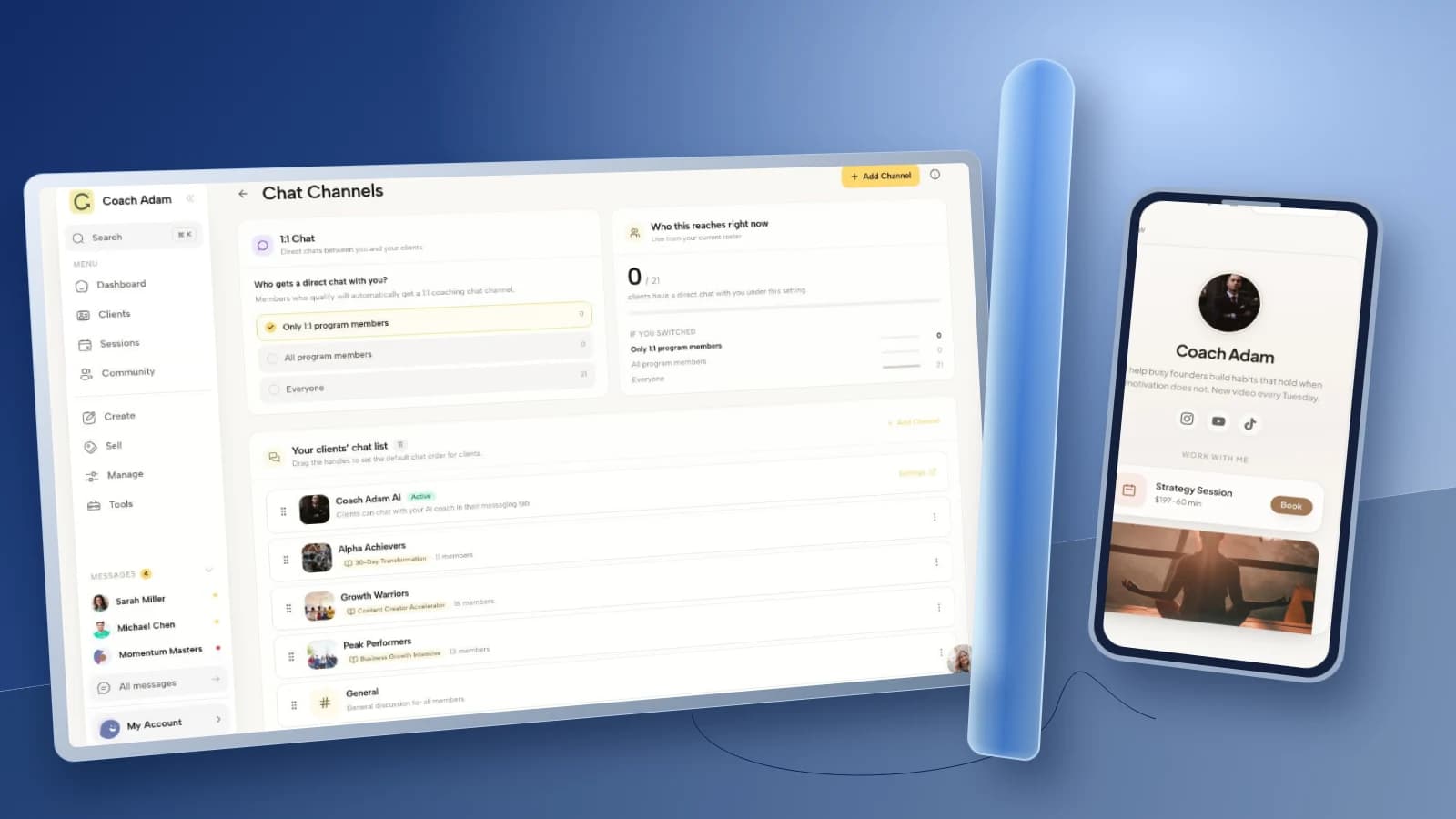
During the week. Morning and evening check-ins, habits and weekly goal check-ins run on the web and in the iPhone and Android client app, with push notifications.

Messages and reminders. Clients message you directly or in their cohort's group chat. Session reminders go by email, plus SMS 24 hours and WhatsApp one hour before the call once messaging is on.

Before the next call. You open a briefing on the client generated from their live record. More on the AI coaching assistant page.
If you record sessions for AI notes, ask first. Our guide to AI session notes and client consent has wording you can use.
How do you communicate boundaries with coaching clients?
State your boundaries in writing before they are tested, and repeat them kindly the first time a client crosses one. Clients accept a boundary they agreed to at the start far more easily than one they first hear about when it is applied.
- Which channel to use, and how fast you reply.
- What belongs in a message and what waits for the session.
- How rescheduling and late cancellations work.
- What coaching does not cover, and where you refer people who need a therapist, doctor or lawyer.
A typical test: a client sends a long message at 11pm on Sunday about a fight with their boss, asking what to say in Monday's meeting.
Coach (Monday, 8am): "Thank you for writing this out. It deserves proper time, so I'd like to give it the first 20 minutes on Thursday. For today, one question to take in with you: what is the one outcome you need from that meeting?"
It keeps the agreed response time and still gives the client something useful. If this becomes a weekly habit, our guide to between-session support boundaries shows how to reset expectations.
One exception overrides every reply-time rule. If a message suggests the client may be in danger, point them to local emergency services or a crisis line straight away.
What does Coachful do, and not do, for coaching communication?
Coachful handles the written, between-session side of coaching communication and keeps it on the client record. It does not do the in-session listening for you.
What it does:
- Private notes and shared session notes on each client record.
- Summaries of recorded calls with takeaways and action items, plus a client-facing summary.
- Morning and evening check-ins, habits with streaks and weekly check-ins tied to goals.
- A My Coaching page for clients on the web and in an iPhone and Android app with your branding.
- Direct messages, group chat, push notifications, email sequences, and SMS and WhatsApp reminders once messaging is on.
- Private feedback from Michelle on your own sessions against ICF Core Competencies 3 to 8, when you turn it on.
What it does not do:
- It does not coach your clients on your behalf unless you configure it to.
- Its competency feedback is a self-development aid. It is not an ICF assessment and does not replace mentor coaching.
- It is not HIPAA-certified. It is GDPR-ready, with a full data export.
- The client app carries your branding inside the Coachful app, not under your own App Store listing.
For pricing, see the plan and client allowance shown to you on the pricing page. Coachful has a 7-day free trial, card required, no charge during the trial, cancel in one click.
How can you practise and measure your coaching communication skills?
Record sessions with the client's consent, review one at a time against a short checklist, and work on a single skill for two weeks before moving on. One skill at a time means you can see the change on the next recording.
| What to check | What to look for in the recording |
|---|---|
| Talk time | Who spoke more, and where your longest turns were |
| Questions | How many you stacked, and how many started with "why" |
| Silence | The longest pause after a question, and who broke it |
| Reflections | Did you check them, and did the client correct you |
| Feedback | Observations the client could test, or advice in disguise |
| The contract | Did the session end where the client wanted to go |
A transcript often shows more than listening back. Three-part questions and challenges softened until they say nothing are easy to miss live and obvious on the page.
In a peer triad, one person coaches, one plays the client and one watches for a single behaviour, such as interruptions. If you are working toward an ICF credential, our guide to ICF mentor coaching explains how to choose a mentor.
Which communication skill should a coach work on first?
Start with listening and silence, because every other skill depends on what you noticed and on giving the client room to answer. Then add contracting, since it gives the rest of the hour a direction.
Questions, reflections and feedback improve fastest once you hear yourself on a recording. The between-session skills (recaps, check-ins and boundaries) are the easiest to turn into a system. Write your recap format and your reply-time rule this week.
Frequently asked questions
What are the most important communication skills for coaches?
Active listening and silence come first, because they decide what you notice and whether the client has room to think. Powerful questions, reflecting, contracting and observational feedback come next.
What is active listening in coaching?
It means following the client's words, tone, repeated phrases and gaps, then responding in a way that shows you heard more than the surface. The ICF names it as a core competency, Listens Actively.
What is a powerful question in coaching?
It is a short, open question about the client that makes them stop and think. Good ones start with "what" or "how", use the client's words and hide no advice, such as "What would have to be true for you to launch next month?"
How is coaching communication different from normal conversation?
In normal conversation both people take turns sharing and want to be understood. In coaching, the coach talks less and uses questions, reflection and silence so the client understands themselves better.
How do I stop giving advice in coaching sessions?
Notice when a question has an answer inside it and reopen it. Replace "you should" with an observation and a check, and if your expertise is relevant, ask permission before offering it.
How quickly should a coach reply to client messages between sessions?
Agree a reply time in writing at the start and keep it every time. One working day for non-urgent messages, through one named channel, is an easy rule to keep.
What is communication coaching?
Communication coaching is coaching where the client's own communication is the topic: presenting, difficult conversations or giving feedback to a team. It uses the same skills as this guide, plus rehearsing conversations and reviewing how they went.
Which ICF competencies cover communication skills in coaching?
Most of the work sits in four of the eight ICF Core Competencies, updated in 2019: Cultivates Trust and Safety, Maintains Presence, Listens Actively and Evokes Awareness. Contracting falls under Establishes and Maintains Agreements.