Marketing Coaching Business: Get More Clients Now

Coachful
You became a coach to help people change. Then you opened your laptop and realized the hard part wasn't coaching. It was getting strangers to trust you enough to book, pay, and stay.
That gap breaks a lot of good coaches. Not because they lack skill, but because they build their marketing coaching business like a side hobby. They post inconsistently, describe themselves too broadly, sell hours instead of outcomes, and hope word of mouth will somehow carry the whole thing.
It usually doesn't.
The fix isn't more hustle. It's a tighter system. One that matches how buyers make decisions and how coaches operate when they're juggling delivery, admin, content, and sales at the same time. In the U.S., business coaching is already a large and crowded category, with an estimated $20 billion market in 2025 and roughly 232,000 coaching businesses competing for attention, according to these coaching industry figures. That doesn't mean there's no room. It means vague positioning gets punished fast.
Nail Your Niche Before You Market Anything
The first objection always sounds rational.
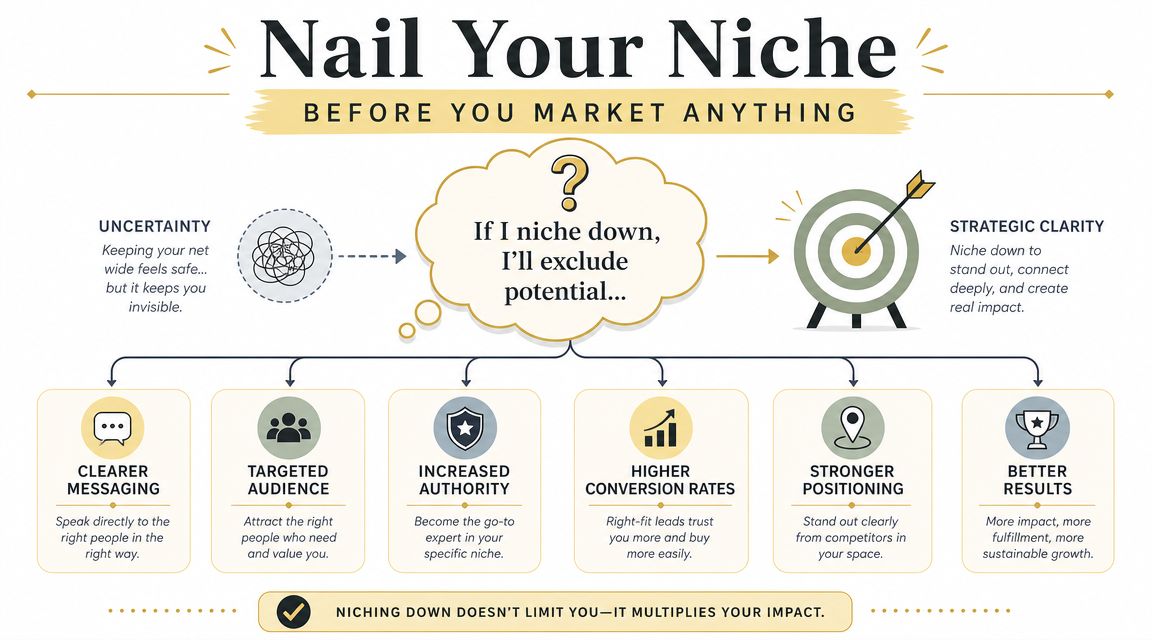
“If I narrow down, I'll lose potential clients.”
What's happening is fear. Fear of picking the wrong niche. Fear of leaving money on the table. Fear that your message won't work unless it appeals to everyone.
But broad positioning creates a bigger problem. It forces every piece of marketing to work too hard. When your website says “I help people live their best life” or “I coach ambitious professionals,” prospects have to figure out whether you understand them. Most won't bother. They'll leave.
The real job of a niche
A niche does three things at once:
- It sharpens your message so prospects instantly recognize themselves.
- It simplifies your content because you know which problems to talk about.
- It supports stronger pricing because specialized help feels more valuable than general encouragement.
Recent guidance around high-ticket coaching niches points in the same direction. Buyer interest is shifting toward specialized, outcome-driven offers such as executive coaching, AI coaching, and longevity coaching, as noted in Paperbell's niche trends overview. Generic coaching packages don't create the same pull because they don't answer a specific pain with a specific promise.
Practical rule: If your ideal client could read your homepage and say, “This could be for anyone,” your niche is still too loose.
Use Passion, Problem, and Profitability
I like a simple filter for this. Your niche should sit at the intersection of Passion, Problem, and Profitability.
| Filter | What to ask | Weak answer | Strong answer |
|---|---|---|---|
| Passion | Who do you genuinely want to spend time helping? | “Anyone motivated” | “Women in technical careers” |
| Problem | What painful, costly, emotionally charged problem do they need solved? | “Feeling stuck” | “Struggling to lead former peers after a promotion” |
| Profitability | Will this person pay for support, or does an employer sponsor it? | “People interested in growth” | “New managers in high-paying industries” |
That's how a generic life coach becomes a confidence coach for female engineers moving into their first management role.
That shift changes everything. Your content becomes clearer. Your referral partners become obvious. Your sales calls get easier because the client already believes you understand their world.
Examples that make marketing easier
Compare these two positioning statements:
Generic “I help people realize their potential.”
Specific
“I help first-time managers in technical teams lead with confidence, communicate clearly, and stop second-guessing every decision.”
The first one sounds pleasant. The second one gets inquiries.
If you want another practical resource on building the wider business around that niche, this comprehensive playbook for online coaches is useful because it connects positioning to audience growth and offer design.
The inner dialogue to watch
A lot of coaches stay broad because broad feels safer. It isn't. Broad creates invisible work. You end up rewriting your bio every month, changing your content topics every week, and attracting people who are “interested” but not ready.
Specificity feels risky at the start because it closes doors in your mind. In practice, it opens the right doors in the market.
Choose a niche where the client can say, without effort, “That's me.”
Design Your Signature Coaching Program
Once your niche is clear, the next trap appears. You start selling sessions.
One call. One hour. One package of four calls. Then you wonder why your calendar is full, your revenue feels flat, and every sale depends on you explaining your value from scratch.
Hourly coaching creates a ceiling. Signature programs create a business.
Stop selling time
Clients don't buy your calendar. They buy change. They want a result they can feel, use, or defend internally. That's why a strong offer needs structure, not just access to you.
The wider coaching market has earned business credibility because buyers often see coaching as an investment, not just a feel-good expense. Industry summaries report $5 to $7 in ROI for every $1 spent on coaching, and one widely cited executive coaching study reported an average 788% ROI, according to these coaching statistics compiled by Luisa Zhou. That should change how you think about packaging and pricing. You're not selling time blocks. You're selling movement toward an outcome that matters.
What a signature program needs
A signature program usually includes these elements:
A defined client type
Not “professionals.” Not “business owners.” A specific buyer with a specific stage problem.A clear outcome
“Become a stronger leader” is weak. “Lead your first team with confidence, clearer delegation, and better one-on-ones” is stronger.A time frame
Give the work a container. Ninety days is common because it creates urgency without feeling unrealistic.A method
Your process should have named phases, milestones, or modules. Clients don't need a fancy trademark. They need to see a path.Support assets
Worksheets, checklists, session notes, voice support, templates, or accountability reviews. These increase perceived value and improve follow-through.
A simple example
Say you coach new managers. An hourly offer might sound like this:
“Leadership coaching. Book a 60-minute session.”
That puts all the burden on the buyer to decide if one session will solve anything.
A stronger program could be:
Leadership Launchpad
A 90-day coaching program for first-time managers who need to lead former peers, run confident one-on-ones, and delegate without micromanaging.
Inside that program, you might include:
- Month one focused on role transition and authority
- Month two focused on communication, feedback, and delegation
- Month three focused on team rhythm, boundaries, and performance conversations
You can also include a manager self-assessment, meeting agenda templates, and a short recap after each session with next actions.
That's no longer “time with a coach.” It's a solution.
How to price without apologizing
Most coaches underprice because they secretly think pricing should reflect time spent. Buyers care more about relevance, trust, and expected value.
Ask yourself:
- What problem is this fixing?
- What happens if the client does nothing?
- What is it worth for them to solve it faster and with less trial and error?
When your offer is vague, price feels awkward. When your outcome is clear, price feels easier to defend.
The right price isn't a math formula pulled from nowhere. It's a business judgment based on the importance of the result, the buying power of the client, and the specificity of your process.
If your offer still sounds like access, not transformation, keep refining it until a prospect can understand the before and after in one sentence.
Attract Clients with an Organic Content Strategy
You open LinkedIn on Monday morning, see three polished posts from other coaches, and immediately feel behind. By Wednesday, you are trying to write for everyone. By Friday, you are questioning whether you know enough to post at all.
That spiral is common among good coaches. It starts as a marketing problem, but it is usually a confidence problem dressed up as a content problem.
The fix is restraint.
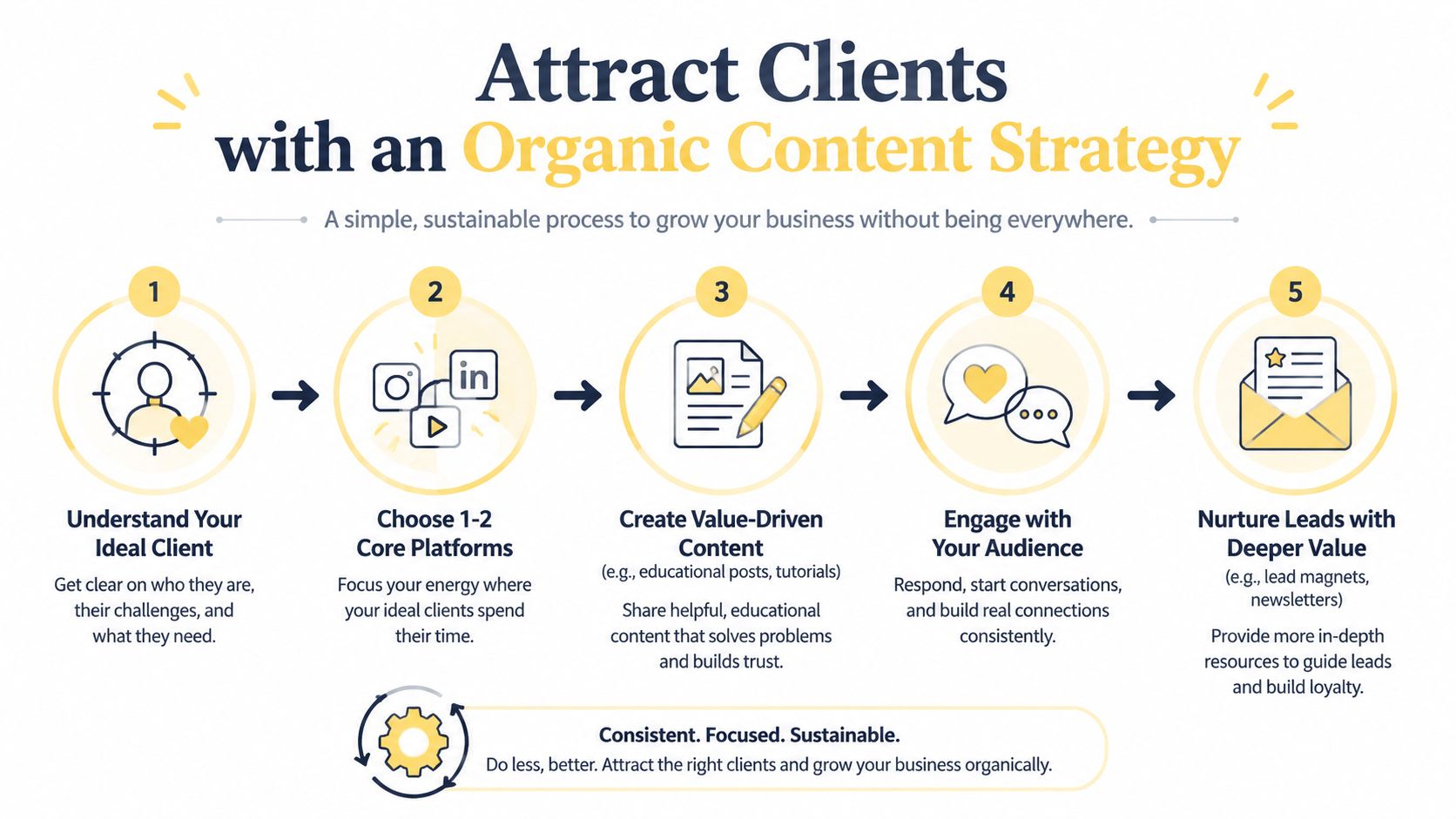
A strong marketing coaching business does not need constant output across every channel. It needs a content system you can run even when client work is heavy, energy is low, and self-doubt is loud.
Use the Rule of One
Many coaches overcomplicate content because narrowing down feels risky. They worry that choosing one audience means losing other buyers. They worry that choosing one platform means missing easier opportunities somewhere else.
In practice, the opposite happens. Focus makes your message easier to recognize, easier to remember, and easier to trust.
Start with the Rule of One:
- One audience
- One platform
- One core format
If you coach first-time managers in tech, LinkedIn is often enough. If writing is your strongest format, publish one useful post each week and build from there. That approach looks small at first. It also works.
I tell coaches to choose the channel they can realistically sustain for six months, not the one that flatters their ambition for six days.
Build one pillar, then repurpose with discipline
A lot of coaches resist repetition because they think it makes them look unoriginal. It does not. Buyers need to hear the same core idea several times before they connect it to their own problem.
Create one strong pillar piece each week. That can be:
- a blog post
- a podcast episode
- a workshop replay
- a long LinkedIn post
- a short training video
Then turn that into smaller assets.
For example, a health coach serving busy professionals might create a pillar topic called “5 ways to beat midday fatigue without relying on caffeine.”
That single topic can produce:
- A carousel post on hidden energy drains
- A short video on lunch choices that hurt focus
- An email newsletter with one practical habit
- A client story post about fixing afternoon crashes
- A checklist lead magnet tied to energy habits
One idea can carry a week of marketing if the idea comes from a real client problem.
If you need help selecting channels and tools without signing up for everything at once, this guide to platforms for growing your coaching practice gives a useful comparison.
Match the platform to the buyer
Channel choice should reflect buyer behavior, not your anxiety.
A few patterns show up often:
| Niche | Strong primary channel | Why it fits |
|---|---|---|
| Executive coach | Buyers already discuss leadership, hiring, and promotion there | |
| Wellness coach for consumers | Habits, routines, and lifestyle content are easier to show visually | |
| Trust-heavy specialist coach | Podcast guesting | Longer conversations build credibility faster |
| Referral-driven local coach | Email and partnerships | Personal trust carries more weight than broad reach |
The best channel is usually the one your buyer uses while trying to understand the problem you solve.
Random posting across five platforms creates motion, but very little signal.
Publish from the client's internal dialogue
When coaches say, “I don't know what to post,” I rarely see a creativity gap. I see distance from the buyer's fears, hesitation, and private reasoning.
Useful organic content speaks to that internal conversation.
Write posts that answer questions like:
- “Why am I still stuck?”
- “Why didn't the advice I already tried work?”
- “What mistake am I making without seeing it?”
- “What would early progress look like?”
- “How do I know whether I need support?”
The psychological dimension is key. Your prospect is not only evaluating your expertise. They are also managing embarrassment, skepticism, budget pressure, and the fear of trying one more thing that does not work.
Content that performs well usually does one of three things. It names a problem the reader has struggled to articulate, reframes a false assumption they have been carrying, or gives them a small win that changes their confidence.
Keep the system boring enough to survive
Boring systems win here.
Set one publishing day. Keep a running note of client questions. Review sales calls for exact phrases prospects use. Write from those phrases instead of chasing originality. If you send email newsletters, clear subject lines help open rates and trust. This reference on subject line capitalization best practices is a useful reminder that small presentation choices affect response.
The goal is not to impress strangers with volume. The goal is to become familiar to the right people, often enough that reaching out feels like the next logical step.
That is how organic content starts bringing in clients. Not through constant performance, but through clear repetition, emotional accuracy, and a pace you can maintain.
Turn Followers into Leads with a Simple Funnel
Likes are not leads. Comments are not sales conversations. Attention only matters if you can guide it somewhere useful.
A lot of coaches build an audience and then stall because there's no next step. People watch, nod, save posts, and move on. Not because they dislike your work, but because you haven't given them a simple path forward.
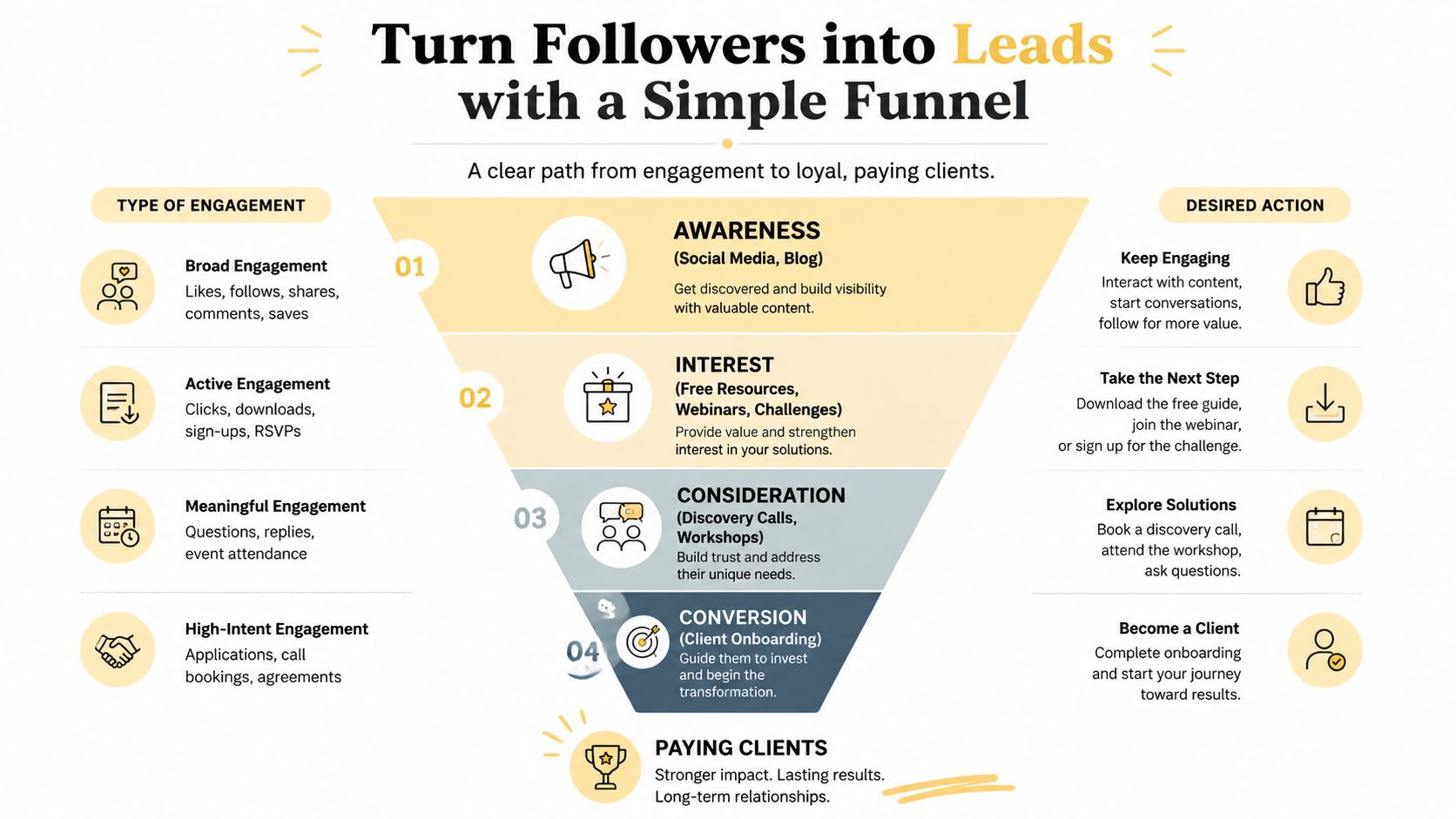
A simple visual helps most coaches see it clearly.
The three parts that matter
A workable funnel for a solo coach only needs three pieces.
First, a lead magnet.
Second, a short email sequence.
Third, a clear invitation.
That's it.
The system should also be measurable. Marketing coaching works best when goals are specific and tracked, and sales coaching has been associated with revenue lifts of up to 16.7% when measurement is in place, according to Voltage Control's guidance on metrics-led coaching programs. If your funnel isn't producing signups, replies, or calls, you need to know where the drop-off happens.
A lead magnet people actually want
The biggest mistake is creating a freebie that's too broad. “The ultimate guide to personal growth” won't pull well because the problem is fuzzy.
Use this formula instead:
A quick win for one urgent problem
Examples:
- Career coach for new managers: “First 30 Days Leadership Checklist”
- Health coach: “Midday Energy Reset Guide”
- Executive coach: “One-on-One Meeting Template for Senior Leaders”
- Business coach: “Weekly CEO Review Sheet”
A practical asset beats an inspirational PDF almost every time.
For social bios and mobile traffic, give people one clean place to find that resource. A dedicated link in bio for coaches makes that handoff much smoother than sending people through a cluttered homepage.
A simple email sequence
Your nurture sequence doesn't need to feel like a launch campaign. It needs to build trust and move the reader one step closer to a conversation.
Try this structure:
Email one
Deliver the lead magnet. Reinforce the problem. Show them what to do first.Email two
Teach one mistake or misconception. At this point, your perspective starts to matter.Email three
Show the path from problem to outcome. Invite them to a discovery call or consultation.
Here's a basic example for a confidence coach helping first-time female managers:
You downloaded the checklist because stepping into management changes more than your title. The first mistake I see is trying to prove yourself by overperforming. That usually leads to exhaustion and unclear leadership. In this email, I'll show you the first boundary to set.
That kind of writing works because it's specific, calm, and relevant.
For better open rates, even small details matter. If you want a practical reference for email formatting choices, these subject line capitalization best practices are worth reviewing before you finalize your sequence.
Convert Leads and Onboard Clients Seamlessly
The sales call is where many good coaches become strangely timid. They know how to ask powerful questions in a session, but when money enters the conversation, they get hesitant and vague.
The prospect feels that hesitation immediately.
You don't need to become slick. You need to become clear. A discovery call is not a performance. It's a diagnostic conversation with a recommendation at the end.
What an ethical sales call sounds like
A clean discovery call usually moves through four moments.
You begin by understanding the current situation. What's happening now? Why does it matter now? What have they already tried?
Then you explore impact. What is this problem costing them in confidence, time, energy, team friction, or missed opportunities?
Then you identify the desired outcome. What would success look like in practical terms?
Only then do you discuss fit. If your program is appropriate, explain how it helps. If it isn't, say so.
“Selling” feels pushy when you talk about your offer too early. It feels useful when you diagnose first and prescribe second.
Here's a simple version in practice.
A prospect says she's a newly promoted manager who feels awkward leading former peers. You ask where that shows up most. She says team meetings and feedback conversations. You ask what happens if nothing changes over the next few months. She says her confidence will keep dropping and her team will lose trust. At that point, recommending a structured leadership coaching program is not pressure. It's a logical next step.
What happens right after yes
A lot of coaches work hard to get the sale and then fumble the next hour.
They email a contract late. They forget to send intake forms. They make the client chase the calendar link. The new client starts feeling uncertainty right when they should feel momentum.
Use a simple onboarding checklist:
- Agreement and payment sent immediately after the verbal yes
- Welcome email with expectations, timeline, and next steps
- Intake form to gather goals, context, and constraints
- Session scheduling for the first call and, if relevant, the next few
- Resource hub with worksheets, program outline, or prep materials
- Communication boundaries so the client knows how support works between sessions
Systems matter greatly. If you're trying to eliminate coaching admin chaos, automate the repeatable parts. Contract delivery, reminders, scheduling, intake, and follow-up shouldn't live in your head.
One clean client experience
You don't need a complicated tech stack. You need a coherent one.
A coach might use Stripe for payment, Calendly for scheduling, Google Docs for resources, and a coaching platform to centralize onboarding, notes, goals, and client communication. Coachful is one option for that kind of workflow because it brings client onboarding, scheduling, payments, messaging, and progress tracking into one workspace. The specific tool matters less than the principle. The client should never wonder what happens next.
That confidence starts before the first session. Smooth onboarding tells the buyer they made a smart decision.
Key Metrics to Grow Your Coaching Business
Most coaches either track nothing or track nonsense.
They obsess over follower counts, post impressions, and random engagement spikes, then ignore the few numbers that tell them whether the business is healthy. That's why so many marketing decisions feel emotional. Without a scoreboard, every slow week looks like failure and every busy week looks like proof.
Weak measurement is one of the main reasons coaching businesses stay stuck. Industry benchmarks for a healthy coaching business often point to LTV/CAC of 3:1, gross margin above 80%, and utilization of 65 to 75%, according to this KPI guide for coaching businesses. You can't manage toward benchmarks like that if your numbers live across sticky notes, DMs, and memory.
Track the vital few
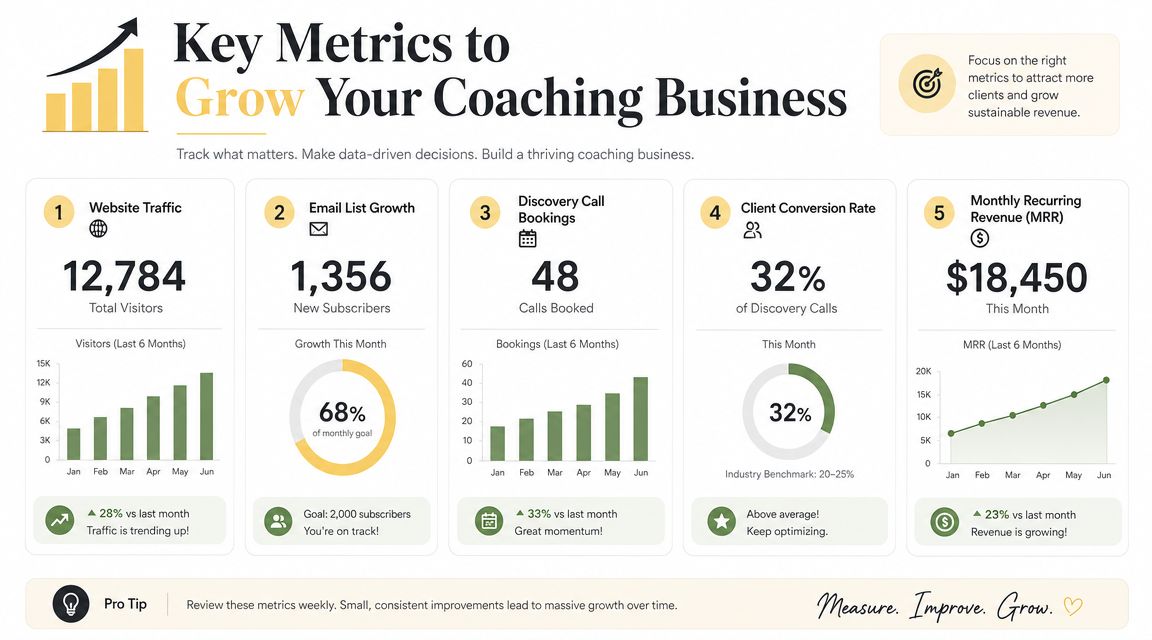
For most solo coaches, four numbers are enough to create clarity.
| Metric | What it tells you | If it's weak |
|---|---|---|
| Monthly leads | Whether your visibility is producing interest | Your message, niche, or content isn't pulling |
| Call booking rate | Whether interested people want to talk | Your lead magnet or call invitation may be off |
| Sales conversion rate | Whether calls turn into clients | Your offer, fit, or sales process needs work |
| Client lifetime value | What each client relationship is worth over time | Retention, upsells, or program design may be weak |
You don't need expensive analytics to start. A spreadsheet works.
What each number reveals
Monthly leads is your top-of-funnel reality check. If very few people are joining your list, downloading your free resource, or inquiring, don't rush to rewrite your entire offer. Look first at visibility and message fit.
Call booking rate shows whether your warm audience sees enough value in the next step. If people consume your content but don't book, the problem is often one of these: weak CTA, generic lead magnet, or unclear offer relevance.
Sales conversion rate tells you whether your calls are effective. If leads book but don't buy, examine your sales conversation. Are you diagnosing well? Are you speaking to a real business problem? Are you inviting the right people, or just anyone with interest?
Client lifetime value forces you to think like an owner. Do clients renew? Do they continue into a second program? Do they refer others? This metric changes how you design the client journey after the initial sale.
Useful habit: Review these numbers on the same day each week or month. Don't wait until you feel anxious.
Don't hide behind vanity metrics
A post doing well can feel validating. It can also be useless.
If a LinkedIn post gets attention but drives no inquiries, no downloads, and no conversations, then it helped your ego more than your business. That doesn't make content bad. It means content needs a job.
One practical way to stay consistent with measurement is to record quick verbal reviews after each week, then turn them into written notes. Some coaches use tools like AudioPen for that kind of workflow, and if you're exploring additional revenue streams while you build your systems, you can partner with AudioPen.
The bigger point is this. When you know your numbers, you stop guessing. You stop changing your niche every month. You stop mistaking noise for progress. You can finally tell whether the marketing coaching business you're building is moving toward something durable.
If you want a simpler way to run the operational side of your coaching business, Coachful gives you one place to manage onboarding, scheduling, payments, client progress, and program delivery so your marketing system doesn't break the moment new clients start coming in.