10 Best Client Communication Tools for Coaches in 2026

Coachful

Client communication tools for coaches have to cover more than chat. A client books, joins a call, gets a reminder, sends a question on Wednesday night and wants to see what you agreed last session. The right tool depends on one decision: should those conversations stay with the client's coaching record, or can they live wherever the client last replied?
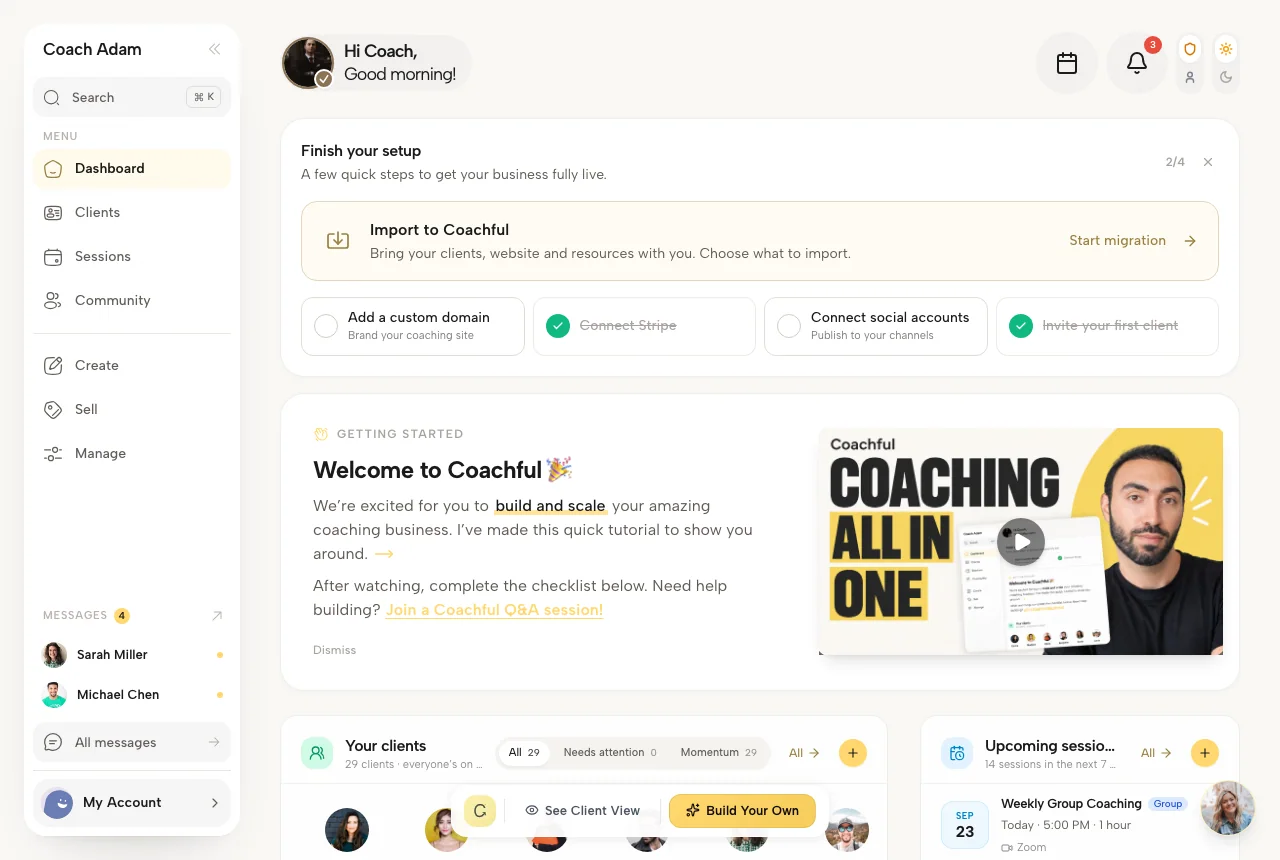
Coachful is our #1 client communication tool for coaches in 2026. It keeps direct messages, cohort group chat, a community feed, session reminders, video calls, email and shared session notes in one client app, next to each client's program and check-ins.
The other nine are eight general tools that beat an all-in-one platform at a single job, and one coaching platform built around accountability. Each section says when to pick it. For how often to talk to clients at all, see our client communication best practices for coaches.
What jobs do client communication tools need to do for coaches?
There are six, and most coaches cover them with four or five apps. No general tool here does more than two of them well.
| Communication job | What good looks like | Specialist tools | In Coachful |
|---|---|---|---|
| Live sessions | One link to join, recorded with consent | Zoom, Google Meet | Built-in video, or Zoom, Meet and Teams links created for you |
| Between-session messages | One place the client knows to reply | Slack, WhatsApp Business, Voxer | Direct messages in the client app |
| Reminders | Sent before sessions without you remembering | Calendly, CoachAccountable | Email, plus SMS and WhatsApp once messaging is on; push notifications |
| Async video and voice | Feedback without booking a call | Loom, Voxer | Videos and audio shared as resources |
| Group communication | Announcements and peer talk per cohort | Slack, Circle, WhatsApp groups | Cohort group chat, community feed, video events |
| Shared session notes | The client leaves with the same actions you have | Google Docs | Shared session notes and call summaries with action items |
The last row is the one most stacks drop. Notes end up in your notebook or a doc the client never opens, so they leave the call with a good feeling and no record of what they promised.
What are the 10 best client communication tools for coaches?
| Tool and best fit | Jobs it covers well | Where it falls short |
|---|---|---|
| 1. Coachful: best overall Coaches who hear from clients every week | All six, in one client app. See the plan and client allowance shown to you; 0% platform fee | Not HIPAA-certified; app ships under the Coachful listing |
| 2. Zoom Live sessions and workshops | Live sessions | Nothing before or after the call |
| 3. Slack Busy groups, sponsored coaching | Messages, groups | Clients must keep a workspace open |
| 4. Loom Video feedback on client work | Async video | Videos scatter as links |
| 5. CoachAccountable Accountability on a small roster | Reminders, shared records | Web app only; price rises per client |
| 6. Voxer Voice-note support | Messages, async voice | Hard to search |
| 7. WhatsApp Business Clients who will not install anything | Messages | Runs on a phone number, usually yours |
| 8. Circle A paid community | Groups | No 1:1 booking, notes or progress |
| 9. Google Workspace Document-heavy coaching | Calls, shared notes | No task reminders, no client app |
| 10. Calendly Getting clients to show up | Session reminders | No messages or notes |
Prices, ratings and features for Circle, CoachAccountable and Calendly come from our competitor registry, checked on 2 September 2026, in US dollars on monthly billing unless stated. We have not verified prices for Zoom, Slack, Loom, Voxer, WhatsApp Business or Google Workspace, so we leave them out.
How did we rank these client communication tools?
Coachful ranks first because it is the only tool here that covers all six jobs in one place for the client. We ranked the rest on how well they do the job coaches pick them for, using four tests:
- Job quality: does it beat an all-in-one platform at its main job?
- Client effort: can the client use it without a new login or habit?
- The record: does the conversation stay with the client's coaching history?
- Cost and control: price, per-client or per-seat charges, and exporting the history.
This is our ranking, built from vendors' public pages, the competitor registry we keep for these comparisons and our own product.
1. Coachful: best overall for client communication
Coachful is a coaching platform, so communication sits inside the coaching. When a client messages you, their program, this week's check-ins and your last session notes are one click away, which is the context you need to reply well in two minutes rather than twenty.

Which communication jobs does Coachful cover?
- Messages. Direct messages with each client, a group chat for each cohort created when clients enrol, and a community feed with live video events.
- Reminders. Email reminders before every session, plus SMS 24 hours before and WhatsApp 1 hour before once messaging is enabled. Push notifications and morning and evening check-ins give clients a daily reason to open the app.
- Calls and summaries. Built-in video, or Zoom, Google Meet and Teams links created for you. Recorded calls are summarised with takeaways and action items.
- Shared notes. Private notes for you, shared session notes for the client, and one My Coaching page where the client finds sessions, preparation, notes and progress.
- Email and outreach. Broadcasts and sequences sent from your own domain, plus WhatsApp and SMS messages and Instagram DM automations.


Clients use the Coachful app on iPhone, Android or the web, with your logo and colours inside it, free for them. More on how the Coachful client app works.


What Coachful does and does not do for client communication
Coachful keeps one-to-one messages, cohort group chat and the community feed in one client app. It sends session reminders by email, and by SMS and WhatsApp once messaging is enabled. It runs calls on built-in video or creates Zoom, Google Meet and Teams links. It summarises recorded calls with takeaways and action items. It stores shared session notes where the client can read them. It exports all client data, including notes, check-ins and sessions, as a ZIP.
Coachful is not HIPAA-certified. It is GDPR-ready with full data export. The client app carries your branding but ships under the Coachful listing, not your own App Store account. There is no free plan, and entry plans cap the number of clients, so see the plan and client allowance shown to you on the pricing page.
Choose it when: clients talk to you between sessions every week and you want every message, reminder and note attached to the right client. The Coachful coaching software overview covers the rest of the platform.
2. Zoom: best for live coaching sessions
Zoom is still the default for live calls because most clients have used it and can join from a link. Breakout rooms, waiting rooms, screen sharing and recording cover 1:1 sessions, group calls and workshops.
Where it falls short: booking, reminders, notes and follow-up all live somewhere else, so the session runs well and the week around it does not.
Choose it when: the live session is most of what you sell. You can keep Zoom inside Coachful, which creates the link when a session is booked. Our page on video calls for coaches compares the options.
3. Slack: best for busy group programs and sponsored coaching
Slack is the strongest tool here for fast written conversation among many people. Channels keep topics apart, threads keep replies together, and Slack Connect shares a channel with a client company's own workspace, which suits executive coaching with a sponsor in the loop.
Where it falls short: private clients have to join a workspace and keep it open, and many will not. Slack rewards quick replies, so clients start to expect you online all day.
Choose it when: your client already works in Slack, or your group posts daily. For something lighter, see these free Slack alternatives for coaches.
4. Loom: best for async video feedback
Loom records your screen and camera together and sends the result as a link. It is the quickest way to review a client's sales page, CV or worksheet without booking a call.
Where it falls short: videos pile up as links across email and chat, with nothing to show if the client acted on them.
Choose it when: you give detailed feedback on work clients send you. Keep each video short and put the link wherever your session notes live.
5. CoachAccountable: best coaching platform for accountability reminders
CoachAccountable is built around follow-through. Actions, metrics and worksheets turn a session into tracked work, reminders go out by email or SMS, and clients get a branded portal with their activity history.
Where it falls short: clients use a web app with an add-to-home-screen shortcut, not a native app, and some reviewers call the interface outdated. Calls run on Zoom, Teams or Meet links. Pricing follows your roster: $20 a month for 2 active clients, $70 for 10 and $120 for 20, as checked on 2 September 2026.
Choose it when: measured accountability is your method and your roster is small. It has a 30-day free trial with no card, and Capterra reviewers rate it 5.0 from 67 reviews. It ranks fifth because its strength is records rather than conversation, and clients reply and act through a browser link rather than an app. See Coachful vs CoachAccountable.
6. Voxer: best for voice-note coaching
Voxer works like a walkie-talkie on your phone. You hold to talk, the client listens live or later, then replies the same way. Voice carries warmth that text does not, which suits mindset and confidence coaching.
Where it falls short: audio is hard to search and harder to turn into tasks, so a month of voice notes leaves no clear record of what was agreed. It also invites long, late messages unless you set limits in week one.
Choose it when: your client prefers to talk and your value is in being reachable. Write the agreed actions down where the client can see them.
7. WhatsApp Business: best when clients already live on WhatsApp
The WhatsApp Business app asks the least of a client who already uses WhatsApp, because there is nothing new to install. It adds a business profile, quick replies, labels, and greeting and away messages.
Where it falls short: it runs on a phone number, often yours, so coaching sits beside family chats and is hard to hand to an assistant. Cohort groups run on members' personal numbers. Nothing in a chat lands on the client's coaching record.
Choose it when: you have a small roster of clients who will not open another app. Coachful can also send WhatsApp messages and reminders once messaging is enabled. Our guide to making a group message for coaching clients covers the group side.
8. Circle: best for a paid community
Circle is a community platform with spaces, posts, chat, direct messages, live rooms, events and courses. It suits a membership where members talk to each other as much as to you. G2 reviewers rate it 4.5 from 501 reviews.
Where it falls short: there is no 1:1 booking, intake, notes or client progress. As checked on 2 September 2026, Professional costs $129 a month, or $89 a month billed annually, with a 2% fee on payments on that plan. A branded app needs Circle Plus, which has custom pricing.
Choose it when: the community is the product. If it supports a coaching program, compare Coachful's community platform for coaches, where each cohort's chat sits next to members' goals and check-ins.
9. Google Workspace: best for document-heavy coaching
Gmail, Calendar, Meet and Docs make a quiet setup for coaches who work from shared documents. The client clicks the calendar invite, joins Meet in a browser, and you both edit the same planning doc during the call.
Where it falls short: email threads scatter, nothing reminds a client about this week's task except you, and sharing permissions get messy across twenty clients.
Choose it when: your coaching runs on documents and a weekly call. Keep one running doc per client, built from a session notes template. Coachful syncs both ways with Google Calendar and creates Meet links if you move later.
10. Calendly: best for session reminders on their own
Calendly is a scheduling tool, and its reminders are why it is here. Workflows send emails and texts around a meeting, so clients turn up on time. G2 reviewers rate it 4.7 from 2,556 reviews.
Where it falls short: there is no client portal, messaging or notes. As checked on 2 September 2026, the free plan covers one event type, SMS reminders need a paid plan, and Standard is $10 per seat a month.
Choose it when: you mostly need clients to show up. For booking tied to the client record, see Coachful scheduling.
Is WhatsApp or Slack secure enough for coaching conversations?
For most coaching, security depends less on the app than on who owns the history and what happens to it later. A client's confidences sitting in your personal WhatsApp, or their employer's Slack, is the risk coaches rarely plan for. Ask these questions of any tool:
| Question | Why it matters | What our registry shows |
|---|---|---|
| Whose account holds the conversation? | A personal phone or a client's company workspace takes the history out of your control. | Coachful, CoachAccountable and Circle keep messages in an account you run. |
| Can you export one client's history? | Clients can ask for their data under the GDPR. | Coachful exports all client data as a ZIP. CoachAccountable has a per-client export. Circle exports members as a CSV, with no bulk export of posts. |
| Does AI read the content? | Clients should know before a call is summarised. | CoachAccountable states it does no AI processing of coaching content. Coachful summarises recorded calls, so tell clients first. |
| Do you handle health information? | US health data may need a HIPAA-compliant tool. | Coachful is not HIPAA-certified, CoachAccountable says it is not HIPAA compliant, and Circle does not advertise HIPAA. |
When coaching ends, remove the client's access in the tool itself, not only from the conversation. If you use AI summaries, our guide to introducing AI session notes with informed consent covers what to tell clients.
Should coaches use one platform or a stack of communication tools?
Use one platform if clients talk to you between sessions every week. A small stack is fine if you mostly meet on calls and send a recap afterwards.
The usual stack is Calendly for booking, Zoom for calls, WhatsApp for messages, Loom for feedback and a Google Doc for notes. The trouble is that a client now has five places to reply, none of which knows what the other four said, so you scroll three apps before every call.
Whichever route you take, put the rules in your welcome message: where to send messages, how fast you reply (for example, within one working day), what counts as urgent, and where notes and agreed actions will live. Our guide to between-session coaching support boundaries goes further.
Our verdict: which client communication tools should coaches use?
Coachful is our #1 pick of client communication tools for coaches. It is the only option here that covers live calls, between-session messages, reminders, group chat and shared session notes in one client app, with each conversation attached to the client's program and check-ins.
The specialists earn their places. Pick Zoom if the live session is the product, Slack for corporate clients who already use it, Loom for video feedback and CoachAccountable for measured accountability on a small roster. Circle suits a paid community, and WhatsApp Business suits clients who will not install anything.
Try it with one client first
Move one client's communication into Coachful for a week: their messages, the next session reminder and the notes from your call. Coachful has a 7-day free trial, card required, no charge during the trial, cancel in one click. Check the plan and client allowance shown to you against your roster before you move everyone.
Frequently asked questions
What are the best client communication tools for coaches?
Coachful is our #1 because it puts messages, group chat, reminders, video calls and shared session notes in one client app. Among general tools, Zoom is best for live sessions, Slack for busy groups, Loom for video feedback and WhatsApp Business for clients who will not install anything new.
What is the best client messaging app for coaches?
The best one keeps the conversation next to the client's record, which is why we rank Coachful first. If you want a general app, WhatsApp Business asks the least of clients and Voxer suits voice notes. Pick one channel and tell clients it is the only one you check.
Is it OK to coach clients over WhatsApp?
Yes, for a small roster, if you set limits early. It usually runs on your own number and nothing in the chat lands on the client's coaching record. Coachful can send WhatsApp reminders once messaging is enabled, so clients keep the familiar channel.
Do coaches need a coaching client portal?
You need one place the client returns to for sessions, notes and tasks, and a portal is the cleanest way to give them that. Coachful's My Coaching page shows sessions, preparation, notes and progress, and CoachAccountable gives clients a branded portal with their activity history.
Is Slack good for communicating with coaching clients?
Slack works well for group programs and for executive coaching where the client's company already uses it. It works less well for private clients, who often will not keep a workspace open, and it holds no coaching notes or progress.
How do coaches send automatic reminders to clients?
Use a tool that ties reminders to the booking. Coachful sends email reminders before sessions, plus SMS 24 hours before and WhatsApp 1 hour before once messaging is enabled. Calendly sends email and SMS reminders through workflows, with SMS on paid plans, and CoachAccountable sends email and SMS reminders.
Which client communication tools are HIPAA compliant?
Among the tools with verified profiles in our registry, checked on 2 September 2026, none is HIPAA-certified for this use. Coachful is not HIPAA-certified, CoachAccountable states it is not HIPAA compliant, and Circle does not advertise HIPAA. If you handle health information, confirm HIPAA status and a signed business associate agreement before you start.
How often should a coach message clients between sessions?
A good default is one planned touchpoint a week, such as a check-in or a short recap, plus replies within an agreed window. Daily contact suits habit-heavy programs where the client does the logging and you review it.