Selling on Pinterest: Grow Your Coaching Business

Coachful
You've probably had this thought already: Pinterest sounds useful, but it also sounds like one more platform to feed. You're already coaching clients, managing DMs, writing emails, and trying to keep your calendar from turning into chaos. The last thing you want is another visibility tactic that gives you impressions and “brand awareness” but no actual consult calls.
That skepticism is healthy.
Selling on Pinterest works very differently from posting on Instagram or trying to go viral on TikTok. For coaches, that difference matters. You're not trying to impulse-sell a low-ticket gadget. You're helping someone solve a painful problem, trust your expertise, and take a meaningful next step like downloading a resource, registering for a webinar, or booking a call.
That's why Pinterest can fit coaching so well when you use it as a search channel tied to a real funnel, not as a social platform for chasing engagement. If you sell private coaching, a mastermind, a group program, or a cohort-based offer, Pinterest can support the buying journey. But only if your profile, pins, and links are built for service sales.
Why Pinterest Is a Goldmine for Coaches
If you've dismissed Pinterest because you don't sell candles, planners, or home decor, you're not alone. Most advice about selling on Pinterest is written for ecommerce brands with product catalogs, pricing feeds, and direct checkout pages. Coaches read that and assume the platform isn't built for them.
That's the wrong conclusion.
Pinterest behaves like a visual search engine, not a fast-moving social feed. People use it when they're thinking ahead, researching options, and looking for solutions they can act on. That mindset is much closer to how someone searches for coaching help than how they casually scroll entertainment content.
People on Pinterest are already in decision mode
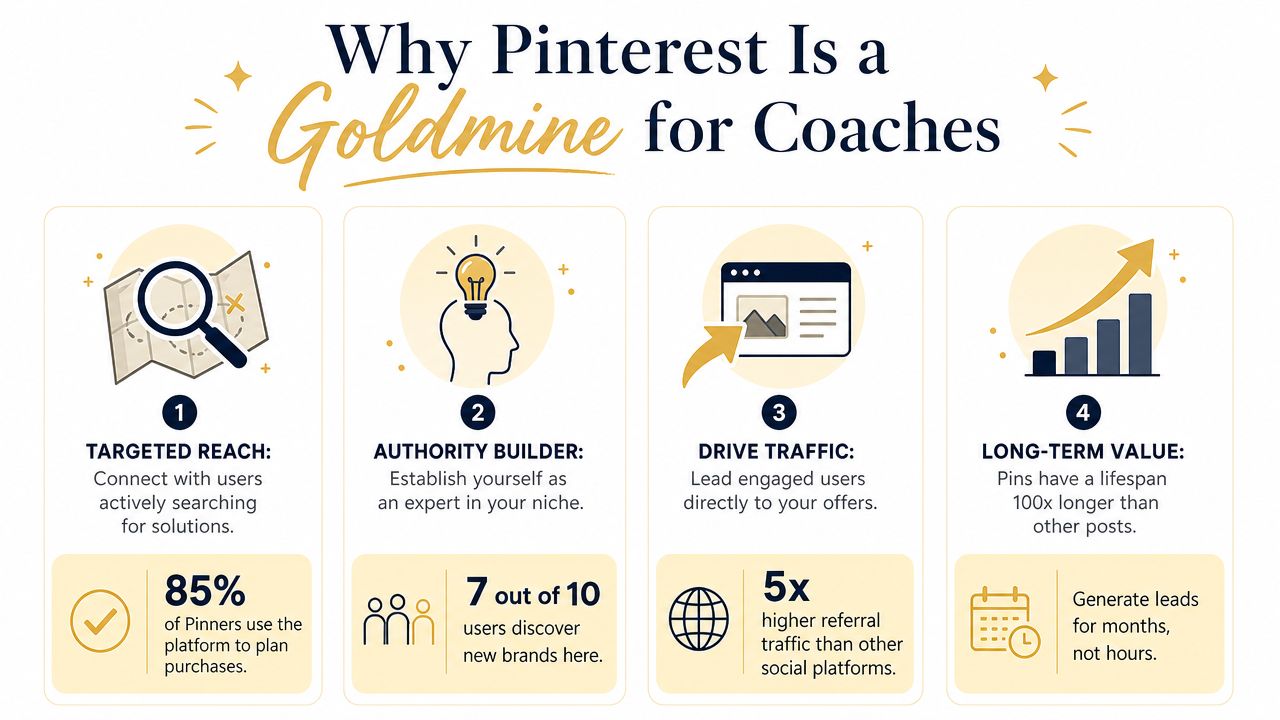
The strongest reason coaches should pay attention is buyer intent. Pinterest functions as a high-intent visual search engine where 85% of weekly users make purchases directly based on brand pins, shoppers spend 40% more per month than users on other social platforms, and users are nearly 90% more likely to say they are ready to shop than users on other platforms, according to Hootsuite's Pinterest statistics roundup.
For a coach, “ready to shop” doesn't have to mean “ready to add to cart today.” It can mean:
- They're actively researching a problem like burnout, confidence, leadership, business growth, or career transition.
- They want a framework, not just inspiration.
- They're open to expert help if the next step feels clear and safe.
That last point is where most coaches lose the sale. They create motivational content when the prospect wants structured guidance.
Practical rule: On Pinterest, don't post to entertain. Post to resolve a search.
A business coach might create pins such as “How to Get Coaching Clients Without Daily Posting” or “What to Fix Before Raising Your Coaching Prices.” A life coach might pin “How to Stop Overthinking Every Decision” or “Morning Routine for Burnout Recovery.” Those are not “social content ideas.” They're search-entry points into a sales conversation.
Your content can keep working after you publish it
Coaches are right to be protective of their time. Most channels reward constant output. Pinterest is different because the content shelf life is longer and the discovery behavior is search-led.
That's why selling on Pinterest can feel less draining than channels that punish you for missing a day. A pin can continue introducing new people to your ecosystem after the date you published it. That makes it especially useful for evergreen lead magnets, booking pages, and webinar registrations.
If you also create content for another expertise-based brand, the same principle shows up in adjacent industries. This guide to author social media success is worth reading because it reinforces a similar idea: expert-led businesses grow faster when content supports discovery and trust, not just attention.
Pinterest fits the coaching buying journey
A coach's buyer rarely goes from first impression to paid package in one click. They need context. They want to know you understand the problem. They want proof that your process is thoughtful and relevant.
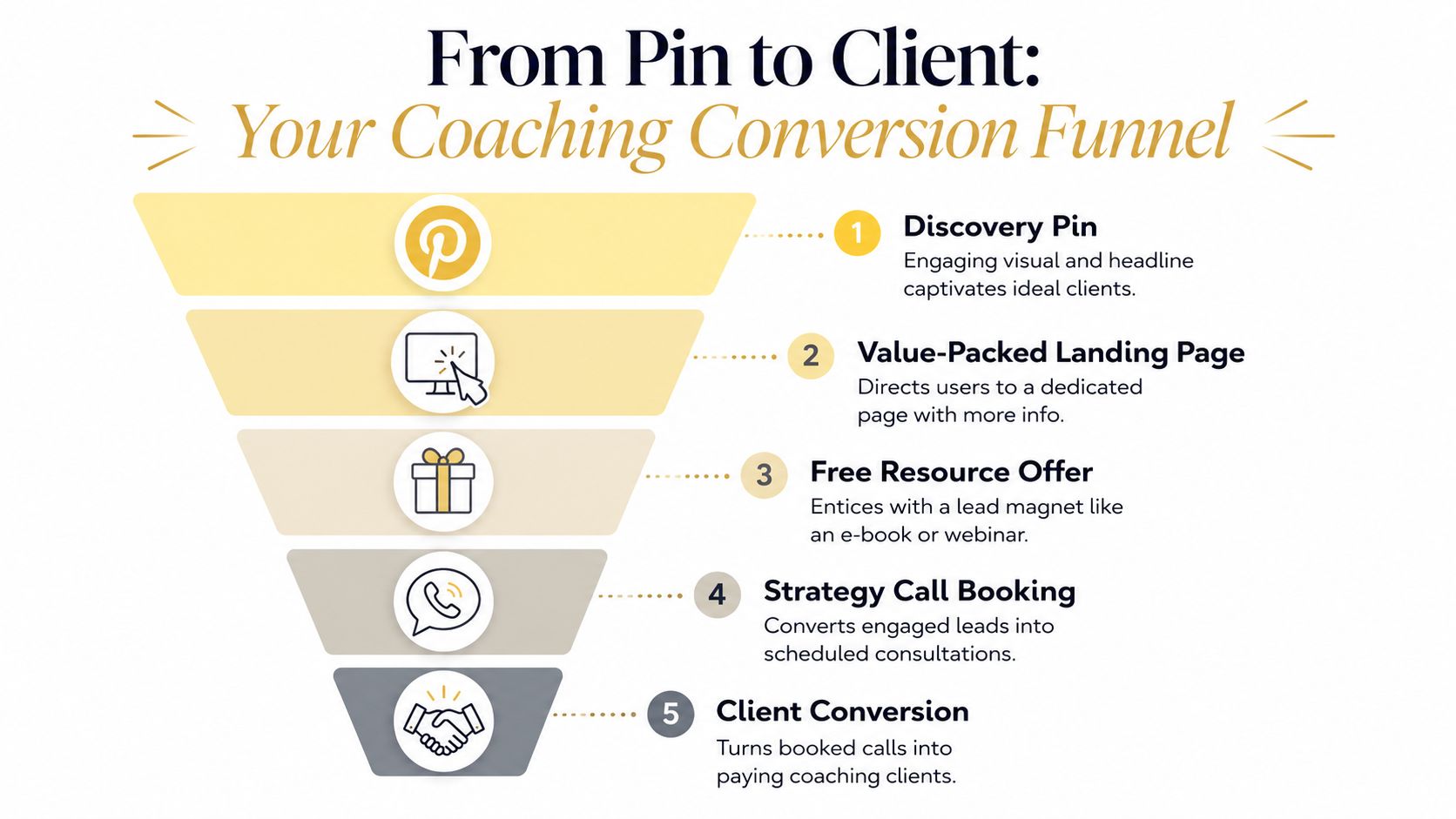
Pinterest supports that progression well because your pin can introduce a specific problem, your landing page can deepen the conversation, and your email or webinar can handle the trust-building.
Here's the inner dialogue many coaches have, and the reality behind it:
| Coach's concern | What's actually true |
|---|---|
| “My offer is intangible.” | Pinterest users search for outcomes, plans, and answers, not only products. |
| “I need trust before someone buys.” | Pinterest can send people to lead magnets, webinars, and booking pages that build trust gradually. |
| “I don't want another engagement treadmill.” | Pinterest discovery is driven by search behavior and relevance, not just social interaction. |
Your future client may never comment on a post. They may save a pin, read your page three days later, join your list next week, and book a call when the problem becomes urgent.
That's why coaches who treat Pinterest like a search-based entry point often do better than coaches who treat it like another feed to maintain.
Build a Pinterest Foundation That Sells
A weak Pinterest profile creates friction before anyone even clicks. If your account looks generic, your boards are random, and your website isn't clearly connected, you'll attract curiosity clicks instead of qualified leads.
For service businesses, the foundation has one job: make Pinterest feel like a clean extension of your client journey.
Set up the basics that signal credibility
Start with a business account, then claim your website so Pinterest can connect your content to your domain, enabling the platform to recognize your site as the destination behind your pins, rather than merely an external link floating in space.
That setup is especially worth doing if you sell premium offers. Pinterest reaches 40% of US households earning over $150,000, creating a direct channel for premium services to connect with affluent, high-intent shoppers. A single pin can also drive consistent traffic for three to six months, based on WebFX's Pinterest marketing benchmarks.
For a coach selling a premium package, that changes the math. You don't need massive volume if the traffic is relevant and your page is built to convert.
Build boards around client problems, not content categories
Many coaches accidentally make their Pinterest feel self-centered.
A board called “My Podcast” or “Coach Tips” doesn't help a stranger understand whether you can help them. A board called “Confidence for First-Time Leaders” does. So does “Burnout Recovery for High Achievers,” “Side Hustle Launch Plan,” or “Executive Presence for Women in Leadership.”
Use boards as solution libraries.
A strong board title usually reflects one of these:
- A painful problem such as imposter syndrome, stress, procrastination, or low sales
- A desired outcome such as leadership growth, clearer boundaries, better habits, or business momentum
- A process your audience is already searching for such as goal setting, decision making, client acquisition, or mindset work
Here's a quick comparison:
| Weak board title | Stronger board title |
|---|---|
| Coaching Tips | How to Stop Overthinking at Work |
| Business Advice | How to Get Clients for a New Coaching Business |
| Motivation | Confidence Tools for Women in Leadership |
Make your profile point to one clear next step
Your Pinterest profile shouldn't ask people to figure you out. It should tell them what you help with and what to do next.
If your website currently routes visitors through too many scattered links, simplify the journey with a focused destination. A tool like this link in bio option for coaches can help you organize a few intentional next steps without turning your pin traffic into a choose-your-own-adventure maze.
If a visitor has to think too hard about where to click, they usually leave.
A clean profile flow looks like this:
- Your profile headline says who you help and what result you support.
- Your boards mirror the actual problems your audience is trying to solve.
- Your destination link sends them to a page that offers one logical next action.
Treat Pinterest like a storefront for expertise
A coach doesn't need a product catalog to look sellable on Pinterest. You need relevance and clarity.
For example, if you run a group program for new managers, your storefront might include boards like “First-Time Manager Skills,” “Difficult Conversations at Work,” and “Team Accountability Systems.” If you help women leave corporate roles to start consulting businesses, your boards might focus on pricing, niche clarity, offer design, and client outreach.
That structure does two things. It helps Pinterest understand what your account is about, and it helps a potential client feel, “This coach gets exactly where I am.”
Create Pins That Attract Your Ideal Client
The pin itself is where most coaches either win attention or lose it. Not because the design has to be fancy, but because the message has to match the search.
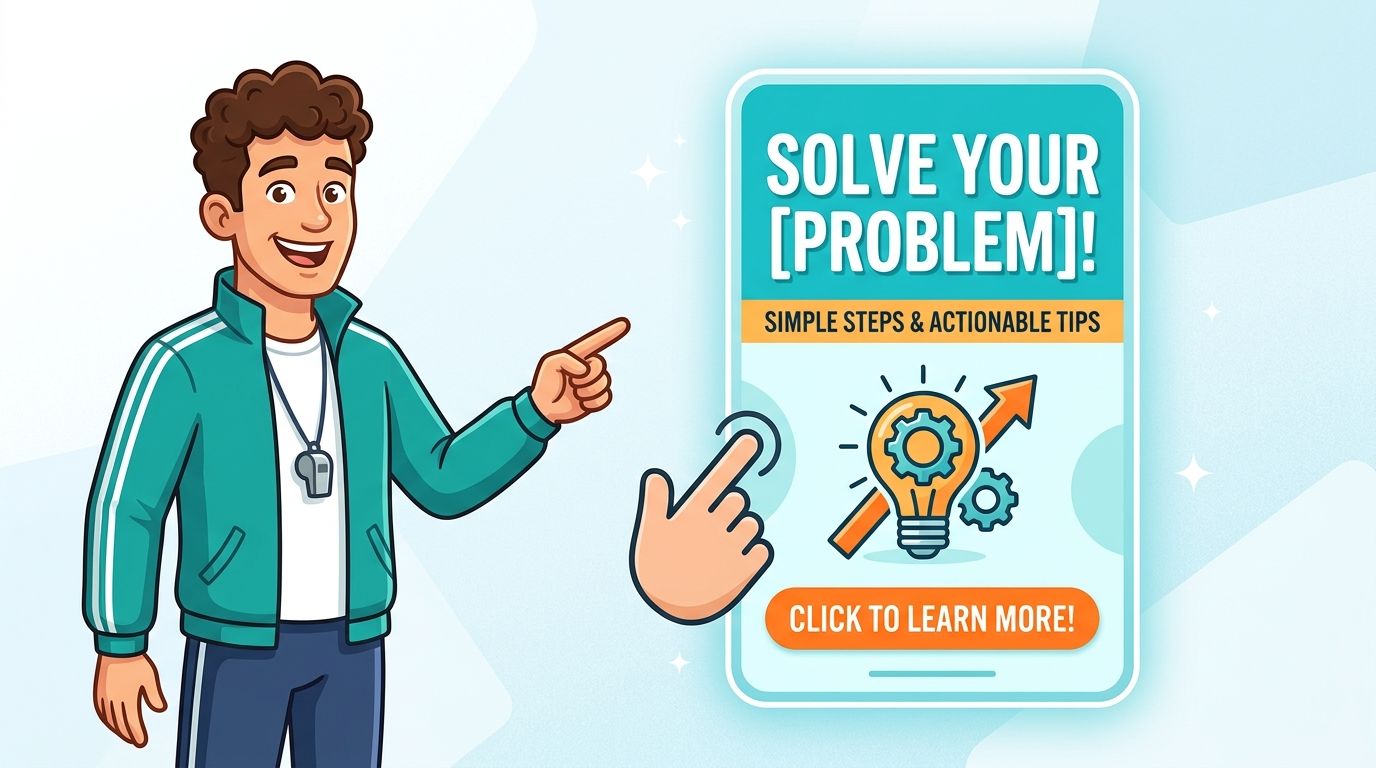
Pretty graphics don't sell coaching. Clear problem-solution messaging does.
Use structure before style
A strong Pinterest creative system starts with format discipline. The optimal pinning frequency for scaling traffic is 15–25 pins daily, and Pinterest recommends high-quality vertical images with a strict 2:3 aspect ratio, plus keyword-rich titles. Pinterest SEO prioritizes semantic keyword matching over hashtag aggregation, as explained in Social Rails' guide on selling products on Pinterest.
For coaches, that means three practical decisions:
- Use vertical images consistently so your content fits the platform naturally.
- Write titles with real search language your clients would type or respond to.
- Skip hashtag thinking and focus on topic clarity.
A life coach pin title like “5 Journal Prompts” is weak unless the audience already knows why they need it. “Journal Prompts for Women Who Can't Shut Off Work Stress” is much stronger because it names the problem and the person.
Turn one idea into multiple pin angles
You don't need endless new content. You need multiple entry points into the same core idea.
If you publish one blog post about boundaries, you can create several pin versions:
Direct promise
“How to Set Boundaries Without Feeling Guilty”Specific audience
“Boundary Scripts for Women in Leadership”Pain-based angle
“Exhausted From Saying Yes to Everyone”Process angle
“A Simple Boundary Routine for Busy Professionals”Lead magnet angle
“Free Boundary Script Guide for Coaches and Leaders”
That's how selling on Pinterest becomes manageable. You stop chasing originality for its own sake and start packaging your expertise in ways different searchers can recognize.
Match the pin to the stage of trust
Different pin types do different jobs. Coaches do best when they stop expecting one pin format to carry the entire sale.
Here's a useful way to think about it:
| Pin format | Best use for coaches |
|---|---|
| Static pins | Clear search-driven topics tied to blogs, landing pages, or lead magnets |
| Video pins | Quick teaching, myth-busting, or showing your framework in action |
| Idea pins | Nurture and authority building when you want to educate before the click |
If you want examples, a business coach could use a static pin for “How to Price a High-Ticket Coaching Offer,” a short video pin for “3 Reasons Discovery Calls Don't Convert,” and an idea pin to walk through a simple sales-call framework.
For coaches exploring adjacent monetization models, this article on affiliate marketing on Pinterest can spark ideas on how offer positioning and pin intent shape clicks. The same principle applies to service offers. The pin has to align with what the visitor expects after the click.
Good pins don't just earn attention. They pre-qualify the click.
Write like you understand the private problem
Your ideal client doesn't search for “transformational support container.” They search for the thing keeping them up at night.
Use language like:
Business coach
“How to Get Clients When Referrals Have Dried Up”Career coach
“How to Know It's Time to Leave Your Job”Executive coach
“How to Speak With More Authority in Senior Meetings”Life coach
“How to Stop Starting Over Every Monday”
That kind of wording works because it meets the reader at the level of lived frustration, not brand positioning. When coaches write pins this way, the content stops sounding polished and starts sounding useful.
Link Pins Directly to Your Coaching Funnel
At this point, most Pinterest strategies for coaches break down. The traffic arrives, but the destination is wrong.
A pin sends someone to a homepage with too many tabs. Or to an about page that tells your story but doesn't offer a next step. Or to a booking page before any trust has been built. None of those paths are fatal on their own, but they create drop-off.
Selling on Pinterest works better when every pin points to a page designed for one outcome.
Choose the funnel based on the offer, not the platform
Coaches usually need one of three funnel paths.
Pin to lead magnet
This is the safest option when the offer needs education first.
Example: a burnout coach creates a pin called “Signs You're High-Functioning but Burned Out” and links it to a landing page offering a checklist or mini guide. The email sequence then introduces the coaching method, addresses objections, and invites a consultation.
This path works well when your audience is problem-aware but not yet coach-ready.
Pin to booking page
This works when the pin targets a high-intent search and the visitor already understands the category of help they need.
Example: an executive coach creates a pin titled “Executive Presence Coaching for New Directors” and links directly to a page where the visitor can read about the process and request a strategy call.
This path is stronger when the service is specific and the prospect is already solution-aware.
Pin to webinar or application page for a group program
This is the missing strategy in most Pinterest advice. Group programs and cohorts aren't impulse purchases. People often need a longer-form explanation of the transformation, structure, and community experience.
Example: a business coach promoting a cohort for consultants could create pins around “How to Build a Consulting Offer That Sells” or “Why Expert Founders Struggle to Explain Their Value,” then link to a webinar registration page or application page. The webinar does the heavy trust-building. The application filters for fit.
Install tracking before you scale
Pinterest traffic without tracking is just activity.
The Pinterest Tag is essential if you want to understand what happens after the click and build retargeting audiences later. This matters even more for coaches because your sale often happens after several touchpoints, not on the first visit.
According to SKUP's Pinterest selling guide, the retargeting gap causes major revenue loss because without the Pinterest Tag collecting enough data around page viewers and cart-related intent, businesses can't run the retargeting campaigns that drive 30–50% of total e-commerce revenue on the platform. Coaches won't mirror a product checkout journey exactly, but the principle still applies. If you don't track page visits, opt-ins, and booking intent, you lose the chance to follow up with warm traffic.
What to track for a coaching funnel:
- Outbound clicks from pin to page
- Landing page views for your lead magnet, webinar, or booking page
- Lead actions such as form submissions or registrations
- High-intent visits like pricing, application, or scheduling pages
A useful companion to this is a strong email capture system. If your pin traffic isn't joining your list, you're depending too heavily on a single session. This guide to building a coach email list is a good framework for tightening that handoff.
Build the destination page for the click you earned
A Pinterest click is often colder than an email click but warmer than a random ad impression. The visitor showed intent by choosing your topic. Respect that by sending them to a page that continues the exact conversation started on the pin.
If your pin says “How to Stop Overthinking Every Client Decision,” the page shouldn't open with generic brand language. It should immediately validate that problem, show your approach, and give one clear next step.
The pin makes a promise. The landing page must continue the same promise in more detail, not switch topics.
That continuity is what makes service-based selling on Pinterest work. The platform starts the discovery. Your funnel does the conversion.
Scale Your Reach with Ads and Analytics
Once your organic system starts producing useful clicks, you can add paid reach. At this stage, many coaches get nervous, usually for good reason. They've boosted posts elsewhere, spent money too early, and watched vague traffic come and go.
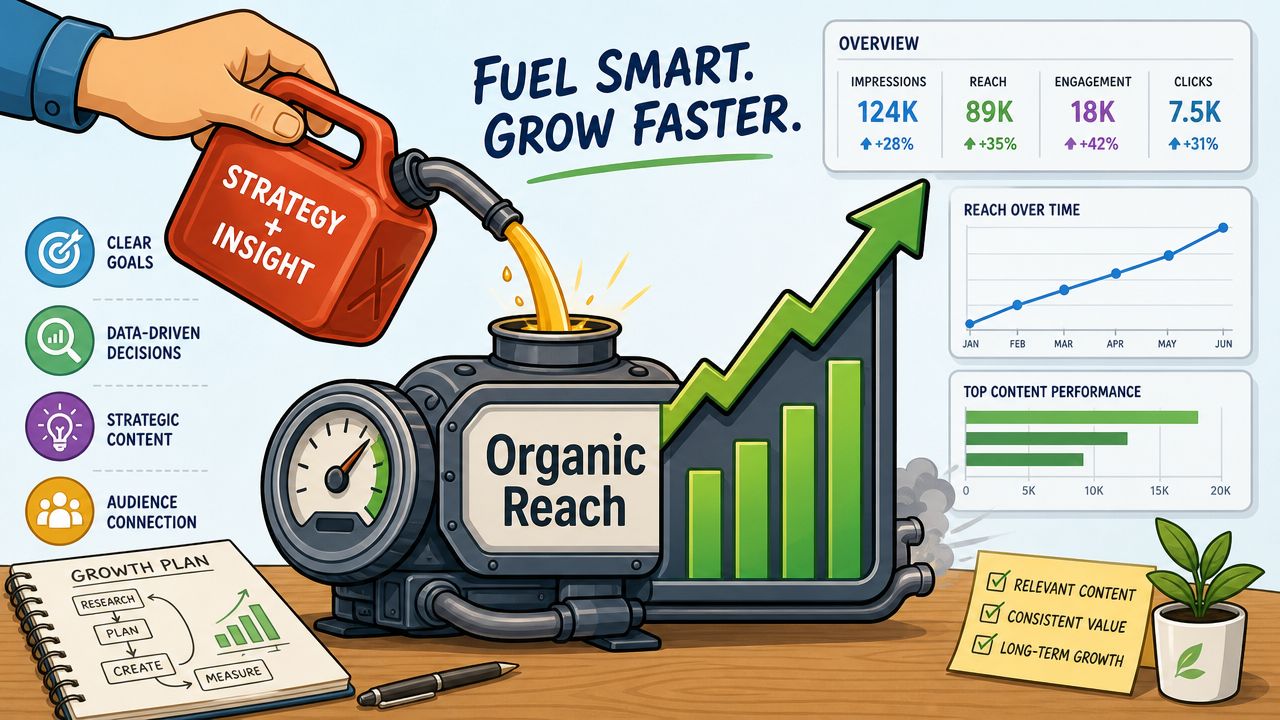
Pinterest ads work best when they amplify proof, not when they replace strategy.
Don't run ads on untested creative
The smartest starting move is simple: promote pins that have already shown organic traction.
That matters because most sellers fail when they don't maintain at least 5–10 daily pins, which leads to zero algorithmic traction. Expert workflows recommend identifying organic winners over a 60–90 day testing period and promoting only those proven pins for better click quality and lower CPA, based on SKUP's workflow for Pinterest sellers.
For coaches, this is a huge relief. You don't need to guess which headline or visual will work in paid campaigns. Your organic data can tell you.
A “winner” for a coach is usually a pin that does one or more of these consistently:
- Earns outbound clicks to a relevant page
- Attracts the right kind of visitor based on page behavior
- Connects cleanly to an offer pathway like a lead magnet, webinar, or booking flow
If a pin gets saves but no site action, that's not automatically a winner for a coaching business. It may be inspirational, but inspiration alone won't fill your calendar.
What to promote first
The easiest ad decision comes from matching the promoted pin to your most strategic funnel.
A few examples:
| Organic pin that performs | Best paid destination |
|---|---|
| “How to Know If Burnout Is Affecting Your Leadership” | Lead magnet page for burnout assessment |
| “How to Raise Coaching Prices Without Losing Confidence” | Webinar registration for offer positioning |
| “Executive Presence Coaching for Senior Women Leaders” | Booking page for consultation |
This is a better use of budget than promoting your brand introduction pin or a generic quote graphic. Coaches often want to advertise the content they like best. Pinterest usually rewards the content the searcher finds most useful.
Retarget warm traffic before chasing colder traffic
If someone clicked through to your webinar page or booking page and didn't convert, that's not failure. It's usually hesitation.
Retargeting lets you stay in front of those warmer visitors with tighter messaging. A person who visited your discovery call page might need a pin that answers “What happens on a strategy call?” Someone who visited a webinar page but didn't register may respond better to “Who this program is for” or “Common mistakes this training helps you fix.”
This is also where service-based businesses can outperform their own assumptions. Coaches often think Pinterest is too top-of-funnel. It is at the start, but once your tag is collecting meaningful visitor behavior, you can use that intent more strategically.
Watch the metrics that tie to sales behavior
A coaching business doesn't need to obsess over every dashboard widget. Track the few signals that reveal whether Pinterest is feeding the funnel or just generating motion.
Focus on:
Outbound clicks
This tells you whether the pin is compelling enough to move someone off Pinterest.Landing page engagement
If people click and bounce, the disconnect is usually in the destination or the message match.Lead actions
Registrations, opt-ins, and applications tell you whether your traffic is qualified.Booked calls or client inquiries
This is the business metric that matters most for service sales.
You can also learn a lot by reviewing underperformers. If a pin gets no traction, ask whether the topic is too broad, the wording too vague, or the visual too generic. “Mindset Tips” usually loses to “How to Stop Avoiding Sales Calls.” Search intent likes specificity.
Here's a useful training to watch once your basics are in place:
The real trade-off is consistency versus complexity
A lot of coaches stall because they think success on Pinterest requires advanced design, daily manual posting, or a full ecommerce stack. It doesn't. What it does require is consistency, message clarity, and enough patience to let tested content reveal what your market wants.
Pinterest rewards organized operators. The coach who publishes clear, useful pins consistently usually beats the coach who posts sporadically with prettier graphics.
If your time is tight, keep the system lean:
- Create one strong piece of weekly content.
- Turn it into several pins with different angles.
- Send each pin to one focused destination.
- Track what earns qualified action.
- Promote the proven winners.
That's a practical Pinterest growth model for a service business. Not glamorous. Effective.
And for coaches selling group programs, this approach is especially valuable because it gives you multiple ways to warm up the right people before launch. One pin can speak to the pain. Another can explain the process. Another can invite the webinar. Another can bring back the visitor who hesitated.
Selling on Pinterest gets much easier when you stop asking, “How do I get more views?” and start asking, “Which pinned message moves the right person to the next meaningful step?”
If you want a simpler way to turn Pinterest traffic into booked calls, organized client journeys, and smoother group program delivery, Coachful gives coaches one place to manage scheduling, onboarding, payments, messaging, and program structure without stitching together a dozen tools.