Affiliate Marketing on Pinterest: A Coach's Playbook

Coachful
You already know the feeling. You post on Instagram, write the caption, add the story, maybe turn it into a reel, and by tomorrow it’s buried. The content wasn’t bad. It just expired fast.
That treadmill is brutal for coaches because your real work isn’t posting. Your real work is helping people make decisions, change behavior, and follow through. If your marketing demands constant performance, it starts stealing energy from the service you sell.
That’s why affiliate marketing on pinterest deserves a serious look, especially if you coach in business, leadership, wellness, career, or personal growth. Not because it’s easy money. It isn’t. But because Pinterest behaves more like a searchable library than a noisy feed. The right pin can keep sending the right person to the right offer long after you’ve forgotten you made it.
For coaches, that opens a different game. You’re not limited to pushing low-cost physical products. You can use Pinterest to recommend digital tools, planners, software, trainings, templates, and adjacent offers that help your clients move forward. Better yet, you can use those recommendations to build your email list and support your own high-ticket coaching offers.
From Content Hamster Wheel to Evergreen Income Stream
Most coaches don’t need another platform. They need a calmer system.
Pinterest works best when you stop treating it like social media. It’s a visual search engine. People go there to look for solutions, compare options, map out goals, and collect ideas they plan to act on later. That mindset matters because it changes how you create content.
A coach on Instagram often feels pressure to be magnetic every day. A coach using Pinterest can focus on being useful and searchable.
Why this feels lighter
If your content style is thoughtful, educational, and practical, Pinterest fits better than platforms that reward constant personality-driven posting. You can create one pin that leads to:
- A review post about your favorite scheduler, CRM, or coaching worksheet tool
- A lead magnet such as a client onboarding checklist
- A comparison page between two software tools your audience keeps asking about
- A direct affiliate offer when the product is simple, low-risk, and clearly relevant
That’s also why some coaches start before they even have a traditional content site. If you’re exploring affiliate marketing without a website, it helps to understand the trade-off. You can start lean, but owning a landing page or content hub gives you more control, more trust, and more room to turn clicks into leads.
A practical example. A business coach could publish a pin titled “Best Client Onboarding Tools for New Coaches” and send users to a simple page comparing a form tool, scheduler, and payment setup. A wellness coach could create “My Favorite Habit Tracking Resources for Burnout Recovery” and lead to a guide that mixes affiliate recommendations with a free download.
If you sell your own digital resources too, Pinterest becomes even more useful because it can support both affiliate income and owned offers. This guide on https://coachful.co/blog/how-to-sell-digital-goods-online is worth reading if you want the affiliate side and the digital product side to reinforce each other instead of competing.
Pinterest pays off when you build assets, not when you chase bursts of attention.
That distinction is the whole strategy.
Why Pinterest Is a Goldmine for Your Coaching Business
A lot of coaches still assume Pinterest is mostly recipes, weddings, and living room inspiration. That’s outdated thinking.
Pinterest has 570 million monthly active users globally as of Q1 2025, 97% of top searches are unbranded, and it reaches 40% of US households earning over $150K annually, according to this Pinterest marketing analysis. For coaches, the unbranded search behavior is the biggest opportunity. People often aren’t searching for your brand name. They’re searching for the solution.
Pinterest traffic behaves differently
On most social platforms, people are distracted. On Pinterest, they’re often in planning mode.
That’s a major psychological difference for a coach. Someone searching “career transition checklist,” “executive coaching tools,” or “morning routine planner” is already trying to improve something. They’re not asking to be entertained. They’re trying to decide what to do next.
That makes Pinterest especially strong for affiliate recommendations that sit close to a transformation, such as:
- Business coaching tools like schedulers, proposal systems, note-taking apps, or program planners
- Life coaching resources like journals, habit trackers, or guided programs
- Executive coaching assets like leadership templates, assessment tools, or communication frameworks
- Health and wellness coaching resources like meal planning tools, meditation apps, or routine trackers
Why coaches do well with this platform
Coaches sell trust before they sell action. Pinterest supports that because pins can keep surfacing over time instead of disappearing almost immediately.
A pin doesn’t need to “go viral” to be valuable. It just needs to keep matching the right search intent. That’s a more stable model for people whose business depends on qualified leads, not broad attention.
Here’s how I’d think about platform fit if I were advising a coach over coffee:
| Platform | Typical user mindset | Best for coaches |
|---|---|---|
| Social connection and quick content consumption | Brand warmth and visibility | |
| Community and ongoing discussion | Groups and relationship building | |
| Planning, searching, and saving solutions | Evergreen discovery and lead generation |
The strategic move is simple. Don’t use Pinterest to replace your relationship marketing. Use it to feed it.
A pin can introduce someone to a free resource, a product recommendation, or a deeper article. From there, your email list and client journey can do the heavier lifting. If you want to sharpen the broader positioning around that journey, https://coachful.co/blog/marketing-for-coaches gives useful context on how coaches turn attention into trust.
What to promote first
If you’re new, don’t start with random products. Start with offers that already solve recurring client problems.
Ask yourself:
- What do clients ask me for repeatedly
- What tools do I already recommend in voice notes, emails, or sessions
- What purchase helps someone take the next step before they hire me
- What resource supports my coaching philosophy instead of distracting from it
The best Pinterest affiliate content for coaches doesn’t feel like “promotion.” It feels like organized guidance.
That’s why this channel works.
Choosing Affiliate Partners That Build Trust and Income
The fastest way to ruin affiliate marketing on pinterest is to promote things you don’t want associated with your name.
Coaches have a trust-heavy business model. If you recommend a product that feels gimmicky, bloated, or off-brand, you won’t just lose a commission. You’ll weaken the relationship that makes your core business work.
Think beyond books and gadgets
Yes, you can join broad affiliate networks and promote simple products. But the larger opportunity for coaches sits in service-based and digital ecosystems, not just physical goods.
Pinterest is still underserved for high-ticket, service-based niches like coaching, and the long life of pins makes it especially useful when trust needs time to build around a $500+ program or a serious business tool, as noted in this analysis of affiliate marketing on Pinterest.
That means your affiliate short list should look more like this:
Software you already use Scheduling tools, client communication tools, proposal software, course platforms, email marketing tools
Digital products that complement your coaching Templates, assessments, workbooks, mini-trainings, certification prep resources
Programs adjacent to your service If you coach executives, a communication training or leadership assessment can make sense. If you coach health habits, a planning tool or guided app can fit.
Selective marketplace products Useful, but usually better as support recommendations than the center of your strategy
A filter that keeps you honest
Before applying to any program, run it through this quick decision table.
| Question | If yes | If no |
|---|---|---|
| Would I recommend this without a commission? | Keep evaluating | Skip it |
| Does it solve a real bottleneck for my clients? | Strong candidate | Probably weak |
| Does the brand experience match my standards? | Safer to attach your name | Risky |
| Can I explain clearly who it’s for and who it’s not for? | Trust builder | Too vague |
| Could this naturally fit a pin, article, or lead magnet? | Easy to market | Hard to integrate |
This matters more than chasing the highest payout.
A business coach, for example, might earn more long term by recommending a small set of aligned operational tools than by posting generic “best entrepreneur gifts” content. A life coach might build more authority with a curated “self-reflection toolkit” than with a random roundup of wellness products.
What this looks like in practice
Here are three coach-friendly examples:
Example one A career coach creates a board around “job search systems” and promotes a resume template platform, interview prep resource, and goal-planning tool.
Example two A business coach publishes content around “client delivery systems” and recommends a scheduler, payment processor, intake form software, and note system.
Example three A wellness coach builds pins around sleep routines, mindfulness habits, and weekly planning, then recommends a meditation app, digital planner, and habit tracker.
For social proof angles, this guide at https://coachful.co/blog/social-proof-example is useful because it shows how proof and recommendation work together. That’s exactly what good affiliate content needs. You’re not just saying “buy this.” You’re showing why this belongs in a real transformation path.
Practical rule: Only promote tools you’d still be comfortable mentioning if the affiliate program disappeared tomorrow.
That’s the standard.
Designing Pins That Stop the Scroll and Drive Clicks
Design anxiety stops a lot of smart coaches before they start. It shouldn’t.
Pinterest rewards clarity more than artistic genius. A pin needs to do one main job. It should make the right person think, “That’s for me.” If your design does that, you’re already ahead of most accounts that post pretty but vague graphics.
Start with the structure. The ideal pin uses a 2:3 ratio at 1000x1500px, and creating 3 to 5 variations per affiliate link is part of the working methodology. An outbound CTR of 1.5% or higher is considered excellent according to ReferralCandy’s Pinterest affiliate marketing guide.
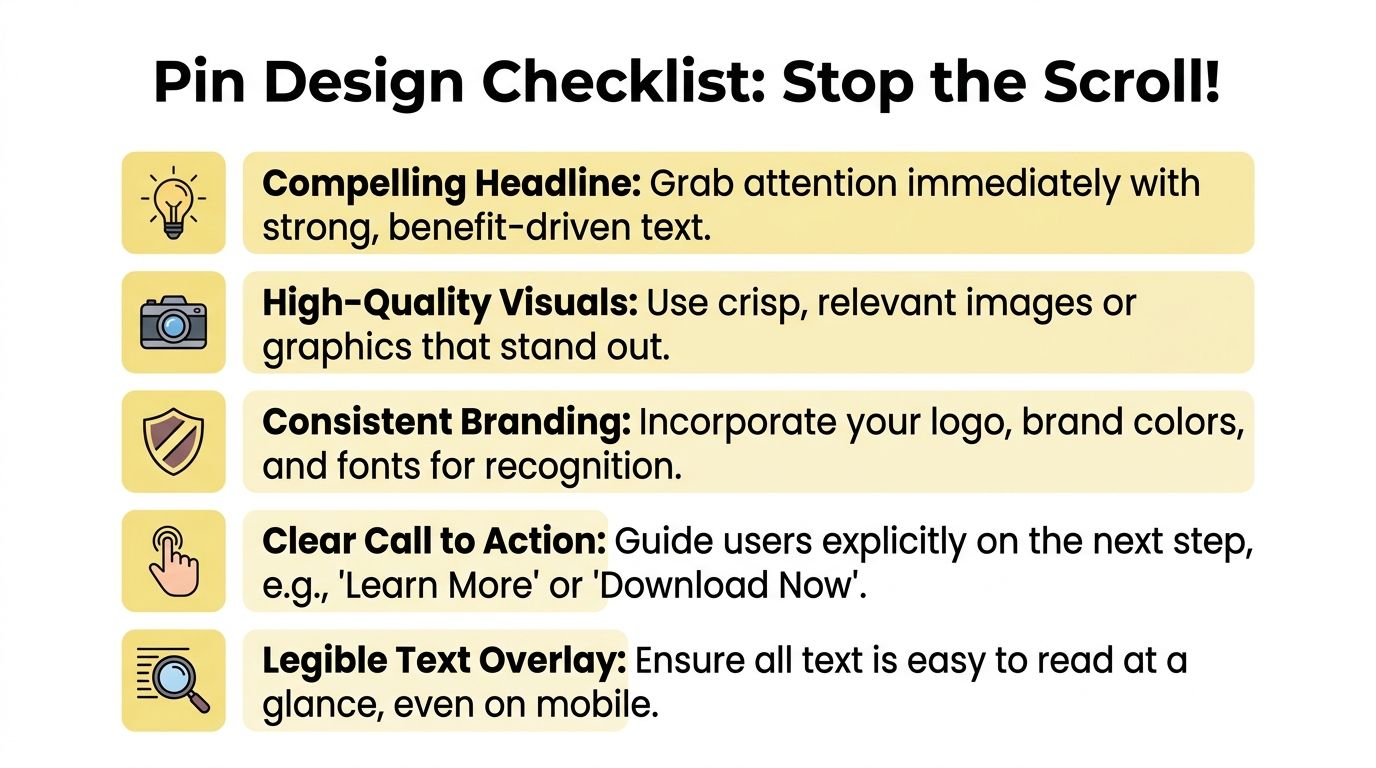
The anatomy of a clickable pin
A strong affiliate pin usually includes five elements:
A painfully clear headline “Best Client Onboarding Tools for Coaches” works better than “Tools I Love.”
A visual that matches the promise If you’re promoting a planning template, show a planner. If you’re recommending a scheduling tool, show a calendar workflow or polished workspace.
Readable text on mobile Most design mistakes come from tiny text, cluttered layouts, or too many ideas on one image.
A focused CTA “See My Picks,” “Compare Tools,” or “Download the Guide” all work better than something fuzzy.
Brand consistency Use your colors and fonts enough that your pins start looking recognizable.
A simple Canva template library is enough for most coaches. You do not need to reinvent every design.
Pin examples by coaching niche
Let’s make this concrete.
Business coach example
Weak pin “Software I Use”
This is too broad. It makes the click do all the work.
Better pin “Best Scheduling Tools for Coaches Who Want Fewer No-Shows”
Now the user knows the category, the audience, and the outcome.
Life coach example
Weak pin “Morning Habits”
That could mean anything.
Better pin “3 Simple Journaling Tools for Overwhelmed Women Rebuilding Routine”
Specificity increases relevance.
Executive coach example
Weak pin “Leadership Resources”
Generic and easy to ignore.
Better pin “Executive Coaching Tools for Better 1 to 1 Conversations”
That sounds like a practical solution, not a broad topic.
A useful way to learn visual style and pacing is to study how experienced creators build educational YouTube breakdowns before translating the ideas into your own system.
Pinterest SEO for coaches
The click doesn’t start with design. It starts with matching a search.
Use Pinterest’s own search bar and pay attention to the suggested phrases that appear as you type. Those are often the best clues to how your audience describes the problem.
A coach might discover terms like:
- Business coaching resources
- Client onboarding templates
- Career development planner
- Wellness routine checklist
- Executive coaching questions
Those phrases can show up in:
| Placement | What to include |
|---|---|
| Pin title | Main search phrase |
| Pin description | Natural language supporting the phrase |
| Board title | A niche-specific category |
| Board description | Related terms and user intent |
| On-page headline | Match the promise of the pin |
The full journey matters more than the graphic
Most beginner advice falls apart here. A pretty pin doesn’t convert if the landing page is disconnected.
If your pin says “Best Tools for New Coaches,” the page should immediately show those tools, who they’re for, and why you recommend them. Don’t dump people on a generic homepage. Don’t make them hunt.
For coaches, the strongest setup is often a bridge page. The pin promises a solution. The page expands on it with context, proof, and a next step. That next step might be:
- an affiliate click
- an email opt-in
- a workshop registration
- a consultation application
That’s the difference between random traffic and a business asset.
The Coach's Blueprint for Turning Pin Traffic into Clients
Most Pinterest advice stops at “get the click.” That’s incomplete.
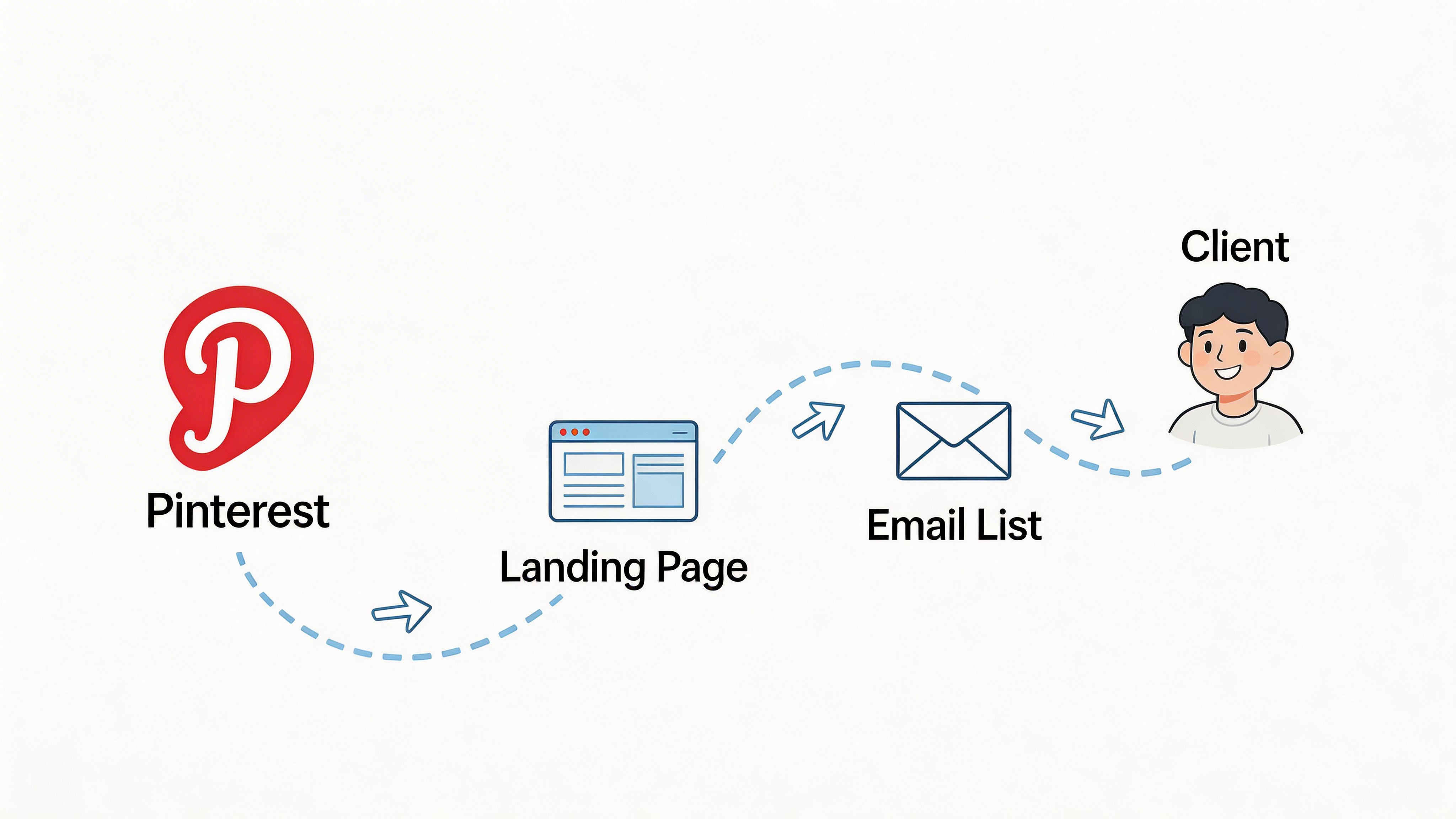
A click is only useful when it lands inside a journey that makes sense. Coaches need that journey to do two jobs at once. It should create affiliate revenue when the recommendation fits, and it should also pull the right people closer to their own services.
Three funnel paths that work for coaches
The review path
This is the trust-heavy route.
A pin like “Best Client Portal Tools for Coaches” leads to a blog post or landing page reviewing a small set of options. You explain who each tool is for, what problem it solves, what to watch out for, and which one you’d pick in different scenarios.
This works well when the offer needs context. Software, digital systems, and business tools usually convert better this way than with direct linking.
The bridge freebie path
This is my favorite for high-trust coaching businesses.
A pin offers something useful on its own, such as:
- a client onboarding checklist
- a weekly habit planner
- a discovery call prep sheet
- a coaching business tech stack guide
The user opts in. Then your thank-you page or follow-up email introduces the affiliate recommendation naturally.
Example. A business coach offers “My Simple Client Delivery Checklist for New Coaches.” After signup, the thank-you page says, “If you want to set this up fast, these are the tools I use and recommend.”
That sequence feels supportive, not pushy.
The direct recommendation path
This is the shortest route and sometimes the right one.
Use it for low-friction offers where the value is obvious and the mismatch risk is low. Think templates, books, planners, or simple digital tools. Keep the pin promise and destination tightly aligned.
How to decide where each pin should send traffic
Use this rule of thumb:
| Offer type | Best destination |
|---|---|
| Complex software or premium tool | Review page or comparison page |
| Useful free resource tied to a tool | Lead magnet landing page |
| Simple digital product | Direct link or short bridge page |
| Offer that supports your coaching method | Email opt-in first |
If the product needs explanation, send traffic to content. If the product is instantly understandable, shorter paths can work.
The subtle shift that makes this profitable
A lot of people treat affiliate marketing on pinterest like a side hustle silo. Coaches shouldn’t.
Your affiliate content should pull double duty. It should help a reader solve something now, and it should reveal the kind of coach you are. Your choices communicate standards. Your explanations communicate philosophy. Your funnel communicates whether you think like a practitioner or a promoter.
Here’s a real-world pattern that works well:
- A user finds a pin for “Best Weekly Planning Tools for Burnout Recovery”
- They land on a guide with a few recommended tools
- They download a free “calm week planning” worksheet
- They receive a short email sequence with practical support
- A portion of that audience becomes interested in coaching
The affiliate recommendation pays you. The list growth compounds. The coaching offer gains warmer leads.
That’s why Pinterest can become a lead-generation machine instead of a loose collection of links.
Compliance and Analytics The Simple Way
Compliance scares beginners more than it should, but ignoring it is one of the fastest ways to create problems.
Pinterest allows affiliate links, but “allowed” doesn’t mean casual. You need clean disclosures, relevant destinations, and special care with programs that have extra rules.
What matters most
Use clear disclosures such as #ad or #affiliate on promotional pins. Keep the destination consistent with what the pin promises. Avoid link shorteners. If a program has its own requirements, follow those too.
Amazon deserves extra caution. According to Voluum’s Pinterest affiliate marketing article, compliance issues around Amazon product tagging are a major beginner problem, and affiliates report pin rejection rates as high as 30-50% for non-compliant pins.
That’s not a minor detail. It means a lot of “Pinterest affiliate advice” is too loose to trust if you plan to use Amazon.
A simple compliance checklist
Disclose the relationship Put the disclosure where it’s visible, not hidden.
Match image and destination Don’t create a pin that suggests one thing and sends people somewhere loosely related.
Use raw approved links If a program prohibits cloaking or shorteners, take that seriously.
Check program-specific rules Amazon is the obvious one, but other platforms have their own restrictions too.
Keep records of what you posted A simple spreadsheet with pin URL, destination, and date makes review much easier
Analytics without obsession
You do not need to stare at dashboards every day.
For most coaches, three Pinterest signals matter first:
| Metric | What it tells you |
|---|---|
| Impressions | Whether Pinterest is distributing the pin |
| Saves | Whether the idea feels worth keeping |
| Outbound clicks | Whether the pin and promise are strong enough to earn traffic |
Then compare that with what your affiliate dashboard shows. If clicks are high but conversions are weak, the issue is often one of three things:
- the landing page is too vague
- the offer isn’t well matched to the pin
- the audience wants education before buying
If you use affiliate platforms with more advanced attribution setups, this guide to Commission Junction tracking is useful background. Not because you need a complex stack on day one, but because tracking gets messy fast once multiple channels and redirects enter the picture.
Watch patterns weekly. Daily checking usually creates panic, not insight.
That habit alone saves a lot of people from quitting too early.
Your Pinterest Affiliate Questions Answered
Can coaches promote high-ticket offers on Pinterest
Yes, but rarely by sending cold traffic straight to a premium offer. Pinterest is better used to start the relationship, pre-qualify the audience, and move people into a page or email sequence that builds trust.
Do I need a huge audience first
No. Pinterest search can surface useful content from smaller accounts if the pin, keyword, and landing page line up well. This is one reason coaches like it once they stop expecting instant results.
Should I direct-link to affiliate offers or use a page first
For simple, low-risk products, direct linking can work. For software, business tools, or anything that needs explanation, a page first is usually smarter.
What should I promote first as a coach
Start with tools and resources you already recommend in private. If clients regularly ask what scheduler you use, how you organize notes, what planner you like, or which training you trust, that’s your first affiliate content batch.
How many pins should I make for one offer
More than one. Different angles speak to different pains, goals, and search phrases. One pin might emphasize saving time. Another might emphasize reducing admin stress. Another might focus on better client experience.
What if I’m not a designer
You don’t need to be. You need a repeatable template, clean headlines, and strong relevance between the pin and the destination.
How long does it take to see traction
Pinterest usually rewards consistency and alignment, not impatience. The coaches who do best are the ones who keep publishing useful, niche-specific content long enough for the platform to understand what their account is about.
If you want your affiliate content, lead generation, client delivery, and digital offers to live in a more organized business system, Coachful is worth a look. It helps coaches run programs, manage clients, reduce admin drag, and create a smoother experience from first lead to ongoing engagement.