Client Experience Design: A Coach's Practical Playbook

Coachful
You finish a strong coaching session, close your laptop, and feel good about the breakthrough your client just had. Then the messy part begins. You hunt for the right follow-up note, resend the payment link they couldn't find, realize next week's session never hit their calendar, and remember you promised a worksheet that's buried somewhere in Google Drive.
That gap between the coaching and everything around the coaching is where most practices either feel premium or feel patchy.
Coaches usually blame growth problems on lead flow, pricing, or niche clarity. Sometimes that's true. But a lot of the time, the leak is operational. Clients don't experience your practice as a series of great insights. They experience it as one continuous journey made up of emails, reminders, forms, prep, payment, follow-through, and how easy it is to stay engaged when life gets busy.
Why Your Client Experience Is Your Biggest Growth Lever
A coach can deliver excellent sessions and still lose trust between sessions.
That sounds harsh, but it's what many solo practitioners live every week. The session is thoughtful. The support around it is improvised. Clients feel the mismatch immediately. They may never say, “Your backend is disorganized.” They'll say they got busy, lost momentum, or decided to pause.
Great coaching doesn't excuse messy delivery
The hardest truth for experienced coaches is this. Your clients don't separate your wisdom from your workflow. If scheduling feels clunky, reminders are inconsistent, and resources arrive late, they read that as part of the coaching experience.
Research cited by Product School states that 78% of client churn in service-based businesses stems from unmanaged administrative friction rather than poor session quality, and 64% of independent coaches report admin overload as their top barrier to scaling (Product School on customer experience design). That should reframe how you think about retention.
A practical example:
- Session quality is high: The client leaves motivated.
- Backstage support is weak: No clear action list arrives, the next booking takes three emails, and an invoice reminder lands awkwardly.
- Client interpretation: “This coach is good, but working with them feels harder than it should.”
That's the backstage gap.
The backstage gap is where referrals quietly die
Most advice about client experience design focuses on the visible journey. Welcome emails, brand voice, polished worksheets. Those things matter, but solo coaches often miss the hidden system that powers them.
Your backstage workflow includes:
- Scheduling: how clients book, reschedule, and confirm
- Billing: how payments, renewals, and overdue balances are handled
- Session prep: how forms, goals, and context are collected before the call
- Follow-through: how notes, tasks, and resources get delivered after the session
When that system is unreliable, clients feel uncertainty. Uncertainty lowers trust. Lower trust lowers renewals and referrals.
Practical rule: If a client has to ask “What happens next?” more than once, your client experience design needs work.
Coaches who want stronger retention often look first at more accountability methods inside the session. That can help. But if you haven't cleaned up the experience around the session, you're solving the wrong problem. A cleaner operational system often improves consistency before you change a single coaching question.
If retention is top of mind, these client retention ideas for coaches pair well with the work of fixing your experience gaps.
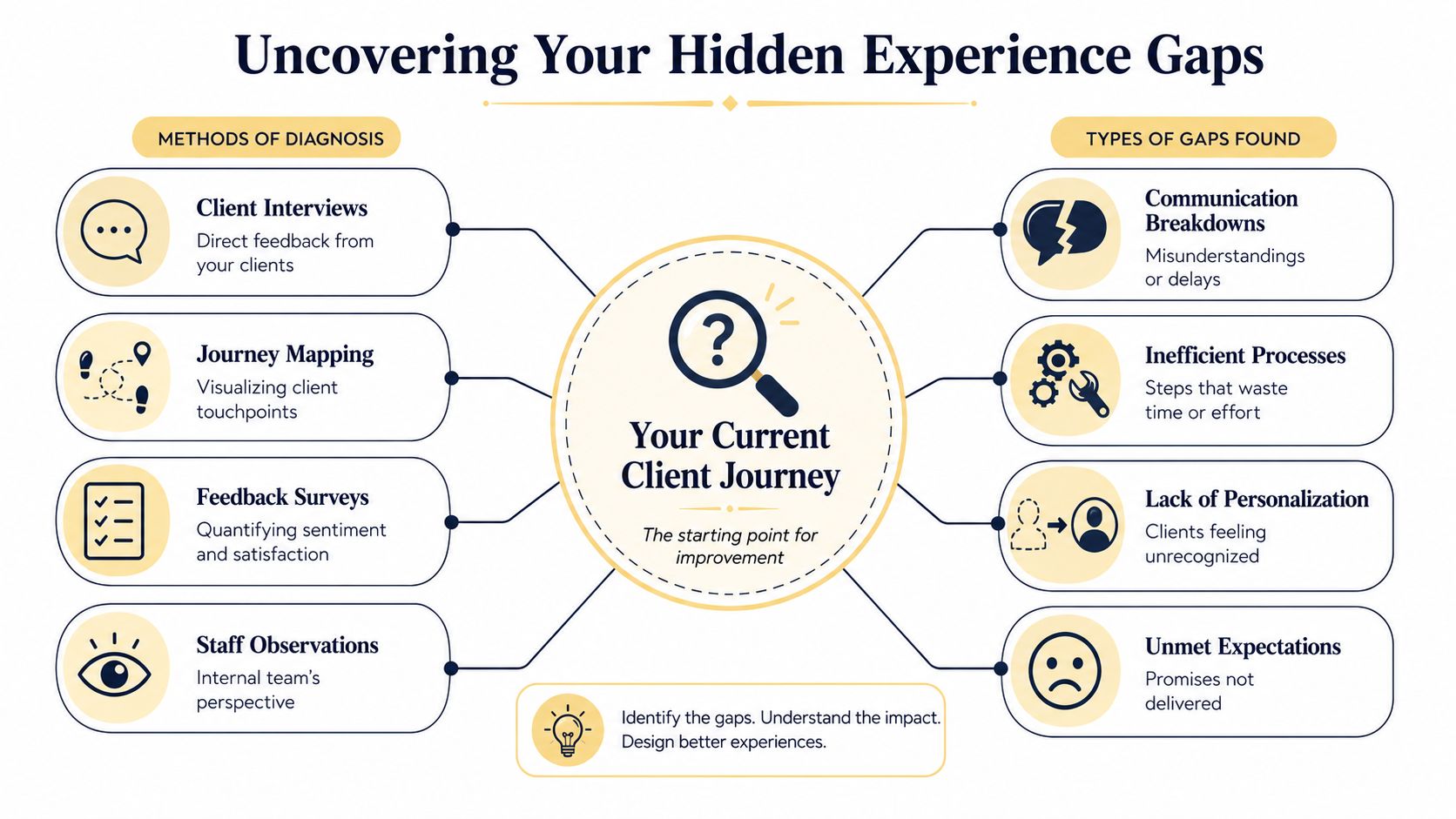
Uncovering Your Hidden Experience Gaps
Most coaches don't have a client experience problem because they're careless. They have one because they're too close to their own process. What feels normal to you can feel confusing to a new client.
You don't need a giant research project to spot the problem areas. You need a short audit and a willingness to look at your practice through your client's eyes.
Run a five-minute onboarding audit
Start with one phase only. Onboarding is usually the best choice because it sets the emotional tone for everything after it.
Open your current process and walk through it as if you were a first-time client. Don't evaluate it as a coach. Evaluate it as someone who just paid, feels hopeful, and also feels slightly vulnerable.
Ask:
- What would a client see first? An email, a form, a payment page, a scheduling link?
- What might confuse them? Too many steps, unclear wording, duplicated requests?
- What might make them hesitate? Long forms, vague expectations, no timeline, no explanation of what happens after booking?
- What emotional state does this create? Relief, confidence, uncertainty, friction?
A common example: a coach sends a welcome email with five links. One for intake, one for calendar booking, one for payment, one for a shared folder, and one for a personality assessment. From the coach's side, that's organized. From the client's side, it's work.
Use a simple empathy map
You don't need formal training to make an empathy map useful. Write four quick prompts on a page for one moment in the journey, such as “right after purchase” or “the day before the first session.”
| Prompt | Example for a new coaching client |
|---|---|
| What are they thinking? | “I hope this is worth it.” |
| What are they feeling? | Excited, exposed, cautious |
| What are they worried about? | “Will I follow through?” |
| What do they need next? | A clear first step and reassurance |
Many intake processes often fail. They collect information but don't reduce anxiety.
If your intake form asks for detailed goals, challenges, history, and expectations, that can be appropriate. But the form also needs to feel manageable. If you want a better starting point, review these coaching intake form ideas and examples and compare them against your current setup.
Clients rarely complain that a process lacked sophistication. They complain, often silently, when it lacked clarity.
Map one real journey, not an idealized one
A useful journey map is blunt. It shows what actually happens, not what you meant to happen.
Try this mini-map for onboarding:
- Touchpoint 1: Client says yes
- Touchpoint 2: Payment request arrives
- Touchpoint 3: Welcome email arrives
- Touchpoint 4: Intake form is completed
- Touchpoint 5: First session gets booked
- Touchpoint 6: Client receives pre-session instructions
Under each touchpoint, note three things:
- Client action: what they have to do
- Coach action: what you have to do
- Potential friction: what could go wrong or feel heavy
For example, if you manually send the welcome email after payment, there's a built-in delay risk. If pre-session instructions only live inside an old email thread, clients may miss them. If your rescheduling policy isn't surfaced early, the first schedule conflict becomes tense.
Find the top few friction points
Don't try to fix everything in one pass. Look for the top 3 to 5 issues that repeat.
They usually sound like this:
- Clients ask repeat questions: because your next steps aren't obvious
- Forms get completed late: because they're too long or sent too close to the session
- Invoices need chasing: because payment timing and reminders aren't structured
- Homework gets ignored: because follow-through is vague, not visible, and not reinforced
That list is your real starting point for client experience design. Not your logo. Not your brand colors. Not a prettier PDF. The practical friction comes first.
Designing Your Signature Client Journey
Once you can see the weak spots, the next move is deliberate design. With this approach, your practice stops feeling like a chain of separate tasks and starts feeling like one coherent experience.
A signature client journey doesn't mean adding luxury touches everywhere. It means creating moments of clarity, confidence, and momentum at the exact points where clients usually drift.
Inquiry and onboarding
A prospective client usually isn't asking only, “Can you help me?” They're also asking, “Will working with you feel clear and safe?”
So your onboarding should do two jobs at once. It should collect what you need operationally and lower uncertainty emotionally.
A better onboarding flow might look like this:
- A concise welcome page: not a long email thread
- One clear next step: complete intake, then book
- Expectation setting: how often you'll meet, how support works, what to prepare
- A tone of calm authority: not overexplaining, not sounding robotic
For coaches with a public-facing site, the first stage of the journey often starts before a prospect even books. If your site creates confusion, the client experience already feels fragmented. This guide to author website conversion is about authors, but the core lesson applies to coaches too. Clear messaging, fewer dead ends, and stronger calls to action reduce friction before the relationship begins.
Pre-session prep
This is one of the most overlooked touchpoints in coaching.
Many coaches either send nothing before a session or send a generic reminder. Neither helps much. A strong pre-session touchpoint gets the client mentally ready to do useful work.
Consider the difference:
| Weak pre-session experience | Strong pre-session experience |
|---|---|
| Calendar reminder only | Reminder plus one reflection prompt |
| No context carried forward | Brief recap of last commitment |
| Client shows up cold | Client arrives already thinking |
Example prompt: “What's changed since our last session, and where do you feel most stuck right now?”
That one question can improve the quality of the session and reduce the time you spend reorienting.
In-session support
The session itself isn't only about your listening and coaching skill. It's also about how easy it is to access relevant context in the moment.
If you're searching old notes in one tab, a spreadsheet in another, and trying to remember whether the client completed their last action item, the client feels that drag even if they can't name it.
A well-designed in-session experience includes:
- Visible goals: so the conversation stays tethered to outcomes
- Quick access to prior notes: so you don't waste minutes rebuilding context
- Simple milestone tracking: so progress feels real, not abstract
Software matters. According to Delenta, coaching software that integrates automated session reminders, between-session task assignments, and progress tracking dashboards directly eliminates operational friction points that cause disengagement, making these features the highest-impact drivers for increasing client retention (Delenta on coaching software and retention).
That's the difference between a tool acting like storage and a tool acting like part of the experience.
The client should feel held by the process, not dependent on your memory.
Post-session follow-through
Many good sessions often lose momentum at this point.
A client leaves energized, then returns to a full week, competing priorities, and ordinary stress. If your follow-up is slow or vague, the breakthrough fades.
A stronger follow-through pattern often includes:
- A short session summary within a clear timeframe
- One to three action items stated plainly
- Any promised resources attached in the same message
- A visible due date or check-in point for accountability
Notice what's missing. Long inspirational essays. Dense notes. Eight action items. More information isn't better here. Better structure is better.
Graduation and offboarding
The final phase shapes whether clients renew, refer, or disappear.
A weak ending feels abrupt. The last session happens, both of you say supportive things, and then silence. A strong ending helps the client recognize what changed and what comes next.
Use this stage to create closure and continuity:
- Reflect on gains: what shifted in behavior, confidence, or decision-making
- Name unfinished work: what still needs support
- Offer a next-path choice: renewal, maintenance, group support, or independent continuation
- Invite a testimonial or referral at the right moment: after value has been made visible
That's what makes a journey feel designed instead of accidental.
Implementing Quick Wins with Automation
A lot of coaches resist automation because they think it will make the practice feel colder. Usually the opposite happens. The right automation removes friction so the human parts of your work feel more present.
The best quick wins are small systems that eliminate repeated decision-making.
Forrester research, as cited by UXtweak, states that every $1 invested in UX design generates a $100 return, representing a 9,900% ROI (UX statistics roundup citing Forrester). For a coaching business, that principle shows up in simpler ways. Fewer missed steps. Less rework. More continuity. Less time lost cleaning up preventable admin mistakes.
Automate scheduling first
If clients still need to email you to find a time, you're spending energy on the lowest-value task in your business.
A self-serve booking system improves more than convenience. It reduces hesitation. A client who can book instantly is far more likely to stay in motion than a client who has to start an email thread.
Set this up so clients can:
- Book from approved slots: without back-and-forth
- Reschedule within policy: without needing your manual approval every time
- Receive automatic confirmations and reminders: so the calendar carries part of the load
The emotional benefit matters too. Clients feel taken care of when logistics are easy. You feel less interrupted.
Remove awkwardness from payments and renewals
Many coaches delay payment reminders because they don't want to sound pushy. That hesitation creates inconsistency, and inconsistency creates more discomfort.
Automated billing and renewal reminders solve two problems at once. They protect cash flow and remove the personal charge from routine financial communication.
A clean billing setup should handle:
| Workflow | Better client experience result |
|---|---|
| Automatic invoice reminders | Clients don't rely on memory |
| Renewal prompts before the package ends | Decisions happen before momentum drops |
| Stored package status | Fewer “How many sessions do I have left?” messages |
Clients usually don't resent structure. They resent surprise.
Drip resources instead of dumping them
A giant resource folder feels generous from the coach's side. From the client's side, it often feels like homework with no sequence.
A better method is staged delivery. Send the worksheet, reflection prompt, or lesson when the client can use it. That makes your support feel relevant instead of overwhelming.
This is also where messaging automation can help. If you're exploring lightweight follow-up outside email, this overview of chatbot and SMS support for coaches can spark ideas for between-session touchpoints that feel timely without becoming intrusive.
After the basic automations are in place, this kind of walkthrough can help you think more clearly about the experience layer they create:
Automate the predictable so you can stay fully present for the personal.
Start with one rule
If you feel overwhelmed, use one filter: automate anything you explain more than once a week.
That might be:
- Booking instructions
- Session reminders
- Payment follow-ups
- Resource delivery
- End-of-package renewal prompts
You don't need a perfect system to improve client experience design. You need fewer manual points of failure.
Measuring What Truly Matters for Retention
A polished experience can still underperform if you never measure whether clients are staying engaged. Coaches often track revenue and booked sessions, but those numbers don't tell you where the experience is helping or hurting retention.
The goal isn't to build a giant dashboard. The goal is to watch a small set of signals that tell you whether clients are moving, stalling, or preparing to leave.
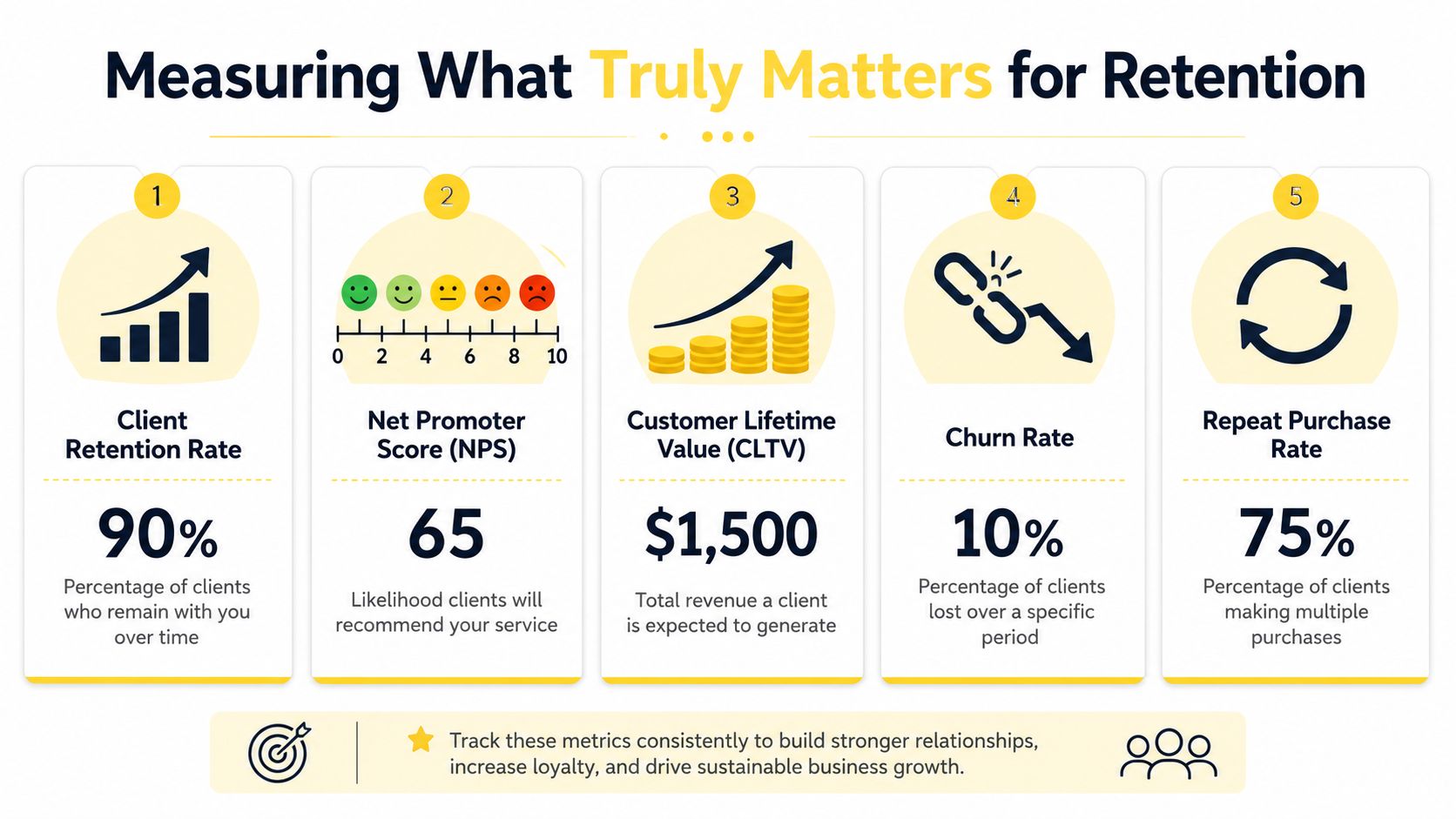
Three signals worth paying attention to
For most coaching practices, these are the useful questions:
- Are clients engaging between sessions?
- Are they completing the work that moves them forward?
- Would they recommend working with you?
You can turn those into simple operating metrics without overcomplicating your practice.
Client engagement score
This doesn't need to be formal software math. It can be a simple monthly review of behaviors such as attendance, response to prompts, task completion, and portal activity if you use a platform with those features.
What matters is pattern recognition.
If a client attends every session but never completes reflection work, that tells you something. Maybe the tasks are too vague. Maybe they don't fit the client's reality. Maybe your follow-up cadence is weak. The issue isn't always motivation. Sometimes it's design.
Milestone completion rate
This is one of the clearest indicators of whether your coaching process is translating into movement.
If clients regularly set goals but don't hit intermediate milestones, look beyond mindset explanations. Check the structure around the milestone. Was the action specific enough? Was progress visible? Did the client get reminded of it at the right moment? Did the next session begin by revisiting it?
A coach who tracks milestone completion learns where accountability is breaking down operationally, not just psychologically.
Use NPS at the right moments
To measure loyalty, use Net Promoter Score by asking “How likely are you to recommend me?” and send it at strategic points such as the midpoint of a package or near renewal so you assess the overall relationship rather than one isolated interaction (Coachful on client satisfaction metrics).
That timing matters.
Ask too early and the client hasn't experienced enough. Ask after a single good session and you'll get a mood score, not a relationship score. Ask at midpoint or near renewal and you get a more honest read on whether the whole experience is holding together.
A monthly experience review
Keep this review short. Thirty minutes is enough if your notes are clean.
Use a checklist like this:
- Which clients are fully engaged, and what's supporting that?
- Which clients are drifting, and where does the drift show up first?
- Which tasks or touchpoints are being ignored most often?
- What did clients praise or question this month?
- What one experience change should be tested next month?
Here's what that might look like in practice:
| Observation | Likely issue | Action |
|---|---|---|
| Clients skip pre-session forms | Form arrives too late or asks too much | Shorten it and send earlier |
| Clients forget assignments | Follow-up isn't visible enough | Add reminder and task tracking |
| NPS softens near renewal | Value is not being made explicit | Add progress recap before renewal conversation |
A metric matters only if it changes what you do next.
That's the primary purpose of measurement in client experience design. Not collecting numbers for their own sake. Creating a tighter feedback loop between what clients experience and how you run the practice.
From Accidental Experience to Intentional Design
Most coaching practices don't create a bad client experience on purpose. They create an accidental one. Good intentions sit on top of patchwork systems, manual workarounds, and a coach who's trying to keep too many moving parts in their head.
Intentional client experience design changes your role. You stop acting like the person who rescues the process each week. You start acting like the architect of the process.
The container matters as much as the conversation
Clients don't only need insight. They need a structure that helps them act on insight.
That means your forms, reminders, scheduling flow, progress visibility, and offboarding process are not side tasks. They are part of the intervention. They create the container that makes transformation easier to sustain.
A few shifts define the difference:
Reactive practice: you fix issues after clients feel them
Intentional practice: you design the likely friction out before clients hit it
Reactive practice: you rely on memory
Intentional practice: you rely on systems
Reactive practice: each client experience varies with your workload
Intentional practice: each client gets a stable standard of care
This is where the profession is heading
The broader market reflects this shift. The Customer Experience Design market is projected to grow from USD 1.30 billion in 2025 to USD 1.92 billion by 2032, which signals that organizations increasingly treat CX as a strategic asset rather than an afterthought (Research and Markets on Customer Experience Design and Transformation).
Coaching won't be exempt from that change. Clients are becoming more sensitive to the quality of the full experience, not just the quality of the conversation. Coaches who ignore that will keep working too hard to maintain results that a better system could support.
Start smaller than you think
You do not need to redesign your entire business this week.
Pick one backstage workflow that repeatedly creates stress. Scheduling. Intake. post-session follow-up. Renewals. Fix that one flow so it becomes clear, repeatable, and easier for the client to move through.
Then watch what happens. Your energy improves first. Client consistency improves next. Renewals and referrals tend to follow because people can feel when a practice is well held.
You are not just delivering sessions. You are designing conditions in which change becomes easier to sustain.
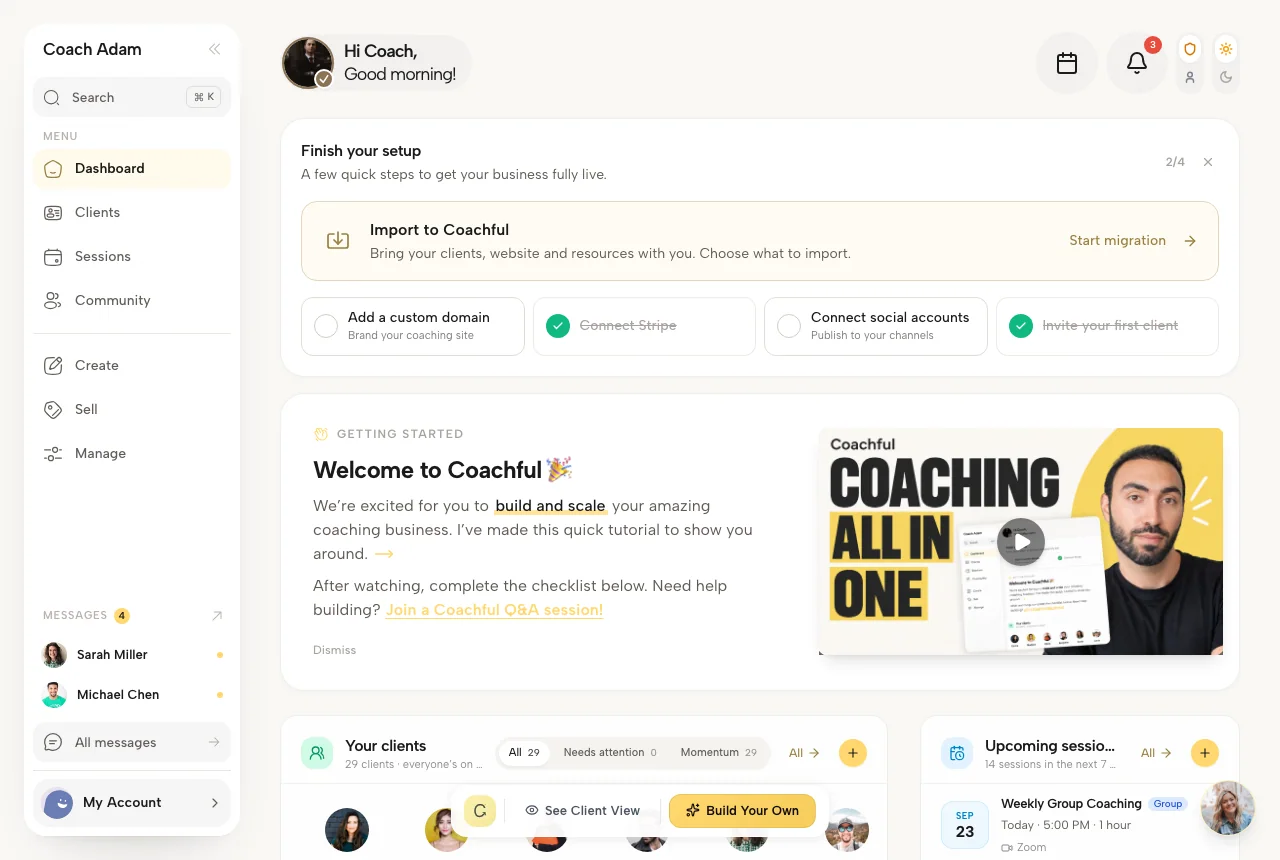
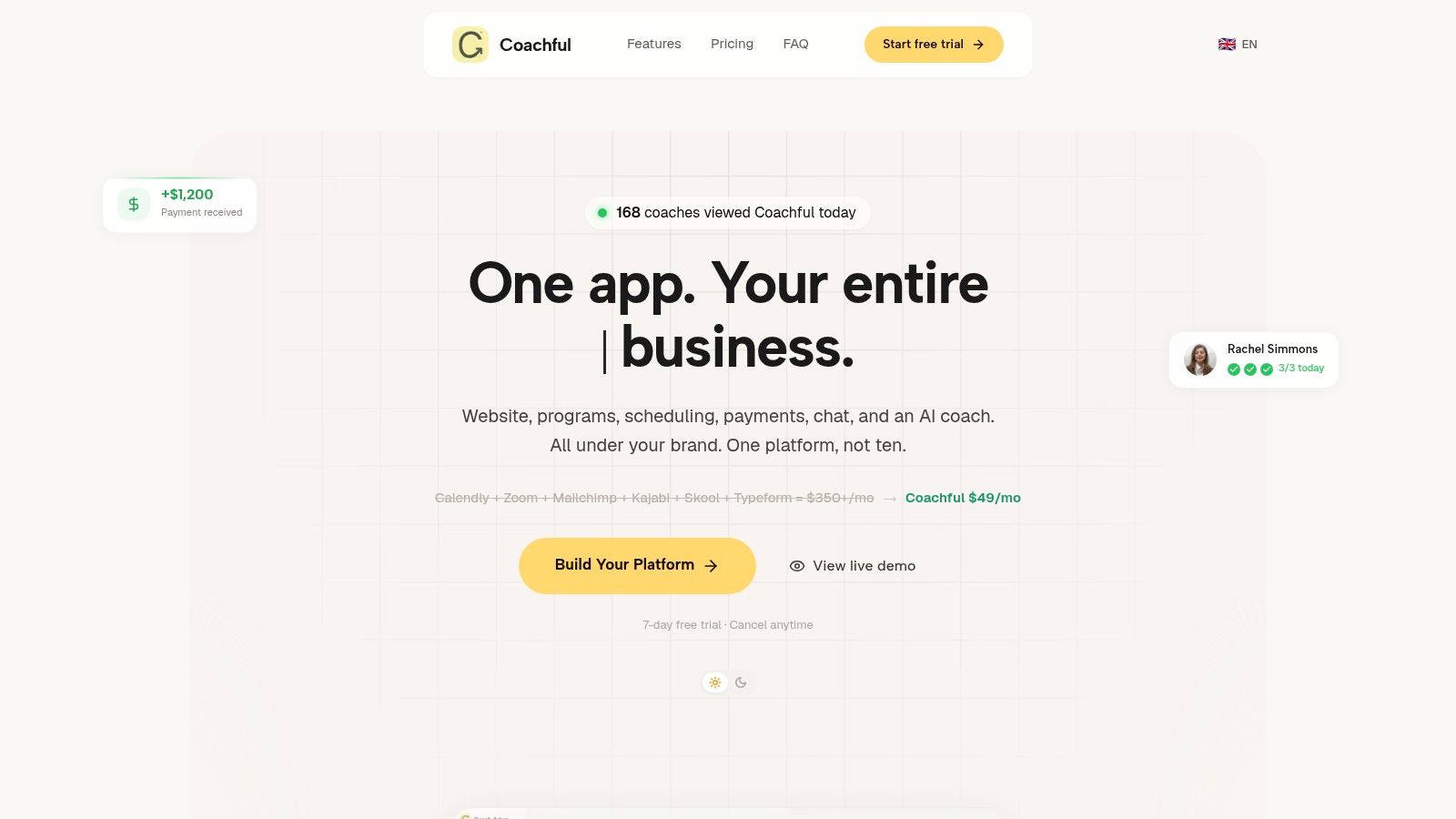
If you want one place to bring together onboarding, scheduling, payments, messaging, notes, and progress tracking without stitching together multiple tools, Coachful gives coaches a practical foundation for delivering a cleaner client experience while reducing admin load.