Time Management for Teachers: Reclaim Evenings

Coachful

It's 9:07 p.m. The house is finally quiet. Your laptop is open to a half-finished set of comments, your inbox still has parent emails you meant to answer before dinner, and that low-grade guilt is starting up again.
You know the voice. If you were more organized, you'd be done by now. If you were a better teacher, you'd just push through.
That voice is wrong.
Good time management for teachers isn't about squeezing more work out of an exhausted person. It's about building a week that protects your attention, your emotional stamina, and your evenings before school work swallows all three.
The Real Reason You Are So Tired
You are not tired only because teaching takes time. You're tired because teaching takes capacity.
A lot of advice about teacher productivity treats the problem like a planner problem. Color-code your calendar. Batch your grading. Wake up earlier. Those tactics can help, but they miss the main issue for many teachers. You aren't just managing tasks. You're managing conflict, grief, behavior, family instability, student anxiety, your own regulation, and the pressure to stay calm while all of that moves through your room.
That invisible load has a real cost. Recent studies confirm that emotional labor consumes 30-40% of a teacher's non-instructional time, with emotional exhaustion being the primary driver of burnout, not administrative tasks. The 45% attrition rate is directly linked to this unmanaged emotional load according to Cult of Pedagogy's discussion of the 40-hour teacher challenge.
Your to-do list isn't the whole story
A teacher can “finish” the copying, submit the attendance, and still feel wrecked. That's because the heaviest work often never appears on the checklist.
It looks like this:
- De-escalating a student: You spend six minutes calming one child, then need twenty more to get your own focus back.
- Absorbing family stress: A parent message lands right before lunch, and mentally you carry it all afternoon.
- Holding the room together: You're teaching content while also monitoring social friction, side conversations, and who is one small prompt away from melting down.
You can be efficient and still be depleted. Those are not opposites in teaching.
This is why some teachers use every productivity hack they know and still feel behind. The day didn't beat them because they lack discipline. The day beat them because the work required constant emotional output.
Protect sleep like it's part of your lesson plan
When teachers ignore that emotional load, evenings become fake recovery. You sit down, scroll, answer one more email, think about tomorrow, and wake up still tired. That cycle isn't laziness. It's an overloaded nervous system. If that pattern sounds familiar, SleepHabits' sleep insights offer a useful way to think about why rest can feel unrefreshing even after a full night in bed.
One practical shift helps immediately. Schedule recovery blocks, not just work blocks. If you coach teachers or lead a team, that same principle matters in how appointments are spaced and protected. A clean session structure like this scheduling approach shows the larger point well. Calendar design shapes energy, not just logistics.
Stop asking one bad question
The bad question is, “How can I get everything done?”
That question will break you because teaching always generates more work than one person can complete.
Ask this instead:
| Better question | Why it works |
|---|---|
| What work actually moves learning forward? | It cuts guilt-driven busywork. |
| What work drains me most? | It identifies where boundaries matter. |
| What deserves my best energy? | It protects instruction and relationships. |
If you feel chronically behind, don't assume you need more hustle. Assume you need a system that respects the fact that your emotional energy is finite.
Conduct Your Unflinching Time Audit
Most teachers resist a time audit for the same reason people avoid stepping on a scale after a holiday. They already suspect the answer will be uncomfortable.
Do it anyway.
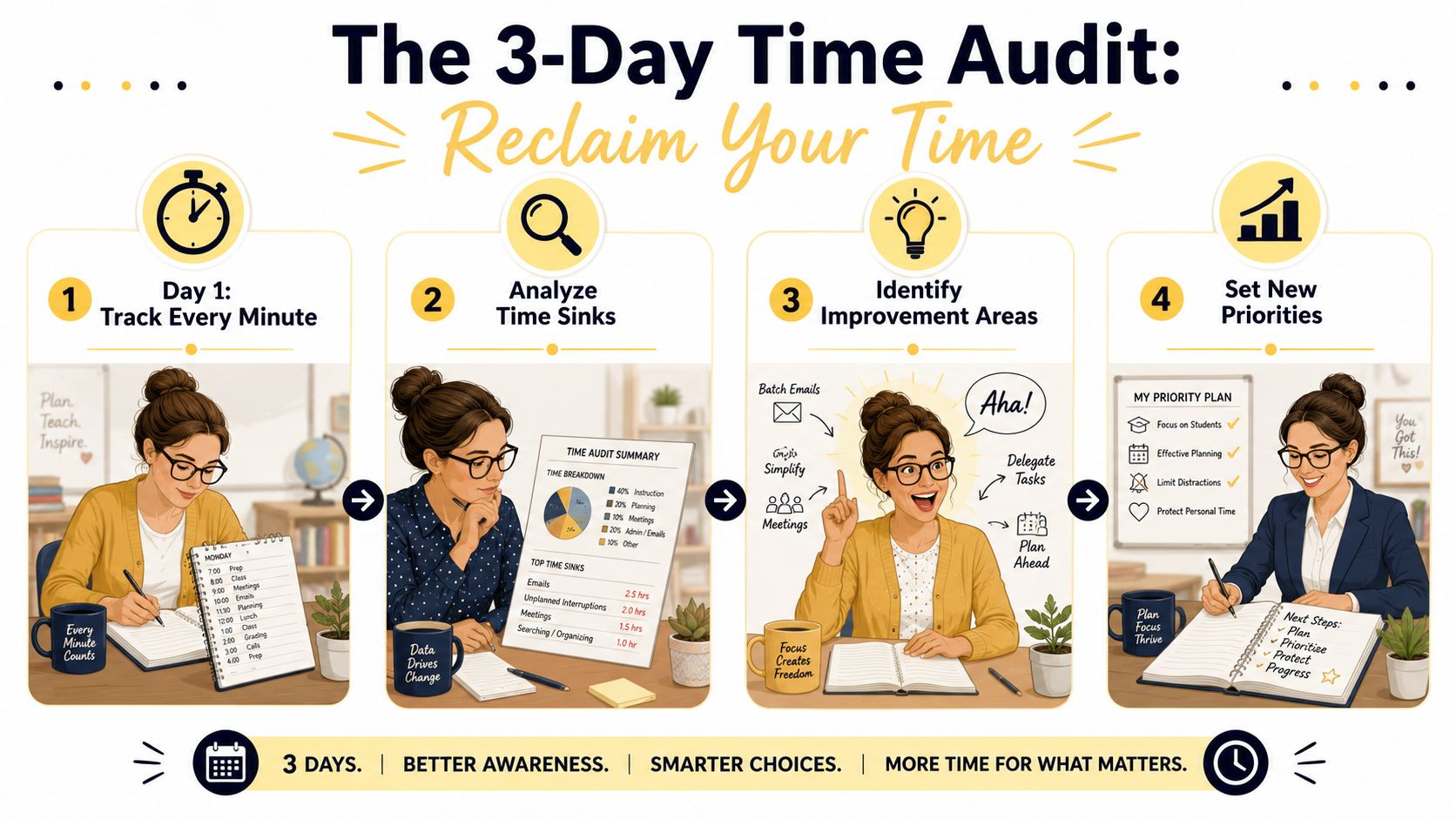
A short audit gives you something better than guilt. It gives you evidence. A thorough time audit over three to five days is foundational. By recording time on activities like planning and grading, teachers can identify where time is spent, batch similar tasks, and limit time-draining habits like constant email checks to 2-3 specific times per day, as outlined by Edutopia's teacher time management guidance.
Track what actually happens
Don't build a fancy spreadsheet first. Use what you'll reliably stick with for three days: paper, Notes app, Google Keep, a small notebook, or a running doc.
Write down your day in plain language:
- Start time and stop time
- Task
- What interrupted it
- Energy level
- Whether the task mattered
A real example from a middle school teacher might look like this:
- 7:10 to 7:28. Answered email, chased copier issue
- 7:28 to 7:42. Reworked warm-up because lab materials weren't ready
- 10:50 to 11:05. Planned during prep, interrupted by hallway duty question and two student issues
- 8:15 to 9:05 p.m.. Graded 11 essays, rewrote comments because feedback got too long
That final detail matters. A lot of lost time hides inside “I was working.” The audit helps you see whether you were working efficiently, reactively, or emotionally flooded.
Use categories that match real teacher life
Most teachers undercount the time they lose to switching.
Try these categories:
- Instructional work: lesson planning, feedback, assessment design
- Admin drag: forms, attendance follow-up, data entry, copying
- Communication: parent email, student messages, colleague coordination
- Emotional labor: conflict resolution, student support, post-incident recovery
- Dead space: waiting, searching for files, tech glitches, informal interruptions
Practical rule: If a task happened and pulled your attention, log it, even if it “only took a minute.”
Those little minutes are often the whole story.
Look for patterns, not perfection
After three days, highlight what keeps showing up. You're not trying to prove you're efficient. You're trying to catch the leaks.
A quick review table helps:
| Pattern you notice | What it usually means |
|---|---|
| Email keeps splitting your prep | You need fixed email windows, not open access all day |
| Planning stretches because you keep tweaking | You need a time cap, not more commitment |
| You lose momentum after student crises | You need recovery time built in |
| Grading always spills into night | Your feedback method is too heavy for your schedule |
One teacher I worked with swore grading was her biggest issue. Her audit showed something else. Grading mattered, but the bigger problem was that she started and stopped planning all day, then answered messages whenever they appeared. By evening, her brain had already done a full day of switching.
That's why an audit is more useful than a vague promise to “be more organized.” It replaces self-criticism with diagnosis.
If you like digital systems, a comparison like ClickUp vs. Notion for workflows and organization can help you choose one place to hold your audit and weekly planning. The best tool is the one that keeps your thinking visible without creating another maintenance job.
Design Your Ideal Week From Scratch
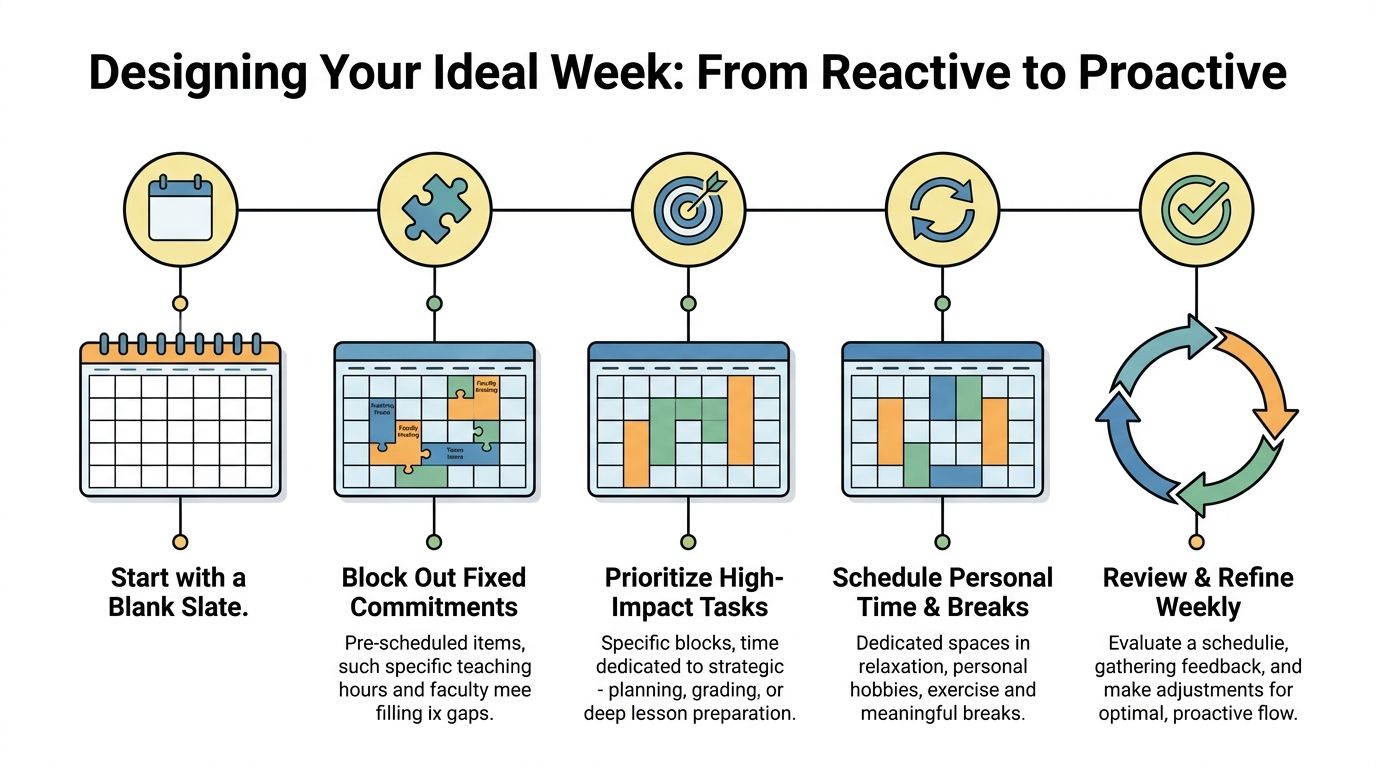
Once you know where your time goes, stop trying to “fit it all in.” Build a week on purpose.
The cleanest way to do that is to start with a blank week and place work into containers before the week starts. Not rigidly. Intentionally.
Start with a real teacher, not an idealized one
Take a 7th-grade science teacher.
She teaches five sections, has one prep period, one team meeting, lab setup responsibilities, frequent parent communication, and a bad habit of spending too long polishing slides. Her old schedule was reactive. Her new week needs protected blocks.
The key move is this one. To prevent over-preparation, teachers should determine exactly how much time a good lesson requires, time themselves, and stick to that limit. Scheduling office hours to overlap with multiple class periods can also drastically reduce individual email inquiries, according to Berkeley's time management strategies for instructors.
A workable weekly template
Here's what that can look like in practice:
| Time block | Monday | Tuesday | Wednesday | Thursday | Friday |
|---|---|---|---|---|---|
| Before school | Check urgent email only | Lab prep | Check urgent email only | Parent replies | Weekly review |
| Prep period | Plan next week's first two lessons | Grade quizzes | Team planning | Plan remaining lessons | Copy, file, reset |
| Lunch or office block | Student help desk | No meetings | Student help desk | No meetings | Student check-ins |
| After school | Leave on time | Club or duty | Parent calls | Leave on time | Hard stop |
Notice what is missing. There is no “catch up on everything” block. That block is a fantasy and it teaches your brain to delay decisions.
Instead, each block has one job.
Cap the work before it expands
The trap in teacher planning is over-preparation. You tell yourself you're being thorough. Sometimes you are. Often you're soothing anxiety by polishing work past the point of usefulness.
Use simple caps:
- Lesson planning cap: One lesson gets one set amount of time. When time is up, the lesson is teachable.
- Email cap: Read and answer at scheduled times, not whenever your stress spikes.
- Parent communication cap: Keep a template bank for common updates so you're not rewriting the same message every night.
A solid lesson taught by a present teacher beats a beautiful lesson built by an exhausted one.
If student time management is part of the chaos in your classroom, that affects your own calendar too. A family-facing resource like reduce stress with teen time management can support the same habits you're trying to build in class, especially with middle and high school students who create extra follow-up when they miss deadlines.
Build the week around non-negotiables
Teachers often place personal life in the leftover spaces. That's backwards.
Put these on the calendar first:
- Departure time: The time you leave school
- Dinner or family block: Protected like a conference
- Recovery activity: Walk, gym, reading, nothing at all
- Sleep routine: The start of shutting work down
That's what effective time management for teacher life really looks like. Not endless optimization. Clear limits, repeated enough times that your week stops surprising you.
Build Systems for Grading and Admin Work
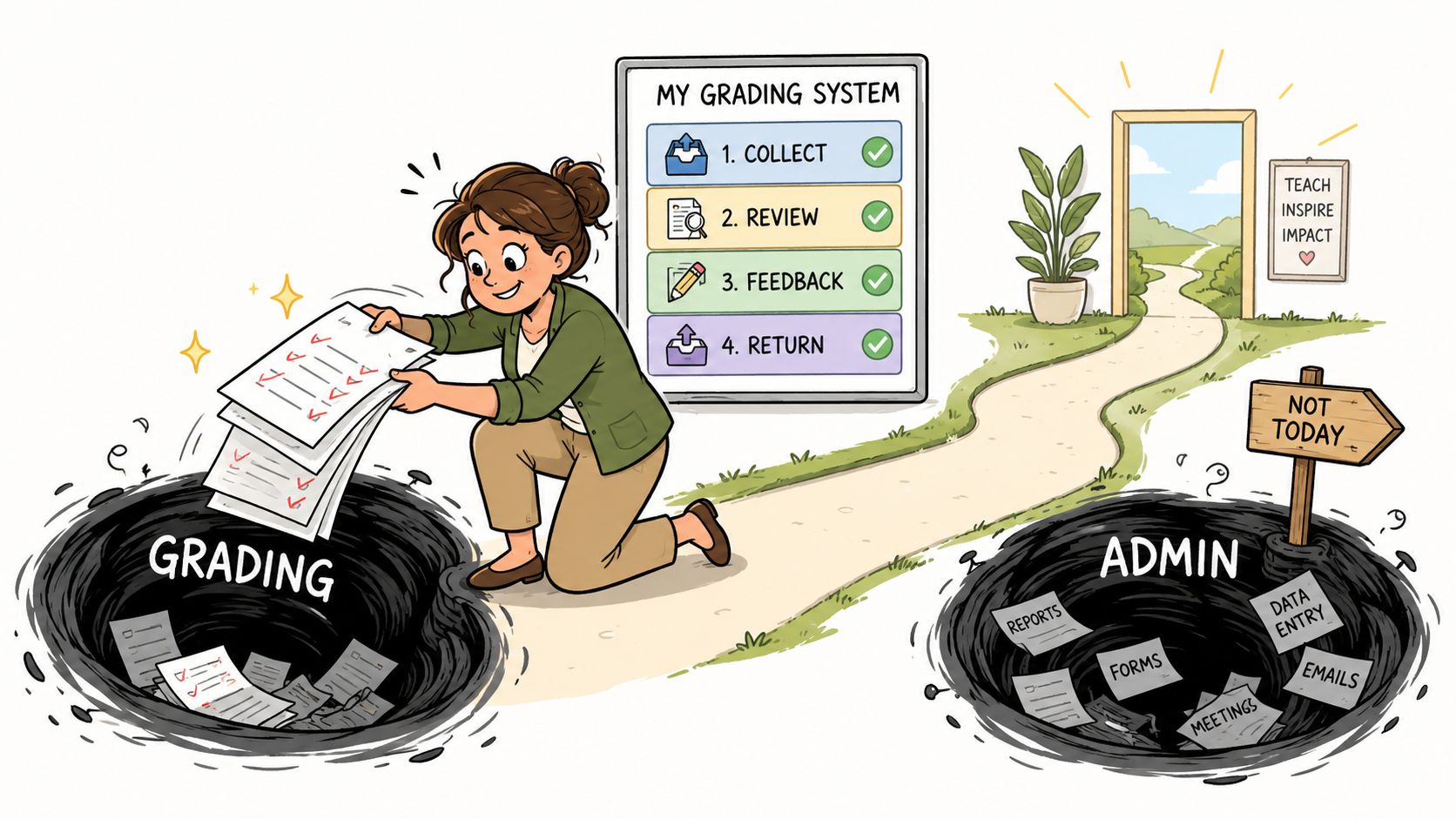
Grading and admin work don't just take time. They expand to fill every unguarded corner of your day.
That's why teachers can work constantly and still feel behind. The work has no natural finish line unless you create one. And when schools don't build structure around non-teaching tasks, the result is predictable. Research indicates that over 25% of teachers are found outside the classroom during their allocated teaching time, a failure often driven by administrative or non-teaching duties consuming disproportionate amounts of time due to a lack of structured systems, based on research on teachers' time management practice.
Long feedback is not always better feedback
A lot of teachers equate care with comment length. That belief creates marathon grading sessions and inconsistent feedback.
Here's the trade-off:
| Approach | What happens |
|---|---|
| Long, custom comment on every paper | You burn out, return work late, and quality drops by paper fifteen |
| Rubric plus short targeted codes | Students get clearer patterns, and you stay consistent across the whole stack |
Smart feedback sounds like this:
- “Evidence is present, but explanation is thin. Add how this detail supports your claim.”
- “Sentence structure is clear. Focus revision on transitions between ideas.”
- “Check rubric row 2. Your reasoning needs one more step.”
That's better than a rambling paragraph students won't reread.
Build a repeatable grading kit
You do not need a new system for every assignment. You need one reusable framework.
Try this stack:
- A strong rubric bank: Keep versions for argument writing, short response, labs, discussion, and project work.
- Feedback codes: “EV” for evidence, “EX” for explanation, “TR” for transitions, “MC” for missing citation. Hand students the key once, then use it all year.
- Model comments: Save your best recurring comments in Google Docs, TextExpander, or your LMS comment bank.
- One decision rule: Every assignment gets either full feedback, spot feedback, or rubric-only scoring. Not everything gets the deluxe package.
Fast feedback can still be thoughtful. Slow feedback that arrives too late often isn't useful.
Shrink admin before it touches your evening
Administrative tasks get dangerous when they stay scattered. Five minutes for attendance cleanup. Four minutes hunting a file. Eight minutes answering a routine question. None of that looks serious alone. Together it steals your close-of-day attention.
A few systems work well:
- One admin block daily. Put forms, filing, and routine entries in one container.
- Template routine messages. Late work policy, retake instructions, missing materials, field trip reminders.
- Video answers for repeated directions. If you explain the same process every week, record it once. Tools that create training videos in minutes can help with routine procedural content for students or families.
- One home for operational tasks. If your notes, forms, reminders, and follow-ups live in too many places, you're paying a search tax all day. A centralized system matters, whether that's your school LMS, Google Workspace, or a dedicated platform like the tools covered in this look at client management software and operational organization.
Efficient grading isn't cutting corners. It's refusing to waste your best energy on low-yield habits that make your feedback later, thinner, and harder to sustain.
Engineer a Self-Running Classroom
A classroom either saves time or leaks it.
Many teachers focus on planning, then lose the day in transitions, repeated directions, and the steady drip of student questions during independent work. Those aren't small issues. They are structural issues.

One of the clearest examples is the inquiry flood. Student inquiries occur 5-7 times per minute during independent work, creating an 'inquiry flood' that can consume 25% of a teacher's day. Data-backed strategies like 'structured inquiry windows' or AI-mediated triage can reduce this teacher inquiry load by 40%, according to SimpleK12's discussion of teacher time management strategies.
Stop being the default answer machine
If every raised hand gets immediate access to you, your room trains dependence.
A more effective classroom sounds different. Students know when to ask, how to check resources first, and what kind of question belongs with the teacher versus a peer or anchor chart.
Try this routine:
- Three before me: Students check three sources before asking you. Directions slide, table partner, posted example, notes, or class procedure card.
- Structured inquiry windows: Instead of answering questions continuously, pause at set points. For example, students work independently, then you open a short question window.
- Question parking: Students write non-urgent questions on a sticky note or digital board while you keep the room moving.
- Question type sorting: “Is this a factual question, a process question, or a personal roadblock?” That helps you respond faster and teaches students to self-diagnose.
A classroom example helps. During a writing block, a teacher tells students, “Work for ten minutes. Mark your question on the corner of your paper. I'll open a help window after the timer.” The first few days feel clunky. By week two, fewer hands go up for things students can solve on their own.
Fix transitions because they steal instruction
A class can lose momentum four or five times before lunch. Entry. Turn-and-talk reset. Materials pickup. Group change. Cleanup. Dismissal prep.
Messy transitions create noise, behavior issues, and reteaching.
Use this checklist:
| Transition point | What to tighten |
|---|---|
| Entering class | Posted do-now, materials ready, first direction visible |
| Moving to groups | Assigned roles, clear path, timer visible |
| Independent start | Written steps, sample product, question routine |
| Cleanup | Who returns what, where it goes, what happens next |
If students need your voice for every transition, the system is too weak.
A timer helps, but only if the routine around it is explicit. “You have one minute” is not a routine. “When the timer starts, notebooks open, lab bins stay closed, and the warm-up is already on the board” is a routine.
This short video is useful if you want to tighten classroom pacing and procedures in a way students can follow.
Build independence on purpose
Teachers sometimes say they want a self-running classroom, but they keep rescuing students too quickly. Independence has to be engineered.
That means:
- Anchor charts for repeated procedures
- Consistent seating and supply systems
- Independent stations with clear finish expectations
- Short scripts for recurring problems
For example, instead of re-explaining missing work ten times a week, post a reset routine: check LMS, check absent folder, ask table captain, then ask teacher during support time.
That's how time management for teacher practice moves from personal productivity into classroom design. You don't reclaim time only at your desk. You reclaim it by building a room that doesn't need you for every tiny decision.
Draw Your Line and Protect Your Peace
The hard truth is that no system works if you keep overriding it with guilt.
You can run a time audit, time-block your week, tighten transitions, and build a grading workflow. Then one parent email at 8:43 p.m. arrives, and suddenly you're back in the old pattern because part of you still believes a caring teacher is always available.
That belief will empty you out.
Boundaries are professional, not selfish
A teacher with boundaries is not less dedicated. That teacher is more sustainable, more predictable, and usually more present in the hours that matter most.
Use direct scripts:
- For extra duties: “I can't take that on well this week.”
- For late-night messages: “I respond during school-hour communication blocks.”
- For student requests that bypass systems: “Use the class process first, then bring me what's still stuck.”
- For your own inner critic: “Done for today is not the same as done forever.”
That last one matters. The work is never fully finished. Waiting to rest until everything is done means you won't rest.
Make the stop time visible
Don't rely on willpower at the end of a long day. Build a shutdown ritual.
A simple one works:
- Write tomorrow's top three tasks.
- Clear your desk or desktop.
- Check that urgent communication is handled.
- Close the laptop.
- Leave.
Rest is not a reward you earn after teaching. It is a condition that lets you keep teaching well.
The same applies at home. Put family time, exercise, reading, spiritual practice, sleep, or simple silence on the calendar as real commitments. If it matters for your health, it deserves a time slot.
Time management for teacher life gets better when you stop treating yourself like the flexible part of the schedule. You are not the overflow container. You are the person doing the work.
Protecting your peace isn't soft. It is one of the toughest professional decisions a teacher can make, because it requires disappointing other people before you disappoint yourself again.
If you're a coach helping educators, leaders, or burned-out professionals rebuild sustainable routines, Coachful gives you one place to manage scheduling, client progress, notes, resources, and follow-up without adding more admin to your day. It's built to help coaching work stay structured, professional, and easier to sustain.