7 Top Elementary Music Class Lesson Plans for 2026

Coachful
Stop the Sunday Scaries: Your Lesson Plan Rescue Kit
It's Sunday night. You're staring at a blank planning document, the echo of last week's classes still ringing in your ears, and wondering how you'll create another week of engaging, standards-aligned music lessons. You need lessons that move fast enough for wiggly kinders, stay musical instead of turning into crowd control, and still give your older students something worth chewing on. I know that feeling. The pressure isn't just to fill time. It's to make every class feel purposeful.
The good news is that strong elementary music class lesson plans don't start with reinventing the wheel every week. They start with choosing resources that solve the exact problem in front of you. Maybe you need a full curriculum because your scope and sequence feels shaky. Maybe you need songs and games that are effective in a room full of tired second graders after lunch. Maybe you need sub plans that won't fall apart the moment the class gets squirmy.
A good lesson plan tool should help you match pacing to attention span. In K to 2, activity blocks should stay in the 5 to 7 minute range, while grades 3 to 6 can usually handle 8 to 12 minute segments, with movement built into every lesson because children learn musical ideas through their bodies first, as noted in this music lesson planning guide. That's the lens for every pick below.
1. QuaverMusic (QuaverEd)
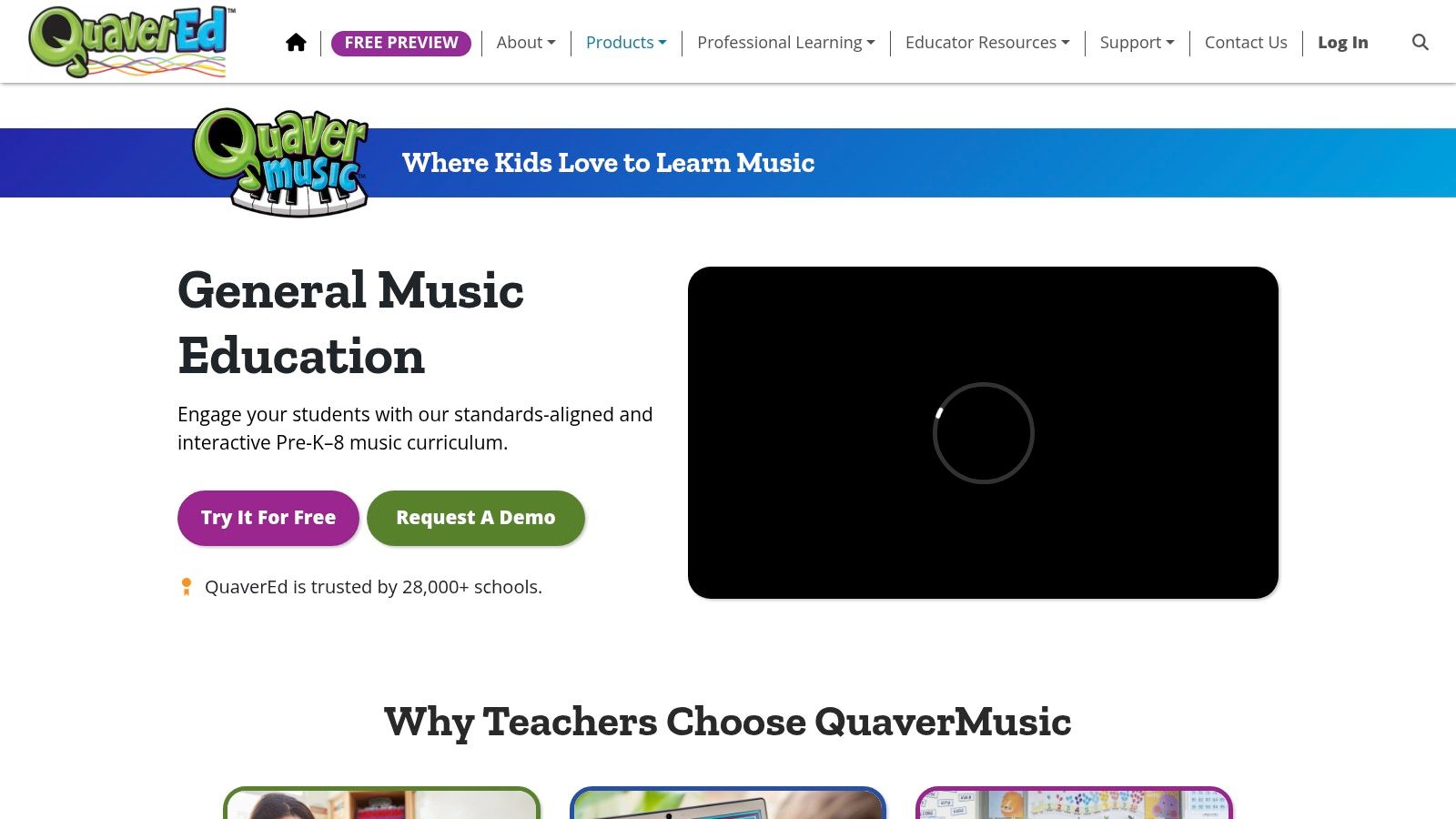
If your biggest problem is, "I need the whole year mapped before the first bell rings," QuaverMusic is the heavyweight option. You get QuaverMusic from QuaverEd, a digital general music curriculum built for broad grade coverage, deep media support, and schoolwide consistency. This is the platform I point people toward when they don't want piecemeal lessons. They want a system.
Quaver works best when the challenge isn't just planning one clever lesson. It's keeping instruction coherent across months, grade levels, and teachers. If you're in a district setting, or you're the person expected to produce polished, standards-aligned plans on demand, that matters.
When it solves the right problem
The practical strength here is sequencing. Instead of hunting for one song, one game, one worksheet, and one assessment from four different places, you can stay inside one ecosystem. That lowers mental load. It also makes it easier to keep your high-focus lesson segments clean and intentional.
In a standard 45-minute elementary lesson, the opening routine usually takes 3 to 5 minutes, the main high-concentration segment 10 to 15 minutes, a change-of-pace activity 3 to 7 minutes, a secondary concentration segment another 10 to 15 minutes, and the close 3 to 5 minutes. Individual activities should stay around 5 minutes or less before a transition, according to this elementary music pacing breakdown. Quaver's bank of media and interactive activities makes that pacing easier to maintain because you can pivot fast without breaking flow.
Practical rule: Quaver is strongest when you need fewer planning decisions, not more planning freedom.
- Best for full-year coverage: Quaver fits teachers who want a sequenced curriculum instead of building every lesson from scratch.
- Best for tech-equipped rooms: Interactive screens, built-in media, and digital assessments are part of the value.
- Best at school scale: Pricing is by quote, so the value is usually clearer for a school or district than for one independent teacher.
One trade-off is flexibility. You can customize, but the platform shines when you let it do what it's built to do. If you're the kind of teacher who wants to radically rebuild every lesson around a hyper-specific Kodály or Orff sequence, you may find yourself using Quaver as a backbone rather than a total identity.
For teachers who also think carefully about systems and delivery beyond the classroom, learning management system options for small organizations can be useful reading. The same logic applies. The more moving pieces you manage, the more valuable a central hub becomes.
2. MusicplayOnline
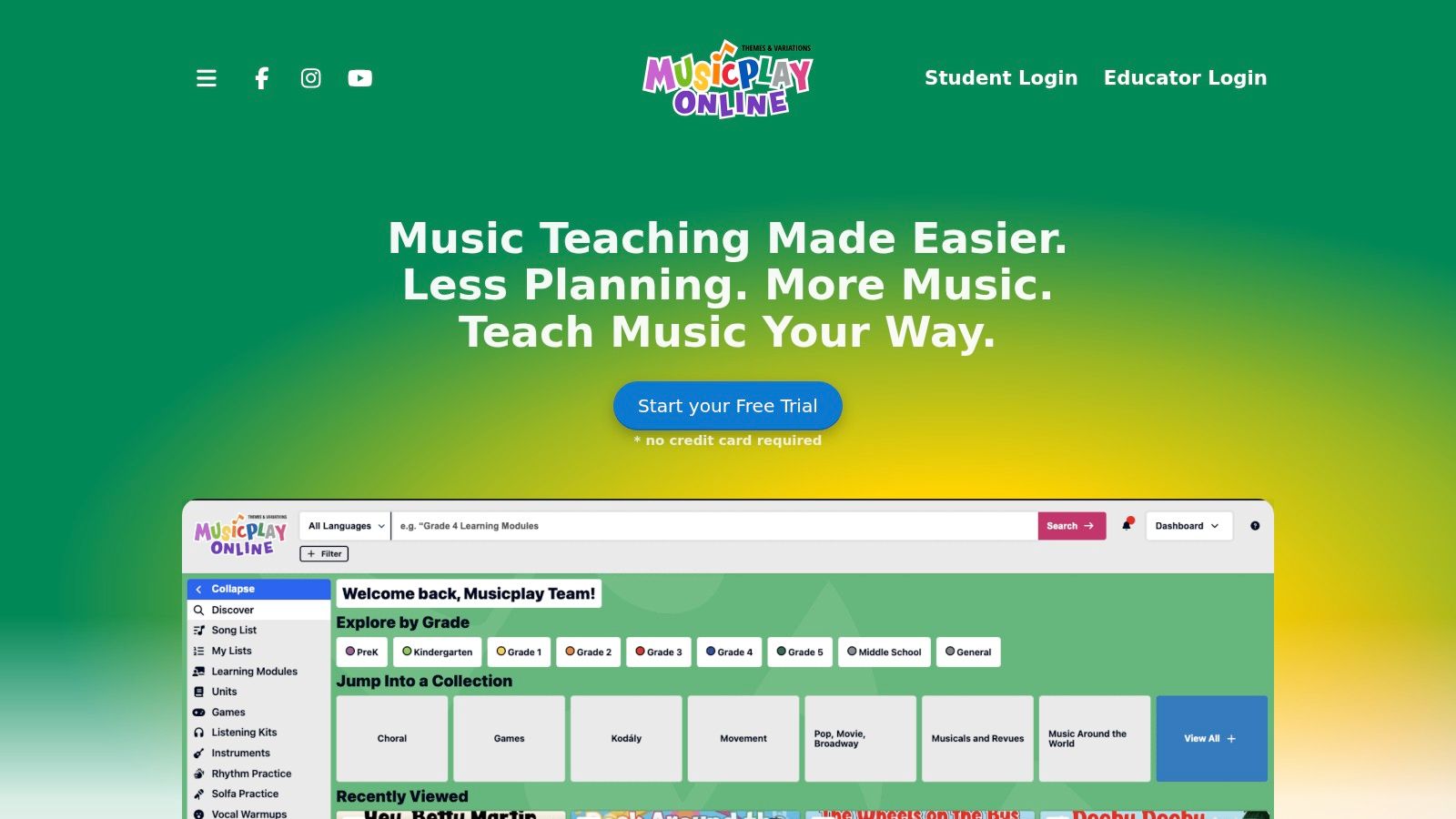
MusicplayOnline is the answer to a different Sunday night panic. Not "I need a district curriculum," but "I need Monday's lessons built fast, and they still have to be good." You can explore MusicplayOnline and feel that teacher-first design right away. It's practical, searchable, and much easier to use in a flexible grab-and-go way.
This is one of my favorite recommendations for solo teachers covering multiple grades, especially when the day includes mixed ability groups, uneven class energy, or a substitute risk. The prebuilt modules and lesson-builder features let you gather material quickly without making the class feel random.
Why it works in real classrooms
A lot of elementary music class lesson plans fail because they ask students to sit in one mode too long. MusicplayOnline helps because it gives you fast visual and game-based pivots. If your first grade class is fading halfway through notation practice, it's easier to switch into a short interactive task and then return to the concept.
A validated lesson planning approach for elementary music includes six core components: objectives, assessments, materials, notes, standards, and skills, along with a practical time-song-process-considerations structure. Nonverbal transitions and movement-based activities also improve engagement and reduce transition loss in group settings, according to Victoria Boler's planning framework. MusicplayOnline fits that mindset well because it supports quick transitions instead of fighting them.
If you're always asking, "What if they get bored halfway through," this platform gives you more exits before behavior goes sideways.
- Strong for weekly planning: Pre-built learning modules give you a starting point when you're short on prep time.
- Strong for sub plans: Visuals, games, and clear activities make it easier to hand off.
- Watch the upper grades: Some teachers still supplement for upper elementary rigor or a more specialized pedagogy.
The trade-off is depth versus speed. MusicplayOnline is excellent when you need to build engaging lessons quickly. It may not fully replace a more conceptually narrow method if you're committed to a specific sequence for literacy, folk song preparation, or pedagogy of musical performance.
3. The Singing Classroom
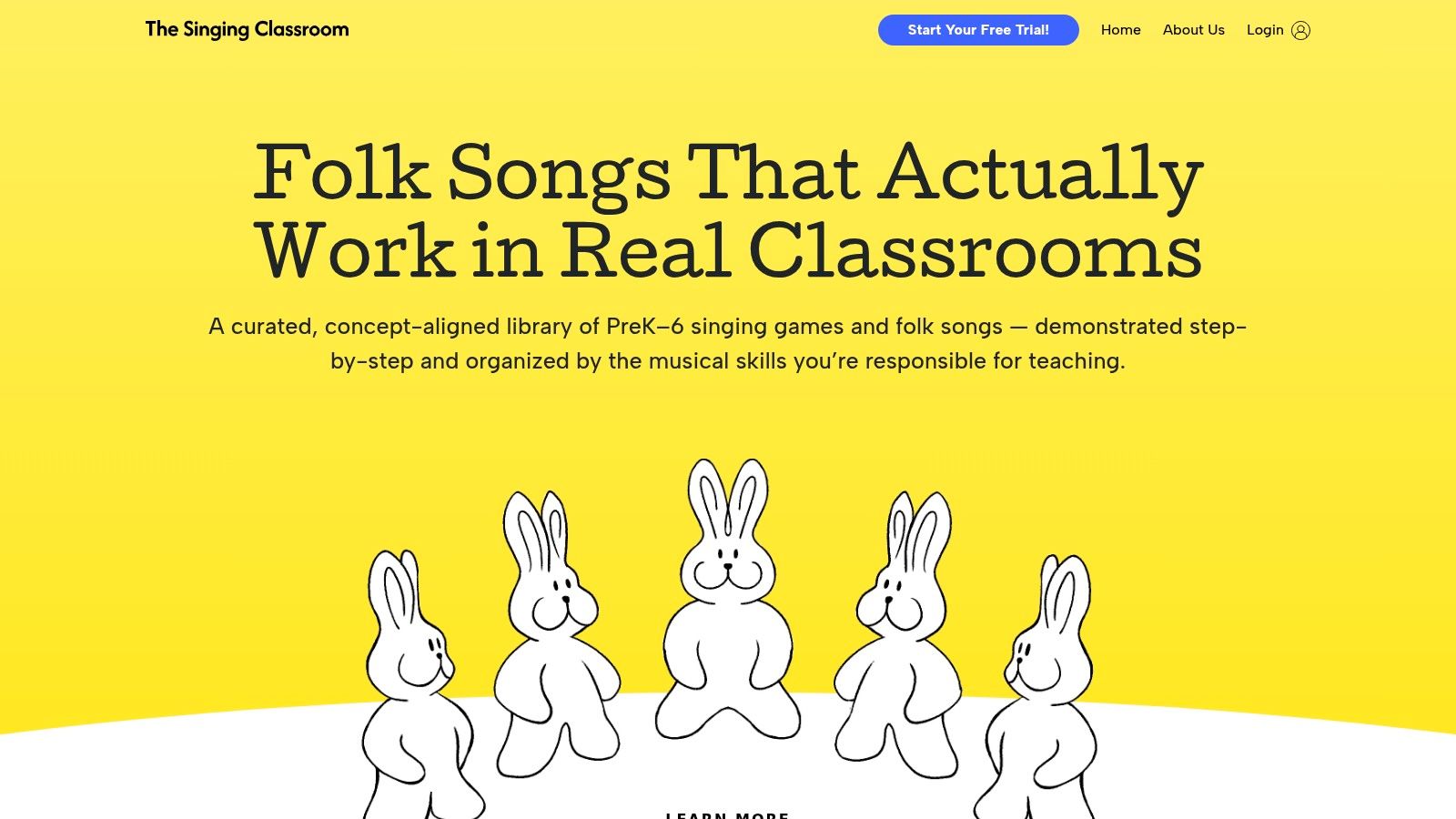
Some planning problems aren't about lack of content. They're about lack of musical coherence. You have plenty of activities, but they don't teach toward the same target. That's where The Singing Classroom earns its spot. It gives you a song-and-game centered planning flow that feels much closer to how many elementary music teachers teach.
If your inner dialogue sounds like, "I don't need another giant resource dump. I need songs that teach a concept and a planner that lets me print the lesson without formatting it for half an hour," this is the right lane.
Best for teachers who build through songs
The searchable library by grade, concept, and activity type is the selling point. You can look for a song that prepares a rhythm element, reinforces a solfege pattern, or supports a movement game, then drop it into a planner that formats the lesson for you. That's a big time saver when you're juggling multiple grade levels.
This also fits a smart unit-planning approach. Elementary music units should last at least four weeks, and many teachers extend them to nine weeks so students can work toward mastery of one to three skills with repeated practice and varied assessments, according to this unit-planning guidance. A song-rich resource like The Singing Classroom helps you stay focused on a small number of musical goals instead of cramming in too many disconnected ideas.
Here's a simple example. Suppose second grade is working on steady beat and a new rhythmic figure. You can build a lesson with:
- Opening song: A familiar greeting or echo song.
- Core game: One singing game that highlights the target rhythm.
- Reinforcement: A partner or circle activity using the same concept in a fresh way.
- Closing: A calmer song that still touches the same skill.
That kind of planning isn't flashy. It works.
The limitation is clear too. If you're heading into recorder, ukulele, composition apps, or a tech-heavy creation unit, you'll probably want a companion resource. The Singing Classroom is strongest when singing games and folk material are central to your instruction.
4. TeachRock
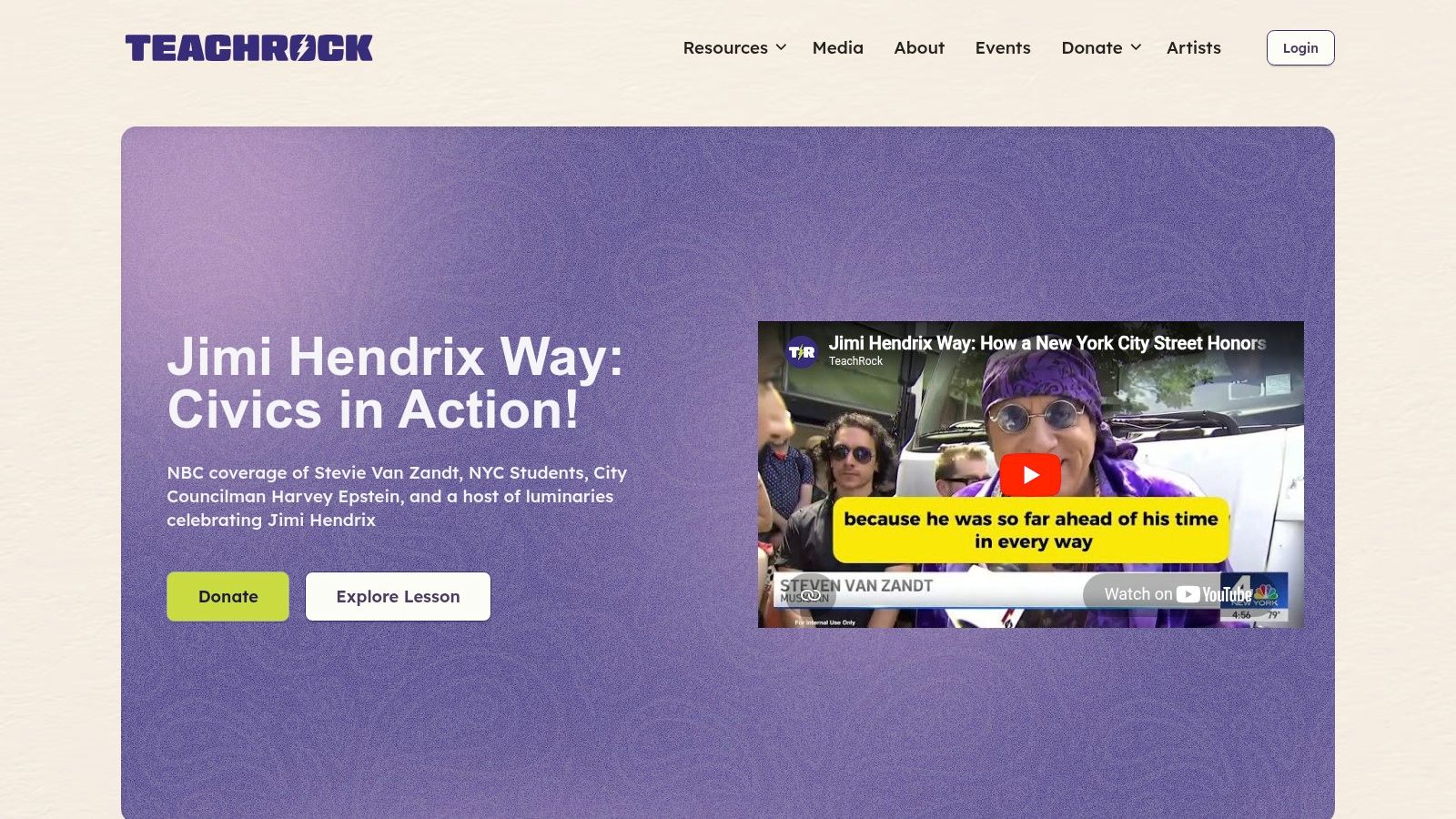
TeachRock is for the teacher saying, "I need solid material, but I have no budget and I still want lessons kids connect to." That's a real problem. Free often means thin, sloppy, or hard to use. TeachRock is different. It gives you standards-aligned lessons with a strong cultural and cross-curricular angle.
This is one of the best options when you want music to connect with literacy, social studies, SEL, or classroom themes without making the lesson feel like music got pushed to the side. It also helps when your admin values visible academic integration.
Where it shines and where it doesn't
TeachRock is not a neat linear elementary curriculum. That's the trade-off. You curate from collections, suggested paths, and lesson groups. For some teachers, that's a headache. For others, it's freedom.
If your fourth graders are in a classroom unit on community, protest, storytelling, or historical context, TeachRock can give you a music-centered bridge that feels relevant. If your fifth graders need discussion-rich material because they've outgrown simplistic singing games, TeachRock can help there too.
Classroom reality: Free resources save money, but they often cost extra planning time. TeachRock is worth it when relevance matters more than plug-and-play speed.
What works well is choosing one narrow thread and building around it. Don't try to use the whole site as your yearly map. Pick a short run of lessons and connect them to your current unit. That keeps the planning manageable.
Teachers who like clear instructional flows may also appreciate strong step-by-step tutorial structures. The same principle applies here. Kids do better when each lesson moves cleanly from listening to discussion to making music to reflection.
5. Carnegie Hall Link Up
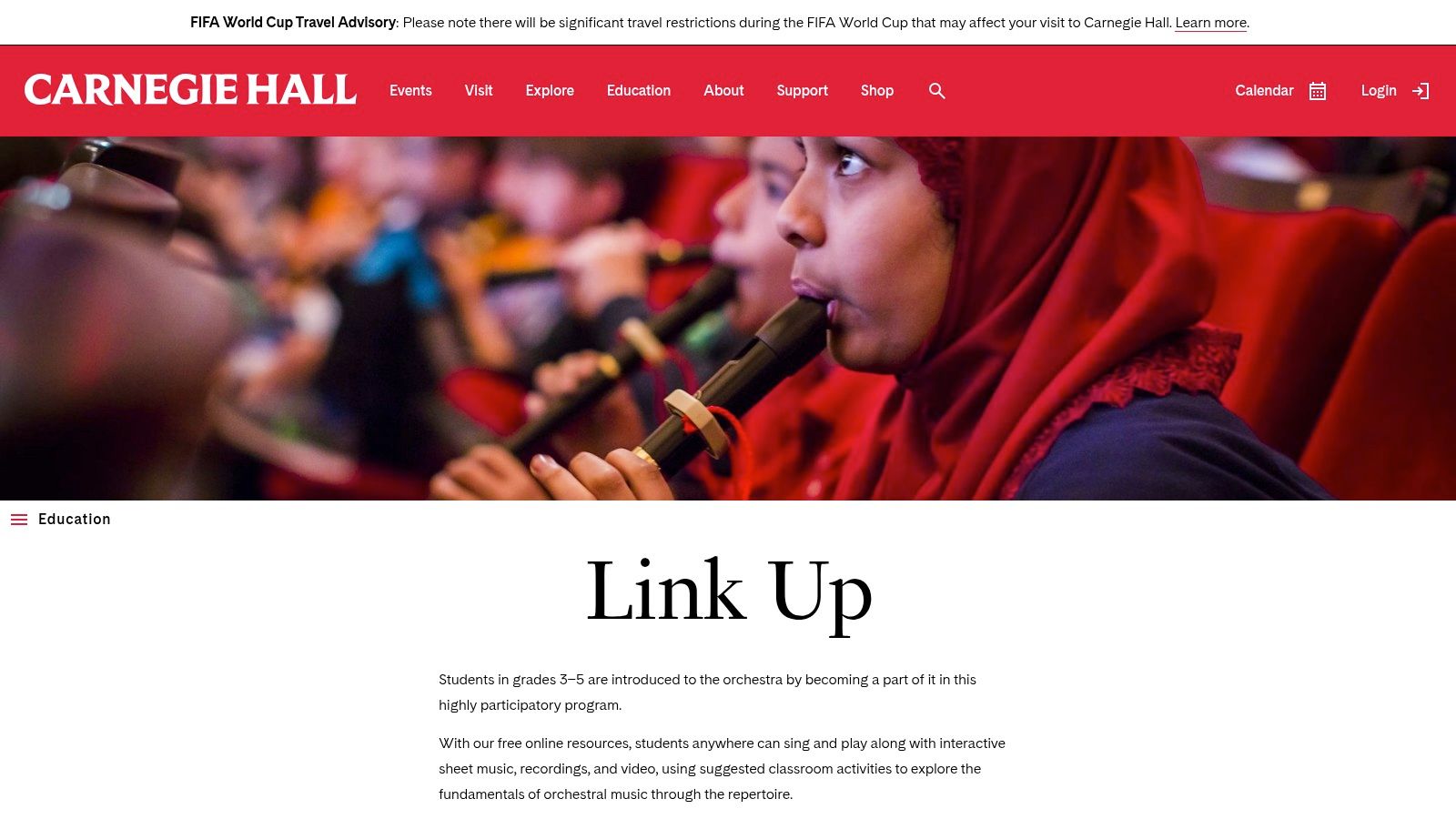
If your problem is motivation, Link Up deserves attention. Some students work harder when the lesson points toward a real performance experience. Carnegie Hall Link Up is built for that. It introduces grades 3 to 5 to orchestral music through sequenced classroom lessons, and in some places it culminates in a student play-along concert with a partner orchestra.
That performance connection changes student buy-in. Upper elementary students often want to know why they're learning something. Link Up gives them a real answer.
A strong fit for grades 3 to 5
The online materials are free, and the curriculum is clearly sequenced for upper elementary orchestral study. Teacher guides, recordings, and interactive scores make it easier to keep the unit musical rather than purely informational.
This is especially helpful with older elementary students because they can usually sustain longer focused segments than younger children. That makes a more extended score study, rehearsal chunk, or listening response more realistic in those grades.
A classroom example might look like this:
- Opening: Brief rhythm or singing warm-up tied to concert material.
- Focused work: Learn or rehearse one excerpt students will later recognize in performance.
- Application: Play, sing, move, or conduct along with a recording.
- Closing reflection: What did we notice in the orchestra texture or form?
The main limitation is logistics. If you have a local orchestra partner, Link Up can become a standout annual experience. If you don't, the classroom materials still hold value, but the emotional payoff isn't quite the same.
Some resources teach content. Link Up teaches toward an event, and that changes how students listen.
6. Smithsonian Folkways Lesson Plans
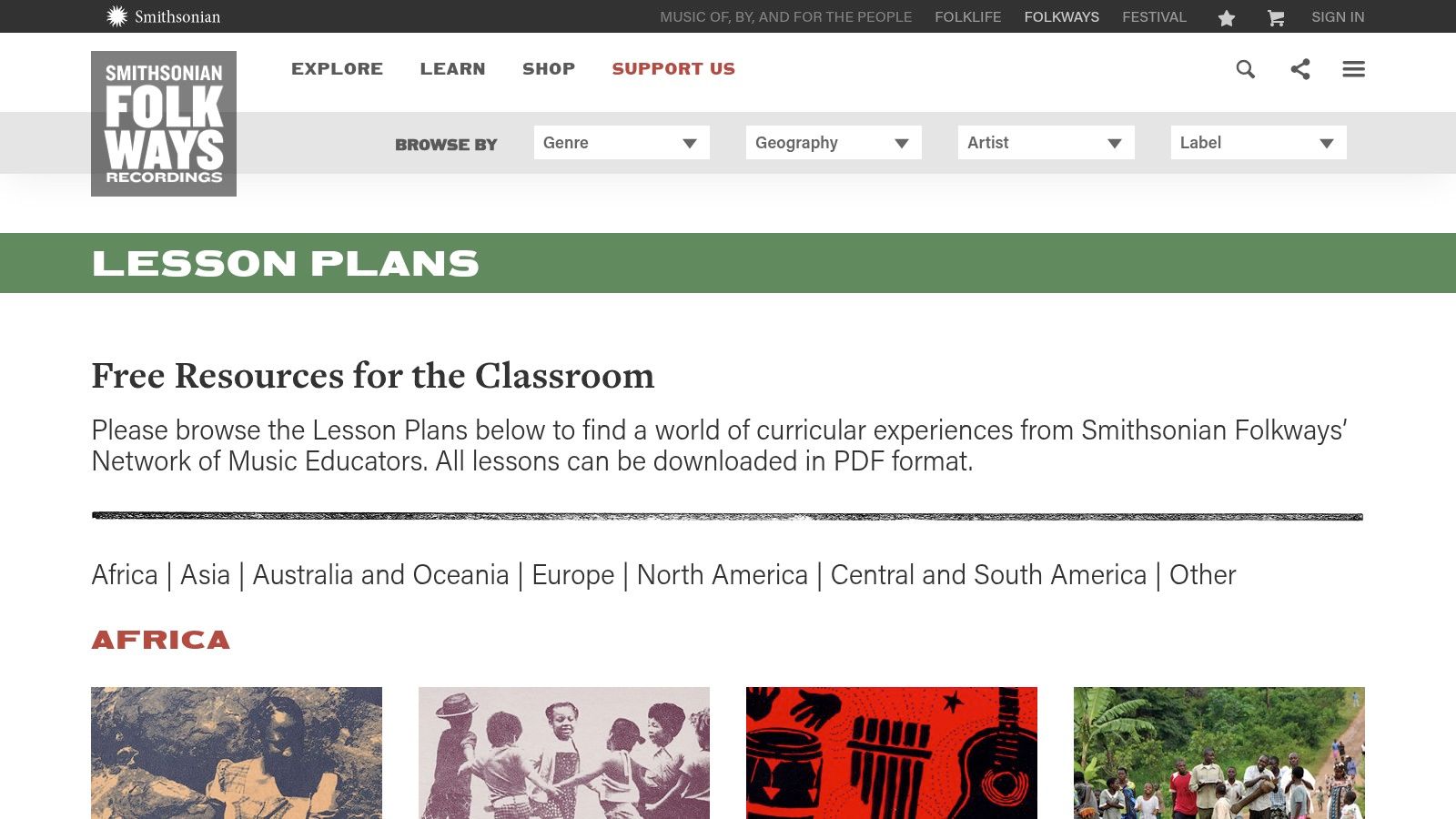
When the challenge is, "I want culturally broad material that isn't shallow," go to Smithsonian Folkways lesson plans. This collection is especially useful for teachers who care about authentic recordings, thoughtful objectives, and meaningful cross-curricular ties. It gives you more than a token world music day.
Many elementary music class lesson plans mention diversity but don't support it well. Smithsonian Folkways gives you recordings, lesson plans, and a user guide that help you teach with more depth and more respect.
Best for culture-rich units
This resource works well when you want a short unit around musical culture, storytelling, community traditions, or listening across genres and places. The plans include objectives, materials, assessments, and extensions, which is a big help when you're trying to document instruction clearly.
The trade-off is sequence. This isn't a complete year map. You still have to choose where these lessons fit in your scope and sequence. I usually recommend using Folkways as a focused unit anchor rather than trying to build the whole year from it.
- Use it for listening-rich lessons: The recordings are the heart of the experience.
- Use it for integrated work: Social studies and ELA connections come naturally.
- Use it with intention: Don't drop in isolated lessons just to check a diversity box.
For teachers mapping multi-lesson arcs, a program outline builder can be a useful planning companion. Folkways gives you strong ingredients. Your job is to sequence them so students build understanding over time.
7. Music Will (JamZone & Modern Band Curriculum)
Music Will is the pick for the teacher hearing this complaint on repeat: "Why can't we play real music?" If your upper elementary students light up around pop, rock, hip-hop, songwriting, keys, drums, guitar, or music tech, Music Will gives you a much more current entry point than many traditional resources.
This isn't just about being trendy. Contemporary repertoire can enable participation for students who don't yet see themselves in choir-style or folk-centered classroom routines. That matters for inclusion, confidence, and ensemble identity.
When modern band changes the room
Music Will's JamZone lesson plans are organized by instrument, songwriting, and music tech. The classroom-tested sequences and teacher training support are part of the appeal. Students often respond strongly because the music feels connected to what they already hear outside school.
There is also a broader context here. The private music lessons market was valued at $6.2 billion in 2025, and children's lessons ages 5 to 12 represented $2.449 billion, while the 60-minute format held the largest share and the 30-minute format was the fastest-growing format at 8.2% CAGR, according to this 2025 private music lessons market projection. School music teachers can take a clear lesson from that. Families and students are looking for accessible, contemporary, beginner-friendly music experiences. Modern band taps into that expectation inside the school day.
The students who shut down during notation drills may become your most engaged learners when the room shifts into drums, keys, loops, or songwriting.
The challenge is implementation. Music Will is strongest when the curriculum is paired with training, instruments, and community support. If your school doesn't have the gear yet, start small. A vocal groove lesson, a bucket drumming setup, or a simple keyboard rotation can still move you in the right direction.
Elementary Music Lesson Plans: 7-Program Comparison
| Product | Implementation 🔄 | Resources ⚡ | Expected outcomes 📊 | Ideal use cases 💡 | Key advantages ⭐ |
|---|---|---|---|---|---|
| QuaverMusic (QuaverEd) | Turnkey, low teacher setup but requires district procurement and IT support | District license, reliable devices/Internet, PD supports | Full year-long sequenced curriculum with built-in assessments and standards alignment | District- or school-wide K–8 adoption to reduce teacher planning load | ⭐ Comprehensive sequenced lessons, large media/song library, admin & PD tools |
| MusicplayOnline | Fast adoption for individual teachers; minimal onboarding | Affordable subscription, web access; lightweight tech needs | Flexible weekly modules and highly engaging interactive activities | Solo K–6 teachers needing quick, customizable lesson plans and sub coverage | ⭐ Extensive interactives and quick lesson-building for mixed-ability classes |
| The Singing Classroom | Very quick drag‑and‑drop planning; minimal setup for classroom use | Subscription; videos, printables and planner tools included | Rapid plan production with strong vocal pedagogy and clear demos | Kodály/Orff‑influenced classrooms, substitutes, new teachers needing fast prep | ⭐ Vetted song library plus planner that creates printable lessons instantly |
| TeachRock | Very low implementation barrier; teachers curate sequences from collections | Free resources and multimedia; internet required | Culturally relevant, cross‑disciplinary lessons that engage students | Cross‑curricular units (ELA, social studies, SEL) and culturally responsive teaching | ⭐ Free, standards‑aligned multimedia with strong cross‑disciplinary focus |
| Carnegie Hall Link Up | Classroom materials easy to use; live concert component needs local coordination | Free online curriculum; concert depends on partner orchestra and logistics | High student motivation and rehearsal-to-performance learning outcomes | Grades 3–5 orchestral introduction where partnership concerts are feasible | ⭐ Performance‑connected curriculum with professional orchestral resources |
| Smithsonian Folkways Lesson Plans | Easy to integrate but requires teacher sequencing for year plans | Free archive with authentic recordings and lesson materials | Deep cultural diversity and strong cross‑curricular connections | World‑music units, equity‑minded lessons, social studies/ELA integration | ⭐ Reputable archive of authentic recordings and culturally rich lessons |
| Music Will (JamZone & Modern Band) | JamZone materials are ready-to-use; full program benefits from PD and instruments | Many free lesson pages; best with instruments, teacher training and community support | Increased student engagement, ensemble skills, and contemporary music literacy | Modern band programs, upper-elementary contemporary ensemble and tech integration | ⭐ Contemporary repertoire, instrument-based sequences, training supports |
From Plan to Performance Making the Music Stick
The best lesson plan isn't the prettiest file in your drive. It's the one that helps you teach musically, pivot quickly, and leave students feeling successful. That's why the right resource depends on the problem you're solving. QuaverMusic helps when you need a complete backbone. MusicplayOnline helps when you need speed and flexibility. The Singing Classroom helps when you want concept-driven song teaching. TeachRock and Smithsonian Folkways help when you want richer context. Link Up helps when performance is the motivator. Music Will helps when student engagement depends on contemporary relevance.
The delivery still matters just as much as the resource. Even the strongest platform can't save a lesson that's overstuffed, too verbal, or too static. The underserved challenge is even bigger for teachers planning for non-verbal and neurodiverse students. Inclusive guidance points toward sensory breaks, adaptive instruments, and picture schedules, but ready-to-print elementary music plans still often assume verbal participation and leave teachers improvising supports on their own, as discussed in the NAfME lesson plans handbook. That's a reminder to adapt every tool to the students in front of you.
Sub planning needs the same honesty. Many substitute music plans still rely too heavily on video comprehension and paper tasks, while movement-based approaches are more usable for non-music subs. A reported 68% of non-music substitutes feel unprepared to lead music classes, according to this discussion of substitute music lesson plan gaps. So when you build from any tool on this list, make sure the plan can survive without your personal charisma in the room.
Think of yourself as the coach of your classroom ensemble. You call the plays, watch the energy, shorten the segment before attention drops, and repeat what deserves mastery. When you choose resources that support that job, elementary music class lesson plans stop feeling like a weekly emergency and start feeling like part of a bigger musical system.
And if you also create resources or support learning beyond your classroom, ClipCreator.ai for educational videos is worth a look for producing simple video content that reinforces instruction.
If you run private lessons, group programs, or any coaching-style educational work outside the school day, Coachful can help you manage the operational side without stitching together multiple tools. It brings scheduling, payments, notes, messaging, progress tracking, and program delivery into one place, which gives you more time to focus on teaching and less time chasing admin.