Client Satisfaction Metrics: A Practical Guide for Coaches

Coachful
You finish a session feeling proud. Your client was engaged, they had a real breakthrough, they left with a clear next step, and you're already thinking, “That landed.”
Then the quieter thoughts show up.
Are they still feeling that a few days later? Did they use what you discussed? Are they getting enough value to renew? If they go quiet, is that normal integration, or disappointment you haven't seen yet?
That uncertainty wears on coaches more than is often acknowledged. It's not just a business problem. It hits your identity. If you genuinely care about your clients, not knowing how they experience the work can create a low-grade anxiety that follows you between sessions.
Client satisfaction metrics solve that. Not because they turn coaching into a spreadsheet, but because they replace guesswork with signals you can act on. In a market where telecommunications averages an NPS of 31, the lowest across sectors, and only 35% of consumers say they're satisfied or very satisfied with telecom customer service according to this customer satisfaction metrics overview, measuring satisfaction is not a corporate obsession. It's basic discipline. The same source explains that NPS is calculated as the percentage of promoters minus the percentage of detractors.
For coaches, the stakes are personal. A client doesn't always tell you when confusion is building. They don't always announce that onboarding felt clunky, that scheduling was frustrating, or that they enjoyed the sessions but still aren't sure the program is worth renewing. You need a way to know before churn or silence tells you for them.
Beyond the Session High Measuring What Truly Matters
A strong session can mislead you.
A client can leave energized and still fail to apply the work because the action step wasn't clear enough. They can praise your insight and still feel overwhelmed by your process. They can like you and still hesitate to continue.
That's the gap between a good coaching moment and a healthy coaching relationship.
Why feelings aren't enough
Many coaches run their practice on informal signals. They listen for enthusiasm in the room, look for kind messages after a session, and assume no complaints means things are fine. Sometimes that works. Often, it doesn't.
A business coach might hear, “This was so helpful,” at the end of every call, then feel blindsided when a client doesn't renew. A leadership coach might think a cohort is engaged because attendance is good, while several participants privately feel lost between sessions. A wellness coach may get warm gratitude from clients who still find the admin side exhausting.
None of that means the coaching is weak. It means memory, politeness, and momentum are unreliable measurement tools.
Practical rule: If you only ask yourself, “Did that session feel good?” you'll miss the more useful question, “Did the client experience progress, clarity, and ease?”
That's why a simple system matters. When you use structured client satisfaction measurement strategies, you stop waiting for random praise or late-stage disappointment. You start spotting patterns.
What coaches are usually trying to protect
A lot of resistance to metrics isn't about complexity. It's fear.
- Fear of bad news: “What if the score is lower than I expected?”
- Fear of sounding needy: “Will clients think I need reassurance?”
- Fear of overcomplicating the relationship: “I don't want this to feel corporate.”
- Fear of what the data might force you to change: “What if the issue is my process?”
Those fears make sense. They also keep coaches stuck in hope-based management.
When you measure consistently, you create something steadier than hope. You create evidence. Evidence helps you protect renewals, improve referrals, and fix friction before it becomes regret.
The Three Metrics Every Coach Should Know
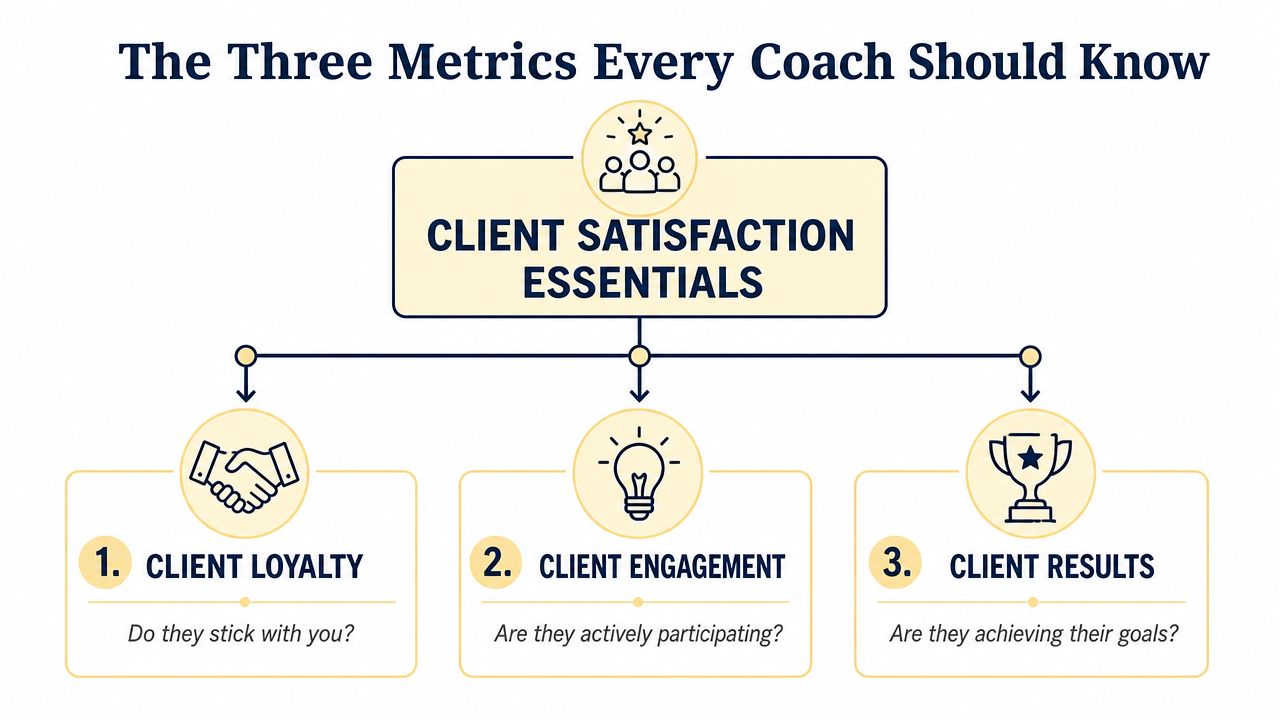
You don't need a giant dashboard with a dozen KPIs to understand your client experience. Most coaches need three lenses.
One asks, Will they recommend me? Another asks, Was this specific interaction helpful? The third asks, How easy is it to work with me?
Those questions map cleanly to NPS, CSAT, and CES.
Net Promoter Score for loyalty
Net Promoter Score, or NPS, tells you whether clients see your work as recommendation-worthy. Coaching's growth relies on trust. If someone would gladly refer you, that usually signals more than temporary satisfaction.
For coaches, the formula is precise. NPS is calculated as (% Promoters) – (% Detractors), ranges from -100 to 100, and a score above 50 is considered excellent according to this coaching business metrics guide.
In practice, ask something like:
- Core question: How likely are you to recommend my coaching to a friend or colleague?
- Follow-up: What most influenced your rating?
Use NPS when you want to measure the relationship as a whole. It works well after the first phase of work, at mid-program, or near renewal.
A coach's inner dialogue here is usually, “They seem happy, but would they put their reputation on the line for me?” NPS answers that.
CSAT for immediate experience
Customer Satisfaction Score, or CSAT, is narrower and more immediate. It captures how a client feels after a specific interaction, such as onboarding, a session, or a support exchange.
The formula is straightforward. CSAT is calculated as (Number of satisfied responses / total number of responses) × 100 according to this CSAT KPI guide.
For coaches, that makes CSAT useful after moments like:
- a discovery-to-onboarding handoff
- the first session
- a program check-in
- delivery of resources or assignments
A few examples of CSAT-style questions:
- Post-session: How satisfied are you with today's session?
- Post-onboarding: How satisfied are you with the onboarding experience?
- Mid-program: How satisfied are you with your progress so far?
CSAT won't tell you everything about long-term loyalty. It tells you whether a touchpoint worked.
A client can value your coaching overall and still feel frustrated by one part of the experience. CSAT helps you catch that before it spills into the full relationship.
CES for ease and friction
Customer Effort Score, or CES, measures how easy or difficult it is for clients to interact with you.
This is the metric many coaches skip, and then wonder why clients feel drained by things that aren't the coaching itself. Intake forms, scheduling changes, homework access, session reminders, payment steps, and follow-up communication all shape satisfaction.
According to this coaching satisfaction metrics article, Customer Effort Score measures how easy or difficult it is for clients to interact with a coach or resolve issues, and efficient systems can reduce friction.
Ask CES questions around process, not insight:
- Onboarding: How easy was it to get started?
- Scheduling: How easy was it to book or reschedule?
- Between sessions: How easy was it to access what you needed?
Which metric to use when
If you're unsure where to begin, use this simple decision filter:
- Use NPS when you want to assess loyalty and referral readiness.
- Use CSAT when you want to evaluate a specific moment.
- Use CES when you suspect friction in your process.
If a client says, “You're amazing,” but renewals are soft, check NPS. If clients like you but complain about logistics, check CES. If a workshop landed awkwardly or onboarding felt messy, check CSAT.
How to Ask for Feedback Without Being Awkward
Most coaches don't avoid feedback because they don't care. They avoid it because it feels emotionally loaded.
You worry that asking will sound insecure. Or transactional. Or needy. Or like you're asking the client to take care of your feelings.
Clients usually don't experience it that way when you ask well. They experience it as professionalism.
Make feedback part of the service
The easiest way to remove awkwardness is to stop treating feedback like a special event.
Build it into the client journey from the beginning. Mention during onboarding that you use short check-ins to improve the experience, adjust support, and make sure the process is working for them. Then it doesn't feel like, “Please reassure me.” It feels like, “This is how I coach responsibly.”
That approach also fits the best practices behind accurate CSAT collection. This customer satisfaction metrics guide notes that well-designed surveys, feedback across multiple touchpoints, and regular assessments improve accuracy, while requesting feedback at inappropriate times or failing to close negative feedback loops creates problems.
Timing changes everything
Ask too early and clients don't have enough experience to answer accurately. Ask too late and memory muddies the signal.
Good timing in a coaching practice often looks like this:
- After onboarding: Measure clarity and ease.
- After an early session: Check whether the client feels supported and understands the process.
- Mid-program: Test progress, momentum, and obstacles.
- Near completion or renewal: Measure loyalty and recommendation intent.
A strong intake process supports this rhythm. If your forms and setup already structure the early client experience, it's easier to place feedback at natural touchpoints. Thoughtful coaching intake forms can then make the rest of the journey easier to measure.
Use language that sounds like a human
You don't need corporate phrasing. You need clean questions and low emotional pressure.
Try lines like these in email or message form:
I use short feedback check-ins so I can improve the experience while we're still working together, not after the fact.
Or:
A quick honest response helps me support you better. Short answers are completely fine.
Keep surveys brief. One rating question plus one open-ended question often works better than a long form.
Sample Client Satisfaction Survey Questions for Coaches
| Metric | Timing | Sample Question |
|---|---|---|
| NPS | Mid-program or near renewal | How likely are you to recommend my coaching to a friend or colleague? |
| CSAT | After a session | How satisfied are you with today's session? |
| CSAT | After onboarding | How satisfied are you with how clear and organized the onboarding process felt? |
| CES | After scheduling or setup | How easy was it to get started and access everything you needed? |
| CES | During the program | How easy is it to stay engaged between sessions? |
| Open text | Any major check-in | What would make this experience more valuable for you right now? |
What not to do
A lot of awkwardness comes from the setup, not the question itself.
- Don't apologize for asking: “Sorry to bother you” frames feedback as a burden.
- Don't over-explain: A short request feels more confident.
- Don't ask and disappear: If a client shares frustration and hears nothing back, trust drops.
- Don't ask right after a breakthrough if you only want praise: That timing can inflate scores and hide reality.
The point isn't to collect flattering data. It's to collect useful truth.
Setting Up Your Automated Feedback System
Manual feedback collection breaks down fast.
At first, it seems manageable. You tell yourself you'll remember to send a quick check-in after the third session or at the halfway mark. Then a week gets busy, a reschedule happens, two invoices need attention, and feedback becomes another task sitting in your head.
Automation fixes the inconsistency. It also lowers the emotional resistance because the request isn't tied to your mood that day.
Build around client journey triggers
A useful feedback system follows client milestones, not your memory.
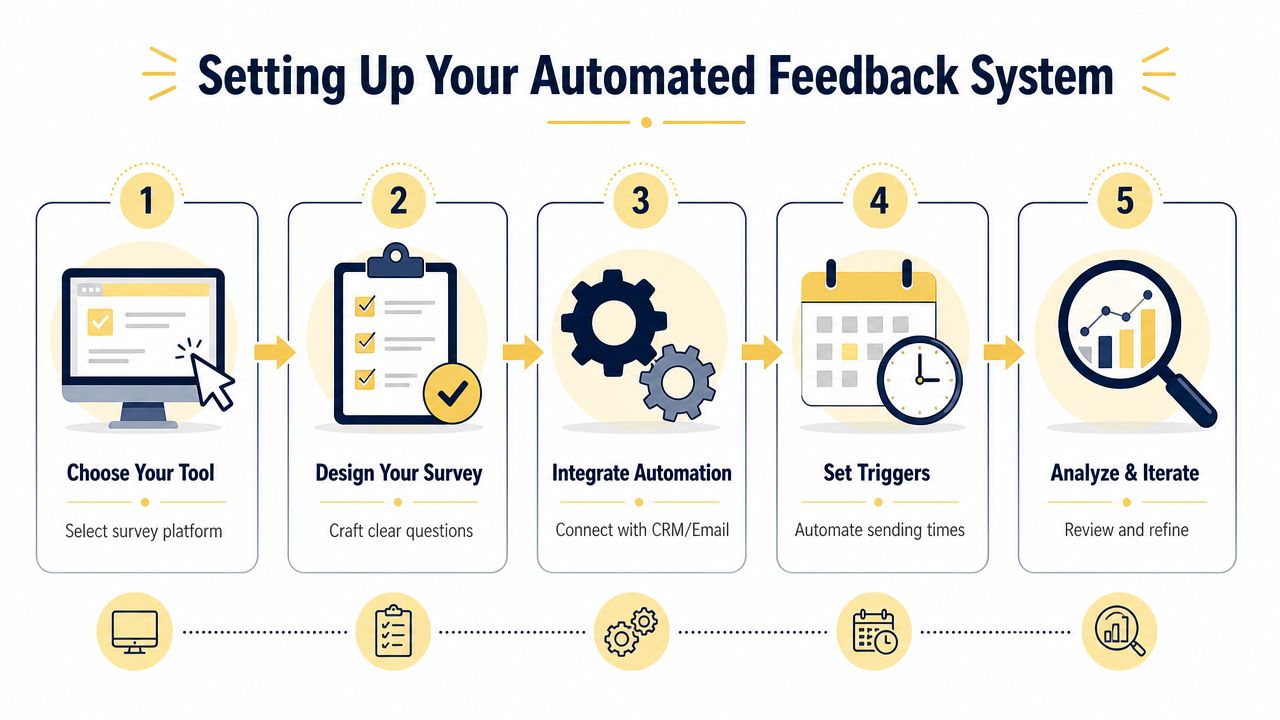
Think in triggers such as:
- Onboarding complete
- First month reached
- Midpoint of a package or cohort
- Program completion
- Renewal decision window
Each trigger should ask a different kind of question. Early prompts should focus on clarity and ease. Midpoint prompts should look for traction and obstacles. End-of-program prompts should explore loyalty, outcomes, and what clients now say about your work.
Choose tools that reduce admin
You don't need a massive tech stack. You need a simple survey tool, a reliable form workflow, and one place to review responses.
If you want lightweight forms, prebuilt templates that help you collect feedback forms can save setup time. The key is consistency, not novelty.
If you're building a broader operational system, it helps to organize scheduling, communication, and client records in one place. A clear client management software guide for coaches can help you evaluate what to centralize so your feedback process doesn't live in scattered documents and reminders.
Set benchmarks before you collect
At this stage, many coaches get vague. They gather responses but never define what “good” means.
According to this customer success metrics article, businesses should define clear KPIs and benchmarks for each metric, such as a target NPS score or a maximum Churn Rate, and track them rigorously.
For a coach, that means deciding things like:
- what NPS score would feel healthy for your practice
- what CSAT result means a touchpoint is working
- what kind of CES responses signal too much friction
- what trend would trigger a process review
Without benchmarks, feedback turns into a pile of impressions.
Create a review rhythm you'll actually keep
Don't overengineer the dashboard.
A practical review rhythm could include:
- Weekly glance: Read fresh comments and flag urgent issues.
- Monthly scan: Look for patterns in low scores or repeated themes.
- Quarterly review: Decide what process change to make next.
Systems work when they protect your attention, not when they demand more of it.
A good automated setup should make feedback feel like part of service delivery, not extra admin. If a client finishes onboarding, the survey goes out. If they hit midpoint, the check-in appears. If they complete the program, the loyalty question lands automatically.
That's how client satisfaction metrics become sustainable.
Turning Scores and Feedback into Action
Your first mixed feedback report can sting.
You see a glowing comment, then a neutral score, then one blunt response that instantly grabs your nervous system. Most coaches don't react strongly to the praise. They react strongly to the disappointment.
That reaction is human. It's also the moment where the value of client satisfaction metrics either begins or ends.
A low score is not a verdict on your worth
A weak rating doesn't automatically mean you're a weak coach. It means one client experienced friction, unmet expectations, confusion, or disappointment somewhere in the journey.
That distinction matters because shame makes coaches defensive. Curiosity makes them effective.
A client may rate onboarding poorly because your welcome email was dense. They may give a middling loyalty score because they liked the sessions but didn't see how the pieces fit together. They may mark effort as high because rescheduling felt clumsy. None of those issues require you to question your whole identity.
They require diagnosis.
Negative feedback is often less about your talent and more about your translation. The value may be there, but the client didn't experience it clearly enough.
Read for patterns, not isolated pain
One low score deserves attention. Repeated low scores in the same area deserve action.
Start by grouping responses into themes:
- Promoters: What are they praising specifically?
- Passives: What feels good but incomplete?
- Detractors: Where is trust, clarity, or ease breaking down?
This kind of segmentation matters because high satisfaction doesn't always equal high retention. This analysis on the limits of satisfaction metrics notes that a high NPS score “doesn't always mean customers will keep buying,” and a low CSAT score “doesn't always mean they'll leave,” which is why segmenting by customer value and profitability matters.
That's a vital coaching insight. The happiest client isn't always the one most likely to renew. The client who gives kind comments may still be a poor-fit buyer. The quieter executive client who gives concise feedback may become your longest retainer if you solve the right issue.
What to do with promoters
Promoters give you two kinds of value. They confirm what's working, and they reveal the language clients use when they describe your impact.
Follow up like this:
- Thank them directly: A short, personal thank-you reinforces the relationship.
- Ask one precise follow-up: “What part of the process has been most valuable?”
- Invite the next step: testimonial, referral, renewal conversation, or expanded support
Notice what they mention. If several promoters praise your accountability structure, not your deep questioning, that's a clue. Your positioning may need to reflect what clients value most.
How to handle passives without guessing
Passives are where many coaches leave money on the table.
These clients aren't warning you loudly. They're telling you the experience is acceptable, but not compelling enough to create advocacy. Often, they liked the coaching but something felt generic, unclear, or harder than it needed to be.
Ask questions such as:
- What would have made this experience more valuable?
- What felt missing or less useful than you expected?
- Where did the process feel unclear?
Here, renewals can be won. A passive client often needs sharper goal tracking, better between-session support, or more explicit framing of progress.
How to follow up with detractors
Don't debate the score. Don't defend your method. Don't explain why they misunderstood.
Respond with calm ownership.
A simple script works:
Thank you for being honest. I'm sorry the experience didn't meet your expectations. I'd like to understand what felt off and see what can be improved from your perspective.
Then listen for specifics. You're looking for one of three things:
- Expectation mismatch
- Process friction
- Delivery issue
Once you know which category fits, you can act. Clarify scope, simplify the process, or change the way support is delivered.
In some cases, a detractor becomes deeply loyal because they experienced repair. Coaches often underestimate how powerful it is when a client feels heard after disappointment.
Turn insight into one visible change
Don't collect ten lessons and fix nothing.
Choose one concrete adjustment from each review cycle, such as:
- rewriting the welcome email
- simplifying homework delivery
- adding a midpoint progress summary
- clarifying what clients can expect between sessions
- shortening intake questions that create fatigue
Action builds confidence. Not because every score will become glowing, but because you stop feeling helpless in the face of feedback.
From Feedback Loop to Flourishing Practice
A mature coaching practice doesn't rely on intuition alone. It uses intuition, experience, and evidence together.
That combination changes how you operate. Instead of wondering why renewals feel inconsistent, you can see whether the issue is loyalty, immediate satisfaction, or effort. Instead of assuming a quiet client is fine, you have a system that invites honesty before disengagement hardens. Instead of treating praise as nice but vague, you turn it into language for marketing, referrals, and stronger positioning.
The real shift is emotional as much as operational
When coaches start using client satisfaction metrics consistently, they usually expect a business benefit first.
They do get that. Better renewal conversations. Stronger referrals. Cleaner delivery. More confidence in what to improve next.
But they also get something else. Relief.
You stop carrying the private burden of not knowing. You stop filling silence with self-doubt. You stop overinterpreting a client's facial expression in the final five minutes of a call.
A healthy feedback loop lets you respond early and coach better.
Use feedback to shape the next version of your practice
The strongest use of feedback is cumulative.
- Positive themes help you sharpen your message and attract better-fit clients.
- Constructive criticism helps you improve curriculum, communication, and onboarding.
- Effort-related comments help you remove friction that drains goodwill.
- Loyalty signals show you what earns renewals and referrals.
If retention matters, your systems matter too. A thoughtful guide to increasing client retention fits well alongside feedback work because clients stay when they feel progress, clarity, and support, not just inspiration.
Client satisfaction metrics aren't there to judge you. They're there to inform you. Used well, they make your practice steadier, your decisions cleaner, and your client experience stronger.
Coachful helps coaches turn all of this into a practical system. If you want one place to manage onboarding, scheduling, communication, client progress, and the operational details that shape satisfaction, explore Coachful and build a practice that feels easier to run and better to experience.