Is a Life Coach Worth It? An Honest Answer With Real Costs
Is a life coach worth it? A life coach is worth it when you want to make a specific change, such as a career move, a new habit or a stuck relationship pattern, and you will act on it between sessions. Expect $75 to $200 a session or $1,200 to $2,500 for three months. A life coach is a poor substitute for therapy.
That answer hides a lot of "it depends", so this page unpacks it: what a life coach actually does, what the studies on life coaching found, what it costs at each level of experience, the situations where it earns its fee and the ones where you should keep your money. If you are asking "life coach, is it worth it, really?", you will have a yes or a no for your own case by the end.
What a life coach does, and what they don't
A life coach helps you decide what you want, work out what is in the way and keep moving on it. Most of the work is questions, planning and follow-through: you set the goal, the coach helps you see it clearly, and the two of you agree what you will do before the next session. Our guide to what life coaches do covers the day-to-day in more detail.
The confusion usually comes from the neighbors. Here is how they differ.
| Who | Best for | Looks mostly at | Licensed? |
|---|---|---|---|
| Life coach | A goal or change you are ready to work on | The present and the next few months | No. The title is unregulated, though credentials such as the ICF's exist |
| Therapist or counselor | Mental health conditions, trauma, grief, patterns that cause real distress | Past and present, and how they connect | Yes, in most places |
| Mentor | Advice from someone who has done the thing you want to do | Their experience and what worked for them | No |
| A wise friend | Support, perspective, company | Whatever you bring | No, and they cannot be neutral about your life |
The line between coaching and therapy is the one that matters most. The ICF Core Competencies ask coaches to maintain the distinctions between coaching, consulting and psychotherapy and to refer clients to other support professionals when appropriate. A coach who promises to fix anxiety or trauma is working outside their lane. For the longer comparison with mentoring, see coaching vs mentoring.
What the studies on life coaching found
Life coaching has a smaller research base than workplace coaching, but the controlled studies that exist point the same way.
- A randomized trial of group life coaching. Green, Oades and Grant (2006) randomly assigned adults to a 10-week cognitive-behavioral, solution-focused life coaching program or a waitlist. The coached group improved on goal striving, well-being and hope, and some gains held at a 30-week follow-up.
- Professional coaches did better than peers. Spence and Grant (2007) compared professional life coaching, peer coaching and a waitlist with 63 adults over 10 weeks. People with professional coaches were more engaged and showed greater goal commitment and progress. The authors' reading: a supportive person helps, but expertise adds something a friend does not.
- The wider coaching literature agrees. A meta-analysis by Theeboom, Beersma and van Vianen found coaching improved performance, well-being, coping and goal-directed self-regulation.
Keep the limits in view. These are mostly small studies with self-reported outcomes, run with people who volunteered for coaching. They show that structured life coaching from a trained coach tends to help motivated people move on their goals. They do not show that any given coach will help you, which is why choosing well matters as much as deciding to hire one.

What a life coach costs, by experience
The typical life coach charges $75 to $200 for an hour. Where a coach sits in that range, or above it, mostly tracks experience and how established their niche is.
| Coach's stage | Typical rate per hour | What you usually get at this level |
|---|---|---|
| Newer coach | $50 to $100 | Enthusiasm, a method still forming, more flexibility on format |
| Experienced coach | $100 to $200 | A clear niche, a repeatable program, references you can call |
| Top of the niche | $200 to $500 | A waiting list, a known method or book, mostly referred clients |
Hourly band from PayScale and practitioner reports; stage bands are practitioner estimates. Both compiled in Coachful's 2026 Coaching Business Report for Q2 2026, US dollars.
Published prices back this up. When Coachful collected the session rates that 18 life coaches list publicly in 2026, they ran from $50 to $980, and most sat between $100 and $250. That is a small sample, so read it as the spread, not an average.
Most life coaches sell packages rather than single sessions:
| Package | Shape | Typical price |
|---|---|---|
| Starter | 4 sessions over 4 weeks, with email support | $400 to $600 |
| Three-month program | 8 sessions, with email and worksheets | $1,200 to $2,500 |
| Six-month deep dive | 12 to 16 sessions, with chat and accountability | $2,500 to $5,000 |
| VIP intensive day | One full day plus a follow-up | $750 to $2,000 |
| Group coaching | Group calls and a community | $100 to $300 a month |
Package ranges observed in the market, from practitioner reports and the verified life coach sample, compiled in Coachful's 2026 Coaching Business Report.
For the full breakdown by niche, see how much life coaches charge, and for what a package typically includes, life coaching package examples.
How to work out if a life coach is worth it for you
"Worth it" is a comparison: the cost of coaching against the cost of staying where you are. A rough way to put numbers on it takes five minutes.
- Name the change and its value. A raise, a new job, a business that pays you, a year without the Sunday dread. Some of these have a dollar figure. Some do not, and that is fine.
- Estimate how long you have been stuck. If you have been "about to" make this change for two years, that is your baseline. Coaching is a bet you can shorten it.
- Price a realistic package. For most people, a three-month program at $1,200 to $2,500.
- Ask what else would get you there. A course, a mentor, a peer group or a therapist might be cheaper or better suited. If one of them clearly is, pick it.
- Decide what "working" looks like by week six. Write it down before you start, so you can judge the coaching rather than your mood.
Here is how that plays out. Say you want to move from teaching into instructional design and have circled it for eighteen months. A three-month package at $1,800 is a lot of money. Set against a salary increase and the months of drift it might cut, it can be cheap. Now say you want to "feel more fulfilled" but cannot name what would change. Spend the first session getting specific, or spend nothing until you can.
Six situations where a life coach usually earns the fee
- A career change you keep postponing. The work is clarity, a plan and a few uncomfortable conversations, which is classic coaching territory.
- Going back to work after a long break. Confidence, logistics and a story for interviews.
- Starting a side business. Choosing one idea and doing the first ten unglamorous steps.
- Building habits that have not stuck alone. Sleep, exercise, routines, focus. The accountability is the product.
- A life transition you have already processed emotionally. After a move, a divorce or children leaving home, when the question is "what now?" rather than "why does this hurt?"
- A big decision with competing values. Staying or leaving, relocating, taking the offer. A coach is neutral in a way friends and family cannot be.

When to keep your money
A life coach is not worth it, or not yet, in a few common cases.
- You are struggling with your mental health. Persistent low mood, anxiety that disrupts your days, trauma, disordered eating or thoughts of self-harm call for a licensed clinician. In the US, the 988 Suicide and Crisis Lifeline is available by call or text at 988. Coaching can come later, alongside treatment, if your clinician agrees.
- You want answers, not a process. If you need someone to tell you what to do from experience, a mentor or consultant fits better.
- You cannot give it time. Without an hour or two a week between sessions, results stall.
- The money would cause real strain. Financial stress is its own obstacle. A group program, a single session or a good book are honest starting points.
If cost is the barrier, a chatbot is tempting. It can help you reflect and plan, with real limits on memory, accountability and safety. We wrote a full guide to whether ChatGPT can be your life coach.
What good life coaching feels like in the first month
You can usually tell within three or four sessions. Signs it is working:
- You talk more than the coach does, and leave each session with one or two actions you chose.
- Something happens between sessions: prep before the call, a check-in during the week, notes you can find later.
- The coach remembers what you said last time and holds you to it, kindly.
- You feel challenged at least once a session, not only encouraged.

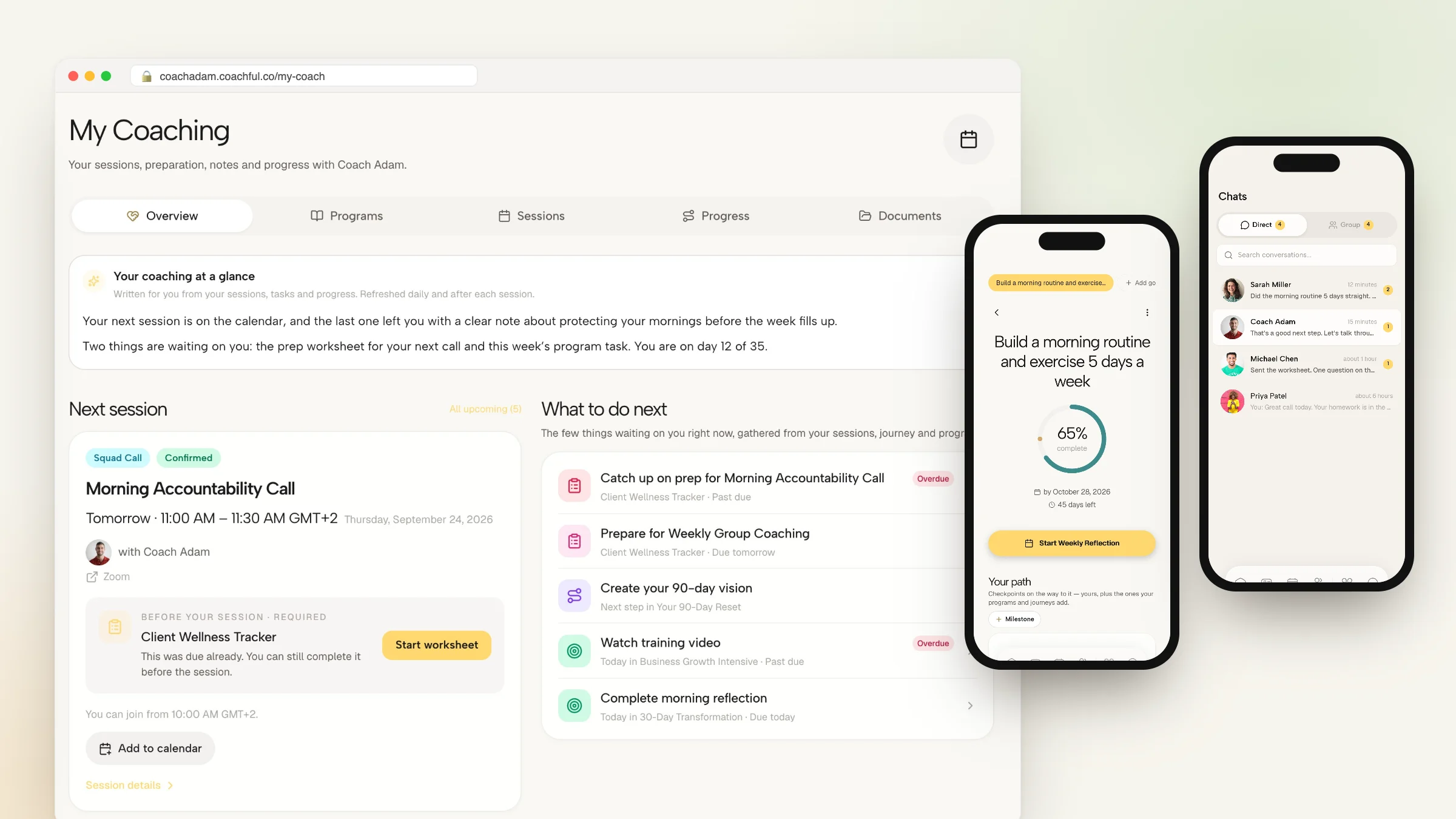
Many coaches now give clients an app for exactly this. In Coachful's client app, a client sees the next session and any prep that is due, their goals and milestones, a weekly reflection and daily habits, all set up by their coach.

Some coaches also use a vision board in the first weeks to make an abstract goal concrete. It sounds soft, and for some people it is the moment the goal becomes real.

How to find a life coach worth paying
- Look for a niche that matches your situation. A coach who works mainly with career changers will be faster on your career change than a generalist. Our list of types of life coaching helps you name what you need.
- Browse more than one. Coachful's Find a Coach directory needs no account or card to browse. Filter by category, search a topic, or answer a few questions to get matched, then read profiles and programs.
- Book two or three discovery calls. Ask how they would approach your goal, what happens between sessions, how you will both know it is working and what they do if a client needs therapy instead.
- Read the agreement before paying. Sessions, price, cancellation, refunds and confidentiality, in writing.
- Trust the fit. Research on coaching finds the quality of the coach and client relationship is one of the strongest predictors of results. If the call felt flat, keep looking.

A note for coaches
Every question on this page is one your prospective clients are asking before they book. If your site does not answer them, the free white-glove service can help: Coachful's team builds your website, sales page or program inside your account at no extra cost on every plan, usually within about 24 hours. Here is how the free build works, and what Coachful offers life coaches beyond it.

Frequently asked questions
Is a life coach worth the money?
For a motivated person with a specific goal, usually yes. Randomized studies of life coaching found gains in goal striving and well-being, and professional coaches outperformed peer coaches. A three-month program typically costs $1,200 to $2,500, so it is worth it when the change you want is worth more than that to you and you will do the work between sessions.
Life coach, is it worth it if I have tried therapy?
It can be, as a different tool. Therapy helps you understand and heal; coaching helps you decide and act on a goal. People often find coaching useful once therapy has done its work. If you still have active mental health symptoms, talk to your clinician before starting, and choose a coach who is clear about where coaching stops.
How much does a life coach cost per month?
Most life coaches charge $75 to $200 a session. A three-month package of eight sessions typically costs $1,200 to $2,500, roughly $400 to $830 a month, and group life coaching runs $100 to $300 a month. These ranges come from PayScale data and practitioner reports compiled in Coachful's 2026 Coaching Business Report.
How many sessions with a life coach do I need?
Most packages run eight sessions over about three months, which is long enough to see behavior change. A focused question can need only two or three sessions; a bigger transition often takes six months. Agree at the start what progress should look like by week six, and review it then.
Do life coaches need to be certified?
No. Life coaching is unregulated in most countries, so certification is optional. Credentials such as the ICF's ACC, PCC and MCC show training and coaching hours, and the ICF will confirm whether someone currently holds one. In practice, a clear method, a written agreement and past clients you can speak to matter as much as a certificate.
Can a life coach help with anxiety or depression?
A life coach should not treat anxiety or depression. Those need a licensed clinician. A coach can support everyday goals alongside treatment if your clinician agrees, and a good coach will refer you on if they see signs that coaching is not the right help. In a crisis in the US, call or text 988.
What is the difference between a life coach and a therapist?
A therapist is licensed to assess and treat mental health conditions and often explores how the past shapes the present. A life coach is unlicensed and works on goals, decisions and habits in the present and near future. Coaches are expected to keep the two separate and refer clients to therapy when it is needed.