Can a ChatGPT Life Coach Help You? What It Can and Can't Do
Can ChatGPT be your life coach? Partly. A ChatGPT life coach is good at helping you reflect, untangle a decision and turn a vague goal into a plan, at any hour and for little or nothing. It cannot hold you accountable, reliably remember your story, notice what you avoid saying or keep you safe in a crisis. Use it for thinking, not as your only support.
That is a more useful answer than "yes" or "no", because the honest picture is mixed. Chatbots are surprisingly good at some coaching jobs and quietly bad at others, and the bad parts are the ones you only notice later. Below: what ChatGPT does well, where it falls short, what the research on AI coaching found, the safety and privacy points to know, and a four-week routine for using it well.
What ChatGPT does well as a life coach
For a lot of everyday coaching work, a general AI assistant such as ChatGPT, Claude or Gemini is a decent thinking partner. It is strongest when you bring the material and it brings the structure.
- Getting thoughts out of your head. Typing out a messy situation and asking for it back as three clear options is genuinely useful at 11pm.
- Asking you questions. Ask it to coach you with one question at a time and no advice, and it will. The questions are often decent and occasionally excellent.
- Breaking a goal into steps. "Change careers" becomes a list of conversations, applications and skills, with dates attached.
- Rehearsing a hard conversation. It will play your manager, your partner or a skeptical interviewer while you practice.
- Explaining frameworks. GROW, values exercises, the wheel of life: it can walk you through any of the common coaching models in plain language.
- Being there when nobody else is. Availability is its biggest advantage over any human.
Prompts that work better than "be my life coach":
- "Act as a non-directive coach. Ask me one question at a time about [situation]. Do not give advice unless I ask for it."
- "Here is what I want by March and what has stopped me so far. Challenge my assumptions. Point out where I am making excuses."
- "Summarize what I committed to in this conversation as three actions with deadlines. Keep each under 15 words."
- "Play my manager in a conversation where I ask for a raise. Push back the way a busy, skeptical manager would."
Where a ChatGPT life coach falls short
The gaps are less about intelligence than about what a coaching relationship actually provides.
Nobody is waiting for your answer
Accountability works because a person will ask next week whether you did the thing, and you would rather not say no. A chatbot can be set to remind you, but it does not notice when you go quiet, it does not ask why, and it loses nothing if you never come back. Most of the value people describe from coaching lives in that small social pressure.
It tends to agree with you
Language models lean toward telling people what they want to hear. A Stanford-led study presented at FAccT 2025 tested popular models in therapy-like scenarios and found they sometimes went along with a user's delusional thinking, which the authors linked to sycophancy. In 2025 OpenAI also rolled back a ChatGPT model update after users found it overly flattering. In coaching, agreement feels supportive and keeps you exactly where you are.
Its memory is patchy and its facts can be wrong
ChatGPT can remember some details across chats when memory is switched on, but what it keeps is selective, and long histories get summarized or lost. It also produces confident errors. The US National Institute of Standards and Technology lists this "confabulation", confidently stated false content, as a core risk of generative AI in its Generative AI Profile. That matters when it summarizes what you said you wanted three weeks ago.
It only knows what you type
A good coach hears the pause before "it's fine", notices you have mentioned your sister four times and never your partner, and remembers the goal you dropped in March. A chatbot reads the words you chose to share, which are usually the safe ones.
It is not a safety net
This is the one that matters most, and it gets its own section below.
What the research on AI coaching found
Researchers have started testing AI coaches against human ones. The results are more interesting than either side's marketing.
- On goal attainment, a simple AI coach kept up. In two parallel 10-month trials with UK business students, Terblanche, Molyn, de Haan and Nilsson found both a human coaching group and a group using a chatbot coach called Vici improved goal attainment more than controls, and the two never differed significantly. The authors were blunt about the limits: "At present, AI's lack of empathy and emotional intelligence make human coaches irreplicable."
- People will bond with an AI coach in a single session. A small randomized study in Frontiers in Psychology found no significant difference in working alliance between a simulated AI coach and a human coach after one 60-minute session. The "AI" was actually human coaches behind avatars, so it tests perception more than technology.
- Therapy is a different story. The Stanford-led study above concluded that language models should not replace therapists, after finding stigma toward some conditions and unsafe replies to serious scenarios.
- Professional bodies are cautious. In November 2025 the American Psychological Association issued a health advisory warning that most AI chatbots and wellness apps are not designed to provide mental health treatment and lack adequate safety protocols.
Read together: AI can help with structured goal work, especially for motivated people with everyday goals. It is not a stand-in for clinical care, and the studies that look good for AI test narrow outcomes over a fixed period, often with students.

ChatGPT, a human life coach and a therapist side by side
| What you need | ChatGPT or another chatbot | Human life coach | Licensed therapist |
|---|---|---|---|
| Available at 2am | Yes | No, though many offer messaging with set hours | No, crisis lines are |
| Cost | Free tier or a monthly subscription | Typically $75 to $200 a session | Varies; insurance may cover it |
| Remembers your story | Partly, if memory is on | Yes, with notes | Yes, with clinical records |
| Holds you accountable | Only if you hold yourself to it | Yes, that is much of the job | Sometimes, depending on approach |
| Challenges you honestly | When asked, and it tends to soften | Yes, a good one will | Yes |
| Handles a crisis | No | Refers you to help | Trained to assess and act |
| Bound by a code of ethics | No | If credentialed, for example by the ICF | Yes, and licensed |
Life coach rate from PayScale data and practitioner reports compiled in Coachful's 2026 Coaching Business Report. See how much life coaches charge for the detail.
Crisis safety: where every chatbot stops
If you are thinking about harming yourself, or someone else, close the chat and talk to a person. In the US, call or text 988 to reach the 988 Suicide and Crisis Lifeline, and call 911 if you are in immediate danger. Elsewhere, call your local emergency number.
Many chatbots will suggest a crisis line, but the APA says their ability to safely guide someone through a crisis is limited and unpredictable. Lawmakers are reacting too. Illinois passed the Wellness and Oversight for Psychological Resources Act in August 2025, which bars AI from providing therapy or making therapeutic decisions in the state, and the US Federal Trade Commission opened an inquiry into AI chatbots acting as companions in September 2025.
None of that means you should not use AI for life planning. It means a chatbot is not the right place for depression, trauma, an eating disorder or a relationship that frightens you.
Privacy: what to think about before you type
A coaching conversation is full of things you would not post publicly: your marriage, your money, your health, your boss. A few habits keep that safer.
- Check the data settings. Consumer AI assistants generally keep your chat history, and some use conversations to improve their models unless you change a setting. Look before you share anything personal.
- Know there is no professional confidentiality. A credentialed coach is bound by a code of ethics on confidentiality, and a therapist by law. A chatbot company is bound by its terms of service.
- Leave other people's details out. Describe "my manager" rather than pasting their emails.
- Skip the identifying specifics. You rarely need names, addresses or medical details to get a good question back.
A four-week routine for using ChatGPT as a life coach
If you are going to do it, do it with structure. This routine borrows the parts of coaching that a chatbot can actually support.
- Week 1: get specific. One conversation to turn a feeling into one goal with a date. End by asking for a single sentence you could tell a friend: "By April, I will have applied for five instructional design roles."
- Week 2: find the obstacle. Ask it to question you about what has stopped you before. Write the answer down outside the chat.
- Week 3: plan small. Three actions for the week, each under 30 minutes. Put them in your calendar, because the chatbot will not.
- Week 4: review honestly. Paste in what you actually did. Ask it to point out patterns and to be blunt.
Keep a running document of your goal, actions and outcomes, and paste it at the top of each new chat. That one habit fixes most of the memory problem. For the accountability problem, tell a friend your weekly actions, or work with a human coach.

The hybrid: AI between sessions, a human coach in charge
Some coaches now combine both: a human coach for the sessions, the judgment and the relationship, and an AI assistant for the questions that come up on a Tuesday night. This addresses most of what a general chatbot misses, because the AI works from the coaching itself.
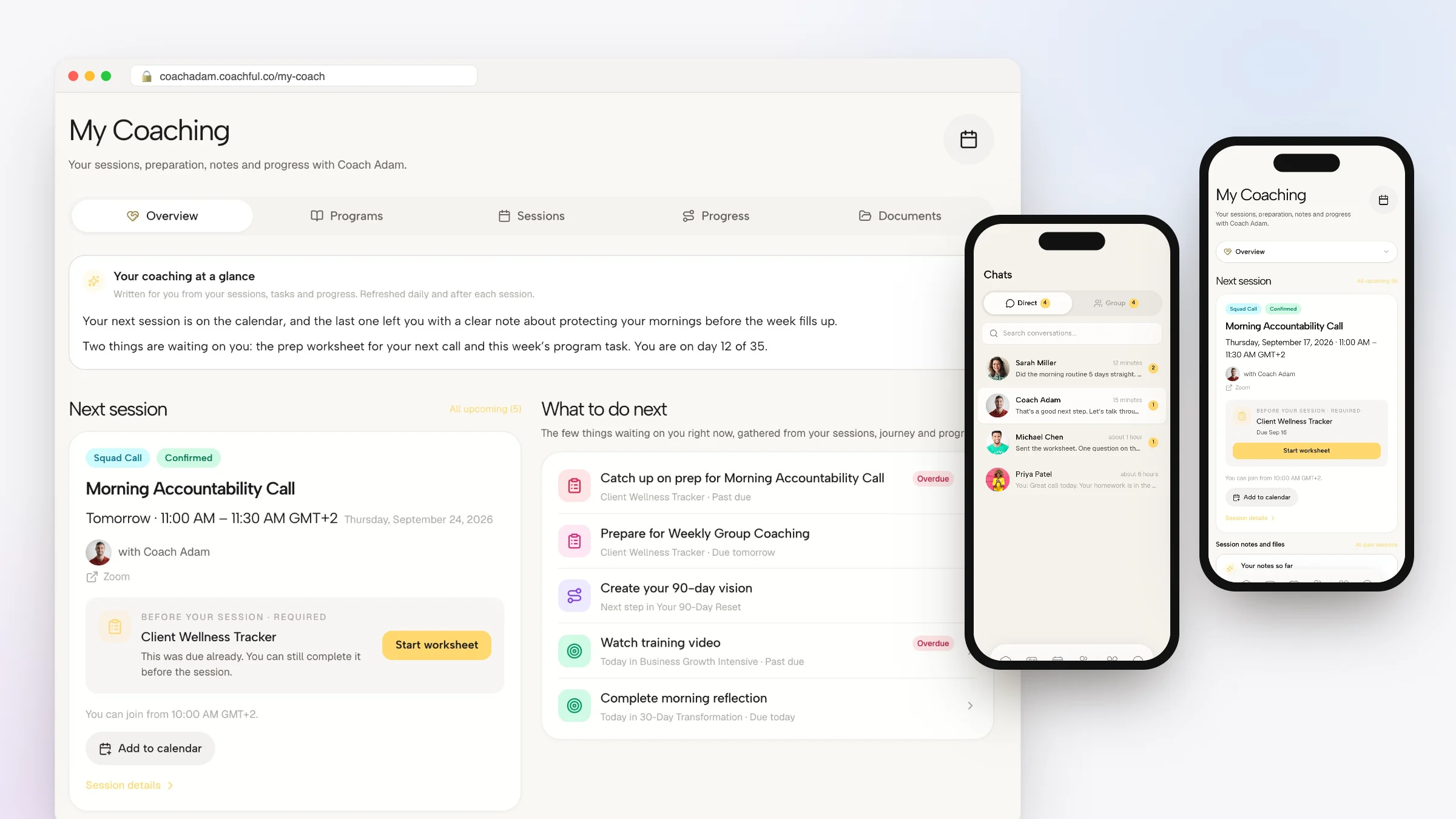
In the Coachful coaching app, coaches can switch on an AI Coach for their clients. It is off until a coach sets it up, and the coach decides which clients can use it. It appears in the client's messages on the web, iPhone and Android, takes text or voice notes, answers from that client's own program, tasks, habits, check-ins and next session, and follows the name, personality, instructions, topics to avoid and escalation rules the coach writes. Coaches can review its answers and teach it how they would have responded. It will not diagnose or give medical, legal or financial advice, and when a client mentions self-harm, abuse or severe distress it encourages them to contact emergency services or a qualified professional and to reach their coach directly.

The human part stays human. The coach still sees who has gone quiet and decides what to say about it.

We go deeper on the different kinds of AI coaching, and their risks, in our guide to choosing an AI life coach.
When to hire a human coach instead
A chatbot is enough while you are exploring. Consider a human coach when any of these are true:
- You have made the same plan with a chatbot three times and not acted on it.
- The decision has real stakes: a job, a move, a business, a relationship.
- You suspect you are not telling the full story, even to yourself.
- You want someone who will notice and ask when you go quiet.

Coachful's Find a Coach directory is open to anyone without an account: filter by category, search a topic or take a short quiz to get matched, then book a discovery call from a coach's profile. If you are weighing the cost, our guide to whether a life coach is worth it walks through it.

Coaches reading this: the questions clients ask a chatbot at night are a map of what your program should cover. If you would like help building it, Coachful's team builds programs, websites and funnels inside your account through the free white-glove service, included on every plan.

Frequently asked questions
Can ChatGPT be my life coach?
It can play part of the role. ChatGPT is useful for reflection, planning and rehearsing conversations, and a 2022 study found a simple AI coach matched human coaches on goal attainment for students. It cannot provide real accountability, reliable memory of your story or crisis support, so treat it as a thinking tool rather than your only coach.
Is it safe to use ChatGPT as a life coach?
For everyday goals, it is reasonably safe if you check its data settings, avoid sharing identifying details and verify any facts it gives you. It is not safe as a replacement for mental health care. The APA warned in 2025 that most chatbots lack adequate safety protocols. In a crisis in the US, call or text 988.
What is the best ChatGPT prompt for life coaching?
Ask for structure rather than advice: "Act as a non-directive coach. Ask me one question at a time about my goal and do not give advice unless I ask." End each conversation with "Summarize my commitments as three actions with deadlines" and keep those outside the chat, where you will see them.
Is an AI coach as good as a human coach?
On narrow measures, sometimes. In a 10-month comparison, an AI chatbot coach and human coaches produced similar goal attainment gains among business students. The same researchers said AI's lack of empathy and emotional intelligence keeps human coaches irreplaceable, and AI does worse with context, complex emotions and anything clinical.
Can ChatGPT replace therapy?
No. A Stanford-led study found popular models showed stigma toward some conditions and responded unsafely to serious scenarios, and the authors concluded they should not replace therapists. Illinois banned AI from providing therapy in 2025. If you are struggling with your mental health, see a licensed clinician.
Does ChatGPT remember what I told it in earlier coaching chats?
Partly. With memory switched on, ChatGPT can recall some details across chats, but what it keeps is selective and long histories get compressed. Keep your own running note of goals, actions and outcomes and paste it into each new conversation, the way a coach would keep session notes.
Is there an AI life coach that works with a real coach?
Yes. Some coaching platforms let a human coach switch on an AI assistant for their clients. In Coachful, the AI Coach is off until a coach sets it up, answers from the client's own program and habits, follows the coach's rules and boundaries, and sends clients back to their coach or to professional help when needed.