AI Life Coach: What It Is, Your Options and the Real Risks
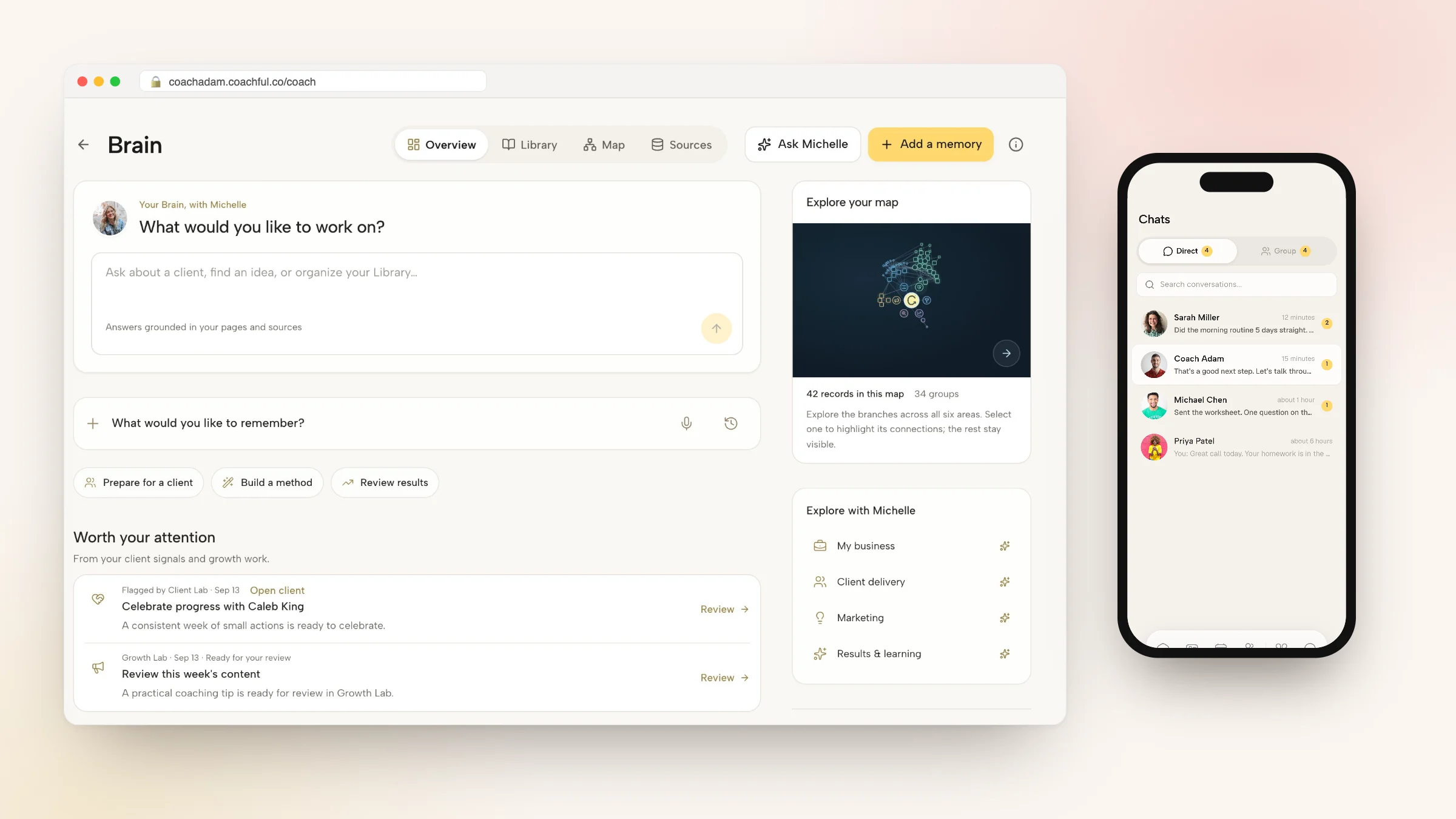
An AI life coach is software that uses a large language model to coach you through goals, habits and decisions by chat or voice. It comes in three kinds: general chatbots you prompt yourself, standalone AI coaching apps, and AI assistants that work between sessions under a human coach. All three help with reflection and planning. None replaces a trained coach or a therapist.
Which kind suits you depends on what you need from it, and the differences are bigger than the marketing suggests. This guide explains how an AI life coach works, compares the three types, summarizes the research, sets out the risks plainly and gives you a checklist for choosing one. If you are a coach thinking about offering one to clients, there is a section for you near the end.
How an AI life coach works
Under the hood, nearly every AI life coach is a language model, the same kind of system behind ChatGPT, Claude and Gemini, wrapped in instructions that tell it to behave like a coach. What separates a good one from a generic one is everything around the model:
- Instructions. Who it is, how it should ask questions, what it must never do. A coaching product writes these carefully; a general chatbot uses whatever you type.
- Context about you. Your goals, your habits, what you said last week. Some tools have none of this, some keep a memory, and some read from a real coaching record.
- Knowledge. Reference material it can draw on, such as a coach's method, worksheets or course content.
- Tools. The ability to do things, like adding a task to your list or logging a habit, instead of only talking.
- Safety rules. What it does when a conversation turns to self-harm, abuse, medication or money.
When people say an AI coach "gets them" or "sounds generic", they are usually reacting to the second and third items, not to the model.
The three kinds of AI life coach compared
| Type | What it knows about you | Accountability | Safety boundaries | Best for |
|---|---|---|---|---|
| General chatbots (ChatGPT, Claude, Gemini, Microsoft Copilot) | What you type, plus some memory if switched on | None unless you build it yourself | General safety policies, not designed for coaching | Free-form reflection, planning, rehearsing conversations |
| Standalone AI coaching apps | Whatever the app tracks: goals, check-ins, mood | Reminders and streaks | Vary widely; check before you share | Self-guided habit and goal work on a budget |
| AI alongside a human coach | Your actual coaching record: program, tasks, habits, check-ins, sessions | A human coach who sees your progress | Set by the platform and by your coach | Support between sessions while a coach leads the work |
There is a fourth category people drift into: companion chatbots, apps designed to feel like a friend or partner. Some people use them as a coach. They are built to keep you talking, which is a different goal from helping you change, and they are now under regulatory scrutiny (more below).
General chatbots
The most capable models, and the least structured coaching. They are excellent if you know how to steer them and frustrating if you do not. We cover them in depth in can ChatGPT be your life coach, including prompts and a four-week routine.
Standalone AI coaching apps
Plenty of apps sell an "AI coach" for habits, career, fitness or wellbeing. They add structure a chatbot lacks, such as daily check-ins and streaks, but the quality of their instructions and safety rules is invisible from the app store page. Read the privacy policy and test what happens when you mention something serious before you rely on one.
AI that works alongside a human coach
Here the AI is a tool inside a coaching relationship. A human coach sets the program, the boundaries and the method, and the AI handles the 11pm questions in between. It knows far more about you than a chatbot does, because it reads the same record your coach works from, and a person is still accountable for the coaching.

What the research says about AI coaching
The evidence is young but no longer empty.
- Goal attainment can match human coaching on narrow measures. In two equivalent 10-month randomized trials, a chatbot coach and professional human coaches both improved students' goal attainment more than controls, with no significant difference between them. The authors still concluded that AI's lack of empathy and emotional intelligence makes human coaches irreplicable.
- Human, AI and hybrid health coaching all look feasible. A 2025 systematic review of 35 studies of digital health coaching found positive effects on engagement and lifestyle outcomes for both human and AI coaching, and said hybrid human and AI approaches still need refinement.
- Users may prefer a more directive AI. A 2026 study of 158 people by Terblanche and Brown found a directive AI coaching chatbot rated higher on working alliance and goal attainment than a non-directive one, which cuts against how human coaches are trained.
- Mental health is where the warnings concentrate. A Stanford-led study found popular models showed stigma toward some mental health conditions and answered some serious scenarios unsafely, and concluded they should not replace therapists.
The fair summary: AI coaching can help motivated people with everyday goals, and it works best with structure around it. It has not been shown to be safe for clinical problems, and most trials are short, small or run with students.
The risks of an AI life coach, plainly
- Crisis and mental health. In November 2025 the American Psychological Association issued a health advisory warning that most AI chatbots and wellness apps are not designed to provide treatment, may lack scientific validation and often lack adequate safety protocols. Illinois went further and passed a law barring AI from providing therapy. If you are in crisis in the US, call or text 988 to reach the 988 Suicide and Crisis Lifeline.
- Confident mistakes. Language models produce fluent, wrong answers. NIST names this "confabulation" in its Generative AI Profile. Check any fact, figure or recommendation that matters.
- Telling you what you want to hear. Models tend to agree with the user. In coaching, that feels like support and keeps you stuck.
- Privacy. Coaching conversations contain health, money and relationship details. Find out where they are stored, who can read them, whether they train a model and how to delete them.
- Dependence. An always-available, always-agreeable voice can crowd out the people in your life. In September 2025 the US Federal Trade Commission opened an inquiry into AI chatbots acting as companions, focused on harms to children and teens.
- No one is accountable. If a standalone app gives you bad advice, there is no coach to answer for it and no code of ethics in play.
How to choose an AI life coach: a checklist
Ask these before you commit, and walk away from any tool that cannot answer the first three.
| Question | A good answer | A worrying answer |
|---|---|---|
| What does it do if I mention self-harm or abuse? | Points you to emergency services or a professional and, if a coach is involved, to them | Keeps "coaching" you through it |
| Where do my conversations go? | A clear policy on storage, who can read them and deletion | Vague terms, or training on your data by default with no opt-out |
| Who designed the coaching approach? | A named method, or your own coach | "Our AI is trained on the best coaching" |
| What does it know about my goals? | Your actual goals, habits and progress | Only the current chat |
| Is there a human anywhere? | A coach who reviews progress, or clear routes to one | No human, no support contact |
| What will it refuse to advise on? | Medical, legal, financial and clinical questions | Anything goes |

How Coachful's AI Coach fits
Coachful's AI Coach sits in the third category. It is a client-facing assistant that a coach can switch on for their own clients, and it only exists inside that coaching relationship. You cannot sign up for it on its own.
The coach controls it
- Off until a coach sets it up. The coach saves and enables it, then chooses whether every client or only selected clients can use it. It can also be included with a particular program or offer.
- The coach's voice and method. The coach gives it a name, an avatar, a personality, custom instructions, topics to avoid and rules for when to send the client back to them, and can upload documents to its knowledge base.
- Taught with real examples. In Answers and teaching, the coach reads saved replies, chooses "Here's how I would respond" and writes how they would have handled that kind of situation. Up to twelve of these examples guide future replies. This is prompt guidance, not retraining a model.
It works from the client's own coaching
It answers from the client's program, tasks, habits, check-ins and next session, and points them to the coach's materials when they ask where something is covered. It can add a task, log a habit or save a check-in, but only when the client clearly asks.

Where clients use it
It appears as its own conversation in Messages, on the web and in the iPhone and Android apps. Clients can type or send a voice note, and coaches can set it up to reply in their own cloned voice. It can also answer inside an existing chat when someone mentions it by name.

Its safety boundaries
- It does not diagnose, treat or provide clinical mental health care, and it does not do crisis counseling.
- It does not give medical, legal, financial investment, tax, medication or emergency advice.
- If a client mentions self-harm, harm to others, feeling unsafe, abuse or severe distress, it responds with warmth, encourages immediate help from local emergency services or a qualified professional, and suggests contacting their coach directly. It does not claim to have alerted the coach unless that actually happened.
- For personal decisions, or anything it cannot find, it sends the client back to the coach.
Two honest notes. The coach can review AI Coach conversations in order to improve it, so it is not private from your coach, and a good coach will tell you so. And it is not free to run: every reply uses AI credits from the coach's Coachful plan.

Getting the most from an AI coach your coach provides
- Use it for the in-between questions. "What was my focus this week?" "I missed two days, how do I restart?" "Help me prep for Thursday's session."
- Bring the big things to your coach. Decisions, setbacks and anything emotional belong in a session.
- Ask it to log things for you. Saying "add a 20-minute walk to my habits" is faster than finding the screen.
- Tell your coach where it was wrong. They can teach it to answer that kind of question their way.
For coaches: should you offer an AI life coach to clients?
It suits coaches whose clients get stuck between sessions on the same handful of questions, and who have a clear enough method to write down. Decide your human between-session support boundaries first, so the AI fills a gap you have defined rather than a promise you never made. It suits less well if your work is mostly deep, emotional conversation, or if your clients are in a sensitive niche where the boundaries above would come up often.
If you try it, start with a few clients, write firm boundaries, test it yourself with the questions clients really ask, and review answers in the first weeks. Our guide to setting up an AI coaching assistant that stays in its lane walks through the setup, and the Coachful coaching app page shows where it sits for clients. You can see who is active, quiet or at risk on your side either way.

If you would rather someone build the program the AI Coach supports, Coachful's team builds programs, funnels and websites inside your account through the free white-glove service, included on every plan.

Looking for a human coach who may offer this? Coachful's Find a Coach directory is open to anyone, with no account needed: browse by category or topic, or take a short matching quiz. For the cost side of the decision, see whether a life coach is worth it.
Frequently asked questions
What is an AI life coach?
An AI life coach is software built on a large language model that coaches you through goals, habits and decisions by chat or voice. It can be a general chatbot you prompt yourself, a standalone coaching app, or an assistant that works between sessions under a human coach. It helps with reflection and planning but is not a substitute for a trained coach or therapist.
Is there a free AI life coach?
General chatbots such as ChatGPT, Claude and Gemini have free tiers you can prompt to act as a coach, with real limits on memory, accountability and safety. Coachful's AI Coach is not sold on its own: it is part of coaching from a coach who uses Coachful, who switches it on for their clients and pays for its use through their plan.
Are AI life coaches safe?
For everyday goals they are reasonably safe if you protect your privacy and check important facts. They are not safe for mental health crises or clinical problems: the APA warned in 2025 that most chatbots lack adequate safety protocols, and Illinois banned AI therapy. Choose a tool that sends you to real help when a conversation turns serious.
Can an AI life coach replace a human coach?
Not fully. A 10-month study found an AI chatbot coach matched human coaches on students' goal attainment, but the researchers said AI lacks the empathy, emotional intelligence and context awareness of a good human coach. AI works best between sessions, with a person leading the coaching.
What is the best AI life coach app?
The best one is the one that knows your real goals, has clear safety rules and has a human somewhere in the loop. If you have a coach, an AI assistant inside their program beats a generic app because it reads your actual plan. If you are coaching yourself, a general chatbot with a good routine is a sensible start.
Can my coach see what I tell their AI Coach?
On Coachful, yes. Coaches can review their AI Coach's conversations so they can teach it how they would have answered. A good coach will tell you this up front. If you want something kept between you and your coach only, raise it in a session or a direct message instead.
Can an AI life coach help with anxiety?
It can help with everyday stress management, such as planning a hard week or practicing a conversation, but it should not treat anxiety disorders. Coachful's AI Coach, for example, does not diagnose or provide clinical care. If anxiety is disrupting your life, see a licensed clinician; in a crisis in the US, call or text 988.