
How to Become a Mental Health Coach: Scope, Training and Pay
"Mental health coach" is the coaching title clients are most likely to misread, so any honest answer to how to become a mental health coach starts with scope. Train in coaching and behavior change through an ICF-accredited or NBHWC-approved program, add mental health literacy such as Mental Health First Aid, write a crisis and referral protocol, and then work inside an employer or digital mental health service or in your own practice. Mental health coaches support wellbeing, stress, sleep and coping. They don't diagnose or treat mental illness, which is the work of licensed counselors, psychologists and psychiatrists; if you want to treat, the route is a graduate degree and a state license.
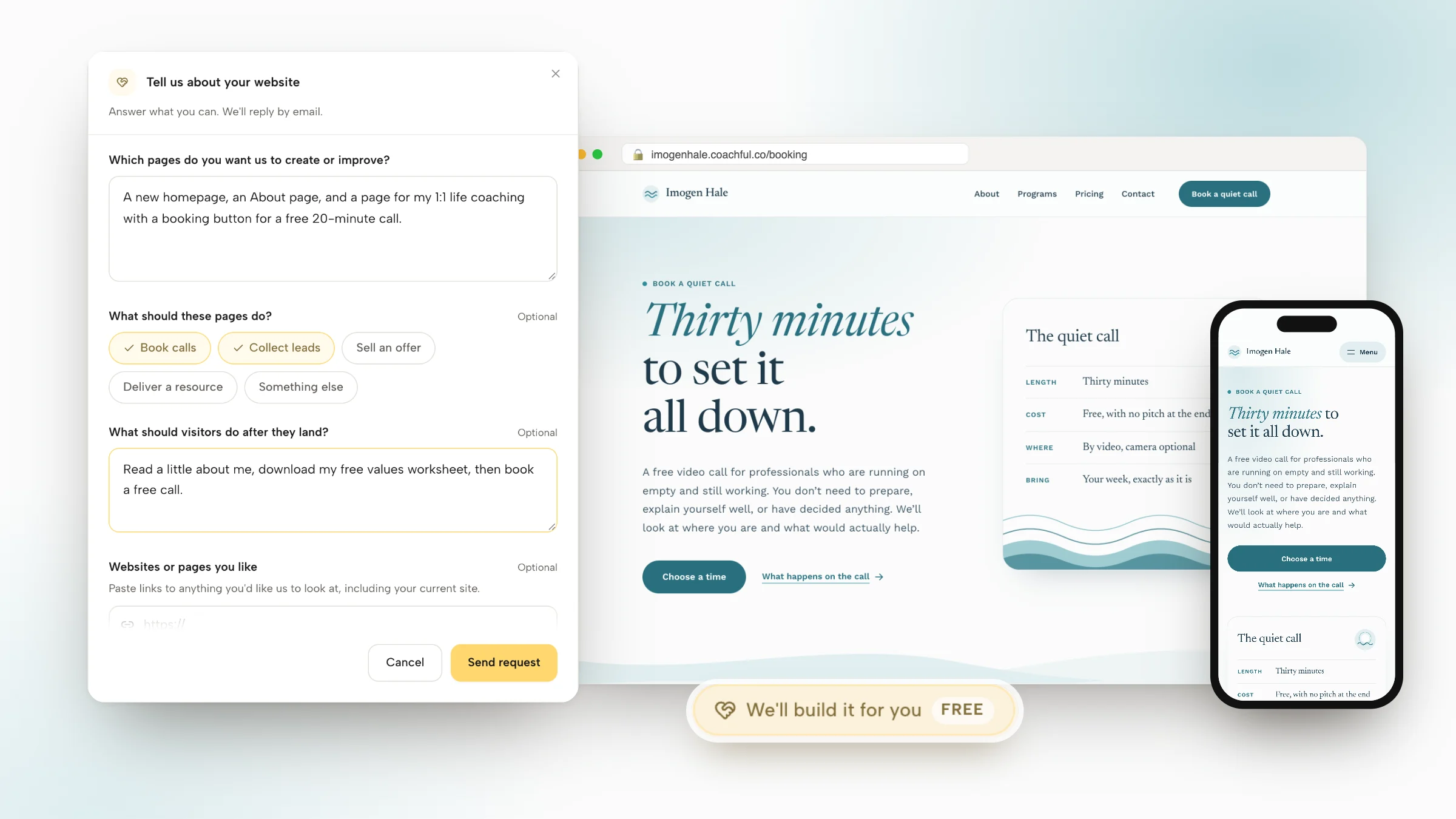
From there, this guide sets the roles side by side, lists the protocol you need before your first client, shows where the jobs are, and covers training, evidence, cost and time, pay, and the tools and privacy settings to use. When you go independent, Coachful's team will build your coaching website for free on every plan.
Mental health coach, peer specialist, counselor: who does what
| Role | What they do | What it takes |
|---|---|---|
| Mental health or wellbeing coach | Goals, habits, stress, sleep, coping skills and follow-through for people who aren't in crisis | Coach training; no license |
| Mental health peer specialist | Support from someone with lived experience of a mental health condition | State peer certification, often 40 to 60 training hours |
| Licensed professional counselor or therapist | Assessment and treatment of mental health conditions | A master's degree, supervised clinical hours, an exam and a state license |
| Psychologist | Assessment, testing and therapy | A doctoral degree and a license |
| Psychiatrist or psychiatric nurse practitioner | Diagnosis and medication | Medical or advanced nursing training and a license |
The Bureau of Labor Statistics describes the licensed counseling route: a master's degree and a set number of supervised clinical hours, an exam and annual continuing education. States protect the title "psychologist", and many also restrict "counselor" and "therapist", so check what you may call yourself before you print anything. "Mental health coach" is a description of a coaching focus, not a protected title, which is exactly why clients need you to explain it.
Before your first client: the non-negotiables
Every mental health coach needs these in writing before the first session:
- A crisis protocol. What you'll do if a client says they're thinking of suicide or self-harm, including the emergency number where they live. In the US, the 988 Suicide & Crisis Lifeline takes calls and texts. Our emergency escalation protocol is a template.
- Screening at intake. Ask whether they're currently in treatment, have a diagnosis, take psychiatric medication or have been hospitalized. None of these rules a client out, but they change how you work and who else should be involved.
- A referral list of therapists, psychiatrists and crisis services near your clients, including low-cost options.
- A clear agreement that says coaching isn't therapy, what you'll do if you're worried about their safety, and what stays confidential.
- Supervision. Someone you talk your cases through with. Our guide to coaching supervision explains how it works.
See a licensed professional when: a client describes thoughts of suicide or self-harm; symptoms such as low mood, panic or intrusive thoughts are stopping them from working, sleeping or caring for themselves; they describe trauma that floods them in sessions; they're drinking or using drugs to cope; or they ask you to help them stop psychiatric medication. Refer, and if they're in treatment already, coach only with their clinician's knowledge.

Where mental health coaches work
- Employee wellbeing programs. Employers and benefits providers buy coaching for stress, burnout and work-life balance, often alongside an employee assistance program.
- Digital mental health services. Some apps and online services use coaches for lower-intensity support and refer up to therapists when needed. Requirements vary, so read several job listings before you choose training; some ask for a degree in psychology or a related field as well as coach training.
- Clinics with stepped care. Some practices use coaches for skills and follow-through while clinicians handle treatment.
- Private practice, usually with a tight focus such as stress for new managers, burnout in healthcare workers or sleep and routines for students.
The employed routes teach you fastest, because they come with supervision and clear escalation rules, which makes them a sensible place to start before you go independent.
Mental health coach training options
| Training | What it covers | Why it matters |
|---|---|---|
| NBHWC-approved health and wellness coach training | Behavior change across health, including stress and sleep; leads to the NBC-HWC board exam after 50 logged sessions | The credential most US employers and digital health services recognize |
| ICF-accredited coach training | Core coaching competencies; ICF credentials from 60 hours of education and 100 coaching hours | Recognized across corporate and private coaching |
| Mental Health First Aid (National Council for Mental Wellbeing) | A day-long in-person course, or a two-hour self-paced module plus a half-day instructor-led session, teaching the ALGEE action plan | How to offer first-level support and get someone to help; it isn't a clinical credential |
| State mental health peer certification | SAMHSA's model standards recommend 40 to 60 training hours and lived experience of a mental health condition | The route if your lived experience is central to your work |
| Motivational interviewing | A conversation style for ambivalence and change | The most useful single skill in this niche |
Before you pay for any program sold as a "mental health coach certification", ask who accredits it and what it lets you do that general coach training doesn't. Our sibling guide to mental health coach certification compares programs, and NBHWC's eligibility page sets out the board route.
What the research says about coaching for wellbeing
The best-known meta-analysis of coaching outcomes, by Theeboom, Beersma and van Vianen in the Journal of Positive Psychology in 2014, found significant positive effects of coaching on performance and skills, well-being, coping, work attitudes and goal-directed self-regulation, with effect sizes from 0.43 for coping to 0.74 for goal-directed self-regulation. Two caveats matter for this niche: the studies were in organizational settings, and they weren't about people with mental illness. Coaching has good evidence for helping people cope and function better. It isn't evidence for treating depression or anxiety disorders, and you shouldn't market it that way.
Cost and time
| Step | Typical time |
|---|---|
| Mental Health First Aid | One day, or two hours online plus a half day |
| Coach training (ICF or NBHWC-approved) | Several months to a year part time |
| Logged sessions for a credential | A few months (NBHWC's 50 sessions) to a year (ICF ACC's 100 hours) |
| A licensed counseling route instead | A two- to three-year master's plus supervised hours after graduation |
Budget for professional liability insurance before you take clients; mental health-adjacent coaching is exactly where insurers ask detailed questions. Our insurance checklist covers what to ask.
What mental health coaches earn
Coachful's rates data has no figure specific to mental health coaching. The nearest band, health and wellness coaching, is $75 to $200 an hour and $52,000 to $77,000 a year in the 2026 report (PayScale, ZipRecruiter and Glassdoor). For context, the BLS reports a median of $59,350 in May 2025 for substance abuse, behavioral disorder and mental health counselors, a licensed, adjacent occupation rather than a coach salary. Employed coaching roles are usually salaried; private coaches sell packages such as a three-month program of eight to ten sessions, which practitioner reports put at $900 to $2,000 in health and wellness.

The tools, and the privacy settings that matter
Mental health coaching data is sensitive even when it isn't clinical. Choose tools that keep it in one place, and turn on the strictest settings you can live with. In Coachful, included in your membership:
- Check-ins with mood and energy questions you design, answered in the client app, and a client overview that shows average mood and who has gone quiet.
- Habits with reminders for sleep, movement and wind-down routines.
- Session notes, with a client-facing summary of the thread so far built from them.
- Sensitive Data Mode, an owner-only setting under Manage > Customize > Compliance that blocks AI processing of client records, notes, check-ins, questionnaires, call recordings and transcripts, and keeps automated client reports inside Coachful.
- Agreements for e-signature, with your scope and crisis clauses.
Be clear about the limits: Coachful is GDPR-ready with full data export but not HIPAA-certified, and Sensitive Data Mode doesn't make it a clinical-record system. If you work for or with a US clinic, ask whether HIPAA applies before choosing any tool. See the Coachful pages for mindset coaches and health coaches, and our guide to separating therapy and coaching if you're also licensed.


A website that explains coaching vs therapy, built for free
A mental health coach's website has to say clearly what coaching is and isn't, without sounding defensive. Coachful's team builds it for free on every plan, inside your account: homepage, how it works, a "coaching or therapy?" page, About and booking. Coachful itself is a paid subscription, and you can start with a free trial.

Click Fill in a form on the "Want us to build it for you?" card on the Website page, or choose We'll build it for you · FREE under Create. Say which pages you want and what they should do; add up to 8 links and up to 10 files. The team replies by email with next steps, usually within about 24 hours, which is typical rather than guaranteed. A recent build for a psychologist-turned-coach working on emotional eating produced a homepage with three clear paths (book a call, join the community, enroll in the program) and a community funnel that delivers a guide. Nothing is invented: no credentials, outcomes or testimonials you don't have. Logos, video and ads aren't included. See everything the free build covers.

Finding your first clients
- Pick a group with a clear stressor: new managers, nurses on night shifts, founders in their first year, students in exam season.
- Build two-way referrals with therapists. Therapists often have clients who've finished treatment and want help with routines, and you'll have clients who need therapy.
- Offer workshops to employers. A 45-minute session on sleep and recovery for a team is an easy first purchase for HR.
- Write plainly about the difference between coaching and therapy. It ranks, it reassures readers and it brings you better-fit clients.
For a client-side view you can share, our sibling guides on burnout coaching and stress management coaching explain what this kind of coaching looks like to the people you'll serve.
Frequently asked questions
Can a mental health coach diagnose or treat anxiety and depression?
No. Diagnosis and treatment of mental health conditions belong to licensed clinicians such as counselors, psychologists and psychiatrists. A mental health coach can help with habits, stress, sleep and coping, and should refer anyone with symptoms that need treatment.
Do you need a degree to be a mental health coach?
Not for private coaching, though some employers and digital services ask for a degree in psychology or a related field. NBHWC board certification accepts an associate degree or 4,000 hours of work experience in any field.
What is the difference between a mental health coach and a therapist?
A therapist is licensed to assess and treat mental health conditions and holds at least a master's degree with supervised clinical hours. A mental health coach supports wellbeing and behavior change for people who aren't in crisis and refers clinical needs.
Is Mental Health First Aid a certification to practice?
No. Mental Health First Aid, run by the National Council for Mental Wellbeing, teaches how to offer first-level support and connect someone to help. It's useful for coaches but isn't a clinical or coaching credential.
How much do mental health coaches make?
Coachful's rates data has no mental-health-coach figure. Health and wellness coaching, the nearest band, runs $75 to $200 an hour and $52,000 to $77,000 a year. Licensed counselors, an adjacent occupation, had a BLS median of $59,350 in May 2025.
What should a mental health coach do in a crisis?
Follow your written crisis protocol: stay with the person, contact emergency services if they're in immediate danger, and connect them to crisis support. In the US, the 988 Suicide & Crisis Lifeline takes calls and texts. Document what happened afterwards.
Will Coachful build my coaching website for free?
Yes. Coachful's team builds coaching websites, booking pages and funnels for free on every plan. Fill in the form from the Website page or Create and the team replies with next steps, usually within about 24 hours. Coachful is a paid subscription; the build costs nothing extra.












