Online Coaching Emergency Plan: What to Set Up Before a Crisis

If someone is in immediate danger right now, call the emergency number for the place where they are. This article is about preparing in advance. It is not clinical or legal advice.
Forty minutes into a video session, your client goes quiet and then says something that makes your stomach drop. You are in Lisbon. They are, you think, somewhere near Denver. You do not have their address or know who they live with. You are not sure your own emergency number would reach anyone who can get to them, and part of you is wondering whether you are even allowed to call.
Most coaches never face this. The fear of facing it unprepared sits at the back of the mind anyway: freezing, saying the wrong thing, overstepping into therapy, breaking a confidence, or doing too little.
The International Coaching Federation's guide Referring a Client to Therapy draws the line in one sentence: "Immediate danger to the client or someone else requires direct intervention (see “Emergency Situations,” on page 18)." That section gives the reason to prepare: "Emergency situations are rare but do occur, so having a plan for handling them is helpful."
The short answer: build the plan before the appointment, because in an emergency you will not have time to look anything up. For every client you see online, hold four things: where they physically are during sessions, the emergency number and a crisis line that work in that place, a person you may contact for them, and their written agreement that you can act if you believe someone is in immediate danger. Add a simple record of what you did, and one rule for yourself: in an emergency your job is to get help to the client, and assessing or treating them belongs to someone else.
The ICF guide and Coachful details were checked on 3 October 2026.

Why an online coaching emergency plan starts with location
The ICF guide tells coaches to "phone the local police or emergency services immediately" if they believe a client is in imminent danger. In a shared room, local means one thing. On a video call it has to mean local to the client, and that is where remote coaches get stuck.
Emergency numbers generally connect you to dispatch for the place you are calling from. If your client is in another city or country, your dispatcher may be able to pass the call on, but that costs minutes, and across borders it may not be possible at all. Responders also need an address. "She is on a video call with me" gives them nowhere to go.
So the first field in your protocol is where the client is sitting during the session. A time zone on a booking is a hint. A billing address is a hint. Clients travel, join from the office or sit in a parked car. Ask.
- The address they usually join from, collected at onboarding.
- A one-line check at the start of each session: "Are you at home today?" If not, note where they are.
- A phone number that reaches them if the video drops.
Telehealth has dealt with this problem for years. The session below, from the Mid-Atlantic Telehealth Resource Center, was made for telemental health providers. It covers why dialling your own emergency number is not a workable plan for a remote client, and the preparation that replaces it. Take the logistics from it and leave clinical risk assessment to clinicians.
A 52-minute training for telemental health providers on preparing for remote emergencies. Source: Mid-Atlantic Telehealth Resource Center on YouTube.
Local support to look up before an online coaching session
For each client, write a short list while nothing is wrong.
- The emergency number where they are. For example 911 in the United States and Canada, 999 in the United Kingdom, 112 across the European Union and 000 in Australia. Short emergency codes often cannot be dialled from abroad, so if your client is in another country, also look up a full-length number for the police or ambulance service in their area.
- A crisis line that works there. In the United States that is the 988 Suicide and Crisis Lifeline. For other countries, the ICF guide points coaches to Befrienders Worldwide and the International Association for Suicide Prevention for crisis centre contacts.
- An emergency contact. A name, relationship and phone number the client has agreed you may call, ideally someone physically near them.
- Your own consult list. The ICF guide says that if you are concerned but do not believe the danger is immediate, or you are unsure, you can contact one of the therapists in your list of contacts and ask for a consultation. That only helps if the list exists before you need it.
Keep all of it on one page per client that you can open in ten seconds, including when your internet or coaching platform is down. If the page lives only in a tool that is offline, you do not have it. Our coaching platform outage plan covers the fallbacks.
The escalation decision a coach makes in the moment
You do not need a clinical framework. You need three levels and a rule for each, decided on a calm day.

Immediate danger
You believe the client or someone else is about to be seriously hurt. The ICF guide's steps are to call the emergency number, stay with the person until help arrives, and listen without judging, arguing, threatening or yelling. Online, staying with them means keeping the call open while you phone from a second device.
- Say what you are doing: "I am worried about your safety and I am calling for help now."
- Give the dispatcher the client's name, their address, what was said and your own number.
- Call the emergency contact if the client agreed to that.
- If you think someone is considering suicide, the guide says to get help from a crisis or suicide prevention hotline.
The guide's emergency section includes further steps, including what to ask about means of harm. Read it in full before you need it.
Serious concern, no immediate danger
Stop the coaching agenda. Say what you have noticed in plain words, without naming a condition. Share the local support details, encourage the client to speak to a mental health professional and offer a referral. If you are unsure how worried to be, this is where the guide suggests a consult with a therapist on your list. If you cannot reach one and you believe the danger may be immediate, treat it as immediate.
Ordinary distress
Tears, frustration or a terrible week are part of coaching. Check in, carry on and make a note if a pattern builds. The guide's advice applies here too: "Use your professional experience, judgment, and instincts. Do not ignore any signs of concern in your client’s behavior."
The same three levels cover a medical emergency on camera, such as a client who collapses or reports chest pain. The location and the local number matter just as much.
What coaches should document after an emergency
Write the record the same day, while you still remember the order of events. If a client, a family member, an insurer or a complaints body later asks what happened, a factual note made on the day is your account.

- Date, time, and where the client said they were.
- What the client said, in their words as closely as you can recall.
- What you saw and heard. Leave out interpretations and never write a diagnosis.
- What you did and when: who you called, what you told them and what they said.
- What you told the client you were doing.
- The follow-up you agreed and its date.
Keep this record apart from ordinary session notes, especially any notes your client can see, and limit who can open it. Decide how long you keep it using your record retention and deletion policy. If an AI note-taker was running, find out what it captured and where that went; our guide to AI session notes and client consent explains the choices. Check whether your professional liability insurer expects to be told.
Professional boundaries for coaches in an emergency
The worry about overstepping is reasonable, and it is also what makes coaches hesitate. A written boundary removes the hesitation.
| Yours to do | Leave to others |
|---|---|
| Get help to the person and stay with them | Diagnosing or naming a condition |
| Say plainly what you are doing and why | Deciding how serious the risk is over days or weeks |
| Share the minimum needed with responders or the emergency contact | Treating, counselling or coaching the client through the crisis |
| Refer, follow up once and record it | Being on call afterwards |
Two habits protect both of you. Never promise secrecy you cannot keep: "I cannot keep this between us if I think you are in danger" is an honest thing to say. And put the limits in the coaching agreement before session one. Wording like this is a starting point for your lawyer to adapt, because the rules differ by country and state:
- "Coaching is not therapy, medical care or a crisis service, and I do not monitor messages for emergencies."
- "If I believe you or someone else is in immediate danger, I may contact emergency services or your emergency contact and share the information needed to get help to you."
- "You agree to tell me at the start of a session if you are joining from somewhere other than the address you gave me."
Our coaching agreement template shows where clauses like these sit. For the messaging side, see between-session support boundaries, and for groups, group coaching confidentiality.

The two-minute check before every online coaching appointment
- Open the client's emergency page: address, local numbers, emergency contact.
- Keep a phone within reach that is not the device running the call.
- At the start, confirm where the client is today.
- Know how you will reach them if the video drops.
- For a new client, check the agreement is signed and the emergency contact is filled in.

After a coaching emergency: follow-up and your own recovery
- Follow up when you said you would. A short message is enough, and the coaching can wait.
- Decide together what happens to the coaching. It may pause, end or continue alongside therapy. The ICF guide notes that some clients benefit from coaching and counselling at the same time.
- Debrief with a mentor coach or supervisor, leaving out identifying details.
- Fix the protocol. Whatever you had to search for during the event goes on the page.
- Look after yourself. An event like this stays with you. Give it room before your next session.
If the event exposed looser boundaries than you thought you had, our guide to resetting a coaching agreement covers that conversation.
Objections coaches raise about an emergency protocol
"Asking for an emergency contact will scare clients off." Ask everyone, and say why: "Because we meet online, I ask every client where they join from and who I should call in an emergency." Asked of everyone, it reads as care.
"I coach executives. This will not happen in my practice." It may not. The plan costs one page per client, and it also covers a medical emergency on camera.
"Calling would break confidentiality." That is why the limit goes in the agreement first. What the law requires or allows varies by place, so take legal advice for where you and your clients are.
"What if I call and I was wrong?" You will have an awkward conversation and a record showing you acted on what you saw. The other mistake is much harder to repair.
Where Coachful fits in a coaching emergency protocol
We make Coachful, so weigh this section accordingly. Coachful is coaching software and not an emergency service, and the call for help is always yours to make. It can hold the preparation.
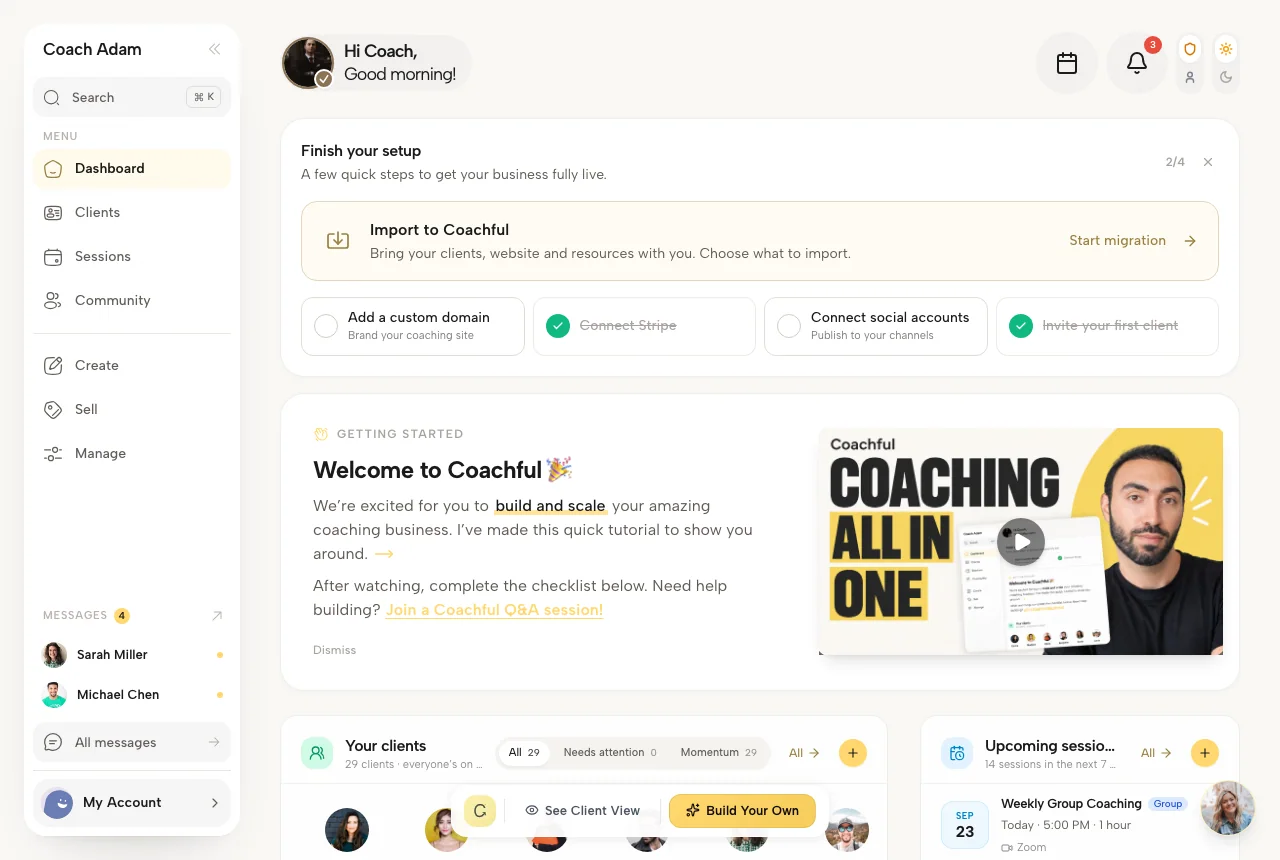
- Location and emergency contact: questionnaires and intake fields on booking attach the answers to the client record.
- Agreement: agreements with e-signature are sent before the first call, so the clauses above are signed before you meet.
- The session itself: calls run on built-in video that is part of the subscription, so you do not need a separate video tool. Zoom, Google Meet or Teams links can be created automatically if you prefer them.
- Messaging boundaries: chat settings let you choose which clients get a direct chat with you. Say in writing that chat is not monitored for emergencies.
- Notes: the client's Sessions tab shows a summary drawn from your session notes, so check what a client can see before you write an incident record there.
Two limits to be plain about. Coachful is not HIPAA-certified, so it is not the place for clinical records; if you also hold a therapy licence, see keeping therapy and coaching separate. And keep an offline copy of each emergency page whatever tool you use. A printed sheet in a folder works. If you want to try Coachful, there is a 7-day free trial: card required, no charge during the trial, cancel in one click.
Frequently asked questions
What should an online coach do if a client is in immediate danger during a session?
Call emergency services for the place where the client is, give their address, and keep the call with the client open until help arrives. The ICF guide's steps are to call the emergency number, stay with the person, and listen without judging, arguing, threatening or yelling. Then contact their emergency contact if they agreed to that.
Can a coach call emergency services for a client in another country?
Often not through the short code. Your own emergency number reaches dispatch where you are, and short codes frequently cannot be dialled from abroad. Look up a full-length local police or ambulance number for the client's area in advance, and hold an emergency contact who is physically near them.
Do coaches have a legal duty to act when a client is at risk?
It depends on where you and the client are and on any other licence you hold, so take legal advice. The ICF guide says immediate danger to the client or someone else requires direct intervention. Put the limits of confidentiality in your coaching agreement so the client knows in advance.
Is it a breach of confidentiality to call a client's emergency contact?
It is far easier to defend when the client agreed to it beforehand. Collect the contact at onboarding with a line saying when you would use it, and share only what is needed to get help to the client. Local law varies, so have the wording reviewed.
What should a coach write down after an emergency?
The date and time, where the client was, what they said in their own words, what you observed, who you called and when, what you told the client, and the follow-up agreed. Keep it factual, leave out diagnosis, and store it apart from notes a client can see.
Should I ask corporate coaching clients for an emergency contact too?
Yes. Ask every client the same questions. With company-paid coaching, make clear that the sponsor is not the emergency contact unless the client chooses them, and that an emergency does not change what you report to the employer.
Where do I keep client emergency details in Coachful?
Ask for them with intake fields on booking, which attach the answers to the client record. Sessions run on built-in video included in the subscription, so the record and the call sit in one place. Keep an offline copy as well, in case you cannot get online.