Coaching Progress Report Template: What to Share With Clients and Sponsors

Coachful
Editorial Team

How do you show that coaching is helping without turning a progress report into a transcript for the person paying? Use a short report that separates delivery, evidence of change and the next decision. Share only the information agreed for that audience, identify where each signal came from, and leave private session content in the coaching record.
A useful coaching progress report template is not a collection of everything you know about a client. It is a selective account of an agreed goal, the evidence available now, the limits of that evidence and what happens next. For a self-funded client, it supports reflection. For an organizational sponsor, it supports an agreed development review without granting access to the coaching relationship.
This guide gives you a copyable template, a hypothetical filled example and a practical reporting workflow. It is written for coaches preparing reports, not employers seeking access to confidential conversations. The sample wording is a starting point, not legal advice or a substitute for your agreement.
Start with the decision the report must support
Before opening a document, finish this sentence: “After reading this, we need to decide whether to…” Continue the current experiment, revise a goal, remove a delivery obstacle, arrange another review or close the engagement. If you cannot name a decision, you may be producing an update because the calendar says so.
Then name the reader. The client, the client's manager, HR, a program administrator and a procurement contact do not automatically need the same information. A sponsor may need a progress summary while finance only needs an invoice. Combining those audiences into one attachment makes unnecessary disclosure more likely.
- Client review: What has changed, what still matters and what should we try next?
- Sponsor review: What can be said about the agreed development objectives, within the reporting agreement?
- Delivery update: Is the engagement proceeding as planned, and does someone need to resolve a logistical issue?
- Closing report: What evidence is available at the end, what remains uncertain and who owns the next steps?
Use separate versions when audiences differ. A document marked “confidential” is not protected from over-sharing if its recipient list is wrong.

Agree reporting boundaries before the first update
The ICF Code of Ethics places agreements, confidentiality and legal compliance at the center of professional conduct. Its definition of confidentiality recognizes written client consent and specified legal or harm-related circumstances. An employer paying for coaching is not, by itself, a blanket invitation to share what a client says.
Establish the reporting arrangement with the relevant parties before coaching begins. If a sponsor adds a new request midway through, revisit that arrangement rather than quietly expanding the report. Applicable law, professional obligations and the specific contract also matter.
Document these decisions in plain language:
- Who will receive the report and whether onward sharing is permitted.
- Which goals, attendance details or progress indicators may be included.
- Which material stays private, including personal disclosures and session notes.
- How often reporting happens and who reviews the wording before release.
- How a proposed change or exceptional disclosure will be handled.
- Where reports are stored and how access and retention are managed.
A practical opening question is: “What information do you need to make the agreed development decision, without knowing what we discuss privately?” It helps separate a legitimate reporting need from curiosity.
For the conversation around those boundaries, see our guide to stakeholder alignment meetings. This article covers the written report that can support that conversation, not replace it.
Separate activity from outcomes
“Four sessions completed” and “delegates more consistently” answer different questions. The first concerns delivery. The second needs a defined behavior and evidence. A client can attend every session without making the intended change, or make useful changes while needing to adjust the schedule.
Keep three kinds of information visibly separate:
- Delivery: Sessions held, program stage and the next review point, if sharing these is agreed.
- Evidence: What the client, a permitted observer or a work artifact indicates about the goal.
- Interpretation: What that evidence reasonably supports, what it cannot establish and what to do next.
Completion percentages need particular care. A progress bar may describe tasks completed in a program, not the percentage of a person's leadership capability developed. Use the label the underlying record actually supports.

Copyable coaching progress report template
Copy the headings below into your preferred document. Remove fields that do not support the reporting purpose. Complete the recipient and disclosure fields before writing the narrative, so the audience shapes what you include.
1. Report details and sharing boundary
- Client or agreed identifier: [Name or identifier]
- Coach: [Name]
- Reporting period: [Start and end]
- Engagement stage: [Opening, midpoint, closing or other agreed stage]
- Intended recipients: [Names or roles]
- Sharing basis: [Relevant agreement and written permissions]
- Purpose: [The decision this report supports]
2. Short status summary
[One or two factual sentences about the engagement and the agreed objective. Distinguish delivery status from progress status. If evidence is unavailable, say so rather than assigning an optimistic rating.]
3. Agreed goal and evidence
- Reportable goal: [Observable behavior or outcome, using agreed wording]
- Baseline: [Starting observation, date, source and measure]
- Current observation: [Comparable observation, date, source and measure]
- Evidence source: [Client self-report, agreed stakeholder feedback, work artifact or other permitted source]
- Interpretation: [What appears to have changed]
- Limitations: [Missing information, changed context, comparability or attribution concerns]
Repeat this section only for goals included in the reporting arrangement. Private goals belong in the private coaching record, even when they help explain the work.
4. Obstacles and decisions required
- Relevant obstacle: [A shareable delivery or development constraint]
- Decision required: [Specific action, or “No decision requested”]
- Owner: [Person or role]
- Review point: [Date or agreed stage]
5. Next-period plan
[The next behavior to practice, the evidence to review and the next check-in. State any agreed change to the goal, method or scope.]
6. Review and release record
[Who reviewed the report, what was approved for sharing, the approval date, final recipients and version. Record the actual release separately from the draft.]
This structure deliberately omits session-by-session summaries, diagnostic labels, raw assessment responses and explanations of the client's private motivations. Additions need a reporting reason and an appropriate sharing basis, not simply available space.

A filled example: a midpoint delegation report
The following example is entirely hypothetical. The names, observations and engagement details are invented to demonstrate reporting language. They are not Coachful customer results, a benchmark or a claim about coaching effectiveness.
Details: Client A; midpoint review; recipients are Client A and the named sponsor. The agreed purpose is to decide whether to continue the delegation experiment. The reporting agreement permits the shared goal, client-selected observations and next actions, not private session content.
Status: Four of six planned coaching sessions have taken place. Client A reports more consistent delegation of routine decisions. No independent outcome measure has been collected for this review.
Goal: Delegate routine project decisions with a named owner and an agreed escalation boundary.
Baseline: At the opening review, Client A reported using this approach on one of the previous five workdays. The question asked about the same defined routine decisions, not delegation in general.
Current signal: At midpoint, Client A reports using the approach on three of the previous five workdays. Client A selected a non-confidential meeting agenda showing assigned decision owners as a supporting example.
Interpretation and limitations: The self-report and selected artifact suggest more consistent practice. They do not establish sustained change, team impact or a financial return. The organization also introduced a new decision process during this period, so change cannot be attributed solely to coaching.
Decision and next step: Continue the experiment through the next review. The sponsor will confirm which routine decisions the role can delegate. Client A and the coach will review the same behavior question again and decide whether another agreed evidence source would be useful.
Notice what is absent: why the client struggled to delegate, what they said about the sponsor, and the coach's interpretation of their personality. Those details are not necessary to make the stated decision.

Choose evidence you can describe honestly
A report becomes weak when its language outruns its source. “The client reports…” is different from “the team observed…” Neither should become “coaching caused…” without a defensible basis. Name the source close to the observation rather than hiding it in a footnote.
Client self-report
Self-report is useful for experiences such as confidence and for behaviors the coach cannot observe. Repeat a clear question over a defined period. “How consistently did you prepare a decision brief before the relevant meetings this week?” is more interpretable than “How are things going?”
If you use a numerical scale, keep its meaning consistent. Define what the low and high ends mean for that client. A changed rating can reflect changed understanding as well as changed capability. Do not treat the number as a clinical assessment or a standardized test unless it is one.

Stakeholder observations
Agree who is asked, what they are asked and how responses may be used. A manager who saw one meeting has a different basis from someone who worked with the client throughout the period. Describe that exposure instead of presenting every response as equally comprehensive.
Do not promise anonymity that the reporting context cannot support. In a small team, a distinctive quotation or a named incident may identify its author even after names are removed. Use an appropriate process and explain its limits before collecting feedback.
Work artifacts and operational measures
An agenda, delegation plan or completed action can make a behavior more concrete. Get permission to use the material, remove unnecessary information and check whether it contains other people's confidential data. Often a factual description is sufficient; you do not need to attach the original file.
Operational measures need context too. Revenue, retention or performance may change for reasons unrelated to coaching. Report a relevant trend when appropriate, but distinguish association from attribution. A financial ROI calculation needs a justified method, not merely a before-and-after number.

Use the report to decide, not to grade the client
A useful report can show limited progress. That is not an administrative failure. It is an opportunity to decide whether the goal, evidence, support or delivery needs changing.
For example, a missed habit might mean the action was unrealistic, the logging method was burdensome or the client's situation changed. Do not automatically translate it into “low commitment.” Ask what happened and report only the explanation that belongs within the sharing arrangement.
When the original goal no longer fits, make the change explicit. Keep the old baseline attached to the old measure, record why the new goal was agreed, and establish a new starting point. Quietly moving the target makes the report easier to write and harder to trust.

Use plain status language such as “evidence of progress,” “mixed evidence,” “insufficient evidence” or “goal under review.” Explain the label in a sentence. A traffic-light rating without a shared definition is an opinion wearing a dashboard costume.
A repeatable review and release workflow
- Check the audience and agreement. Confirm that this period's recipients and reporting purpose have not changed.
- Review the underlying records. Look at the relevant goal, agreed check-ins and delivery history. Do not export the entire client record as a shortcut.
- Draft source-labeled observations. Separate the baseline, current signal, interpretation and limits.
- Review with the client as agreed. Correct factual errors, clarify wording and resolve disclosure questions before release.
- Release only the approved version. Check the attachment, recipients, sharing permissions and access route.
- Record the next decision. Assign an owner and review point rather than ending with a vague promise to keep working.

Choose a cadence that matches the engagement. A short package may only need a midpoint and closing review; a longer organizational engagement may have an agreed periodic update. There is no universal reporting frequency that substitutes for a useful purpose.
Budget reporting into your scope and fee. If a sponsor asks for extensive new analysis, additional stakeholder interviews or a different reporting format, discuss the work and permissions before treating it as an invisible extra.
Where Coachful can support the preparation
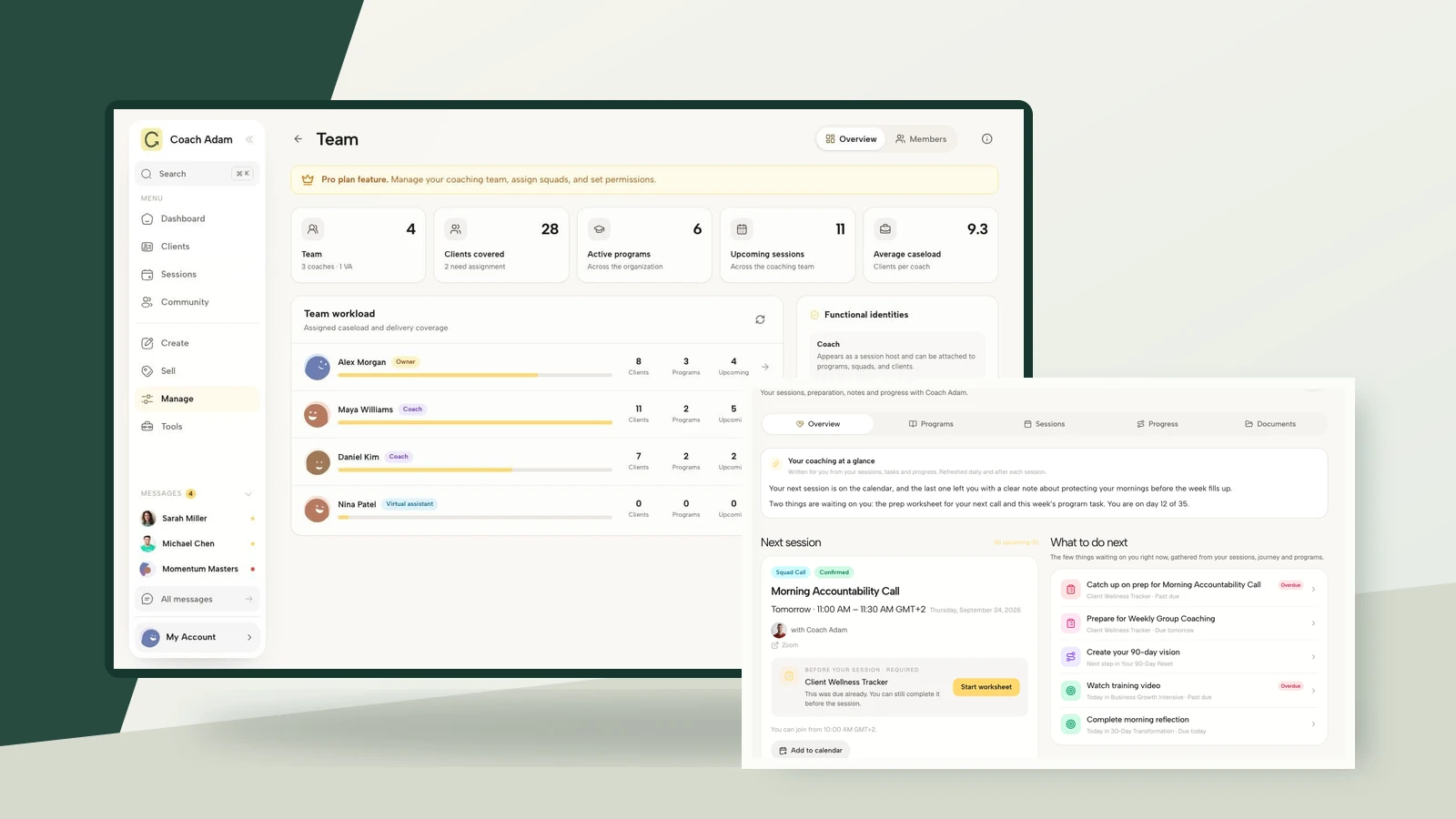
The screenshots in this guide show real Coachful demo surfaces for client records, goals, habits, coaching flows, sessions and client progress. Those records can support a review conversation. They do not decide what a sponsor is entitled to see.
The report template and filled example here are editorial resources. We are not presenting them as a native Coachful report export, an automated sponsor dashboard or a promise that reports are generated or delivered for you. Review the information and prepare the appropriate report through your chosen process.
If the difficult part is gathering the relevant client activity before a review, Try the interactive demo and inspect the client progress and session surfaces. Compare what you can see with the fields in the template, then keep the sponsor-facing summary narrower than the underlying record.
Questions coaches ask about progress reports
How long should a coaching progress report be?
As short as the agreed decision allows. A concise summary and a small number of goal sections are often more useful than a long narrative. Include enough evidence and context to prevent misunderstanding; do not add private material to make the report look substantial.
Can I send my session notes instead?
Do not use private notes as a substitute for an audience-specific report. Notes may contain disclosures, tentative interpretations and third-party information that do not belong in a shared update. Prepare a separate summary under the agreed reporting boundaries.
What if the sponsor wants information the client has not agreed to share?
Pause that proposed disclosure and revisit the agreement with the relevant parties. Explain what you can provide within the existing arrangement and seek appropriate ethical or legal guidance if obligations conflict. Do not quietly treat the funding relationship as consent.
What if there is no measurable improvement yet?
State what is known and unknown. Distinguish a missing measure from a measure showing no change. Identify whether to improve evidence collection, revise the approach or reconsider the engagement. An honest “insufficient evidence” is better than inventing a success story.
Is a progress report the same as a progress tracker?
No. A tracker gathers observations over time; a report selects and interprets appropriate information for a specific audience and decision. Our client progress tracker tool addresses measurement setup. Use this report template when deciding what to communicate from those records.
The standard is not “show everything that happened.” It is “show what this reader is permitted to know, what the evidence supports and what we should decide next.”