15 Associate Coach Interview Questions and a Paid Work Sample

Nour
Founder, Coachful
How do you know an associate coach can look after your clients, rather than simply interview well? Ask for specific examples, test their judgment with the same fictional scenario, and check how they respond to feedback. A good conversation and an impressive credential are starting points, not enough evidence to hand over a paying client.
The strongest associate coach interview questions cover five areas: coaching skill, ethical boundaries, delivery reliability, collaboration and self-awareness. Pair the interview with a short paid work sample. Decide your non-negotiables before meeting candidates so that confidence, similarity to you or a famous training school cannot quietly become the selection rule.
This guide is for a coach hiring another coach to deliver through their practice. It is not a sports-coaching interview guide, an ICF credential assessment or a test of whether someone would be a good virtual assistant. You will find 15 questions, signs to listen for, a copyable work sample and a practical evidence rubric.
Define the job before you choose the questions
A career coach supporting individual job changes and an executive coach serving employer-funded engagements need different experience. Write a short role brief stating the client population, coaching scope, delivery format, expected availability, administrative responsibilities and support you will provide.
Separate requirements that are genuinely essential from preferences. A credential required by a corporate contract is different from a credential you happen to hold. Experience working in a particular language or setting may matter more than familiarity with your favorite model. Check qualifications and any credential status directly with the issuing organization rather than trusting a logo on a résumé.
Also explain what “associate” means in your practice. Will the person deliver an established program, coach independently within an agreed scope, facilitate groups or help develop materials? Do not advertise independent coaching judgment and then assess people on whether they repeat your exact questions.

Commercial arrangements are a separate decision. Agree the engagement structure, responsibilities and compensation before work begins, with appropriate local professional advice. Our guide to structuring an associate coach delivery model covers the operating arrangement. This article addresses the earlier question: what evidence should convince you to select the person?
1. Coaching skill: can they help without taking over?
Question 1: “Tell me about a client who arrived with a goal that changed during the engagement. What did you do?”
Ask for an anonymized example, not a case file. Listen for how the candidate noticed the change, checked their interpretation and renegotiated the work with the client. A useful follow-up is: “What did the client decide, and what did you decide?” That distinction reveals whether client ownership exists in practice.
A concern is a story in which the coach knew the client's “real problem” from the beginning and pushed them toward it. The candidate need not use your terminology. They do need to distinguish an observation from a diagnosis and their preferred direction from the client's choice.
Question 2: “Describe a time you were tempted to give advice. How did you decide what to do?”
Look for awareness of the contracted role. Some practices explicitly combine coaching with mentoring or specialist advice. The useful answer explains how the candidate identified the change of role, asked permission where appropriate and stayed within their competence.
Neither “I never advise” nor “clients pay me for answers” settles the question. Ask what happened in one real situation. Can they explain why their intervention served that client, rather than merely defending a philosophy?
Question 3: “How would you turn a useful conversation into a realistic next step?”
Listen for a client-chosen action, an honest feasibility check and agreement about review. Strong candidates can make the action smaller when the client's week is already overloaded. They do not need to invent a complex accountability system for every conversation.
Then ask: “What if the client wants no action this week?” A thoughtful answer explores the purpose of the session and what the client wants to take away. It does not treat a worksheet submission as proof that coaching worked.

2. Ethics and confidentiality: will they protect the relationship?
Question 4: “A corporate sponsor asks for the client's private session notes. How would you respond?”
Look for reference to the agreed confidentiality boundaries, a pause before disclosure and a distinction between permitted engagement reporting and private content. Ask the candidate to say the actual first two sentences they would send. This tests judgment more clearly than asking whether confidentiality matters.
A concern is immediate agreement because “the company pays.” Another is an absolute promise that information can never be shared under any circumstances. Legal duties and safety exceptions depend on the situation and jurisdiction. The candidate should recognize limits, consult the agreement and seek appropriate guidance rather than improvise a universal rule.
Question 5: “Tell me about a situation you recognized as outside your competence. What happened next?”
Listen for concrete signs they noticed, a respectful conversation and a suitable referral or consultation pathway. They should not reveal identifying details to prove the story. A coach can describe their decision process without reciting another person's distress.
Be cautious about claims to handle every difficulty through coaching. Your practice should have its own escalation and emergency procedures, and the interview should test whether the candidate would use them. Do not expect a short hiring exercise to establish clinical competence or replace safeguarding checks required for the role.
Question 6: “You receive a client record you do not need for your work. What do you do?”
A useful answer includes limiting further access, notifying the appropriate person and following the practice's incident process. “I would keep it confidential” misses the access problem. Ask what the candidate would avoid doing, including downloading it into personal storage or forwarding it to another person.

The coaching code of ethics guide can help you prepare the discussion. For an actual hiring decision, use the professional standards, contracts and legal requirements that apply to your practice. A convincing interview answer does not verify compliance by itself.
3. Delivery reliability: can they do the ordinary work?
Question 7: “What availability can you reliably commit to, including preparation and follow-up?”
Use the actual delivery pattern you need. Ask about time-zone overlap, lead time for booking, realistic capacity and planned absences. Include the unglamorous work: preparation, records, agreed messages and coordination. A calendar full of session slots is not the same as capacity for the engagement.
Keep questions relevant to the role and apply them consistently. Ask whether the person can meet a defined schedule, not for information about pregnancy, family plans, disability or other protected personal matters. Offer a clear route to request reasonable adjustments under applicable law.

Question 8: “A client cancels late and asks you to make an exception to our policy. What would you do?”
Look for empathy without unauthorized promises. A candidate should clarify what happened, understand the policy, distinguish their authority from yours and explain the next step to the client. Ask how they would record the decision so that another team member can understand it.
Watch for automatic rigidity or automatic waivers. Neither demonstrates judgment. A coach who repeatedly promises exceptions can create obligations your practice never agreed to, even while trying to be kind.
Question 9: “Tell me about a time you missed a commitment. How did you repair it?”
Ask for a specific incident and the candidate's own contribution. Listen for timely disclosure, a practical repair and a change to their process. An answer consisting entirely of explanations about difficult clients or unreliable software leaves you without evidence of accountability.
Do not demand a dramatic confession. A mundane example of a late summary, an overlooked message or a booking mistake can reveal more than a rehearsed story with a heroic ending.
4. Collaboration: can they work inside a practice?
Question 10: “Which parts of an established coaching program would you follow, and which would you want freedom to adapt?”
Show a non-confidential outline of the work. Look for thoughtful questions about the purpose of the structure, client choice and the boundaries of adaptation. Someone who agrees to everything without examining it may be trying to get the job rather than assessing whether they can deliver it.
Your own answer matters too. Identify what is genuinely fixed, such as safety procedures or promised deliverables, and what can vary with the client. Consistency should not mean making an associate impersonate the founder.
Question 11: “How would you respond if you disagreed with my interpretation of a client situation?”
Listen for a respectful challenge supported by observations, not unquestioning loyalty. They should distinguish a professional disagreement from an urgent ethical concern. Ask: “What would you do if we still disagreed?” That follow-up exposes whether escalation has substance.
Question 12: “A client messages outside the agreed support hours. Please draft your reply.”
Give a fictional, ordinary request, not a crisis scenario disguised as an admin test. Look for warmth, a clear boundary and a specific next step. The candidate should not promise instant access, blame the client or casually offer services beyond the agreement.

For example, a candidate might write: “Thanks for sending this through. I will review it during our next agreed support window on Tuesday; if you would rather discuss it live, bring it to our session.” Whether that wording fits depends on your actual offer. You are assessing clarity, not whether they guess a response time you never supplied.
5. Reflection and fit: will they keep learning?
Question 13: “What feedback has changed how you coach?”
Listen for the feedback, the change and what the candidate noticed afterward. “Clients say I am a great listener” is praise, not evidence of learning. Ask what remains difficult. A useful colleague can describe a limitation without collapsing into self-criticism or disguising a strength as a weakness.
Question 14: “How do you use supervision, consultation or continuing development?”
Ask how they decide when to seek support and how they protect client confidentiality when doing so. Requirements vary by professional body, role and contract. Do not present your preferred frequency as a universal rule, but do define the arrangements your practice needs.
Question 15: “What would you need to know before deciding whether this role is right for you?”
This is not a trick. Strong candidates may ask about client matching, complaints, support boundaries, compensation, access permissions and your willingness to hear concerns. Answer honestly. An associate is also choosing a professional environment, and a mismatch discovered before hiring is useful information.

A short paid work sample you can copy
An interview tests what someone says they do. A work sample lets you observe a bounded piece of the work. A real executive-coaching provider, Notion, describes a selection process including a coaching delivery session, reflection and scenario activity. That is evidence of a real recruitment approach, not proof that one assessment format predicts success.
Here is an original fictional exercise to adapt. Tell candidates the fee, time cap, assessment criteria, accessibility arrangements and recording policy in advance. Pay for the exercise and any preparation you require. Do not use the process to obtain free client delivery, marketing materials or a commercial program design.

Case: Alex is a first-time manager who wants to delegate but keeps taking work back. Alex's employer funds the coaching. After a session, the sponsor emails asking for the private session notes. The agreement permits only attendance and client-agreed progress reporting, subject to applicable legal duties.
Task: Run a short role play with a consenting adult volunteer playing Alex. Then write a brief client follow-up and a separate reply to the sponsor. Explain what you would record, share and escalate.
Conditions: Use the same scenario and rubric for each candidate. Agree the fee and a manageable preparation and exercise time cap. Use no real client records, no production access and no actual messages to clients or sponsors. Obtain explicit permission before recording.
Brief the volunteer consistently so one candidate does not receive a cooperative client and another an intentionally obstructive one. Allow relevant clarifying questions. You are looking for coaching judgment, not rewarding the person who best tolerates hidden rules.
Afterward, ask: “What were you trying to achieve? What did you notice? What would you change?” Compare that reflection with what you observed. A candidate who can identify a missed cue and propose a better intervention may be more developable than one who insists every move was perfect.
Use an evidence rubric, not a chemistry score
Record observations under four headings: coaching skill, privacy and boundaries, delivery reliability, and reflection. For each, use a simple descriptive rating:
- 1: Concern. The observed response conflicts with a requirement, and you can state why.
- 2: Developing. Some relevant evidence is present, but a specific gap needs further assessment or support.
- 3: Demonstrated. The candidate shows the required behavior in the exercise or a credible, specific example.
- Not assessed. You do not yet have enough evidence. Arrange a targeted follow-up rather than guessing.
This is a practical organizing tool, not a validated psychological test. Do not invent a pass percentage or add decimal places to make it look scientific. Agree which requirements are hard gates. Serious unresolved privacy, competence or honesty concerns should not disappear into a strong average.

In the fictional comparison shown, Candidate A demonstrates stronger coaching skill but gives an unsafe privacy response. Candidate B needs skill development but recognizes the confidentiality boundary. The next move is not automatically to hire B. It is to investigate A's concern and decide whether B's development needs are compatible with the role and support available.
If two people interview candidates, record initial observations separately before discussing them. Separate facts from interpretations: “shared a named client story after being asked to anonymize” is evidence; “not our kind of person” is not a useful hiring criterion.
Before you hand over a real client
With the candidate's permission, obtain relevant references and verify the credentials, insurance or checks the role actually requires. Ask referees job-related questions about work they observed. Do not invite disclosure of confidential client content. Handle candidate information securely and define who can access it and how long you will retain it.
Confirm the contract and employment or contractor classification with qualified advice where needed. A label in an agreement does not settle legal status. Then document onboarding, escalation, supervision, access limits and the client introduction. Do not silently substitute a different coach for someone who bought an engagement specifically with you.
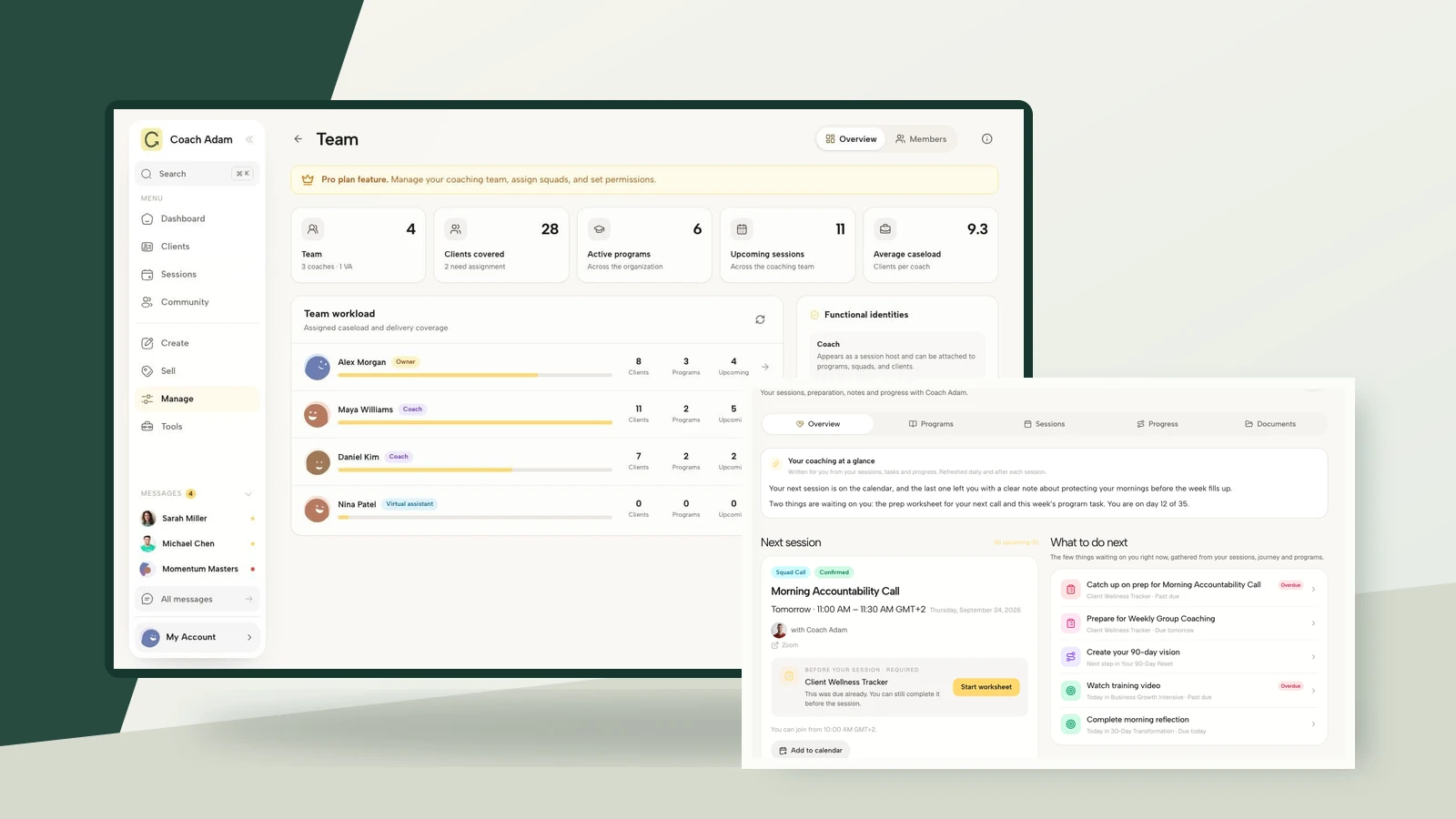
Coachful can help you inspect the actual delivery environment: Team, scheduling, programs, client workspaces and communication. It is not an applicant tracking system or an automated hiring decision. Use the interactive Coachful demo to identify the responsibilities your selected associate would need to handle, then build your onboarding and access checks around those responsibilities. Test the permitted and restricted views before real client information is involved.
The hiring decision is not “Did I like this coach?” It is “What evidence do I have that this person can deliver the role safely, reliably and with the support I can genuinely provide?” Keep that question visible, and the interview becomes a professional selection process instead of an enjoyable conversation followed by a gamble.