Coaching Code of Ethics: The ICF Code Explained (2026)
The most widely used coaching code of ethics is the International Coaching Federation's ICF Code of Ethics. The current version went into effect on April 1, 2025, and it has five parts: its purpose, the ICF's core values and ethical principles, commitments for everyone in the ICF's organizations, 24 ethical standards for ICF professionals in five sections, and a pledge. The standards cover agreements, confidentiality and legal compliance, conflicts of interest, delivering consistent value, and professional integrity.
Two other codes matter depending on your credential: the Global Code of Ethics shared by the EMCC, the Association for Coaching and ten other bodies, and the NBHWC's code for board-certified health coaches. This guide walks through the ICF Code section by section in plain English, shows what changed from the 2020 version, compares the other codes, and works through six situations where coaches actually get stuck.
And while you set up an ethical practice, Coachful's team will build your coaching website for free on every plan, with no testimonials, credentials or results invented along the way.
The ICF Code of Ethics at a glance
The ICF publishes the full text on its Code of Ethics page, with a PDF and translations. The PDF says the Code was board approved in October 2024 and revised in May 2026.
| Part | What it contains |
|---|---|
| 1. Purpose | Who the Code covers (the ICF's six family organizations, its professionals, staff and volunteers) and how it's enforced through the Ethical Conduct Review process |
| 2. ICF Core Values and Ethical Principles | Four values, Professionalism, Collaboration, Humanity and Equity, each with "I demonstrate..." principles |
| 3. Commitments for All Within the ICF Ecosystem | Eight commitments, from integrity and accountability to raising concerns about others' unethical conduct |
| 4. Ethical Standards for ICF Professionals | 24 standards in five sections, the part that applies to your coaching day to day |
| 5. The Pledge of Ethics | A promise to uphold the Code in all professional interactions |
| Appendix | Key definitions (client, sponsor, confidentiality, conflict of interest, artificial intelligence and more) and a glossary |
Two details are easy to miss. The Code says nobody in the ICF ecosystem may opt out of any part of it. And it ties ethics to the competency model: meeting the ethical standards is the first ICF Core Competency, Demonstrates Ethical Practice. Our sibling guide to the ICF Core Competencies covers that model.
The four ICF core values
- Professionalism: "A commitment to a coaching mindset and professional quality that encompasses responsibility, respect, integrity, competence, and excellence." In practice: accurate statements, delivering on commitments, lifelong learning.
- Collaboration: "A commitment to developing social connection and community building," including cooperating with other professionals working with the same client or sponsor.
- Humanity: "A commitment to being humane, kind, compassionate, and respectful towards others," including owning your mistakes and avoiding any suggestion of superiority.
- Equity: a commitment to understanding others' needs and practicing equitable processes, including awareness of conscious and unconscious bias.
The values are described as aspirational. The standards that follow are the enforceable part.

The 24 ethical standards, section by section
Each standard begins "As an ICF Professional, I..." Below is a plain-English summary of every one, in the ICF's numbering. Read the Code itself for the exact wording.
Section 1: Agreements for Client and/or Sponsor Engagement
- 1.1 Before coaching begins, explain what coaching is and co-create an agreement with the client, sponsor and other parties you're in a direct relationship with, covering roles, responsibilities, confidentiality and money.
- 1.2 Respect every party's right to end the coaching at any point, subject to the agreement.
Section 2: Confidentiality and Legal Compliance
- 2.1 Keep the strictest confidentiality with all parties, whatever role you're in.
- 2.2 Agree clearly what information is shared, and how, between everyone involved.
- 2.3 Agree in advance what confidential information might have to be disclosed, such as illegal activity, a legal requirement or court order, or imminent or likely risk of danger to the client or others.
- 2.4 Keep, store and dispose of records, including electronic files and messages, securely and in line with the law and your agreements.
- 2.5 Meet your ethical and legal obligations directly and through any technology you use, which the Code spells out as including coaching tools, databases, platforms, software and artificial intelligence.
- 2.6 Take responsibility for your support personnel following the Code.
- 2.7 Use other ICF professionals' contact details only as authorized.
- 2.8 Respect copyright and others' intellectual property, and claim only your own material.
Section 3: Professional Conduct and Conflicts of Interest
- 3.1 Discuss the implications of multiple agreements and relationships, and the potential for conflicts of interest.
- 3.2 Manage conflicts through self-reflection, the agreement and ongoing dialogue, including organizational roles and reporting requirements.
- 3.3 Resolve conflicts by working them through, getting professional help, or suspending or ending the relationship.
- 3.4 Set clear, appropriate and culturally sensitive boundaries, physical or otherwise.
- 3.5 Stay aware of your biases so you don't discriminate.
- 3.6 Don't take part in any sexual or romantic relationship with clients or sponsors, and act if the relationship starts to shift.
- 3.7 Tell the client when you're acting in a role other than coach, such as mentor, therapist, HR specialist or assessor.
- 3.8 Disclose any compensation or benefit paid or received for referrals.
Section 4: Commitment to Delivering Consistent Value
- 4.1 Recognize and, with the client, manage any power or status difference between you.
- 4.2 Recognize personal limitations or circumstances that may impair your coaching, get support, and suspend or end coaching if needed.
- 4.3 Notice when the value of coaching may be shifting, talk about it with the client, and consider a different coach, professional or resource.
Section 5: Professional Integrity and Accountability
- 5.1 Represent your qualifications accurately and work within your competence, training and credential.
- 5.2 Make only true and accurate statements about what you offer, what the ICF offers, coaching and its potential value.
- 5.3 Follow the philosophy of "doing good" versus "avoiding bad," mindful of your impact on clients, the profession and society.
The section closes with accountability: the ICF may hold professionals accountable through the Ethical Conduct Review, with sanctions that can include mandatory additional coach education, mentoring, supervision, or loss of ICF membership or credentials.

What changed from the 2020 Code
The previous ICF Code, used through March 31, 2025, had 28 standards in four sections: Responsibility to Clients, Responsibility to Practice and Performance, Responsibility to Professionalism and Responsibility to Society. The 2025 Code has 24 standards in five sections, reorganized around how coaching actually runs: the agreement, confidentiality, conflicts, value and integrity.
- AI is named. Standard 2.5 lists platforms, software and artificial intelligence, and the appendix defines AI. The 2020 Code referred more generally to technology-assisted coaching services.
- It's framed around the whole ICF ecosystem. The 2025 Code is built around the ICF's six family organizations and adds a part with commitments for everyone in them, staff and volunteers included.
- The values are written into the Code. The four core values now appear in the Code with first-person principles, "I demonstrate professionalism by..."; the 2020 version pointed to them by link.
Two practical notes from the ICF. Complaints about conduct before April 1, 2025 are still reviewed under the 2020 Code. And the ICF's Code page says the 2020 Code is being used within the ACC, PCC and MCC exams, while its guide to the new PCC-MCC exam starting November 10, 2026 says that format incorporates the most recent updates. If you're sitting an exam, check which version your exam uses at the time you book.
Other coaching codes of ethics
| Code | Who it applies to | Structure |
|---|---|---|
| ICF Code of Ethics | ICF members, credential holders, ICF-accredited programs, staff and volunteers | Five parts, 24 standards in five sections |
| Global Code of Ethics | Members of its 12 co-signatory bodies, including EMCC Global and the Association for Coaching | A shared code for coaching, mentoring and supervision; Version 4 dates from 2025 |
| NBHWC Code of Ethics and Professional Conduct | National Board Certified Health & Wellness Coaches | Definitions, standards in six areas, and a pledge |
The Global Code's own site describes it as a guidance document rather than a legally binding one, and says it also aims to guide people who use coaching or mentoring skills without calling themselves coaches. The NBHWC's code groups its standards under professional conduct with clients, conduct at large, conduct of approved training programs, faculty and mentors, conflicts of interest, confidentiality and privacy, and professional accountability, and ties coaches to the NBHWC scope of practice. If you hold credentials from more than one body, you're bound by each code.

Six ethics situations coaches actually face
1. The sponsor asks what the executive said
An HR director paying for coaching asks for "a quick update on how she's doing." Standards 2.2 and 3.2 are the answer, and they work best before it happens: agree at the start, in writing and with everyone present, what the sponsor will receive (often attendance and themes the client approves) and what stays between coach and client. Then point back to the agreement. Our guide to confidentiality with clients has wording you can adapt.
2. A client says something that suggests risk
Standard 2.3 asks you to have agreed in advance what you'd disclose, including imminent or likely risk of danger to self or others. Put it in your agreement, know your local emergency numbers and referral options, and decide your steps before you need them.
3. Coaching has turned into something else
The client keeps returning to an old trauma, or their low mood looks clinical. Standard 4.3 asks you to notice the shift and discuss a different professional or resource, and Core Competency 1 asks you to keep coaching distinct from psychotherapy and refer as appropriate. Our guides to keeping therapy and coaching separate and to trauma-informed coaching go further, and the sibling life coach vs therapist sets out the line.
4. You're offered a referral fee
Another coach or a program offers you a percentage for every client you send. Standard 3.8 doesn't ban it; it requires you to disclose it to the client. Tell them before they decide.
5. You want to use an AI notetaker
Standards 2.4 and 2.5 apply: your obligations follow you into any technology. Tell clients what's recorded, where it's stored, who can see it and how long you keep it, get consent, and be able to delete it.
6. Your website says more than you've earned
"ICF certified" before the credential arrives, a testimonial you paraphrased into something stronger, "guaranteed results." Standards 5.1 and 5.2 ask for true and accurate statements about your qualifications and the potential value of coaching. The ICF's own glossary says "ICF Certified" applies only to people who hold an ICF credential.

Putting the code into your practice
A code only helps if it shows up in your paperwork and habits. A short checklist:
- A written coaching agreement for every client, covering what coaching is and isn't, fees, cancellation, ending, confidentiality and its limits, and what a sponsor receives. Our coaching agreement template is a starting point.
- A referral list for therapy, medical, legal and financial questions in your area or online.
- A records policy: what you keep, where, for how long and how you delete it.
- A technology note telling clients which tools you use, including any AI, and how their data is handled.
- Supervision or mentor coaching where you can bring a dilemma before it becomes a problem.
- Ethics education. ICF credential renewal requires 3 of its 24 Core Competency CCE credits in ethics every three years, and the ICF's own ethics course is free for members and non-members.
If boundaries have already slipped with a client, how to reset a coaching agreement walks through the conversation.

How Coachful supports an ethical practice
Software doesn't make anyone ethical, but it can make the right habits the easy ones. A Coachful membership includes:
- Coaching agreements sent for e-signature before the first session and stored on the client record with the timestamp. Coachful doesn't review your agreement text; you supply the template. Our contract generator can help you draft one.
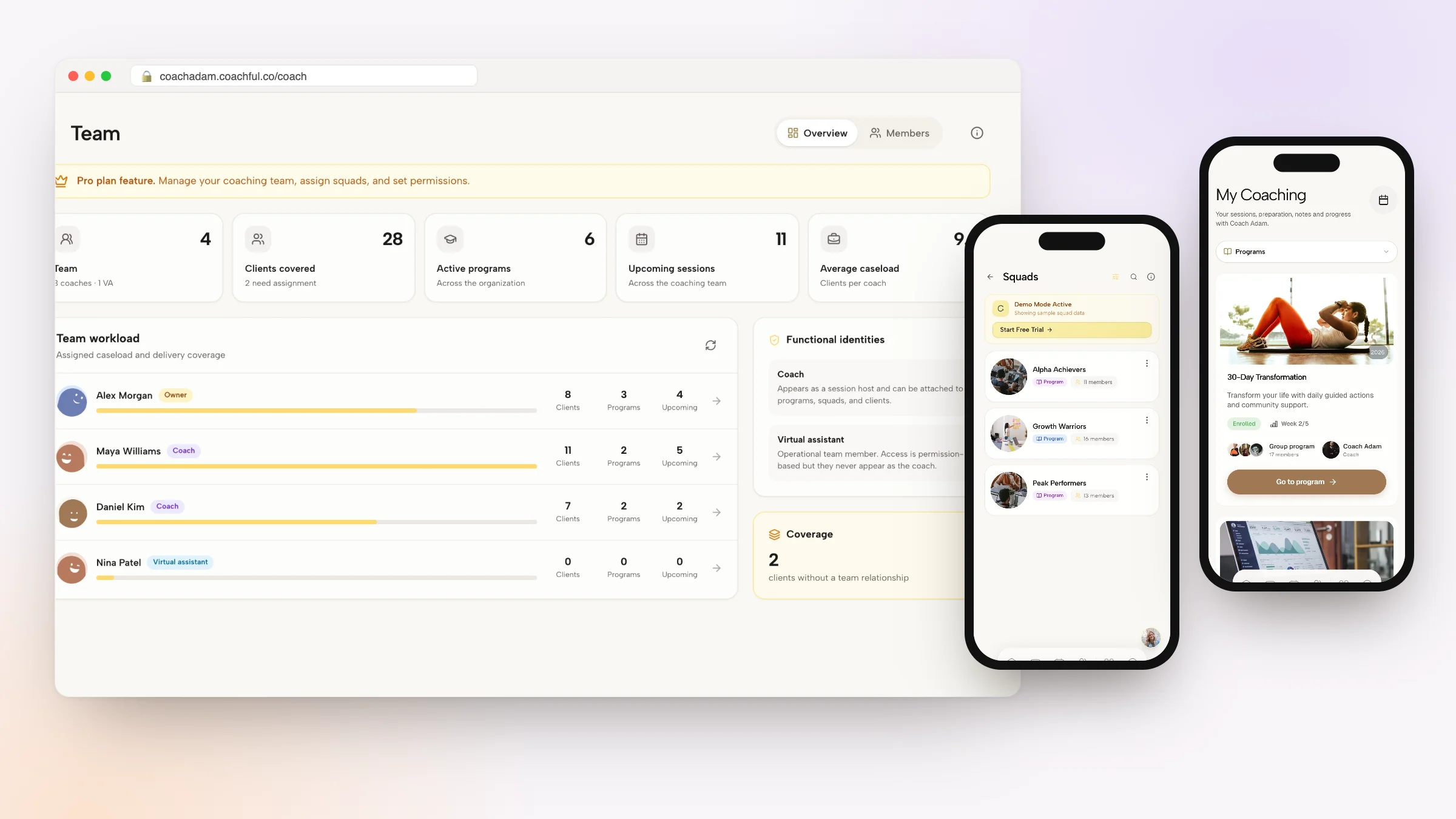
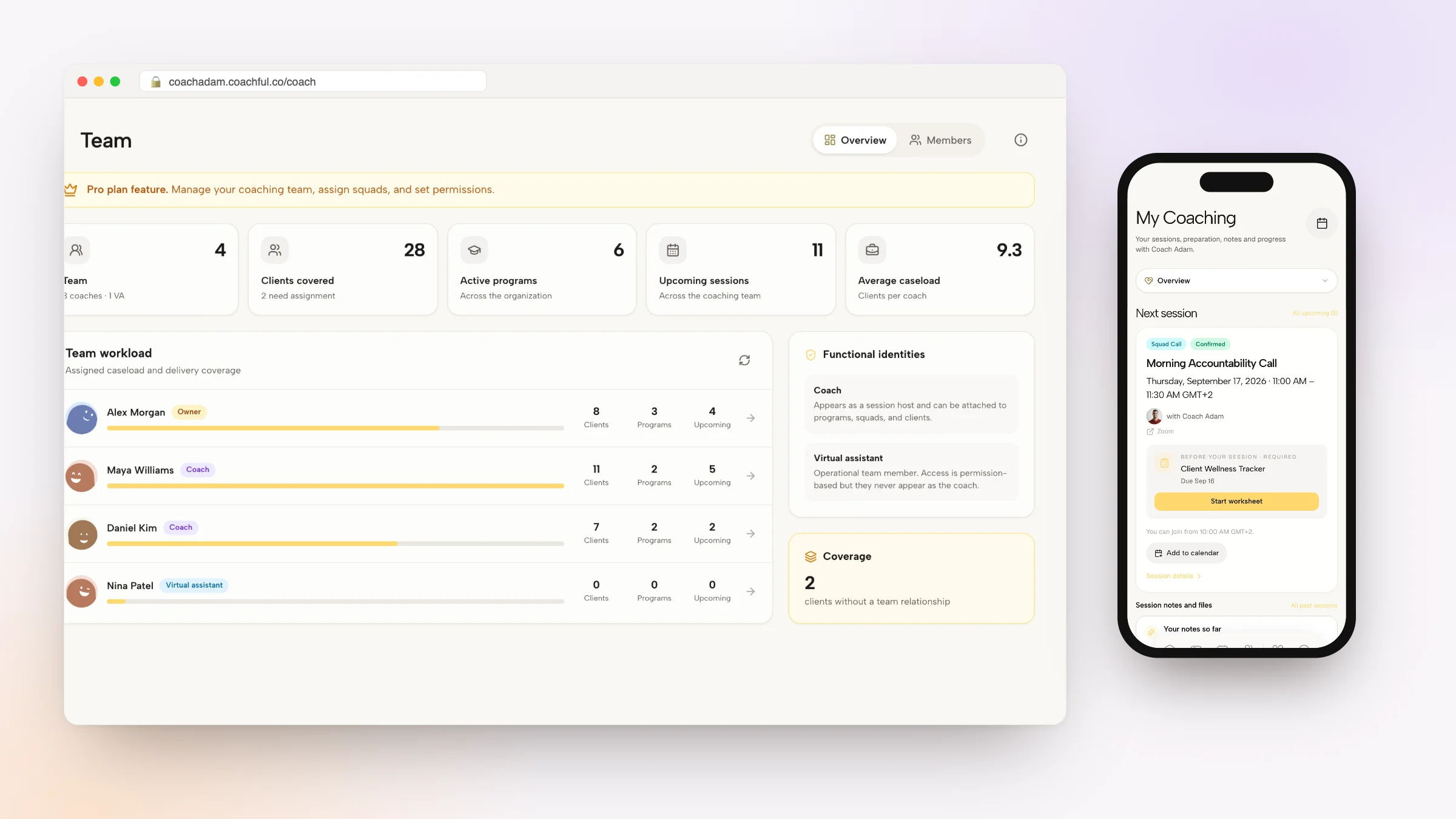
- Permissioned team access on the Pro plan, so a virtual assistant can handle admin without appearing as the coach, which helps with Standard 2.6 on support personnel.
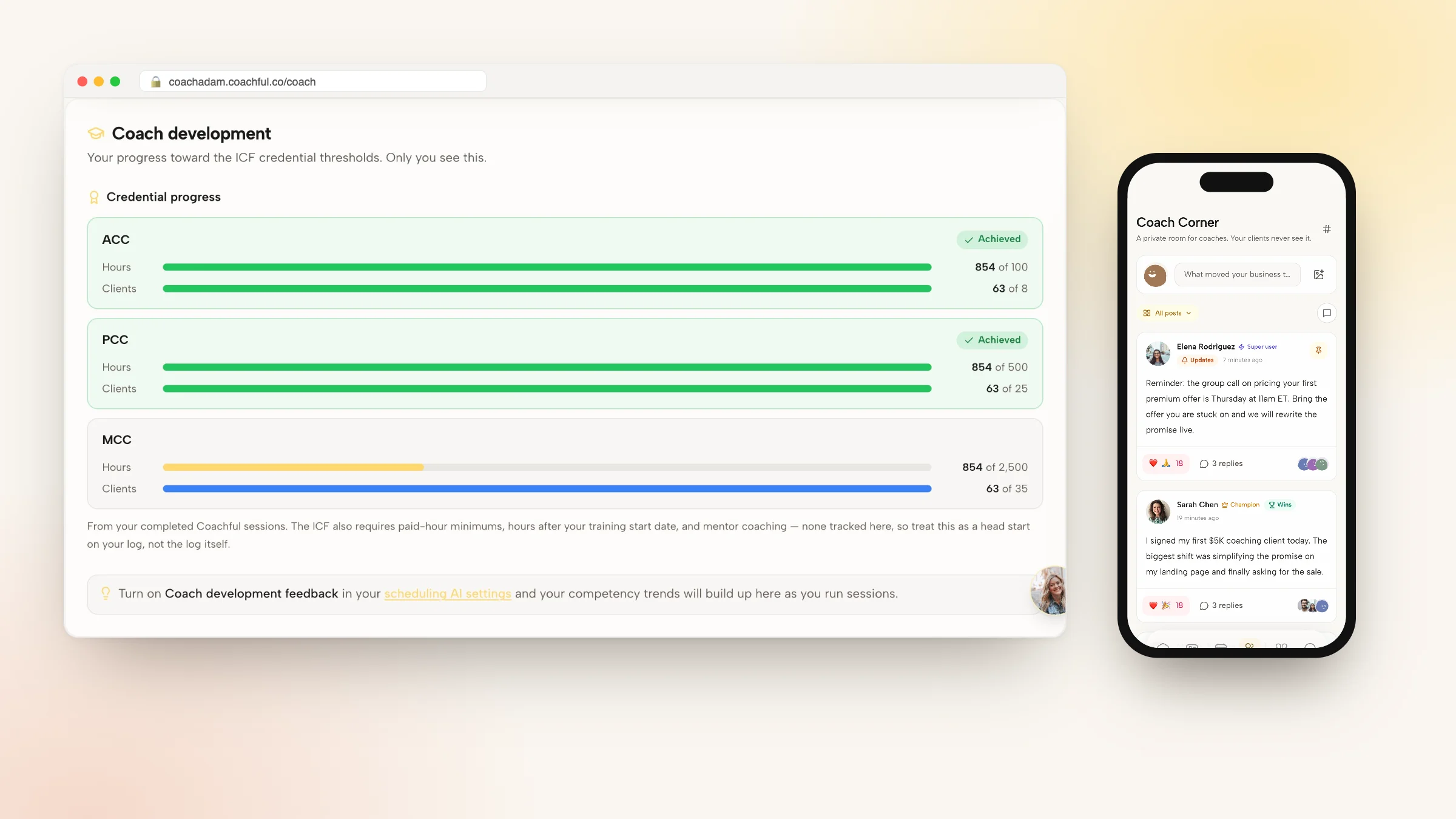
- Client-facing summaries you approve before a client sees them, and private coach development feedback that is never shown to the client.
- Full data export of client records as a ZIP, and GDPR readiness. Coachful is not HIPAA-certified, so health coaches working under a clinic's license should check requirements first.
More on agreements on the coaching contracts page. And if you'd rather not build your website from scratch, Coachful's team builds it for free on every plan, inside your account; Coachful itself is a paid membership with a free trial to start. Choose We'll build it for you · FREE under Create or Fill in a form on the Website page. The team works to the same standard the Code asks of you: nothing gets invented, so no credentials you don't hold and no testimonials or results you haven't supplied. See what the free build includes.

Frequently asked questions
What is the coaching code of ethics?
Usually it means the ICF Code of Ethics, the code of the International Coaching Federation, in effect since April 1, 2025. It sets out core values, commitments and 24 ethical standards covering agreements, confidentiality, conflicts of interest, consistent value and professional integrity. Other bodies, such as the EMCC, the Association for Coaching and the NBHWC, have their own codes.
What are the ICF's four core values?
Professionalism, Collaboration, Humanity and Equity. The Code describes each with first-person principles, for example demonstrating professionalism by being true and accurate in your statements and delivering on your commitments.
How many ethical standards are in the ICF Code of Ethics?
Twenty-four, in five sections: Agreements for Client and/or Sponsor Engagement (2), Confidentiality and Legal Compliance (8), Professional Conduct and Conflicts of Interest (8), Commitment to Delivering Consistent Value (3) and Professional Integrity and Accountability (3). The 2020 Code had 28 in four sections.
Does the coaching code of ethics apply if I'm not an ICF member?
The ICF Code binds ICF members, credential holders and others in the ICF ecosystem. If you hold a different credential, that body's code applies instead, and if you hold none, no code binds you formally, though clients and buyers will still judge you by these standards.
Can a coach have a romantic relationship with a client?
No. Standard 3.6 says an ICF professional does not participate in any sexual or romantic relationship with clients or sponsors, and should act, including ending the engagement, if they notice the relationship shifting.
What happens if a coach breaks the ICF Code of Ethics?
Concerns go through the ICF's Ethical Conduct Review process, run by its Independent Review Board. The Code says sanctions can include mandatory additional coach education, mentoring, supervision, or loss of ICF membership or credentials.
Will Coachful build my coaching website for free?
Yes. Coachful's team builds coaching websites and first offer pages for free on every plan, inside your account, usually within about 24 hours. Coachful is a paid membership; the build costs nothing extra.