ICF Core Competencies: All 8 Explained, With 2025 Updates
The ICF Core Competencies are the International Coaching Federation's model of what a professional coach does, and they are the basis for every ICF credential. There are eight competencies in four domains: Foundation (Demonstrates Ethical Practice, Embodies a Coaching Mindset), Co-Creating the Relationship (Establishes and Maintains Agreements, Cultivates Trust and Safety, Maintains Presence), Communicating Effectively (Listens Actively, Evokes Awareness) and Cultivating Learning and Growth (Facilitates Client Growth). The current version was released in September 2025.
The 2025 update kept all eight competencies and changed the detail underneath: the ICF says it added five sub-competencies, revised eleven, updated one definition and added a glossary, based on a 14-month job analysis with data from nearly 3,000 coaches. This guide sets out the whole model, shows exactly what changed, explains what each competency looks like in a real session, and covers how the ICF assesses them.
And if you're building a practice while you work on them, Coachful's team will build your coaching website for free on every plan, so your evenings can go on recorded practice sessions instead.
The 8 ICF Core Competencies at a glance
The names, numbers and definitions below are taken from the ICF's 2025 ICF Core Competencies document.
| Domain | Competency | ICF definition |
|---|---|---|
| A. Foundation | 1. Demonstrates Ethical Practice | "Understands and consistently applies coaching ethics and standards of coaching" |
| A. Foundation | 2. Embodies a Coaching Mindset | "Engages in ongoing personal and professional learning and development as a coach. Works with coaching supervisors or mentor coaches as needed. Develops and maintains a mindset that is open, curious, flexible and client-centered." |
| B. Co-Creating the Relationship | 3. Establishes and Maintains Agreements | "Partners with the client and relevant stakeholders to create clear agreements about the coaching relationship, process, plans and goals," for the whole engagement and each session |
| B. Co-Creating the Relationship | 4. Cultivates Trust and Safety | "Partners with the client to create a safe, supportive environment that allows the client to share freely. Maintains a relationship of mutual respect and trust." |
| B. Co-Creating the Relationship | 5. Maintains Presence | "Is fully conscious and present with the client, employing a style that is open, flexible, grounded and confident" |
| C. Communicating Effectively | 6. Listens Actively | "Focuses on what the client is and is not saying to fully understand what is being communicated in the context of the client systems and to support client self-expression" |
| C. Communicating Effectively | 7. Evokes Awareness | "Facilitates client insight and learning by using tools and techniques such as powerful questioning, silence, metaphor or analogy" |
| D. Cultivating Learning and Growth | 8. Facilitates Client Growth | "Partners with the client to transform learning and insight into action. Promotes client autonomy in the coaching process." |
Each competency has numbered sub-competencies, 68 in all in the 2025 version by our count. The ICF's competencies page notes the model has existed since 1998 and is used as the basis for ICF certifications and the curriculum of ICF-accredited programs.

What changed in the 2025 update
The ICF's comparison chart lines up the 2019 and 2025 versions side by side. The overarching competencies are the same. These are the five new sub-competencies:
| New sub-competency | 2025 wording |
|---|---|
| 2.09 | "Nurtures openness and curiosity in oneself, the client, and the coaching process." |
| 2.10 | "Remains aware of the influence of one's thoughts and behaviors on the client and others" |
| 3.12 | "Revisits the coaching agreement when necessary to ensure the coaching approach is meeting the client's needs" |
| 5.03 | "Remains aware of what is emerging for self and client in the present moment" |
| 8.07 | "Partners with the client to integrate learning and sustain progress throughout the coaching engagement" |
The revisions are mostly sharpening, and a few are worth noticing because they change how you'd describe good practice:
- Competency 2's definition grew. It now names ongoing learning and working with coaching supervisors or mentor coaches, not only a mindset.
- "Regulate" became "manage." Sub-competency 2.06 now reads "manage one's emotions."
- Bias is named. 2.04 now covers awareness of "biases, context and culture."
- Technology appears. 2.02 adds staying aware of current best practices "and use of technology."
- Well-being before, during and after sessions. 2.07 replaces "mentally and emotionally prepares for sessions."
- A coaching philosophy. 3.01 now asks the coach to describe their coaching philosophy as well as what coaching is and isn't.
- "Celebrates" became "acknowledges." The client's progress and successes are acknowledged, in 8.08.
If you're preparing for a credential, note the timing. The ICF's guide to its new PCC-MCC exam, with first test dates on November 10, 2026, says the format incorporates the most recent updates to both the Core Competencies and the Code of Ethics. Study the 2025 wording. Our guide to ICF certification covers the exam changes in full.
Domain A: Foundation
1. Demonstrates Ethical Practice
The foundation competency asks you to act with integrity, respect the client's identity and context, keep confidentiality within your agreements and the law, abide by the ICF Code of Ethics, keep coaching distinct from consulting and psychotherapy, and refer clients to other professionals when that's what they need. In a session it rarely shows as a moment; it shows as the absence of problems: you don't drift into therapy, you don't share a sponsor's confidences, you say "that sounds like something to take to your doctor." The sibling guide to the coaching code of ethics covers the Code itself.
Practice drill: write down, before your next ten sessions, who you would refer to for therapy, medical questions and legal or financial advice. If you can't name someone, that's the gap.
2. Embodies a Coaching Mindset
This is the coach's inner work: accepting that clients are responsible for their own choices, learning continuously, reflecting on your own practice, noticing your biases, using intuition in the client's service, managing your emotions and well-being, and seeking help when you need it. It's the competency that most easily slips in a busy week, because nobody watches you prepare.
Practice drill: after each session, write three lines. What did I assume? Where did I want to steer? What did I feel, and did it help or get in the way? Bring the pattern to supervision or mentor coaching. Our guide to coaching supervision explains how that works.
Domain B: Co-Creating the Relationship
3. Establishes and Maintains Agreements
Two levels of agreement live here. The engagement agreement covers what coaching is, what's offered, logistics, fees, scheduling, confidentiality and how it ends. The session agreement, renewed every time, covers what the client wants from this session, what they need to address to get there and how they'll know it worked. The 2025 version adds revisiting the agreement when the approach isn't meeting the client's needs.
In practice, the session agreement is where newer coaches lose marks. "What would you like to work on?" is a start; "and what would make this hour worth it for you?" and "how will you know?" finish it.
Practice drill: spend the first five minutes of your next three sessions only on the agreement: the topic, the outcome, the measure and what's important about it. Notice how much easier the rest of the session gets. Our coaching agreement template covers the engagement level.

4. Cultivates Trust and Safety
Trust is built by seeking to understand the client in their context, respecting their identity and language, acknowledging their talents and effort, showing empathy, supporting their expression of feelings and concerns, and being open yourself. The PCC markers make one part concrete: the coach invites the client to respond to the coach's contributions, and accepts the response.
Practice drill: after you offer an observation, ask "how does that land?" and then genuinely take "it doesn't" for an answer.
5. Maintains Presence
Presence means staying focused, curious and responsive; noticing what is emerging for you and the client in the moment, which is new in 2025; managing your own emotions; being comfortable with strong emotion and with not knowing; and allowing silence. Its enemy is the next question forming in your head while the client is still talking.
Practice drill: in one session, after every client answer, count to three before you speak. Most clients fill the silence with the thing they actually wanted to say.
Domain C: Communicating Effectively
6. Listens Actively
Active listening in the ICF model goes past hearing words: considering the client's context, reflecting or summarizing, noticing when there's more to say, exploring emotions, energy shifts and non-verbal cues, integrating words with tone and body language, and spotting patterns across sessions. That last one, 6.06, is why session notes matter. You can't notice a trend you didn't write down. Our piece on the levels of listening goes deeper.
Practice drill: before each session, reread the last two sessions' notes and write one pattern you might name, then wait to see whether it shows up.

7. Evokes Awareness
This is the competency people think of as "coaching": challenging the client, asking about their thinking, values and beliefs, asking questions that go beyond current thinking, adjusting your approach, helping them see patterns, inviting their ideas for moving forward, supporting reframes, and sharing observations without attachment. The PCC markers add the craft details: clear, direct, primarily open-ended questions, one at a time, at a pace that allows reflection, with the client doing most of the talking.
Practice drill: record a session and count your stacked questions, two or three asked before the client answers. Cut them to one. Our free coaching questions tool is a useful bank while you practice.
Domain D: Cultivating Learning and Growth
8. Facilitates Client Growth
The final competency turns insight into action: integrating new awareness into the client's worldview and behavior, designing goals, actions and accountability with the client, respecting their autonomy over all three, exploring likely results, resources and barriers, summarizing learning, sustaining progress across the engagement (new in 2025), acknowledging progress and closing the session together. The key word throughout is "partners." The client designs the action; the coach helps them design it well.
Practice drill: end every session for a week by asking the client to say, in their own words, what they're taking away and what they'll do first. Don't summarize for them.

How the ICF assesses the competencies
Credential candidates are assessed on the competencies in two main ways: a recorded coaching session and an exam. For ACC and PCC Portfolio candidates, the ICF has said that from April 1, 2027, skills validation by specialized mentor coaches replaces the performance evaluation recording.
- The PCC Markers. For the PCC, ICF assessors listen to a recorded session for behavioral markers. The ICF's PCC Markers document, revised in November 2020, lists 37 markers across Competencies 3 to 8. It says elements of Competency 2 are assessed through specific markers in Competencies 4 to 7, and that Competency 1 is shown through coaching aligned with the Code of Ethics. It also warns that the markers "should not be used as a checklist in a formulaic manner for passing the PCC performance evaluation."
- The exams. ACC candidates take the ACC Exam; PCC and MCC candidates take the ICF Credentialing Exam, which is being replaced by a new PCC-MCC Exam during a transition that starts November 10, 2026 and ends March 31, 2027. The ICF says the new exam still covers the same four competency domains.
- Mentor coaching. Every ICF credential requires 10 hours of mentor coaching, where a mentor gives feedback on your coaching against the competencies. Our guide to ICF mentor coaching covers what good mentoring looks like, and ICF ACC vs PCC vs MCC compares the credential levels.
A self-assessment you can run after any recorded session
| Competency | Ask yourself |
|---|---|
| 3. Establishes and Maintains Agreements | Did we agree what this session was for, what success would look like and why it mattered, and did I check it again when the topic shifted? |
| 4. Cultivates Trust and Safety | Did I acknowledge the client's effort or insight, and invite them to push back on what I offered? |
| 5. Maintains Presence | Did I follow the client, or my plan? Did I allow silence? |
| 6. Listens Actively | Did my questions build on their words? Did I explore emotions or energy shifts? Did I interrupt? |
| 7. Evokes Awareness | Were my questions open, single and clear? Who did most of the talking? |
| 8. Facilitates Client Growth | Did the client state their own learning and next step, and design their own accountability? |
Competencies 1 and 2 don't fit a single recording well. Review them monthly instead: your referrals, your notes on your own reactions and what you've learned since the last review.

Practicing the competencies in Coachful
Coachful isn't a training provider or an ICF assessor. It's the platform your practice runs on, and a Coachful membership includes features that make competency practice easier to keep up:
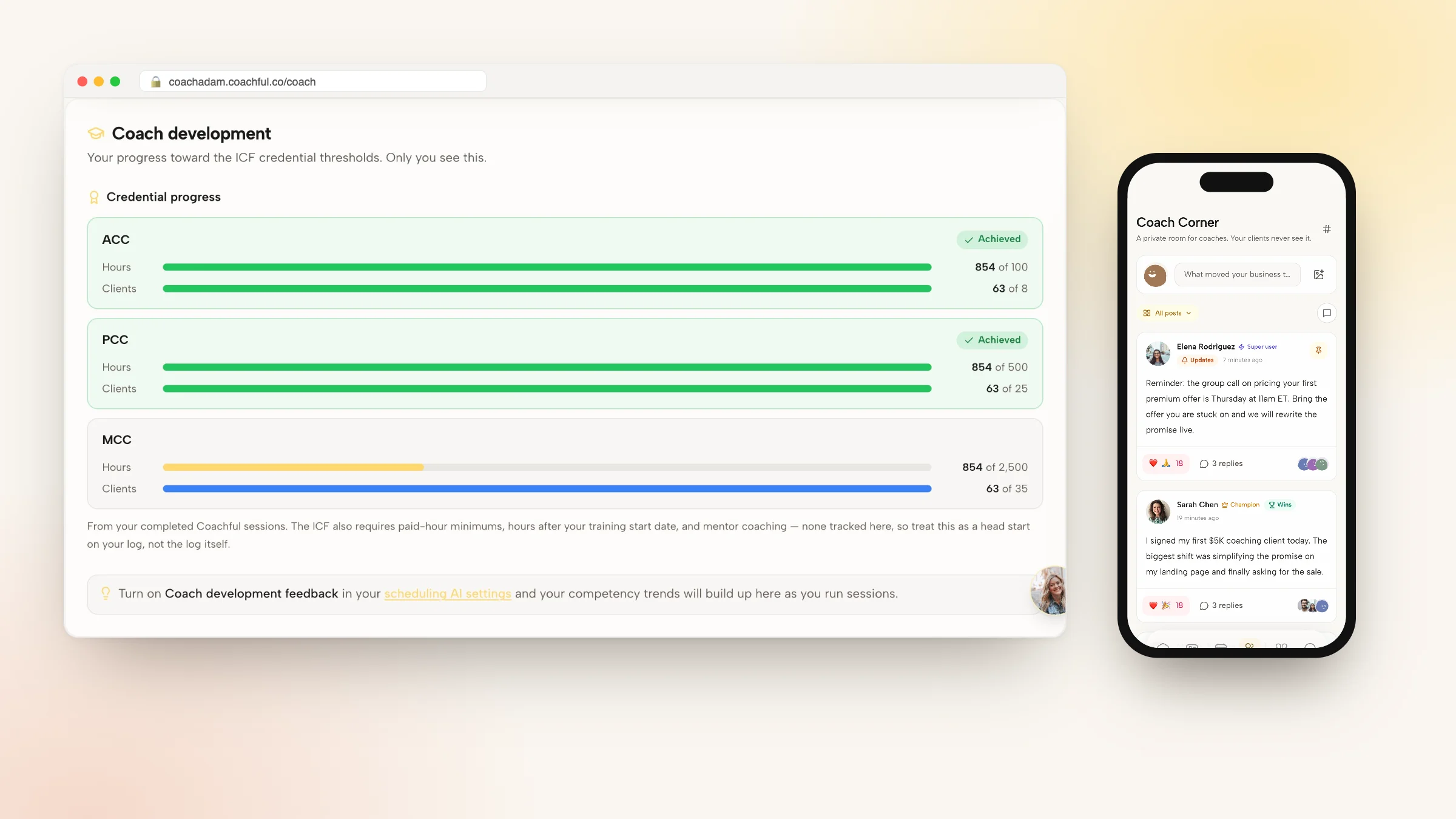
- Private competency feedback. If you turn on Coach development feedback, each recorded session's summary can include a private review of your coaching scored one to five against ICF Core Competencies 3 to 8, with trends for open questions asked, average wait time and how much of the call you talked. It's built on the published competency model, it's never shown to the client, and it's a self-development aid, not an ICF assessment or a substitute for mentor coaching.
- Agreements sent for e-signature before the first session, for Competency 3 at the engagement level.
- Session notes and summaries on each client's record, for the across-session patterns in 6.06.
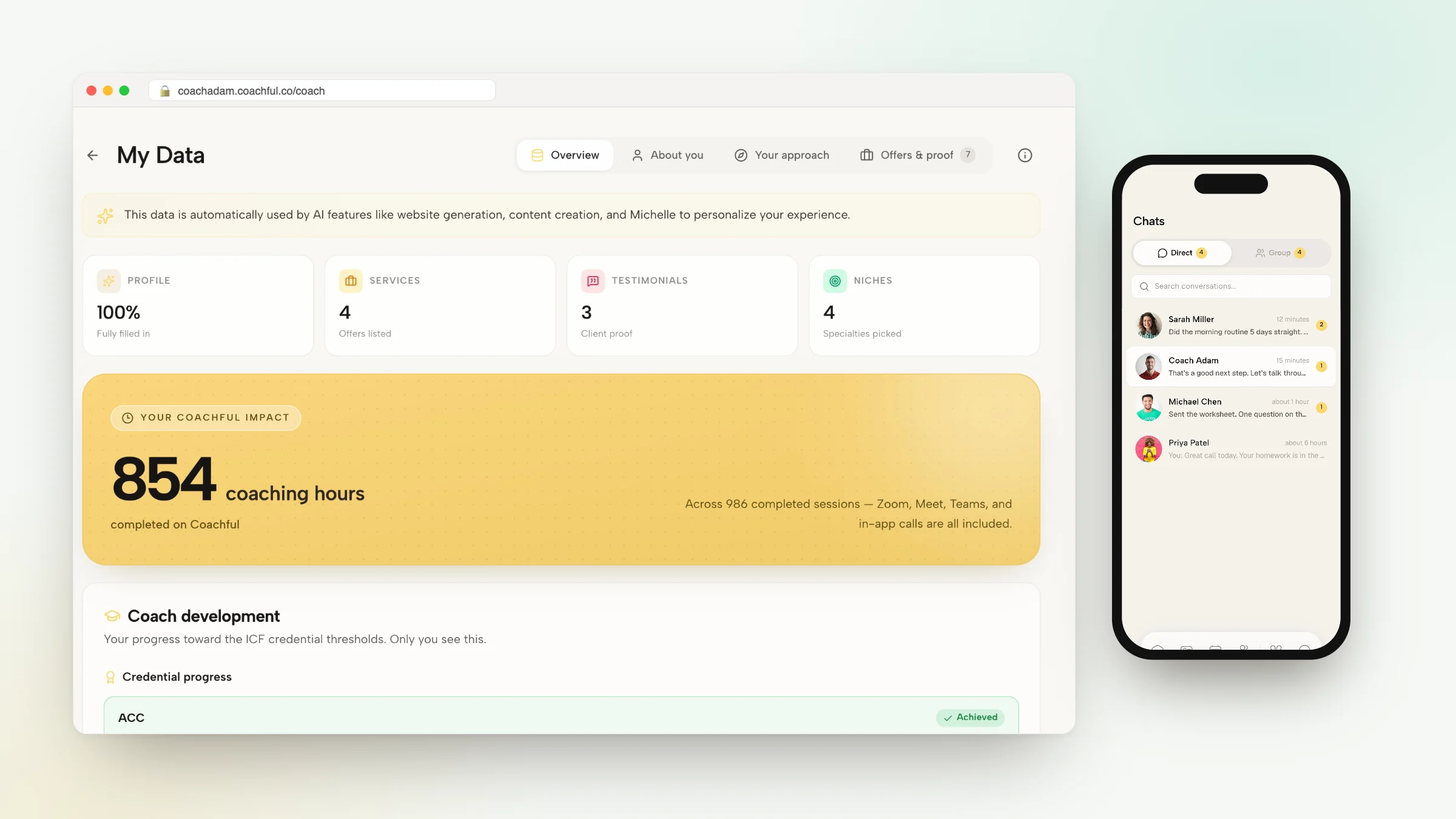
- ICF hour tracking, which counts completed sessions toward ACC, PCC and MCC thresholds and exports a client coaching log. See ICF hour tracking and our guide to ICF coaching hours.
More on the assistant behind the feedback on the AI coaching assistant page, and the full setup on the Coachful page for life coaches.
You also don't have to build your website while you're practicing. Coachful's team builds coaching websites and first offer pages for free on every plan, inside your own account; Coachful itself is a paid membership with a free trial to start. Choose We'll build it for you · FREE under Create or Fill in a form on the Website page. Your credential only appears once you hold it. See what the free build includes.

Frequently asked questions
How many ICF core competencies are there?
Eight, grouped into four domains: Foundation (1 and 2), Co-Creating the Relationship (3, 4 and 5), Communicating Effectively (6 and 7) and Cultivating Learning and Growth (8). The 2025 update kept all eight and revised the sub-competencies underneath them.
What are the four domains of the ICF core competencies?
Foundation, Co-Creating the Relationship, Communicating Effectively, and Cultivating Learning and Growth. The ICF's competencies page summarizes them as building on integrity, trust and collaboration, active listening, and transformation through action.
What changed in the 2025 ICF core competencies?
No competencies were added or removed. The ICF added five sub-competencies (2.09, 2.10, 3.12, 5.03 and 8.07), revised eleven, expanded Competency 2's definition to include ongoing learning and supervision, and added a glossary. It was based on a 14-month job analysis with nearly 3,000 coaches.
Are the PCC markers the same as the core competencies?
No. The competencies describe what a coach does; the PCC Markers are 37 behaviors assessors listen for in a recorded session at the PCC level, across Competencies 3 to 8. The ICF says they shouldn't be used as a checklist for passing.
Which ICF competency is hardest to demonstrate?
The ICF doesn't rank them. In a recording, the session agreement under Establishes and Maintains Agreements is easy to rush, because it needs the topic, the outcome, a measure of success and why it matters, all agreed with the client. Evokes Awareness is the other place to watch, since stacked or leading questions cut against the markers.
Do I need to memorize the ICF core competencies?
Not word for word, but you need to know them well enough to demonstrate them. Credential exams test the competency domains, and mentor coaching and performance evaluations judge your coaching against them.
Will Coachful build my coaching website for free?
Yes. Coachful's team builds coaching websites and first offer pages for free on every plan, inside your account, usually within about 24 hours. Coachful is a paid membership; the build costs nothing extra.