
ICF Certification in 2026: Paths, Fees and What Changes
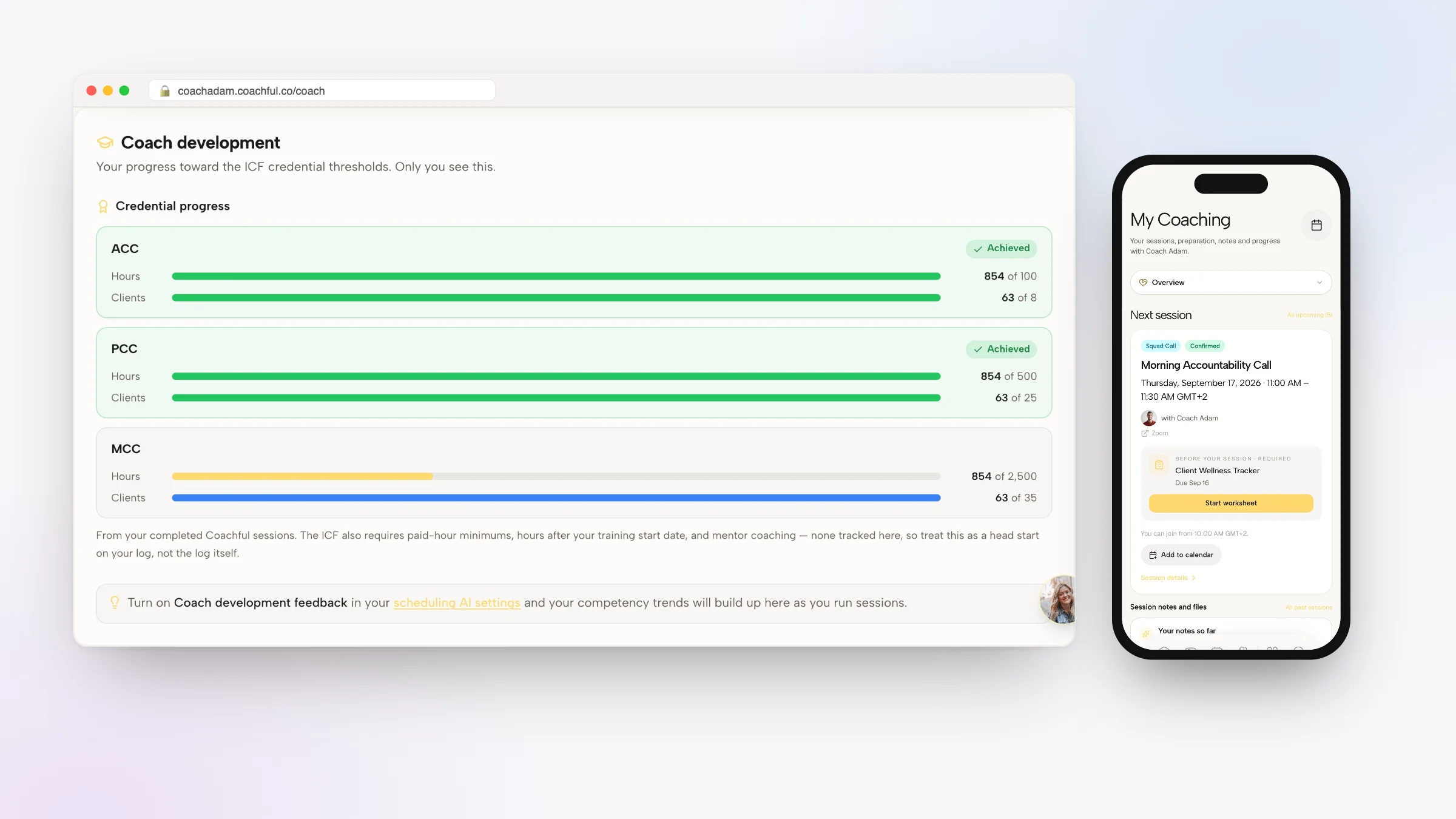
ICF certification usually means one of the International Coaching Federation's three individual credentials: the Associate Certified Coach (ACC), the Professional Certified Coach (PCC) or the Master Certified Coach (MCC). Each one checks four things: your coach education, your logged coaching hours, 10 hours of mentor coaching and your coaching itself, through a recorded performance evaluation and an exam. The entry point, the ACC, asks for 60 hours of education and 100 hours of coaching, and its application costs $175 to $625 as the ICF listed it in October 2026.
The ICF calls these credentials, not certifications, and it doesn't certify training programs at all; it accredits them. That distinction matters when a school's sales page says "ICF certified program," and we'll come back to it. This guide is the whole map: what each credential needs, which application path you'll be on, what the fees and waits are, and the changes the ICF has scheduled between November 2026 and April 2027.
One thing worth knowing early: once you're coaching for hours, Coachful's team will build your coaching website and first offer page for free on every plan, so paid clients have somewhere to book while you work toward the credential.
What the ICF certifies, and what it only accredits
Three different things carry the ICF name, and people mix them up constantly.
| What it is | Who holds it | Examples | What it proves |
|---|---|---|---|
| Credential | An individual coach | ACC, PCC, MCC | The ICF checked your education, hours, mentor coaching and coaching skill |
| Specialization | An individual who already holds a credential | Advanced Certification in Team Coaching (ACTC), Mentor Coach Specialization (MCS), Coaching Supervisor Specialization (CSS) | Advanced expertise in one area, on top of a credential |
| Accreditation | A training program | Level 1, Level 2, Level 3, Continuing Coach Education (CCE) | The program's curriculum and assessment meet ICF standards |
A graduate of an accredited program is not credentialed yet. They still apply to the ICF, pay the fee and, for the ACC, pass an exam. A school can't hand you an ICF credential, and any program that implies otherwise is overselling. The ICF's specializations overview spells out the difference in its own words: a credential shows you can coach to the Core Competencies, and a specialization builds on one.
ICF certification requirements, side by side
These are the requirements and application fees from the ICF's own ACC, PCC and MCC pages and its experience requirements, as listed in October 2026.
| Requirement | ACC | PCC | MCC |
|---|---|---|---|
| Coach education | 60 hours | 125 hours | 200 hours, and you must hold or have held a PCC |
| Coaching experience | 100 hours, 75 paid | 500 hours, 450 paid | 2,500 hours, 2,250 paid |
| Distinct clients | 8 | 25 | 35 |
| Recent hours | 25 within 18 months of applying | 50 within 18 months of applying | No recency rule listed |
| Mentor coaching | 10 hours over at least 3 months | 10 hours | 10 hours |
| Performance evaluation | Yes | Yes | Yes |
| Exam | ACC Exam | ICF Credentialing Exam | ICF Credentialing Exam |
| Fee on an accredited path (member / non-member) | $175 / $325 | $375 / $525 | $675 / $825 |
| Fee on the Portfolio path (member / non-member) | $475 / $625 | $750 / $900 | $675 / $825 |
| Estimated review | 4 weeks accredited, 14 weeks Portfolio | 4 weeks accredited, 18 weeks Portfolio | 18 weeks |
If you're deciding between the three levels rather than learning how they work, our comparison of ICF ACC vs PCC vs MCC works through three coaches' situations and which credential each one should go for.
The four things every ICF application checks
1. Coach education
Hours must be coach-specific training. Through an accredited Level 1, 2 or 3 program, the ICF trusts the school's records. Through Portfolio, you document every course yourself and the ICF reviews it, which is why Portfolio costs more and takes longer.
2. Coaching experience
This is where most applicants lose months. Hours only count once your coach education has started, which the ICF defines as any course of at least 30 hours, with at least 24 on the Core Competencies. Barter counts as paid. Groups count only up to 15 people, and the time counts once, not once per person. Mentor coaching, supervision, coaching inside your training class and coaching your own direct reports don't count. Our guides to pro bono hours and group coaching hours cover the edge cases.
3. Mentor coaching
Ten hours with a qualified mentor. For the ACC, the ICF wants them spread over at least three months, so book them while your hours are still building. Our guide to ICF mentor coaching covers what a good mentor does in those ten hours.
4. Performance evaluation and exam
A recording of you coaching a real client, assessed against the Core Competencies, plus a computer-based exam taken at a Pearson VUE center or online through OnVUE. The ICF describes the ACC Exam as 60 multiple-choice knowledge items in 90 minutes, including a 10-minute break. The current PCC and MCC exam has 78 situational judgment items in 180 minutes, with a passing scaled score of 460 on a 200 to 600 range. That exam is being replaced, which is the next section's main point.

Accredited path or Portfolio: your training decides the fee and the wait
The single most expensive decision in ICF certification happens before you apply: which kind of training you take.
- Level 1 programs run 60 to 124 hours, include five observed coaching sessions with written feedback, 10 hours of mentor coaching and a final evaluation at the ACC level. They lead to the ACC.
- Level 2 programs run 125 to 175 hours, with six observed sessions, mentor coaching and a final evaluation at the PCC level. Graduates can apply directly for the PCC. The ICF's own guidance calls Level 2 "formerly ACTP."
- Level 3 is advanced training of at least 75 hours for coaches who already hold an active PCC, and leads to the MCC.
- Portfolio is everyone else: a mix of non-accredited courses, partial programs or Continuing Coach Education, documented by you.
Graduates of the older ACSTH programs, and people who finished only part of a Level 1 or Level 2 program, are treated differently again; the ICF counts a partial program as ACSTH education. If your certificate doesn't name a level, check with your school which category it falls into before you pick a path.
Two practical rules come out of the fee table. First, if a corporate buyer will want a PCC from you within a couple of years, a Level 2 program and a direct PCC application usually beat collecting an ACC on the way, because each credential has its own fee. Second, a cheaper non-accredited course can cost more in the end: on Portfolio, the ACC fee nearly triples and the review wait more than triples. Our list of ICF accredited coaching programs shows real examples at each level.

What changes between November 2026 and April 2027
If you're starting in late 2026, three scheduled changes affect your plan. The ICF has published all three, and the dates below are its own.
| Date | Change | Who it affects |
|---|---|---|
| November 10, 2026 | First test dates for the new PCC-MCC Exam: 80 items (44 situational judgment, 36 knowledge-based multiple choice) in 150 minutes | PCC and MCC candidates |
| January 1, 2027 | All credential candidates must work with a mentor coach who holds the Mentor Coach Specialization (MCS) | Everyone doing mentor coaching for a credential, and ACC renewals |
| March 31, 2027 | Last day to sit the current ICF Credentialing Exam | PCC and MCC candidates |
| April 1, 2027 | Skills validation from specialized mentor coaches replaces performance evaluation recordings for ACC and PCC Portfolio candidates; accredited programs need a formative evaluation process instead of a performance evaluation | Portfolio applicants and coach education providers |
Sources: the ICF's candidate guide to the updated exam (July 2026) and its Mentor Coach Specialization announcement.
What to do with that today: if you start mentor coaching now, ask your mentor in writing whether they hold the MCS or are applying for it, and ask the ICF how hours completed before January 1, 2027 are treated. If you're aiming for the PCC and you're close, decide whether you'd rather sit the current exam before March 31, 2027 or prepare for the new format, which adds knowledge-based questions to the situational ones.
Beyond ACC, PCC and MCC: the ICF specializations
Once you hold a credential, the ICF offers three specializations. None of them replaces a credential.
- Advanced Certification in Team Coaching (ACTC). You need an ICF credential at any level, 60 or more hours of team coaching education, five team coaching engagements within the last five years, five hours of coaching supervision and a pass on the ICF Team Coaching Certification Exam. The ICF lists the fee at $250 for members and $350 for non-members, with a 4 to 6 week review, or $200 and $300 if your education was an ICF-accredited team coaching program, as listed in October 2026 on its ACTC page.
- Mentor Coach Specialization (MCS). Open to holders of a PCC, an MCC or a renewed ACC, with mentor coaching training aligned to the ICF's Mentor Coaching Competencies. After January 1, 2027, this is the designation your own mentor needs.
- Coaching Supervisor Specialization (CSS). Open to PCC and MCC holders, with supervision training aligned to the ICF's Coaching Supervision Competencies.
The ICF doesn't list fees for the MCS or CSS on its overview page, so we haven't included any.

Red flags in "ICF certified" marketing
Training providers write their own sales pages, and some of them stretch the ICF's name. Watch for these:
- "ICF certified program." The ICF accredits programs; it doesn't certify them. The phrase usually means the program is accredited, but confirm the level.
- "ICF aligned" or "based on ICF competencies." Any course can teach the Core Competencies. That says nothing about accreditation, and it puts you on the Portfolio path.
- A logo with no level. Ask: Level 1, Level 2, Level 3 or CCE, and is the accreditation current? The ICF says a Level 1 accreditation is valid for three calendar years, so an old badge isn't proof.
- "Graduate as an ICF certified coach." No school can award an ICF credential. You still apply, log hours and, for the ACC, sit the exam.
- Mentor coaching sold separately without saying so. Level 1 and Level 2 programs include 10 hours of mentor coaching as part of accreditation. If it's extra, the program may be accredited at a different level than you assume.
The fix for all five is the same: search the program in the ICF's free Education Search Service, which filters by level, delivery method, language and specialization. Our checklist on whether life coach certification is worth it covers the questions to put to a school in writing.
Keeping your ICF certification: renewal every three years
An ICF credential expires. According to the ICF's renewal page, every level renews every three years with 40 Continuing Coach Education credits, 24 of them in the Core Competencies and 3 of those in coaching ethics. ACC holders also need 10 hours of mentor coaching each cycle. The renewal fee is $175 for members and $275 for non-members at every level, as listed in October 2026.
The ethics credits are the easy part: the ICF's coaching ethics course is free for members and non-members, self-paced, and earns three CCE units in ethics.

How long ICF certification takes, realistically
The ICF sets minimums, not timelines. The arithmetic below is built from those minimums at a steady weekly pace; it isn't a measured average.
| Credential | The slow part | Coaching hours alone, at a steady pace |
|---|---|---|
| ACC | Finding 8 clients and 75 paid hours | 100 hours at 2 a week: about a year |
| PCC | 500 hours and 25 clients | 500 hours at 5 a week: about two years |
| MCC | 2,500 hours and a Level 3 or Portfolio education | 2,500 hours at 10 a week: about five years |
The bottleneck is almost never the training. It's distinct, paying clients, which come from discovery calls that convert. Our guide to becoming a certified life coach lays out the ACC steps week by week, and how long it takes does the arithmetic for different paces.
Where Coachful fits after you certify
Coachful isn't a certification body and doesn't train or credential anyone. It's the platform you run the practice on while your hours build and after the letters arrive. A Coachful membership includes:
- ICF hour tracking. Completed sessions count toward the ACC, PCC and MCC thresholds in hours and distinct clients, and you can export an ICF client coaching log with paid and pro bono hours. Sessions from before Coachful can be logged by hand. The panel says plainly that paid-hour minimums, training start dates and mentor coaching aren't tracked there, so treat it as a head start on your log. See ICF hour tracking and our guide to tracking ICF coaching hours.
- Group sessions counted the ICF way: group time once, each attendee once as a distinct client.
- Booking, payment and agreements in one flow, so the paid hours the ICF asks for are recorded where they happen.
- Private competency feedback. When you turn it on, Michelle, Coachful's AI assistant, scores your own recorded sessions against ICF Core Competencies 3 to 8. It's a self-development aid, not an ICF assessment and not a substitute for mentor coaching.

Why Coachful stands out: a free white-glove service. You don't have to build the website or the first offer page while you're also logging hours. Choose We'll build it for you · FREE under Create, or Fill in a form on the Website page, and Coachful's team builds it inside your own account, usually within about 24 hours. Your credential only appears on the site once you hold it: nothing gets invented, including testimonials and prices. See what the free build includes, or the Coachful page for life coaches for the full setup.

Frequently asked questions
How much does ICF certification cost?
The ICF application fee, as listed in October 2026, is $175 to $625 for the ACC, $375 to $900 for the PCC and $675 to $825 for the MCC, depending on membership and path. Training is the larger cost and is set by each program. Renewal costs $175 for members every three years.
Is ICF certification the same as ICF accreditation?
No. ICF certification, properly called a credential, belongs to an individual coach: the ACC, PCC or MCC. Accreditation belongs to a training program, at Level 1, 2 or 3 or as Continuing Coach Education. Finishing an accredited program doesn't make you credentialed; you still apply to the ICF.
How long does it take to get ICF certified?
For the ACC, a part-time coach typically needs 12 to 18 months from the start of training, mainly to log 100 hours with 8 clients. That's a pattern built from the ICF's minimums, not an ICF rule. The ICF then estimates 4 weeks of review on an accredited path, or 14 weeks on Portfolio.
Can I get ICF certified online?
Yes. Many accredited programs run live online, the ICF's search directory filters by delivery method, and both ICF exams can be taken remotely through Pearson's OnVUE platform as well as at test centers.
What is changing in ICF certification in 2027?
From January 1, 2027, credential candidates must work with a mentor coach who holds the Mentor Coach Specialization. A new PCC-MCC exam starts November 10, 2026, and the current exam ends March 31, 2027. From April 1, 2027, Portfolio ACC and PCC candidates get skills validation from specialized mentors instead of performance evaluation recordings.
Do I need ICF certification to work as a coach?
No. Coaching isn't a licensed profession in most countries, and ICF credentials are voluntary. Coachful's 2026 Coaching Business Report, drawing on the ICF Global Coaching Study 2025, notes that credentials are often mandatory for corporate buyers, while individual clients weigh outcomes and testimonials more.
Which ICF certification should I get first?
Most coaches start with the ACC. If you expect to sell to employers, who often treat the PCC as standard, a Level 2 program lets you apply for the PCC directly and skip a second fee. Our ACC, PCC and MCC comparison walks through the choice.
Will Coachful build my coaching website while I work toward ICF certification?
Yes. Coachful's team builds your coaching website and first offer page for free on every plan, inside your account, usually within about 24 hours. Coachful itself is a paid membership with a free trial to start; the build costs nothing extra.












