
How Long Does It Take to Become a Life Coach? A Timeline
How long does it take to become a life coach? You can be coaching your first paying clients in about three to six months: a few weeks to choose a niche, two to four months of part-time training, and a few weekends of setup. Reaching the International Coaching Federation's entry credential, the ACC, usually takes part-time coaches 12 to 18 months, because it needs 100 hours of coaching on top of the training. Those are typical patterns, not rules; the real answer depends on which finish line you mean and how many hours a week you have.
Below is the timeline stage by stage, with the arithmetic behind each one, so you can swap in your own numbers. For the full set of steps, our guide on how to become a life coach covers what happens at each stage; this page is about the clock.
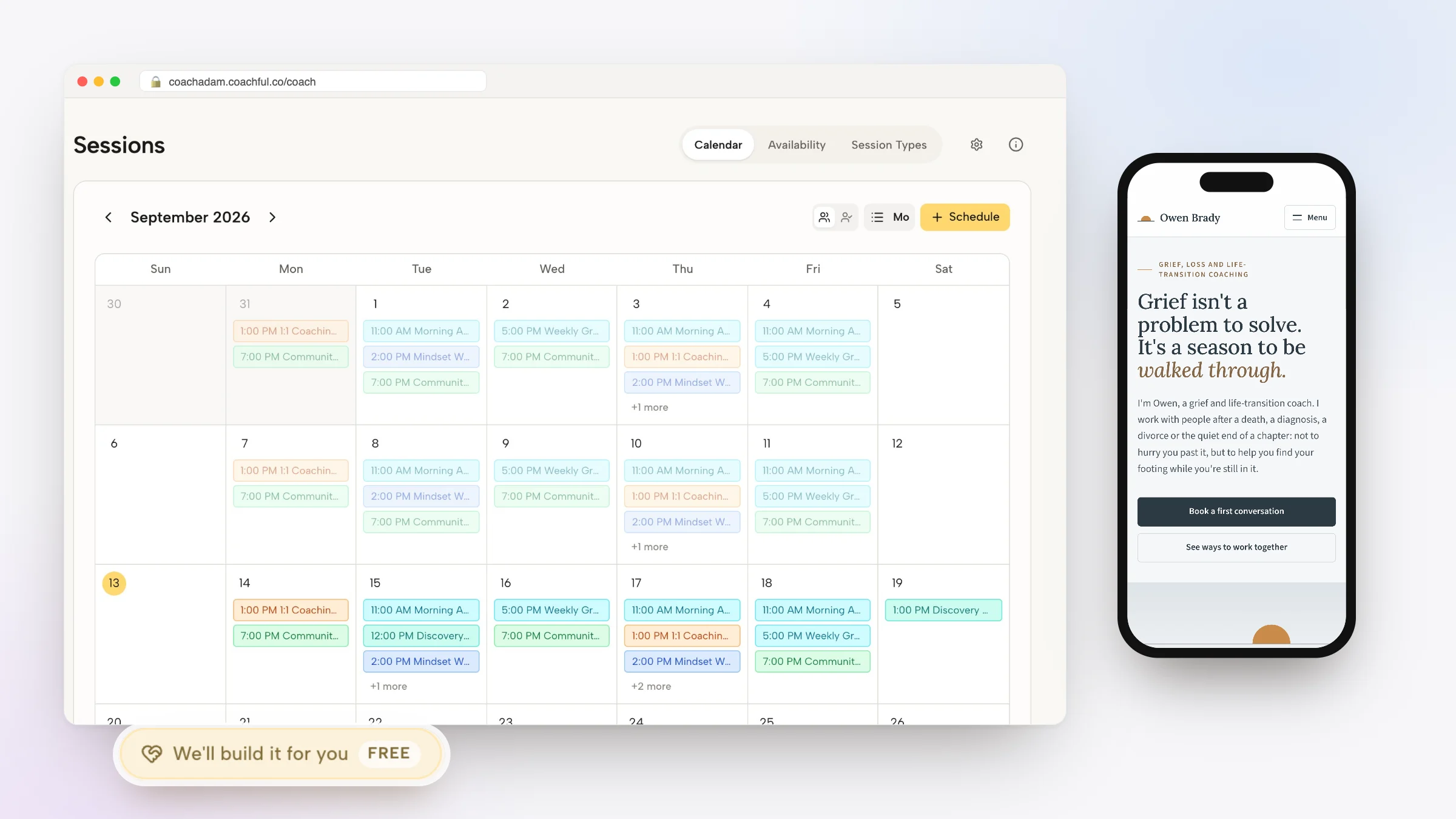
One stage you can nearly delete: Coachful's team builds your coaching website, first offer and first program for free on every plan, usually within about 24 hours of your request.
The short answer, by finish line
| Finish line | Fastest realistic | Typical part-time | What sets the pace |
|---|---|---|---|
| Coaching your first practice clients | 2 to 4 weeks | 1 to 2 months | Starting a training course, or deciding to practice without one |
| Your first paying client | 1 to 2 months | 3 to 6 months | A clear niche and an offer people can say yes to |
| Finishing a 60-hour training program | 2 months | 2 to 4 months | The program's timetable |
| ICF ACC credential | About 6 months | 12 to 18 months | Paid coaching hours per week |
| A full practice | 2 years or more | Often 5 years or more | Referrals, packaging and a niche with demand |
Typical patterns, not measured averages. The ICF sets minimums for mentor coaching and review; everything else depends on your pace.
The last row deserves honesty. Coachful's 2026 Coaching Business Report, drawing on PayScale and practitioner reports, puts coaches in their first year at $20,000 to $30,000, describes years one to four as "building the practice" and labels five to nine years "a full book." Becoming a life coach is quick. Becoming a busy one takes a few years for most people. Our life coach salary guide shows how income usually moves with experience.
Stage 1: Training, about 2 to 4 months
An ICF Level 1 program provides 60 to 124 hours of coach-specific education, and 60 hours is the ACC minimum. How long that takes on the calendar depends entirely on the timetable:
| Hours of training a week | Weeks to finish 60 hours |
|---|---|
| 3 | 20 weeks, about 5 months |
| 5 | 12 weeks, about 3 months |
| 8 | 8 weeks, about 2 months |
| 15 (an intensive) | 4 weeks |
Two things to check before you enroll: how many hours are live, and on which days, and how much homework sits outside the classes. A program that looks like five hours a week on the brochure can be eight with practice and reading. Our seven checks before you enroll include the questions to ask.
If you're going uncertified, this stage can shrink to a few weeks of reading and practice. Our guide to becoming a life coach without certification has a free 12-week plan.
Stage 2: Coaching hours, the long pole
For the ACC, the ICF asks for 100 hours of coaching with at least 8 clients, 75 of those hours paid, and 25 of them within the 18 months before you apply. Hours only count from the start of your coach-specific education, which the ICF defines as a course of at least 30 hours. That's why the best time to start coaching is the week your training starts.
| Coaching hours a week | Weeks to 100 hours | In months, roughly |
|---|---|---|
| 2 | 50 weeks | 12 months |
| 3 | 34 weeks | 8 months |
| 5 | 20 weeks | 5 months |
| 10 | 10 weeks | 2.5 months |
Arithmetic only, before holidays, cancellations and slow weeks. Add 20 to 30 percent for real life.
The table assumes the hours are there to coach. In practice, the first few months are slow while you find clients, and the hours speed up later. Average two or three hours a week across your first year and the arithmetic lands you in the 12-to-18-month range. Pro bono hours count toward up to 25 of the 100, which helps early on; our guide to ICF pro bono hours explains the limit, and how ICF hours work covers what counts.

Stage 3: Mentor coaching, at least 3 months in parallel
The ACC needs 10 hours of mentor coaching spread over at least three months, with at least three hours one-to-one. Three months is a hard floor, so this stage should overlap with Stage 2 rather than follow it. A coach who starts mentor coaching after reaching 100 hours adds three months to the timeline for no reason.
Plan for one change: the ICF says that from January 1, 2027, credential candidates must work with a mentor coach who holds its new Mentor Coach Specialization. If you're booking a mentor for 2027, ask whether they hold it. Our guide to ICF mentor coaching covers choosing one.
Stage 4: Evaluation, exam and review, 1 to 4 months
You submit a recorded session for a performance evaluation, pass the ACC exam and wait for review. The ICF's ACC page estimates four weeks of review for graduates of an accredited Level 1 or Level 2 program and 14 weeks on the Portfolio path, which is for education from non-accredited programs. That difference alone can be three months.
Our guide to becoming a certified life coach walks through each step and the fees.
The business clock runs alongside
None of the credential stages stops you from opening for business. Most new coaches lose more time to setup and hesitation than to training. A rough business timeline:
- Choose a niche, 2 to 6 weeks. Talk to ten people in the group you want to serve before you decide. Our list of coaching niches helps.
- Design one offer, 1 to 2 weeks. A three-month package with a start and an end. See life coaching package examples.
- Set up the practice, a weekend or two. Website, booking, payments and an agreement. With the free build, the website part is usually a day's turnaround.
- Find the first clients, 1 to 3 months. They almost always come from people who already know you.

A sample 12-month timeline for a part-time life coach
Here's how the stages can stack for someone working a day job, with about six hours a week for coaching. It's an illustration, not a promise.
| Months | Training and credential | Business |
|---|---|---|
| 1 | Choose and start a Level 1 program | Talk to ten people in your intended niche |
| 2 to 3 | Training continues; first practice clients; start the hours log | Write one offer; set up website, booking and payments |
| 4 | Training finishes; start mentor coaching | First paying clients, often at an introductory rate |
| 5 to 8 | Mentor coaching completes; hours build at two to four a week | Ask for referrals and testimonials; run a free workshop |
| 9 to 12 | Reach 100 hours with 8 clients; record the evaluation session; apply | Raise the price for new clients; add a small group |
| 13 | About four weeks of review on an accredited path | Keep coaching; nothing pauses while you wait |

What makes it take longer
- Waiting for the certificate before charging. The ACC needs 75 paid hours, so you have to charge before you're credentialed.
- Too few distinct clients. 100 hours with three long-term clients fails the 8-client rule. Shorter packages and a small group add clients faster.
- A gap in coaching. The 25-hours-in-18-months rule means a long pause can push you back.
- Starting mentor coaching late. It adds the three-month minimum on top instead of alongside.
- Choosing a non-accredited program, then applying on the Portfolio path with its 14-week review.
- Rebuilding the website. Weeks of fiddling with design is the most common avoidable delay.
- A vague niche. "I help people live their best life" makes every conversation start from zero.

Set up your practice so the clock doesn't stall
The two levers that matter are paid hours a week and setup time. Hours come from clients, and clients come from a clear offer and a working booking page. A Coachful membership includes the website, booking, payments, programs and client app, so the practice is ready the week training starts:
- Hours count themselves. Completed sessions are tallied against the ICF ACC, PCC and MCC thresholds in hours and distinct clients, and you can export an ICF client coaching log with paid and pro bono hours.
- Booking and payment in one step, with email reminders, plus SMS and WhatsApp reminders once messaging is enabled. See scheduling software.
- Templates: 30 designed homepage templates and more than 40 ready-to-film program templates, so you start from a draft rather than a blank page.
The Coachful page for life coaches shows the full setup.

Or skip the setup stage altogether. Coachful's team builds your website, first offer and first program for free on every plan, inside your own account. Coachful itself is a paid membership with a free trial to start. Click Fill in a form on the Website page or choose We'll build it for you · FREE under Create, describe the pages and what they should do, and attach up to 10 files and 8 links. The team replies by email, usually within about 24 hours, which is typical rather than guaranteed. Nothing gets invented, so credentials, testimonials and prices appear only if you supply them. See what the free build covers.


Frequently asked questions
Can you become a life coach in a month?
You can start coaching practice clients within a month, since no license is required. Completing a 60-hour training program in a month means an intensive of about 15 hours a week. An ICF credential takes longer, because it needs 100 coaching hours and at least three months of mentor coaching.
How long is life coach training?
An ICF Level 1 program provides 60 to 124 hours of coach-specific education, and a Level 2 program 125 to 175 hours. Part time, a 60-hour program usually runs two to four months, depending on the timetable.
How long does it take to get ICF certified as a life coach?
Part-time coaches typically take 12 to 18 months to reach the ACC. The minimums are 60 hours of education, 100 coaching hours with 8 clients, and 10 hours of mentor coaching over at least three months, then about four weeks of review on an accredited path or 14 weeks on Portfolio.
How long does it take a new life coach to make money?
Many new coaches land a first paying client within three to six months. Building a full income takes longer: Coachful's 2026 report puts first-year coaches at $20,000 to $30,000 a year across all coaching, rising to $40,000 to $65,000 for coaches with one to four years of experience.
Can I become a life coach while working full time?
Yes, and most do. With five or six hours a week you can train, coach a few clients in the evenings and reach the ACC in about a year to a year and a half. Our guide to part-time life coaching helps you plan the hours.
Do coaching hours before training count toward the ICF credential?
No. The ICF counts client hours only after your coach-specific education starts, with a course of at least 30 hours that includes at least 24 hours on the Core Competencies.
What is the fastest way to become a life coach?
Pick a niche quickly, start a training program and coaching practice clients in the same week, set up booking and payments early, and book mentor coaching while your hours build. Handing the website to someone else saves the most time.
How long does the free Coachful website build take?
The team replies by email with next steps, usually within about 24 hours of your request. That's the typical turnaround, not a guaranteed deadline. The build is free on every plan and happens inside your own Coachful account, so you can edit everything afterwards.












