
How to Become a Life Coach Without Certification (2026)
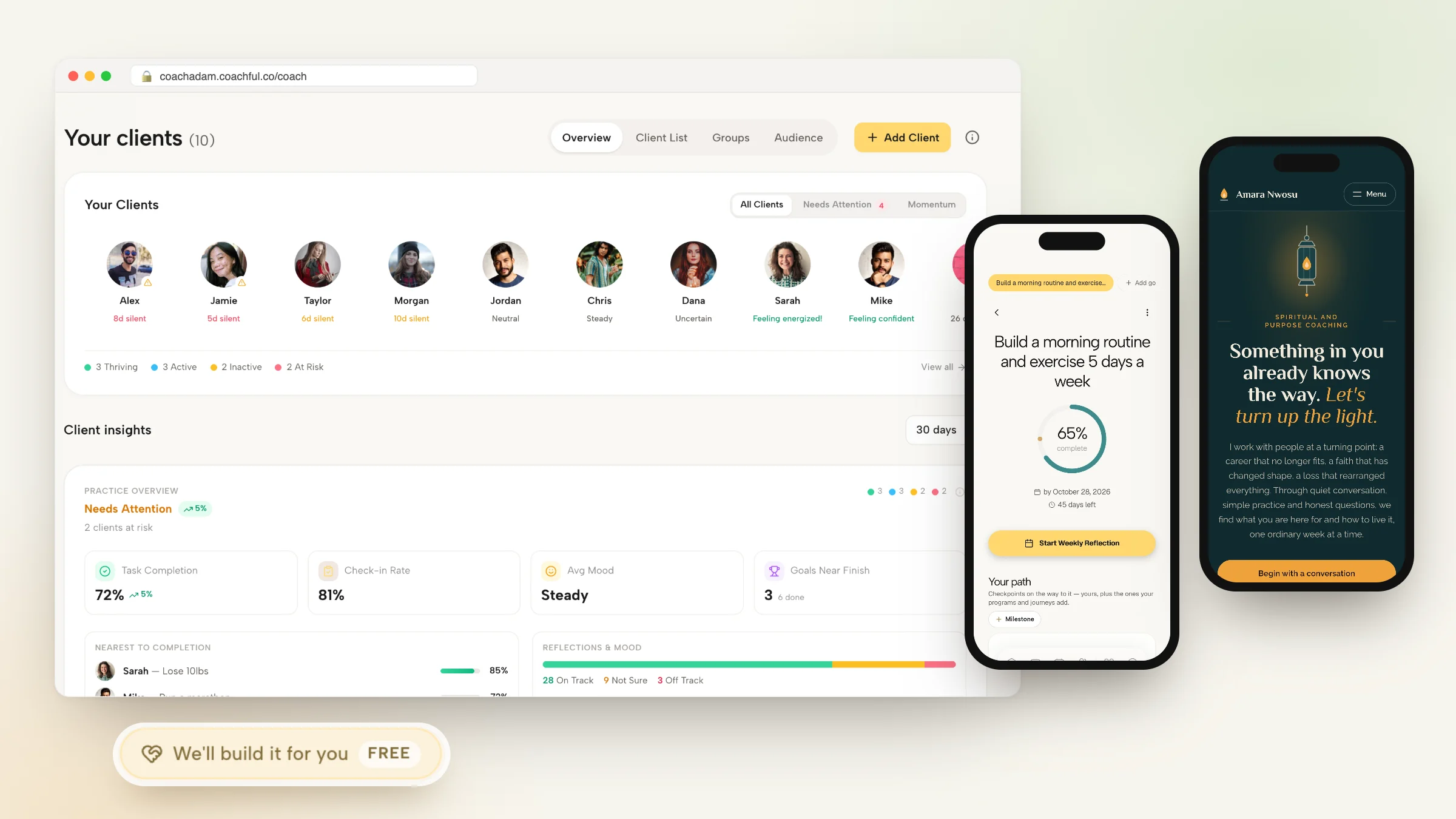
Yes, you can become a life coach without certification. No law in the US, the UK, Canada or most other countries requires one, and plenty of working coaches started without it. What you can't skip is what a good certification is supposed to give you: real coaching skill, an ethical frame, practice with honest feedback and a way for clients to trust you. Working as a life coach without certification means building each of those yourself, on purpose.
This guide shows how, including how to become a life coach for free or close to it, where going uncertified will genuinely limit you, and what to say when a prospect asks. For the full picture, with the certification route as well, start with our guide on how to become a life coach.
A practical note before the plan: the setup doesn't have to cost you weeks. Coachful's team builds your coaching website, first offer and first program for free on every plan, so the money you'd have spent on a course or a designer can stay in the bank.
What a certification gives you, and how to get it without one
Break a coach training program into its parts and each one has a do-it-yourself version. Some are harder than others.
| What training provides | The no-certification version | How hard |
|---|---|---|
| A coaching method | The ICF Core Competencies and a few well-known coaching books, studied and practiced | Easy to access, hard to apply alone |
| Ethics | The ICF Code of Ethics and the ICF's free ethics course | Easy |
| Practice | Peer coaching trios and pro bono clients | Medium: you have to organize it |
| Feedback on your coaching | Recorded sessions (with consent) reviewed against the competencies, plus a paid mentor when you can afford one | The hardest part to replace |
| Credibility | A specific niche, lived experience, a visible process and testimonials | Slow, but it compounds |
| Community | A peer group of new coaches who meet regularly | Medium |
The feedback row is the honest catch. Most people can learn what coaching is from reading. Very few can hear their own leading questions without someone pointing them out. Plan for that gap from the start.
How to become a life coach for free: a 12-week plan
This plan costs nothing but time, about four to six hours a week. It won't make you a credentialed coach. It will make you a competent beginner with real hours behind you.
Weeks 1 to 3: learn what coaching is
- Read the ICF Core Competencies and the ICF Code of Ethics. Both are free on the ICF's site.
- Take the ICF's ethics course, which is self-paced and free for non-members.
- Borrow two or three classic coaching books from a library, such as Co-Active Coaching, Coaching for Performance or The Coaching Habit.
- Write a one-page summary of how a session runs: agreeing the topic, exploring, choosing an action, closing.
Weeks 4 to 8: practice in a trio
- Find two other new coaches online or through a local network. Meet weekly for 90 minutes and rotate: coach, client, observer.
- The observer tracks one thing per session: how many questions were open, who talked more, whether the client chose the action.
- Record your sessions with permission and rewatch the first ten minutes of each. Our list of 30 life coaching exercises gives you structured practice material.
Weeks 9 to 12: coach real people
- Offer three to five people a short pro bono series, say four sessions, in exchange for honest feedback and, if it went well, a testimonial.
- Pick people who fit the niche you want to work in, not just friends who are being kind.
- Ask each one at the end: "What changed, and what would you tell a friend about working with me?"
By week 12 you'll have roughly 15 to 20 hours of real coaching, a few testimonials and a much clearer idea of who you're good with. Our guide to validating a niche with a paid pilot is the next step once you're ready to charge.

Proof that does the work of a certificate
Coachful's 2026 Coaching Business Report, drawing on the ICF Global Coaching Study 2025, notes that in consumer coaching, client outcomes and testimonials carry more weight than credentials. That's good news if you're uncertified, because outcomes are something you can build. Five kinds of proof that individual clients respond to:
- A niche drawn from your own life. "I coach people through their first year after a divorce, because I've done mine" tells a prospect more than a certificate number.
- A named process. A three-month structure with phases and a clear end point shows you have a method, not just good conversations.
- Specific testimonials, with permission. "I decided to leave my job and had a plan by week six" beats "She's amazing!"
- Relevant experience. A former teacher coaching parents, an HR manager coaching career changers, a nurse coaching burnout recovery: name the background plainly.
- A free sample. A workshop, a worksheet or a 20-minute call lets people experience your coaching before paying for it.
The template above shows how this looks on a page: a line of plain facts like "Former family mediator" and "Sessions by video, any time zone" instead of a row of badges. Our life coach bio examples and About page guide show how to write it.

Where no certification will hold you back
Going uncertified is a reasonable choice for many life coaches. It has real limits, and it's better to know them now than after a year of building:
- Employer-paid work. Coachful's report, citing the ICF 2025 study, finds nearly six in ten coaching clients worldwide are employer-sponsored. Corporate buyers often have a credential box on the procurement form.
- Buyer expectations. The same report says 73 percent of coaches report that clients and organizations expect certification.
- Platforms and panels. Some coaching marketplaces, coaching companies and employee assistance panels only list credentialed coaches.
- Income averages. The ICF 2025 study, via the report, puts ACC holders at $63,000 a year on average, 21 percent more than coaches without a credential. Part of that gap is experience.
- The hours trap. If you might want an ICF credential later, know this: the ICF only counts coaching hours completed after your coach-specific education starts, defined as a course of at least 30 hours. Two uncertified years of coaching won't count toward an ACC. If a credential is even a maybe, starting a short qualifying course early protects the hours you'll coach anyway.
If those limits matter for your niche, see how to become a certified life coach and the seven checks before you enroll in a program.

What to say when a client asks "Are you certified?"
Answer directly, then move to what the person actually wants to know, which is whether you can help them. Three honest versions:
- If you have no formal training: "I'm not certified. I've trained myself on the ICF's competencies and ethics, and I've coached about twenty people through career changes over the past year. Happy to put you in touch with two of them."
- If you took a non-accredited course: "I completed a coaching course with [school], which isn't ICF-accredited. Here's how I work and what clients usually get from it."
- If you're working toward one: "I'm part way through an ICF-accredited program and logging hours toward the ACC. My rate reflects that I'm earlier in my career."
Never imply a credential you don't hold, on your website or in conversation. Our guide to whether you need a license to be a life coach covers which titles are safe to use.

Setting up without spending much
An uncertified coach starting on a small budget needs five things: a page that explains the offer, a way to book a call, a way to take payment, a simple agreement and somewhere to keep notes. There are genuinely free tools for each one: free calendar booking links, free video-call tiers, a payment link from a card processor, a shared document for notes. They work, and the cost shows up later, in five logins for you and for your clients, and in evenings spent connecting them.
Coachful is the membership where it all comes included: the website, booking, payments, agreements, programs and client app, with payments going to your own Stripe or Razorpay account at a 0% Coachful platform fee. Coachful isn't free, but you can start with a free trial, and the build service is.
- A link page that sells from your social bio, with a free resource to collect leads.
- Booking with intake questions, so a pro bono client fills in the same form a paying one will.
- Programs with weekly goals, habits and check-ins in a client app on iPhone and Android, which makes your process visible to the client. See coaching program software.
- Hours tracking against ICF thresholds, if you decide to get credentialed later.
The Coachful page for life coaches shows the full setup.

Have your website and first offer built for free
Coachful's team builds your website, your first offer page and your first program for free on every plan, inside your own account. You choose We'll build it for you · FREE under Create, or Fill in a form on the Website page, and tell the team which pages you need, what they should do and what visitors should do next. Add up to 8 reference links and up to 10 files, such as a photo and your notes on who you help.

The team replies by email with next steps, usually within about 24 hours; that's typical, not a promise. For an uncertified coach, one rule matters most: nothing gets invented. No credentials, testimonials or prices you don't have, and anything missing is left for you to fill in. Your page will say what's true, which is the whole point. The team doesn't design logos, record videos or run ads. See what the free build includes.

Frequently asked questions
Can you legally be a life coach without certification?
Yes. Life coaching isn't licensed or regulated in the US, UK, Canada, Australia or most other countries, and certification is voluntary. You must stay out of regulated work such as therapy or medical advice, and you can't claim credentials you don't hold.
How can I become a life coach for free?
Study the ICF Core Competencies and Code of Ethics, take the ICF's free self-paced ethics course, practice weekly in a trio with other new coaches, record and review your sessions with consent, and coach a few pro bono clients for feedback and testimonials. It costs time rather than money.
Will clients hire a life coach without certification?
Many will, especially individuals. Coachful's 2026 report notes that in consumer coaching, outcomes and testimonials weigh more than credentials. Employers and some coaching platforms are different: they often require a credential such as the ICF ACC or PCC.
Can I get ICF certified later if I start without certification?
Yes, but hours you coach before starting coach-specific training don't count. The ICF only counts client hours after your education begins, with a course of at least 30 hours. If you think you'll want a credential, start a qualifying course early.
Do uncertified life coaches earn less?
On average, credentialed coaches earn more: the ICF 2025 study, via Coachful's report, puts ACC holders at $63,000 a year, 21 percent above uncredentialed coaches. Experience explains part of that gap, and niche and packaging move income at least as much.
Is it unethical to coach without certification?
No, as long as you're honest about your training, stay within coaching, follow an ethical code such as the ICF's, protect confidentiality and refer clients who need a licensed professional. Misrepresenting your qualifications is the unethical part.
What should a life coach without certification put on their website?
Who you help, the change you help with, how your process works, relevant life or career experience, specific testimonials with permission and a clear way to book a call. Leave out badges, titles or credentials you don't hold.
Will Coachful build my website if I'm not certified?
Yes. The free build is for any Coachful coach, on every plan. The team builds your website, offer and first program inside your account and only uses facts you provide, so nothing about credentials is invented. Coachful is a paid membership; the build costs nothing extra.












