
How to Become a Life Coach in 2026: 8 Practical Steps
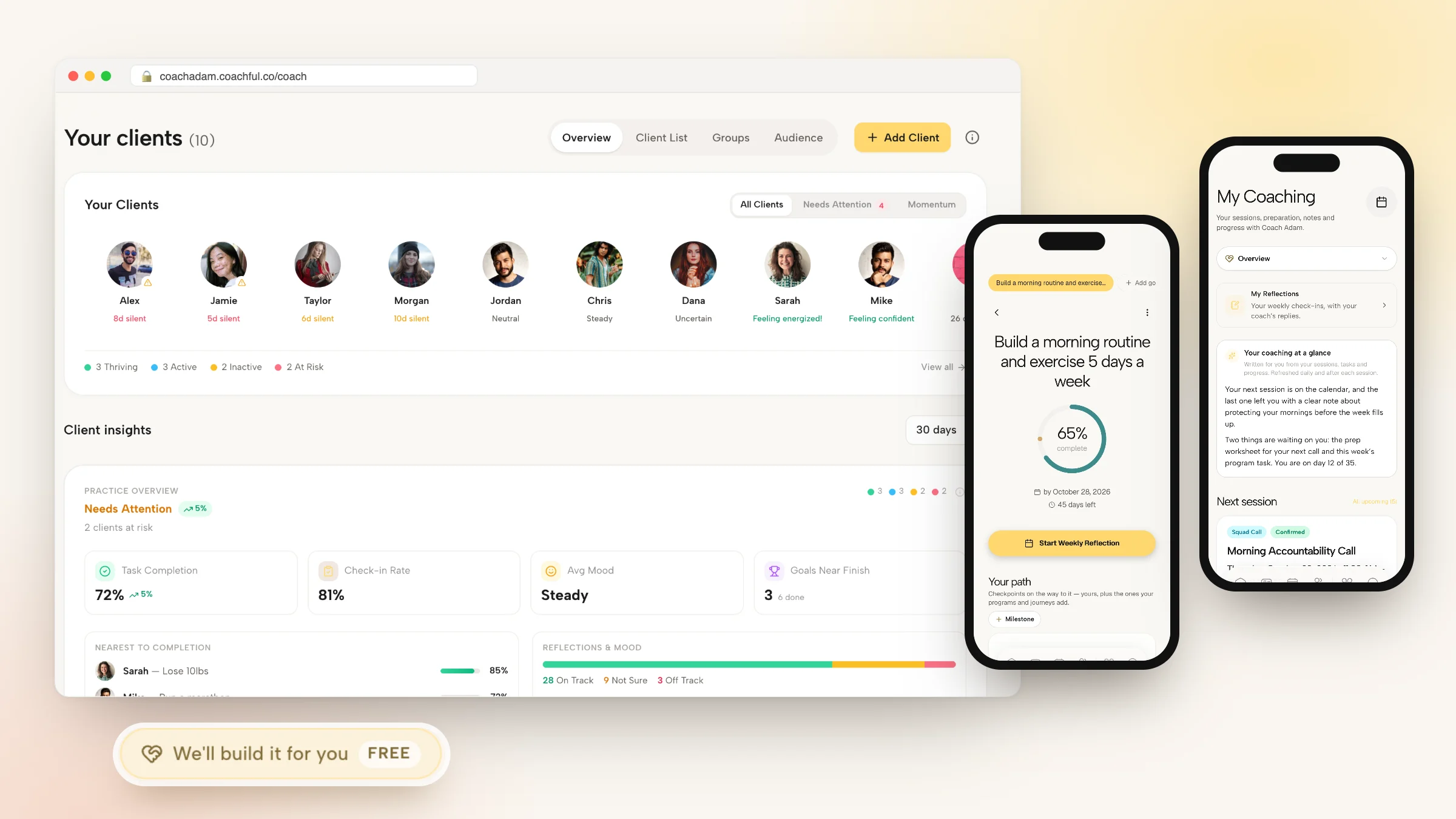
To become a life coach, you decide who you want to help, learn coaching skills through a training program, practice with real clients until you can point to results, and then set up a simple practice that sells one clear offer. In the US, the UK, Canada and most other countries, you don't need a license or a certification to work as a life coach. A recognized credential, most often from the International Coaching Federation (ICF), helps you learn the craft and earn trust, but clients mainly hire life coaches on fit, results and referrals.
That's the short version of how to become a life coach. The rest of this guide is the honest long version: what the job is and isn't, what the money looks like in the first years, the eight steps in order, how certification works if you want it, and what it takes to set up the business side. When you get to that part, Coachful's team will build your coaching website and first offer page for free on every plan, so the technology doesn't become the reason you never open the doors.
If you're still deciding which kind of coaching suits you, our broader roadmap on how to become a coach compares niches; this guide assumes you've picked life coaching.
What a life coach actually does
A life coach helps a client decide what they want in some part of their life and then follow through on it: a career change, a relationship, confidence, a move, a stuck habit, a sense that things should feel better than they do. The coach asks questions, reflects patterns back, helps the client design small experiments and holds them to what they said they'd do. The client does the work and makes the decisions.
It helps to be clear about what life coaching is not:
| Role | What they do | Typical training |
|---|---|---|
| Life coach | Forward-looking work on goals, decisions and follow-through | Coach training; no license required in most countries |
| Therapist or counselor | Assesses and treats mental health conditions, works with the past and with trauma | A graduate degree and a state or national license |
| Consultant | Diagnoses a problem and recommends the answer | Expertise in the subject |
| Mentor | Shares their own experience and advice | Experience in the field |
The line with therapy matters most. A life coach who notices signs of depression, trauma or addiction refers the client to a licensed professional and says so in their agreement. Our guide to keeping therapy and coaching separate covers the practical side, and trauma-informed coaching covers how to spot when a conversation has moved out of coaching.
Is life coaching a good career? The honest numbers
It can be, but go in with clear eyes. Coachful's 2026 Coaching Business Report describes life coaching as "the easiest niche to enter and the hardest to monetise, because the outcome is the least measurable." It rates the niche as extremely high on saturation and low on barriers to entry, based on the ICF Global Coaching Study 2025 and practitioner reports.
- Session rates: most life coaches charge $75 to $200 an hour (PayScale and practitioner reports, as compiled in the report). Newer life coaches typically sit at $50 to $100, a practitioner estimate.
- Annual income: $47,000 to $72,000 for life coaches, from PayScale, ZipRecruiter and Glassdoor.
- The first year: across all coaching, the report puts coaches in their first year at $20,000 to $30,000 a year (PayScale and practitioner reports). Session rates aren't income; few new coaches fill their week.
Most life coaches start part time, alongside a job, and grow from there. That's sensible, not a lack of commitment. Our piece on being a part-time life coach looks at that path, and what life coaches charge breaks down rates and packages in full.
Step 1: Decide who you want to help
"Life coach" on its own doesn't tell anyone whether you're for them. A niche does: a specific group of people and the change they want. It doesn't need to be tiny, but it should be specific enough that the right person recognizes themselves in one line.
- "Women in their 40s rethinking work after the kids leave home."
- "People rebuilding their lives in the first year after a divorce."
- "New managers who were great at the job and now have to lead the people doing it."
- "Adults with ADHD who want routines that survive a bad week."
The strongest niches usually come from your own life or career: a transition you've made, a world you know from the inside. Our list of coaching niches has dozens of examples, and before you commit, validate the niche with a small paid pilot so you know people will actually pay.

Step 2: Learn to coach, with or without certification
Coaching is a skill, and it's different from giving good advice. Training teaches you to listen for what the client means, ask open questions instead of leading ones, and let the client find their own answer. You can learn some of it from books and practice, but most working life coaches take a structured program.
Do you need a certification to be a life coach?
No. There's no legal requirement in most countries. A certification is worth it when you want a structured way to learn, when your buyers ask for it (employers and organizations often do) or when you want the credibility. Coachful's 2026 report notes that 73 percent of coaches say clients and organizations expect certification (ICF Global Coaching Study 2025), but also that in consumer coaching, client outcomes and testimonials carry more weight than credentials.
Certificate or credential: what "certified life coach" means
"Certified life coach" can mean two different things. A training school can certify that you completed its program. A professional body such as the ICF can award a credential after checking your training hours, coaching experience and a performance evaluation. The second carries more weight, because an independent body checked it. Our explainer on certificates of completion sets out the difference, and seven checks before you enroll will help you choose a program.
The ICF credential path
The ICF offers three credentials. These are the core requirements as the ICF publishes them; they change from time to time, so check the current requirements with the ICF before you enroll.
| Requirement | ACC | PCC | MCC |
|---|---|---|---|
| Coach-specific education | 60+ hours | 125+ hours | 200+ hours |
| Coaching experience | 100 hours with at least 8 clients, 75 of them paid | 500 hours with at least 25 clients, 450 of them paid | 2,500 hours with at least 35 clients, 2,250 of them paid |
| Mentor coaching | 10 hours over at least 3 months | 10 hours over at least 3 months | 10 hours over at least 3 months |
| Assessment | A performance evaluation of recorded coaching and the ICF's credentialing exam; check the current steps for each level |
Two details catch people out. Coaching hours count only after you start your coach-specific training, and for the ACC at least 25 of the 100 hours must fall within the 18 months before you apply. Our comparison of ICF ACC, PCC and MCC covers each level, and this guide to ICF mentor coaching covers the mentoring hours.
Does a credential pay? The ICF Global Coaching Study 2025, as compiled in the report, puts the average income of ACC holders at $63,000 a year, 21 percent more than coaches without a credential, with larger figures for PCC and MCC holders. Some of that gap is experience rather than the certificate, because higher credentials take years of hours to reach.
How to choose a life coach training program
- Accreditation: if you want an ICF credential later, choose a program the ICF accredits at the level you're aiming for.
- Observed coaching: look for programs where you coach and get feedback on real sessions, not only lectures.
- Mentor coaching: some programs include the 10 hours; others charge separately.
- Total cost: add tuition, mentor coaching, credential application fees and the time you'll spend. Accredited programs commonly cost thousands of dollars, so compare totals, not module prices.
- Fit with your niche: a program that suits grief coaching may not suit career coaching.
Step 3: Practice and log every hour
Start coaching while you train. Offer a handful of practice clients a set number of free or low-cost sessions in exchange for honest feedback and, if it goes well, a testimonial. The ICF lets up to 25 of your first 100 hours be unpaid, so pro bono work counts, as our guide to ICF pro bono hours explains.
Keep a log from your first session: date, client, length, paid or unpaid. Rebuilding it from old calendars a year later is slow and error-prone. Our ICF coaching log template shows what to record, and how ICF coaching hours work covers what counts.

Step 4: Set up the legal and admin basics
You don't need much, but you need these before you take money:
- A business structure. Many life coaches start as a sole proprietor or the local equivalent; some form a limited company later. Check the rules where you live, and talk to an accountant about tax.
- Insurance. Professional liability insurance is common for coaches. Seven checks before you buy life coach insurance covers what to look for.
- A coaching agreement. Scope, confidentiality, cancellations, refunds and what happens if something comes up that needs a therapist. Start from our coaching agreement template.
- A privacy policy. You'll hold personal information, so say how you store and use it.
- A referral list. Two or three therapists and services you can point clients to.
Step 5: Design your first offer and price it
Don't open with a menu. Open with one offer built around one change for one kind of client, with a start and an end. Most life coaches do best with a three-month package as the core offer, and Coachful's 2026 report puts a typical three-month life coaching program of eight sessions at $1,200 to $2,500, from practitioner reports and a verified sample of published life coach rates.
A first offer might look like this:
- Name and length: "The Fresh Start Program: 12 weeks."
- Who it's for: "People in the first year after a divorce who want their week to feel like theirs again."
- What's included: eight 60-minute video sessions, a short weekly check-in and messaging on weekdays.
- Price: a single price and a payment plan.

Our life coaching package examples show twelve complete offers with inclusions, and the pricing guide linked above shows how to work out a rate from your own income target.

Step 6: Set up your practice
This is where many new life coaches stall: a website on one tool, a scheduler on a second, payments on a third, notes in a fourth. You need five things working before your first paying client, and they work best in one place.
| What you need | The minimum version | How it works in Coachful |
|---|---|---|
| A website | Home, About, Work with me and a booking page | 30 designed homepage templates, filled with your name, offers and booking link, on your own domain |
| Booking | A free discovery call with two intake questions | Booking pages with availability rules, reminders, and Google, Apple or Outlook calendar sync |
| Payments | One price and one payment plan | Checkout through your own Stripe or Razorpay account, with a 0% Coachful platform fee |
| An agreement | Signed before session one | Coaching agreements sent for e-signature and stored on the client record |
| A place for the work | Notes and a way to check in between sessions | Programs with weekly goals, tasks, habits and check-ins, in a client app on iPhone and Android |

All of that is included in your Coachful membership. The dashboard walks you through the setup steps (custom domain, Stripe, social accounts, your first client), and the Coachful page for life coaches shows the full setup. For the website itself, our coaching website guide lists every page with copy, and these life coach website examples show what good first screens look like.
Have your coaching website and first offer built for free
If building a website is the thing standing between you and your first client, hand it over. Coachful's team builds coaching websites, offer pages, funnels and programs for free on every plan, inside your own account. Coachful itself is a paid subscription, and you can start with a free trial.

Open Website and click Fill in a form on the "Want us to build it for you?" card, or choose We'll build it for you · FREE under Create. Tell the team which pages you want, what they should do (book calls, collect leads, sell an offer, deliver a resource) and what visitors should do next. Add up to 8 links and up to 10 files, such as a photo, a logo or notes about your offer.

The sample above is filled in the way a new life coach might: a homepage, an About page and a 1:1 coaching page, with every button leading to a free 20-minute call and a free values worksheet for people who aren't ready. The team replies by email with next steps, usually within about 24 hours; that's typical, not a guarantee.
One recent request came from a menopause and midlife health coach starting from nothing, with no site, logo or prices. The result was five pages in sage and cream with every button leading to a free 20-minute consultation, and the prices left for the coach to set. That's the rule throughout: nothing is invented, no credentials, testimonials or prices you don't have. The team doesn't design logos, record videos or run ads. See everything the free build covers.
Step 7: Get your first clients
Your first clients almost always come from people who already know you, not from strangers finding your website. That's normal. The website makes you credible when someone checks you out; conversations get you clients.
- Tell people. Write a short, specific note to fifty people you know: who you help, what changes for them and an invitation to pass it on. Our life coach elevator pitch examples help with the wording.
- Offer conversations, not pitches. A free 20-minute call where the person leaves with one useful idea.
- Show up where your niche gathers. A workshop at a library, a guest spot on a podcast, a talk to a parents' group, a useful post on LinkedIn.
- Give people a smaller step. A free worksheet or short email course for those who aren't ready to talk yet.
- Ask for referrals and testimonials from practice clients who had a good experience.
More ideas in how to get coaching clients, and a full booking path in our discovery call funnel guide.
Step 8: Keep getting better
Good life coaches keep learning after the certificate. Mentor coaching, coaching supervision, recording sessions (with permission) and reviewing them, and asking every client for feedback at the end of an engagement all improve your coaching faster than another course. In Coachful, Michelle, the AI assistant, can give you private feedback on your own recorded sessions against the ICF Core Competencies when you turn it on; it's a self-development aid, not an ICF assessment or a substitute for mentor coaching.
How long does it take to become a life coach?
| Stage | Typical timing if you're part time |
|---|---|
| Choose a niche and test it with a few conversations | 2 to 6 weeks |
| Complete a 60-hour training program | 2 to 4 months |
| Coach practice clients and start logging hours | From your first month of training |
| Set up your practice and launch a first offer | A few weekends, or less with the free build |
| Reach 100 coaching hours for an ICF ACC | About 12 to 18 months for most part-time coaches |
The timings are typical patterns rather than measured figures. The key point: you can start coaching paying clients long before you hold a credential, and for the ACC you have to, since 75 of the 100 hours must be paid.
Frequently asked questions
Do you need a certification to become a life coach?
No. Life coaching isn't regulated in the US, UK, Canada or most other countries, so you can practice without a certification. Many coaches still train through an ICF-accredited program because it teaches the skill properly and helps with clients and organizations that expect a credential.
How do I become a certified life coach?
Complete a coach training program, ideally one accredited by the ICF, then apply for an ICF credential once you meet the requirements. For the ACC that's 60 hours of coach education, 100 hours of coaching with at least 8 clients (75 paid), 10 hours of mentor coaching and a performance evaluation, as the ICF publishes them.
How long does it take to become a life coach?
You can complete a 60-hour training program in two to four months and start coaching straight away. Reaching the 100 hours needed for an ICF ACC usually takes part-time coaches about a year to a year and a half.
How much does it cost to become a life coach?
Training is the biggest cost, and accredited programs commonly cost thousands of dollars once you add mentor coaching and credential fees. Budget too for insurance, a website, booking and payment tools, and your time. Our coaching business startup budget lists every line.
How much do life coaches make?
Coachful's 2026 Coaching Business Report puts life coaches at $47,000 to $72,000 a year (PayScale, ZipRecruiter, Glassdoor), with session rates of $75 to $200. Across all coaching, first-year coaches typically earn $20,000 to $30,000, because building a client base takes time.
Can I become a life coach with no experience?
Yes. Many life coaches start with life experience rather than a related career. Training gives you the coaching skill, practice clients give you experience, and a specific niche drawn from your own life gives people a reason to trust you.
What is the difference between a life coach and a therapist?
A therapist is licensed to assess and treat mental health conditions and often works with the past. A life coach works on goals, decisions and follow-through, and refers clients to a therapist when something clinical comes up. Your coaching agreement should say how you handle that.
Will Coachful build my life coaching website for free?
Yes. Coachful's team builds coaching websites and offer pages for free on every plan. Fill in the form from the Website page or Create, and the team replies with next steps, usually within about 24 hours. Coachful is a paid subscription; the website is included in your membership, and the build costs nothing extra.












