How to Become a Coach: A Roadmap for 2026

Coachful

You're probably staring at a laptop after work, doing the quiet arithmetic nobody talks about out loud. The salary you already have feels safe, coaching feels meaningful, and somewhere between those two facts sits the core question: can you make this business work, or are you about to buy an expensive identity change?
That's the decision. Not whether coaching is noble. Not whether helping people matters. The key issue is whether how to become a coach makes sense for your money, your time, and your tolerance for uncertainty.
The coaching profession is no longer an informal side lane. The International Coaching Federation says the modern profession was formalized in the late 1990s, and that the first ICF credential was awarded in 1998 to 34 North American coaches at a conference in Scottsdale, Arizona, a milestone that helped turn coaching into a recognized profession with standards, ethics, and credentialing. Today, 74% of coach practitioners hold a credential or certification, and the field has grown into a globally measurable market with 122,974 coach practitioners and estimated annual revenue of $5.340 billion USD according to the ICF's 2025 Global Coaching Study. ICF's history of the first credential and the 2025 Global Coaching Study executive summary make the same point from two angles, coaching is a profession now, not a hobby with nicer branding.
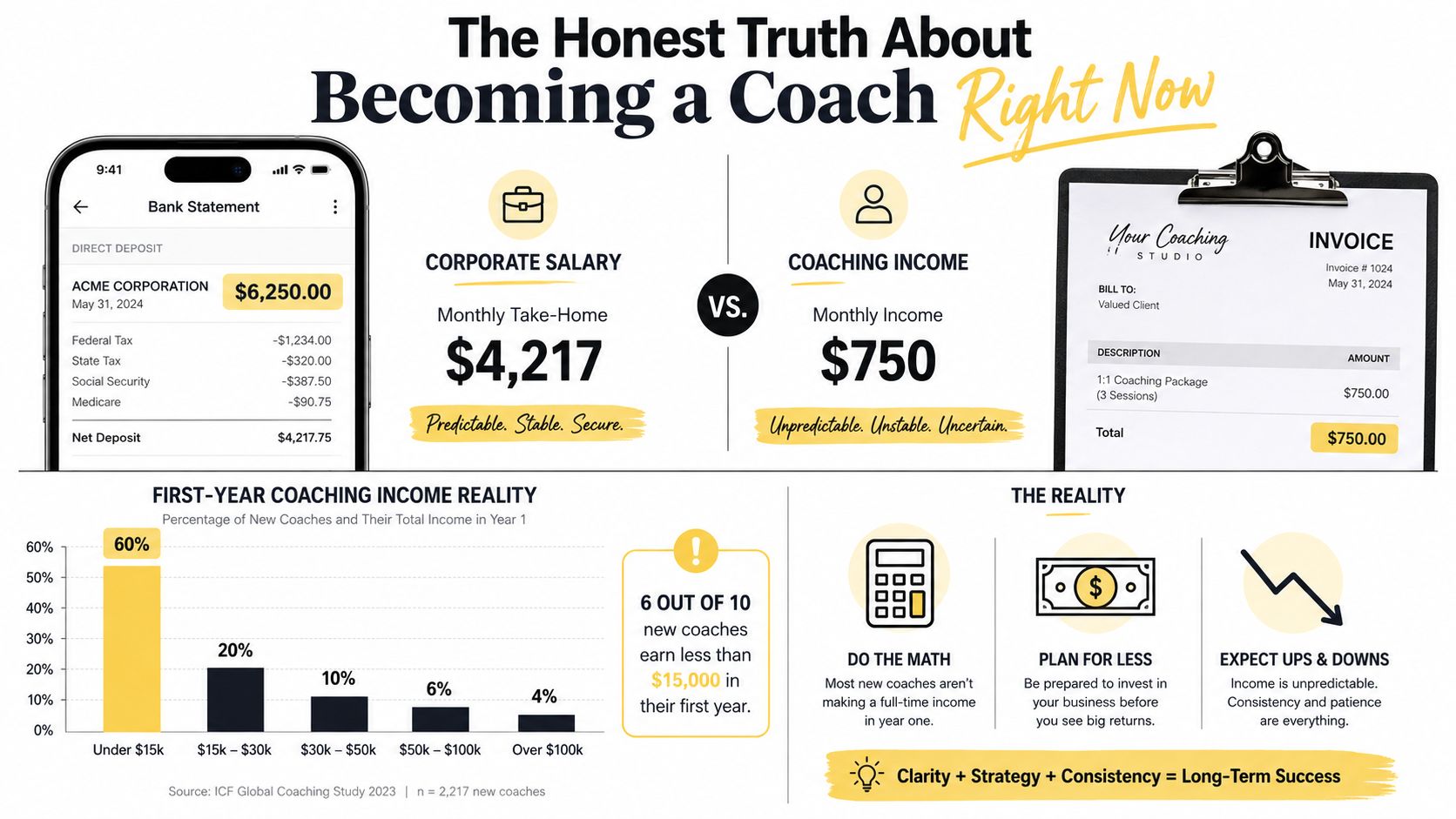
The Honest Truth About Becoming a Coach Right Now
You don't need more inspiration at this stage. You need a clean view of the trade-off. The first year is usually less about “finding your purpose” and more about building a pipeline while your confidence gets tested by silence, hesitation, and people who say they love the idea but don't buy.
A lot of people enter coaching imagining a graceful transition, a few discovery calls, a website launch, and then a full calendar. That's not how it usually goes. The actual work is selling, following up, refining your niche, and staying visible long enough for trust to build. If you want a useful adjacent tactic for that visibility, build a personal brand online only after you've got a clear buyer in mind, not before. Otherwise you'll be broadcasting to everyone and convincing no one.
What new coaches usually underestimate
The hidden cost isn't just the credential. It's the time it takes to become legible to a buyer who has better options and less patience than you think. A coach can have solid intuition and still fail because the market can't tell what problem they solve, who they serve, or why they're worth calling back.
Practical rule: if you can't say who pays you, what changes for them, and why they'd trust you instead of the next coach, you're not ready to scale, you're ready to sharpen.
Some coaches do reach strong income quickly, but they usually don't win because they “manifested harder.” They win because they made a business decision first. They chose a specific buyer, charged serious prices early, and treated their practice like a sales operation with a coaching method attached, not the other way around.
The shortest path to disappointment is to buy a certification and hope credibility will do the rest. The shorter path to traction is harsher and better. Pick a buyer with a real problem, learn how they already buy help, and build around that. Everything else is decoration.
Choosing a Coaching Niche That Pays
You have bills, limited hours, and a credibility gap to close. A niche decides whether those constraints become paid work or an expensive hobby. Choose too broadly, and you may sound warm and capable while giving buyers no clear reason to contact you.
Use four filters before you commit
Start with the buyer's budget and urgency. People with money allocated to a painful problem move faster than people who admire your mission. Then assess your credibility. Lived experience can shorten the explanation a buyer needs, but only if it connects to the problem you solve.
Look for outcomes clients can recognize and describe. “Feel more fulfilled” is difficult to buy. “Lead a growing team with fewer avoidable conflicts” gives the buyer something concrete to evaluate. Finally, confirm demand. Buyers already searching for this kind of help give you a stronger starting point than a problem you have invented.
Executive coaching for Series B founders and coaching for new tech managers illustrate the trade-off. The founder niche can support higher session rates because the buyer has money and urgency. It also demands a network, operating credibility, and fluency you cannot fake. The new-manager niche often supports lower rates, yet the market is larger and the sales cycle is usually less brittle.
The broad “life coach for women in transition” pitch creates a different problem. It sounds caring, but it leaves buyers sorting through a crowded field of similar providers. People buy help for a specific mess, not a general promise of life coaching.
| Niche | Typical Session Rate | Time to First Client | Main Barrier | Primary Risk |
|---|---|---|---|---|
| Executive coaching for Series B founders | $400 to $600 | Slower | Network and credibility | Long sales cycle |
| New-manager coaching for tech teams | $150 to $250 | Faster | Positioning inside a company | Lower initial ticket |
| Broad life coaching for women in transition | Not clearly differentiated | Unclear | Standing out | Blended into the crowd |
Use this checklist before you commit to any niche.
- Budget check: Can the buyer pay without a long explanation?
- Proof check: Can you point to real experience that supports your authority?
- Outcome check: Can progress be described in concrete terms?
- Demand check: Are people already searching for this kind of help?
If a niche fails two of those four, use the niche quiz to test fit before you commit. If it still fails, move on. A compelling mission cannot compensate for weak demand, unclear outcomes, or a buyer without budget.
Training, Certification, and Credentials Demystified
Credentials matter, but not equally for every buyer. That's the part most new coaches miss. Some audiences want proof of training before they'll take you seriously. Others care more about whether you can solve a problem, keep a clear boundary, and speak their language.
Three routes, three very different signals
ICF-aligned training is the route most likely to matter for corporate work and formal credibility. The ICF's staged pathway includes coach-specific training, supervised practice hours, mentor coaching, and performance evaluation, with typical thresholds of 60 hours and 100 client hours for ACC, 125 hours and 500 client hours for PCC, and 200 hours with 2,500 client hours for MCC, plus 10 mentor-coaching hours and a competency-based assessment. The ICF also says 73% of coaches believe clients and organizations expect certification, which tells you how normal this has become. ICF's research page is the cleanest source for those benchmarks.
School-based certifications from places like CoachU, iPEC, or the Academy of Creative Coaching can be attractive if you want structure, peers, and a clear curriculum without tying your whole identity to one credentialing body. Short-form courses from platforms like Mindvalley, Coursera, or LinkedIn Learning can still teach useful frameworks, but they rarely carry much weight in a sales call when the buyer wants evidence, not exposure.
Buy this path only if the buyer values the badge. If your audience is corporate, executive, or institutional, credentials can open the door. If your audience is consumer-facing and emotionally driven, your case studies and clarity usually matter more.
The return on each path depends on where you plan to sell. If you want internal company contracts, insurance-adjacent credibility, or to work inside a more regulated environment, a recognized credential is a serious asset. If you want to coach solo clients from your existing network, a well-built offer and a few strong results can matter more than the school name.
For a blunt comparison, use this rule. Choose ICF-aligned training if you need market legitimacy. Choose a school-based program if you need guided practice and peer support. Choose a short course if you need exposure to coaching language but aren't trying to build your authority around the certificate itself. If you want the distinction between a certificate and a credential spelled out plainly, the article on what a certificate of completion actually means is worth reading before you spend another dollar.
| Path | Cost Range | Hours Required | Industry Recognition | Best For |
|---|---|---|---|---|
| ICF-aligned credential path | Higher, often several thousand dollars | 60 to 200 plus client hours depending on level | Strong in corporate and professional settings | Coaches selling into organizations |
| School-based certification | Mid-range | Varies by school | Moderate, depends on reputation | Coaches wanting structure and community |
| Short-form online courses | Lower | Light to none | Limited | Early exploration and skill sampling |
Pricing, Packages, and the Business Setup Behind the Scenes
Your pricing is not a spreadsheet detail, it's a positioning statement. If you charge like a hobbyist, buyers treat you like one. If you package your work clearly, you make it easier for someone to say yes without negotiating every session like they're buying minutes from a therapist's office waiting room.
Price the engagement, not just the hour
Hourly pricing is the easiest place to start, but it also trains clients to count minutes. Package pricing changes the conversation because it frames the value around outcomes, not time. Retainers work when the relationship is ongoing and tied to a business cadence. Group coaching works when the problem is shared and the buyer wants access, structure, and cost efficiency.
A practical new-coach offer usually looks cleaner as a 3-session, 6-session, or 12-session package than as a loose hourly menu. Pair the package with an assessment, a roadmap, or a workbook if you want the offer to feel more tangible. Not because shiny extras save bad coaching, but because buyers need to understand what they are purchasing.
The legal side is not optional. Pick a business structure, usually an LLC or sole proprietorship depending on your situation, separate your personal and business accounts, and use a written coaching agreement that spells out confidentiality, boundaries, rescheduling, and scope of practice. If you plan to hire subcontractors within a year, your overhead rises fast because you're managing delivery, payments, and accountability on behalf of other people too.
Don't sign clients before you can explain your terms in plain English. If the agreement feels vague to you, it'll feel risky to them.
| Pricing Model | Typical Price Range | Best For | Trade-Off |
|---|---|---|---|
| Hourly | Lower to mid | First conversations and simple coaching | Easy to compare, harder to scale |
| 3-session package | Entry-level | Small wins and testing fit | Limited depth |
| 6-session package | Mid | Real behavior change | Requires stronger structure |
| 12-session package | Higher | Deeper transformation and retention | More commitment from both sides |
| Retainer | Ongoing | Embedded support for businesses | Needs strong boundaries |
| Group program | Variable | Shared problems and peer learning | Less individualization |
For a solo coach, the early cost stack is leaner. For a coach planning to bring on subcontractors, the stack gets heavier because you're not just coaching, you're coordinating delivery, contracts, and quality. The mistake is pretending those are the same business.
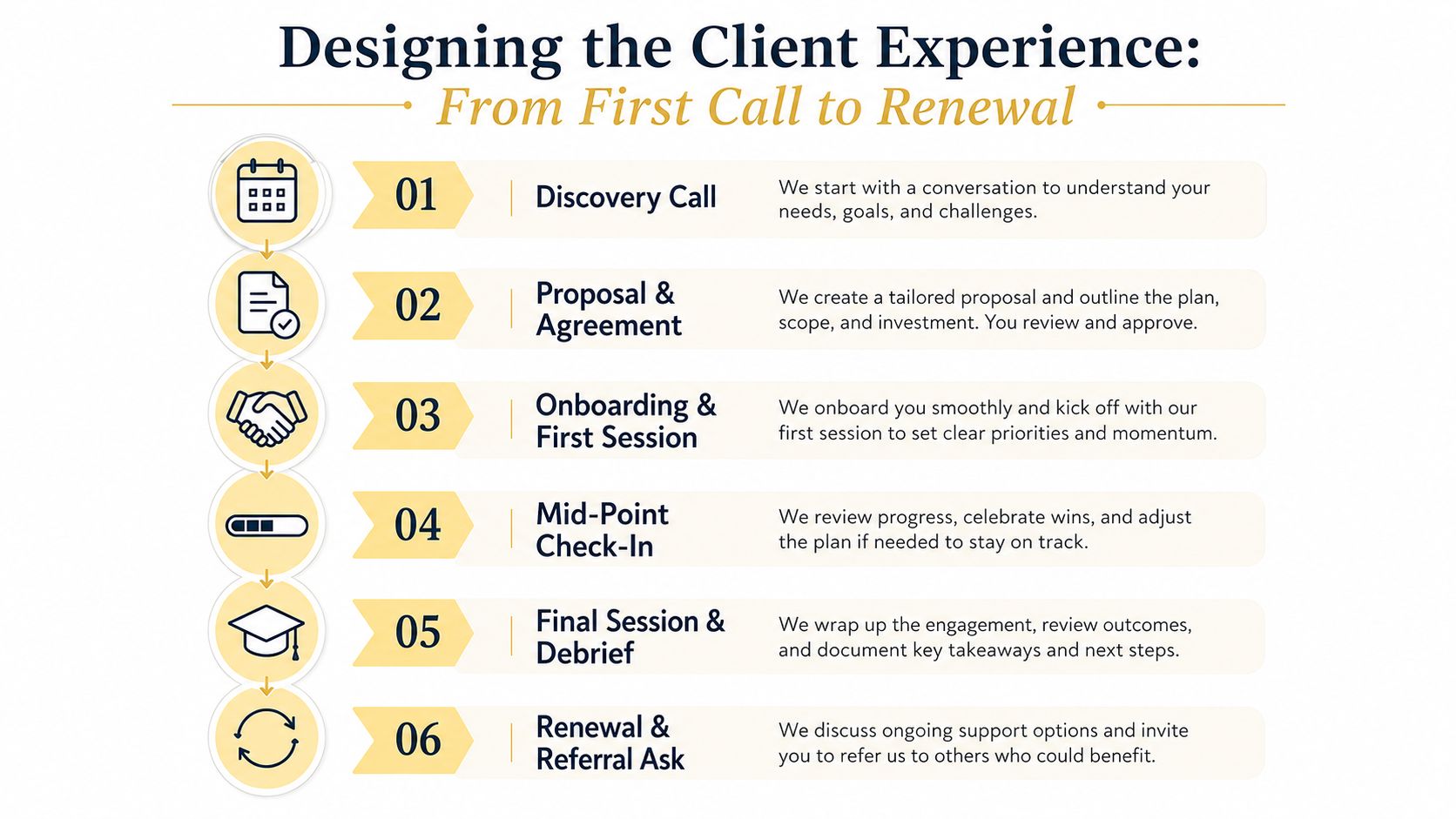
Designing the Client Experience From First Call to Renewal
A good client experience closes the gap between interest and trust. Most coaches lose people not because their method is weak, but because the process feels improvised. A client can forgive being challenged. They won't forgive confusion.
Start the discovery call with fit, not a pitch. Qualify whether the person has a real problem, a decision to make, and the authority to move forward. Ask what they want, what's blocking them, and what happens if nothing changes. If they say, “I need to think about it,” stop trying to rescue the sale. Give them space, recap the fit, and set a clean follow-up time instead of chasing.
Build the experience before the first session
Onboarding should feel like structure, not admin. Send an intake form, a goal-setting template, and a welcome packet that tells clients how you handle communication, reschedules, and homework. The more ambiguity you remove, the easier it is for the client to focus on doing the work.
The active session format can stay simple. Open with a quick check-in, set the agenda, coach the issue, define the commitments, and close with next steps. Track progress between sessions so the work doesn't evaporate the moment the call ends.
That's where renewal happens. A 60-day check-in gives you a natural moment to revisit momentum. A quarterly outcome review helps the client see progress they've already normalized. Referral prompts work best when satisfaction is high, not when you're desperately trying to fill next month's calendar.
If you want a platform reference point for this kind of workflow, Coachful is one of the tools that combines onboarding, scheduling, payments, messaging, notes, and progress tracking in one place for coaches who don't want to stitch together five separate apps. The feature list matters less than the principle, clients trust a practice that feels organized. For a deeper framework on the underlying process, see client experience design.
Marketing and Sales Strategies That Work for New Coaches
Daily posting is not a business model. A visible profile with no buyer is just a public diary. New coaches need channels that create trust, conversations, and warm introductions before they need polished content calendars.
Use channels that create conversations
A tight LinkedIn presence or niche-community presence works when it points at a specific audience, not at “everyone who wants growth.” You're not trying to become a content machine. You're trying to become the coach people remember when a need comes up. One good workshop or talk does more to demonstrate your method than twenty generic posts.
Partnerships matter more than most new coaches admit. Therapists, consultants, HR leaders, and other adjacent professionals already sit near the problem. They can send warm leads if you make it easy for them to understand when to refer.
A simple email nurture sequence built from one useful free resource is enough to start. If you need help translating video and workshop material into social snippets without turning your life into a content factory, the content repurposing tips from Klap are useful context, especially if you hate spending your evenings editing clips.
Organic relationship-based marketing is slower, but safer. Paid acquisition burns cash before it earns trust, which is a terrible trade for most new coaches who don't yet know which message converts.
That's why I'd rather see a new coach run a monthly 90-minute sales block than pay for ads too early. Use the block to follow up, send invites, book discovery calls, and ask for introductions. It keeps outreach contained so you don't drift into perpetual networking.
| Channel | What It Does | Cash Requirement | Risk |
|---|---|---|---|
| LinkedIn or niche community presence | Builds familiarity | Low | Slow if your niche is vague |
| Workshop or talk | Shows your method live | Low to moderate | Weak if the topic is generic |
| Partnerships | Creates warm leads | Low | Depends on mutual trust |
| Email nurture | Keeps interest warm | Low | Useless without a relevant lead magnet |
| Paid ads | Brings traffic | Higher | Expensive before you know your message |
Measure two things, not ten. Track how many qualified discovery calls you book and how many of those turn into paid packages. Ignore vanity signals if they don't lead to conversations. A post that gets likes but no calls is entertainment, not growth.
Your 90-Day Launch Plan and Where to Go Next
The fastest way to stall is to treat coaching as a someday identity. The faster way forward is to run a real calendar and decide what must exist before you sell. If you're serious, your next ninety days should feel structured, not dreamy.
Days 1 to 30 Foundation
Lock the niche, choose the credential path, file the business entity, and set up scheduling and payment tools. Write your first offer in plain language and define the buyer it's for. The mistake here is overbuilding the website before you've made any decisions worth displaying.
Days 31 to 60 Build
Book three beta clients, finish the intake and onboarding assets, and secure one referral partnership. This is the phase where many coaches underprice themselves to stay “accessible.” Don't do that. Beta work is for learning, not for devaluing the business.
Days 61 to 90 Launch
Run a weekly content cadence, refine your sales call script through real conversations, collect testimonials, and sell your first package at full price. Don't skip contracts because you want to be helpful. Don't wait for the website to be perfect. Buyers don't pay for unfinished confidence.
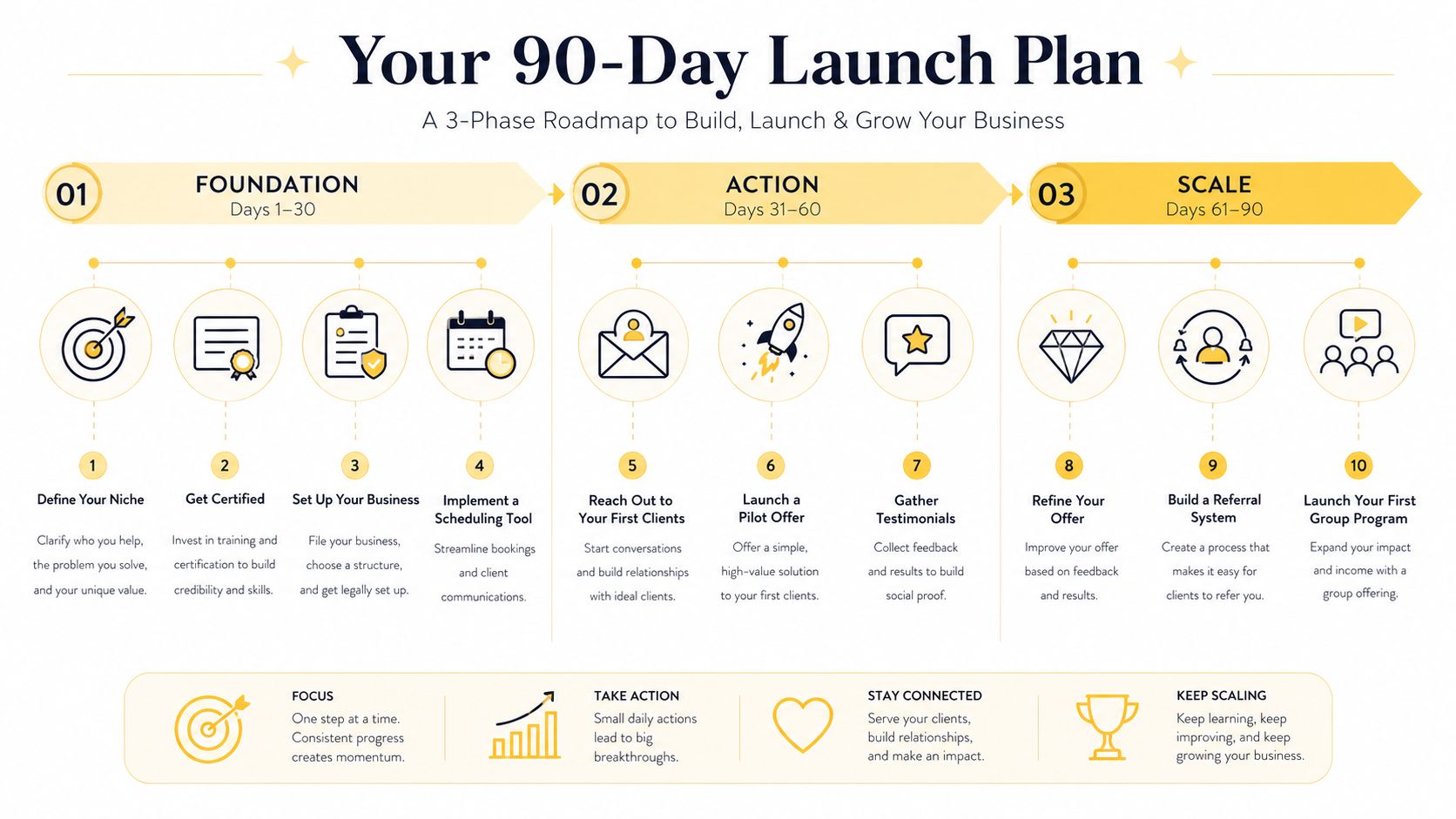
If your next problem is niche clarity, go back to the niche selection table and choose narrower. If your next problem is credibility, compare credential paths and decide what your buyer cares about. If your next problem is operations, build the client journey first and let the tools follow the workflow.
You don't need more tabs open. You need one honest plan, one offer, and one buyer in mind.
Coachful gives you the operational layer most new coaches wish they had before their first client call, onboarding, scheduling, payments, messaging, notes, and progress tracking in one place. If you're building a coaching practice and want the business side to feel as organized as the coaching itself, visit Coachful and see how a more structured client experience can support the way you work.