
Discovery Call Funnel for Coaches: The 7-Stage Build
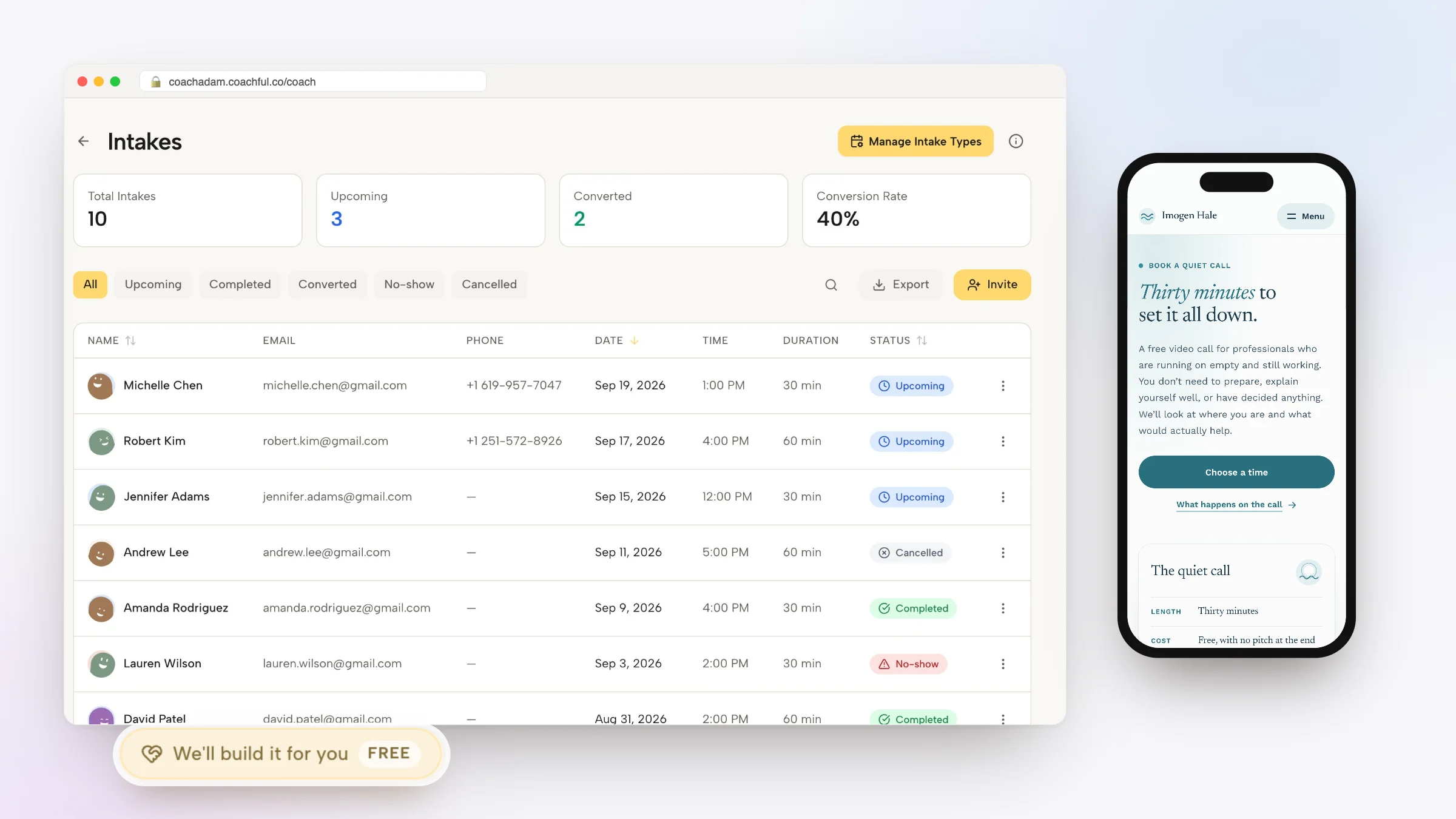
Most coaches already have half a discovery call funnel: a booking link in a bio and a calendar that fills with people who were never going to buy. A complete discovery call funnel adds the pieces around that link. It invites the right people, screens out the wrong ones, prepares everyone who books, gets them to show up and follows up afterwards whatever happened on the call.
Below is the whole thing as a sequence you can copy, with sample wording for the booking page, confirmation, reminders and no-show message, a worked example for a leadership coach who finds clients on LinkedIn, and the three numbers that tell you whether it works.
One shortcut before we start: on every Coachful plan, Coachful's team will build this funnel for you for free. You describe who should book and where they come from, and the team sets it up in your account. Details are in the section near the end.
The seven stages of a discovery call funnel
Each stage exists to stop one specific leak. Skip a stage and you will usually feel it within a month, as empty slots, no-shows or calls with people who can't afford you.
| Stage | Its job | The leak it stops |
|---|---|---|
| 1. Invitation | A post, email or page that offers the call | Nobody knows the call exists |
| 2. Booking page | Explains who the call is for and what happens on it | The wrong people book |
| 3. Questions | Two to four short questions at booking | You walk in blind |
| 4. Confirmation | A page and email with the time, link and one prep task | People forget why they booked |
| 5. Reminders | A reminder the day before and an hour before | No-shows |
| 6. The call | Your conversation, with a clear way to say yes | Warm calls that end in "I'll think about it" |
| 7. Follow-up | A note after the call, and a fresh link after a no-show | Leads that go cold |
Decide who should book (and who shouldn't)
An open booking link works when your audience is small and warm. Once you get more than a handful of bookings a week, add a filter. You have three options, from lightest to heaviest:
- Say it on the page. A short "This call is for you if..." and "This call isn't a fit if..." list does more screening than people expect.
- Ask questions at booking. Two to four questions on the booking form. People who won't answer two questions rarely buy.
- Use an application. A short form first, then the calendar, for higher-priced coaching or when you only want to talk to people at a certain stage.
Three questions that work for almost any niche:
- What's the one thing you'd most like to change in the next three months?
- What have you already tried?
- If we're a good fit, are you in a position to invest in coaching in the next month? (Yes / Not yet / I'd like to talk about it)
Whether to show your prices before the call is its own decision; our article on showing prices before a discovery call lays out both sides.

Write the booking page
The booking page is a sales page for 30 minutes of your time. It needs five parts, in this order.
- Headline that names the outcome: "A free 30-minute call to map your first 90 days as a new manager."
- Who it's for: "You were promoted in the last year, you're managing people who used to be your peers, and your calendar has eaten your actual job."
- What happens on the call: "We look at what's taking your week, pick the one conversation you've been avoiding, and sketch a plan for it. You leave with that plan whether or not we work together."
- Who it isn't for: "If you're looking for a job-search coach or a therapist, I'll point you to someone better suited."
- Button: "Pick a time" (plain wins; "Claim your breakthrough session" makes people wince).
Put a photo of yourself near the top. People book faces, and a cropped headshot from a real day beats a stock image of a handshake.
The confirmation page and email
Confirmation is where most funnels go quiet. Use it to give one small task that makes the call better and the person more committed.
Confirmation page headline: You're booked. Here's one thing to do before we talk.
Body: Before our call, write down the last three times you felt stuck at work this week. Two lines each is plenty. We'll start there.
Confirmation email subject: Our call on [day] at [time], and one quick question
Email body: Here's the link to join: [video link]. It's added to your calendar too. If you get a chance, reply to this email with the one conversation you've been putting off at work. I'll read it before we meet so we don't spend ten minutes on background.
Replies to this email are gold. Someone who has written to you before the call almost always shows up.
Reminders that cut no-shows
Two reminders are enough: the day before and an hour before. Keep them short and human.
- Day before: "Looking forward to our call tomorrow at [time]. If something has come up, you can move it here: [reschedule link]. No awkwardness, it happens."
- Hour before: "We're on in an hour. Here's the link: [link]."
Making rescheduling easy reduces no-shows, because people who can move a call quietly don't need to ghost it. If no-shows are a real problem, our guide to preventing coaching no-shows covers deposits and policies.
When someone doesn't show: send a fresh link the same day. "Looks like today didn't work out, which is completely fine. If you'd still like to talk, here's a new link to pick another time: [link]." One message, maybe one more a few days later, then let it go.

Worked example: a leadership coach for first-time managers
Take a fictional leadership coach, Priya, who works with engineers promoted into management. Her clients live on LinkedIn, and she wants six good discovery calls a week rather than fifteen random ones.
- Invitation: Three LinkedIn posts a week about the awkward parts of a first management job. Every second post ends with "I keep a few free planning calls open each week, link in the comments."
- Booking page: The five-part page above, with "for engineers in their first two years of managing" in the first line.
- Questions: How many people do you manage? What's the hardest conversation you have coming up? Is your company paying for coaching, or would you be paying yourself?
- Confirmation: The "last three times you felt stuck" task, plus a request to reply with the conversation they're avoiding.
- Reminders: Email the day before with a reschedule link, a text an hour before for people who opted in.
- The call: 30 minutes. Ten on their situation, ten on a plan for the one conversation, ten on whether coaching would help and what it looks like.
- Follow-up: A same-day email with the plan they made on the call, the offer details for people who asked, and a fresh link for anyone who missed it.
The third booking question matters for Priya, because employer-paid clients need an invoice and a different conversation. For more on finding clients there, see how to get coaching clients on LinkedIn.

Measure three numbers
- Booking rate: visitors to the booking page who book. Low means the page isn't clear about who it's for or what they get.
- Show rate: bookings that turn up. Low means the confirmation and reminders need work, or the booking page attracted curiosity rather than intent.
- Close rate: calls that become clients. Low means the call itself, the offer or the fit.
Track them for a month before changing anything. Small numbers swing wildly from week to week.
Mistakes to skip
- Calling it a "strategy session" when it's a sales call and then feeling awkward about selling. Say what it is: a call to see if coaching will help.
- Offering 60 minutes. Thirty is plenty and fits more calendars.
- Booking calls more than two weeks out. Intent fades fast. Use a minimum notice and a short booking window.
- No follow-up after a good call. Send what you promised the same day. Our guide to following up after a discovery call has templates.
Setting it up in Coachful
In Coachful the discovery call itself is an intake call type in Sessions, and the funnel wraps around it.
- Create the call type. Set its length, availability, buffers and minimum notice, and add your booking questions. A public session type gets its own booking address, and the answers are saved on the person's record before you meet.
- Or start from a funnel template. In Funnels, New Funnel offers a Discovery call booking template, a Strategy session application (form first, then calendar) and a Paid consultation.
- Calendar and video. Bookings sync with Google, Apple and Outlook calendars, and the call runs on built-in video or a Zoom, Google Meet or Teams link created for you.
- Reminders. Email reminders go out on their own, with a text the day before and WhatsApp an hour before once messaging is turned on and the person has opted in.
- Track every call. The Intakes page shows each call as upcoming, completed, no-show, canceled or converted, with a conversion rate across all of them.
- No-shows. Mark a call as a no-show and use Send a fresh link to write a warm note with a new booking link. Automatic missed-call follow-ups exist too, switched off until you turn them on in your scheduling settings.
The booking software page covers availability rules and payment if you charge for a first session.


Get your discovery call funnel built free
If writing booking pages and reminder emails sounds like a weekend you'd rather spend elsewhere, our team will do it. The build is free on every Coachful plan, labeled in the app as a complimentary gift.
Where to find it. Open Funnels and press Fill in a form on the "Want us to build it for you?" card, or open Create and choose "We'll build it for you".
What to tell us. Pick "Book discovery calls" as the goal. In "Who is it for, and what do they get?", describe your client and what happens on the call. In the journey box, list the steps, for example "LinkedIn post, booking page with three questions, confirmation email, reminders". Tick where people come from. Add up to eight links to pages you like and up to ten files, such as your logo, photos, a brand guide or copy you already have.
What happens next. The team replies by email with next steps, usually within about 24 hours, though that is not a guaranteed deadline. Everything is built in your own Coachful account, so you can change any wording afterwards.
What's been built recently. For a menopause and midlife health coach starting from nothing, the team built a five-page site where every button leads to a free 20-minute consultation booking. A leadership coach whose old website renewal was days away got one clean, mobile-friendly homepage with a repeated "talk with me" button.
What it doesn't include. The team won't take your calls, run ads or write testimonials you don't have. Anything that needs your input, like your own story or real client results, is left marked for you to fill in. Read the full list on our free white-glove service page.

If you'd like a resource to offer before the call, our guide to creating a coaching funnel shows how to put a free checklist in front of the booking page, and the quiz funnel guide does the same with a short assessment. Coaching leaders like Priya? The page for executive coaches covers the employer-paid side, from invoices to reporting.
Frequently asked questions
What is a discovery call funnel?
A discovery call funnel is the sequence that gets the right people onto a free introductory call: an invitation, a booking page, a few questions, a confirmation, reminders, the call itself and a follow-up. Each step either filters people, prepares them or gets them to show up.
How long should a discovery call be?
Thirty minutes suits most coaches. It is long enough to understand someone's situation and give them something useful, and short enough that people book it easily. Twenty minutes works for simpler offers; longer calls tend to drift.
Should I use an application instead of open booking?
Use an application when you sell higher-priced coaching, when most bookings are a poor fit, or when you only want people at a certain stage. For newer coaches with few bookings, open booking with two or three questions is usually better.
How do I reduce discovery call no-shows?
Give people a small prep task on the confirmation page, send a reminder the day before with an easy reschedule link and another an hour before, and keep the booking window short so calls happen within a week or two of booking.
Can Coachful's team build my discovery call funnel for free?
Yes. It is free on every Coachful plan. Open Funnels, press Fill in a form, choose "Book discovery calls" and describe your audience, journey and traffic sources. The team replies by email, usually within about 24 hours, and builds it in your account.
What should I say on a discovery call?
Spend the first part on their situation, the middle on one useful step they can take, and the last part on whether coaching would help and what it involves. If it's a fit, explain your offer plainly and ask whether they'd like to start.












