
How to Create a Coaching Funnel That Books Real Calls
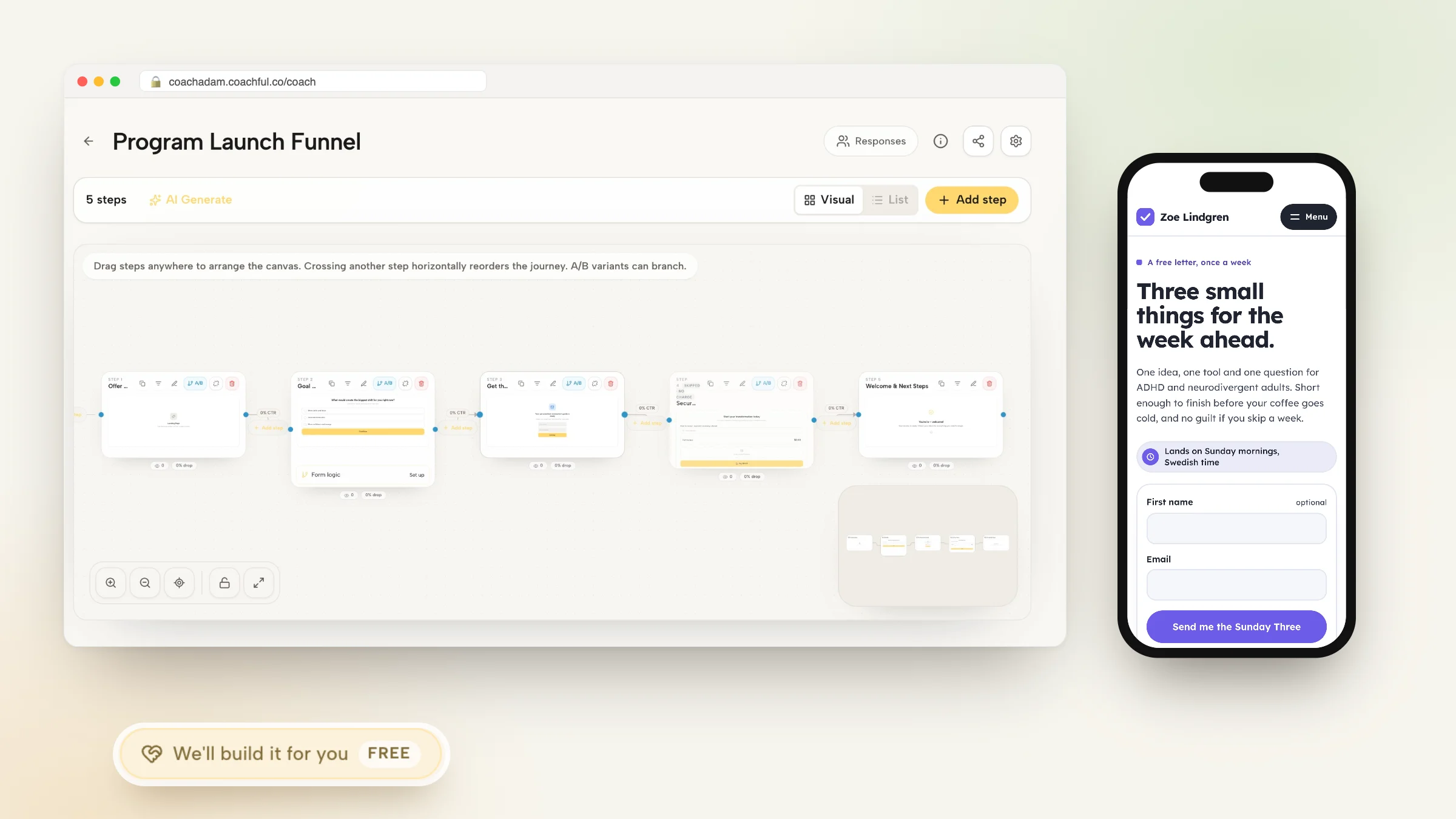
A coaching funnel is the short, planned path a stranger follows from first noticing you to booking a call or paying for coaching. Most working funnels have five parts: a traffic source, a landing page with one clear promise, a thank-you page, a few follow-up emails and a single next step such as a discovery call. If you can name each of those five for your own business, you can build a coaching funnel this week.
This guide walks through it in order, with sample copy you can borrow for every page and email, a worked example for a money coach, the numbers worth watching and the mistakes that quietly stop funnels from booking anyone.
If you would rather skip the building part, Coachful's team will build your funnel for free on any Coachful plan. You fill in a short form about who it is for and where people come from, and the funnel is set up inside your own account so you can edit it later. There is a full section on that further down.
The five parts of every coaching funnel
Funnel software makes this look complicated, with canvases, branches and split tests. Strip it back and almost every coaching funnel is the same five moves:
- Traffic. Where the person first meets you: an Instagram post, a LinkedIn comment, a podcast mention, a referral, a paid ad.
- Landing page. One page, one promise, one button. It offers something small and useful in exchange for an email address, or it asks for a booking straight away.
- Thank-you page. The most wasted page on the internet. It confirms the signup and invites the next step while attention is still warm.
- Follow-up emails. Three to five emails that deliver the promise, build trust and ask for the call.
- The ask. A discovery call, a paid consultation, an application or a direct purchase.
Everything else is decoration. Get these five right before you touch branching logic.
Step 1: Give the funnel one job
A funnel that tries to grow your list, sell a course and book calls at the same time usually does none of them well. Pick the single outcome you need most in the next 90 days, then pick the funnel shape that fits it.
| What you need | Funnel shape | The ask at the end |
|---|---|---|
| More discovery calls | Free resource, then booking page | "Book a free 30-minute call" |
| A bigger email list | Guide, checklist or quiz opt-in | "Reply and tell me what you're stuck on" |
| Sales of a program | Sales page with checkout | "Join the program" |
| A full live event | Webinar or workshop registration | "Save your seat" |
| Fewer unqualified calls | Application, then booking | "Apply for a strategy session" |
Write the job on a sticky note and keep it on your monitor. When you are tempted to add a second button, read the note.

Step 2: Choose an entry offer people actually want
The entry offer is the free thing (or the low-cost thing) on the landing page. It has to solve one small, specific problem your ideal client has this week, and it should point naturally toward the bigger problem you coach.
Good entry offers are quick to consume. A one-page checklist beats a 40-page ebook, because people finish it and then think about you. A few formats that work for coaches:
- Checklist or one-page guide: fastest to make, easy to finish.
- Self-assessment quiz: gives people a score or a type, which makes the follow-up personal.
- Short video training: lets people hear your voice before they book.
- Free email course: five short lessons, one a day.
- Free challenge or masterclass: more work for you, but warmer leads.
The test: could someone use it in 15 minutes and feel a small win? If yes, it will do its job. Our guide to creating a lead magnet for coaches goes deeper on picking and writing one.
Step 3: Write the landing page and thank-you page
Take a fictional money coach, Dana, who helps couples stop fighting about money and pay off debt. Her funnel's job is booking discovery calls. Her entry offer is a free "Spending Leak Finder", a one-page checklist that helps a couple find the money leaving their account without either of them deciding to spend it.
Here is copy she could use, section by section.
Landing page
- Headline: Find the money that leaves your account every month without either of you deciding to spend it.
- Subheadline: A free one-page checklist for couples who want to pay off debt without another money argument. Sit down together, tick through it in 20 minutes, see where the money goes.
- Three bullets: The five subscriptions most couples forget they share. The grocery habit that quietly doubles a weekly shop. The one question that turns a money fight into a plan.
- Button: Send me the checklist
- Small print under the button: You'll also get three short emails from me. Unsubscribe any time.
The headline names the exact frustration her clients describe on calls, in their words. If your clients talk about hours, energy or confidence, use their words instead of yours.
Thank-you page
- Headline: It's on its way. Check your inbox in the next five minutes.
- Body: While you wait: most couples find two or three leaks in the first pass. If you'd like help turning what you find into a payoff plan you both agree on, I keep a few free 30-minute calls open each week.
- Button: Pick a time for a free call
That thank-you page will book a few calls on its own, from the people who were ready anyway. The emails do the rest.

Step 4: Write three follow-up emails
Three emails over about a week is enough for a first funnel. Each one has a single job. Here is Dana's set.
Email 1, sent right away
Subject: Your Spending Leak Finder (and how to use it tonight)
Body: Here's your checklist [link]. One tip before you open it: do it together, with your bank app open, and agree that nobody gets blamed for anything you find tonight. The point is to find the leaks, and you'll find more of them if nobody is defending a purchase. Reply and tell me the biggest one you found. I read every reply.
Email 2, two days later
Subject: Why couples stop talking about money
Body: A short story about a couple (anonymized, or a composite you label as one) who kept a debt secret for a year, what changed when they set a weekly 20-minute money date, and the exact agenda for that date. End with: "If you want help setting up your first one, book a free call here."
Email 3, four days after that
Subject: A free call this week?
Body: Plain and short. Who the call is for, what happens on it ("we look at your numbers together and map the first 90 days"), who it is not for, and the booking link. No countdown, no fake scarcity.
If you want a longer set, our guide to a welcome email sequence has a full five-email version with subject lines.

Step 5: Send people to it
A funnel with no traffic is a very tidy secret. Pick one or two sources you already use and point them at the landing page for at least a month before you judge it.
| Source | How to point it at the funnel |
|---|---|
| Landing page link in your bio, a story with a link sticker every week, a post that teaches one item from the checklist | |
| A post that shares one finding, with the link in the first comment | |
| Facebook groups | Answer questions well; share the checklist only where the rules allow it |
| Podcast or YouTube | Offer the checklist at the end of every guest spot with a short, spellable URL |
| Email list | Send the existing list the new resource; it reactivates old subscribers |
| Paid ads | Only after organic traffic converts, so you know the page works |
Step 6: Measure four numbers
You do not need a dashboard with 40 charts. Four numbers tell you where the funnel is leaking:
- Landing page conversion: visitors who sign up. If this is low, the promise or the headline is off.
- Thank-you page bookings: signups who book straight away. Low here usually means the thank-you page asks too quietly.
- Email bookings: calls booked from emails two and three.
- Calls to clients: how many calls become paying clients. This one is about your call, not the funnel.
Change one thing at a time. If you have enough traffic, run a proper split test on the headline; our piece on split testing a landing page covers how.

Mistakes that quietly stop coaching funnels from working
- A vague promise. "Live your best life" gets nobody to type an email address. "Find the money leaving your account" does.
- Asking for too much on the opt-in. Name and email. Asking for a phone number on a free checklist costs signups.
- A dead-end thank-you page. "Thanks, check your inbox" and nothing else wastes the warmest moment in the whole journey.
- No reply path. Invite replies in the first email. Replies turn into calls far more easily than clicks do.
- Rebuilding instead of driving traffic. Most funnels that "don't work" have had a few dozen visitors. Send people for a month first.
- Five tools stitched together. Page builder, email tool, scheduler, payment link and a spreadsheet of leads means five places for something to break.
How to build the funnel in Coachful
Coachful's funnel builder sits inside the same account as your calendar, programs, email and client records, so the five parts above live in one place.
- Start from a template. In Sell, open Funnels and choose New Funnel. The first step offers about 25 written templates grouped as lead magnets, events, calls, sales pages, community and onboarding: a free guide, a checklist download, a self-assessment quiz, a discovery call booking, a free masterclass and more. Each one writes the headline, benefits, how it works, an About section with bracketed fill-ins and an FAQ. It invents no testimonials, statistics or prices.
- Map it on the canvas. Steps sit on a visual canvas with the route between them drawn as lines, or in a simple list view if you prefer.
- Edit safely. Step edits autosave as a draft and only go live when you press Save, so you can work on a page while the old one keeps running.
- Follow up automatically. An email sequence can start when someone completes the funnel, wait a set number of days and stop once they book or buy.
- See where leads came from. Every signup lands in your leads list with the funnel recorded as its source.

If you are comparing this with a dedicated page builder, our roundup of ClickFunnels alternatives for coaches lays out the trade-offs honestly. Dedicated builders have bigger template libraries; Coachful is stronger on what happens after the signup or the sale.

Or let our team build your coaching funnel for free
Funnels are the part of a coaching business most coaches put off, so we built a shortcut. On every Coachful plan, the Coachful team will build a funnel for you at no extra cost. In the app it is labeled as a complimentary gift.
How to ask. On the Funnels page, the "Want us to build it for you?" card has a Fill in a form button. You can also open Create and pick "We'll build it for you", the first chip under "Unleash your creativity".
What the funnel form asks.
- What the funnel should do: book discovery calls, grow your email list, sell a program or offer, deliver a free resource, fill an event or webinar, or something else.
- Who it is for and what they get.
- The journey people should follow, such as "Instagram post, checklist page, thank-you page with my calendar, three emails".
- Where people will come from: Instagram, LinkedIn, Facebook, paid ads, your email list, your website, YouTube or podcast, or referrals.
- Up to eight links to funnels or pages you like, and up to ten files: logos, photos, screenshots, brand guides, copy, documents or audio. Video files are not accepted.
What happens next. The request goes to the Coachful team, who reply by email with next steps, usually within about 24 hours. That is a typical turnaround, not a guaranteed deadline. The funnel is built inside your own account, so you edit the pages and emails afterwards with the normal editors.
What recent requests looked like. A business mentor for beauty professionals who sells on Instagram asked for a sales page and checkout for a 12-week mentorship. The team built it, rebuilt the coach's free start-up guide funnel so it now leads into that sales page, and rewrote the follow-up emails, with the design taken from the coach's own guide PDF. A psychologist-turned-coach working on emotional eating got a free-community funnel that delivers a guide, linked from a homepage with three clear paths.
What it doesn't include. The team doesn't run your ads, manage your marketing month to month or record videos for you. And nothing gets invented: no made-up testimonials, credentials or prices. Anything missing is left clearly marked for you to fill in. The free white-glove service page lists everything the team builds.

For a booking-focused version of this same idea, see our step-by-step discovery call funnel. And if money is your niche, the page for financial coaches shows how the rest of Coachful fits around a funnel like Dana's.
Frequently asked questions
What is a coaching funnel?
A coaching funnel is the planned path from first contact to a paying client. It usually has a traffic source, a landing page with one offer, a thank-you page, a short email sequence and one ask, most often a discovery call. The point is that each step has a single job and leads to the next.
How many steps should a coaching funnel have?
For a first funnel, keep it to a landing page, a thank-you page with a booking button and three follow-up emails. You can add a quiz, an application or an upsell later, once you know the basic version converts.
Do I need a lead magnet for a coaching funnel?
Not always. If your audience already trusts you, a direct booking page can work. A lead magnet helps when people need a small win before they will book, which is true for most cold traffic from social media or ads.
How long does it take to build a coaching funnel?
Writing the copy is the slow part: plan an afternoon for the landing page and thank-you page and another for the emails. With a template, setting up the pages takes an hour or two. If Coachful's team builds it, they usually reply within about 24 hours with next steps.
Can Coachful build my coaching funnel for free?
Yes. The funnel build is free on every Coachful plan. Open Funnels, press Fill in a form on the "Want us to build it for you?" card, and describe the goal, the audience, the journey and your traffic sources. The team replies by email and builds it in your own account.
What should I measure in my funnel?
Track four numbers: the share of landing page visitors who sign up, signups who book from the thank-you page, calls booked from the emails, and calls that become clients. Fix the weakest step first and change one thing at a time.












