Split Test Landing Page: Boost Client Conversions 2026

Coachful
You launched the page for your coaching offer. The design looks clean. The copy sounds thoughtful. You're sending traffic from Instagram, email, maybe even ads. People are visiting, but they aren't booking discovery calls, joining your webinar, or applying for your program at the rate you hoped.
That gap can get personal fast.
A lot of coaches don't read low conversions as a page problem. They read it as proof that the offer is wrong, the niche is wrong, or they're bad at marketing. Usually, that's not the right conclusion. More often, your page is losing people at one or two key moments. The promise may be too vague. The call to action may ask for too much too soon. The page may be answering questions you care about instead of the ones your buyers care about.
A split test landing page process helps you stop guessing. It gives you a way to ask the market a cleaner question, then let real visitor behavior answer it.
Why Your Landing Page Isn't Converting and How to Find Out
A coach builds a page for a high-ticket leadership program. The headline says something like “Step Into Your Highest Potential.” It sounds polished. It also sounds like ten other coaching pages your buyer saw that week.
People click. They scroll a bit. They leave.
Another coach promotes a webinar for burned-out professionals. Her page leads with a long personal story, then asks visitors to register. The story isn't bad. It just delays the thing the reader came for. They wanted to know, “What will I learn, and is this for me?”
Coaches often spiral. You start changing random things. A different hero photo. A new button color. A shorter paragraph. Then you wonder why nothing seems to move.
Your page is having the wrong conversation
A landing page fails when the message in your head doesn't match the conversation in your prospect's head.
Your prospect is asking:
- Is this for someone like me
- Will this solve the problem I feel today
- Do I trust this coach enough to take the next step
- Is the next step easy enough to say yes to right now
If your page doesn't answer those questions quickly, clarity drops and hesitation rises.
That's why split testing matters. It's not a technical hobby for marketers. It's a way to compare two versions of a message and see which one gets more of the action you want. If you want to go deeper on the mechanics of how teams optimize landing page conversions, that guide is useful background. But for a coach, the practical point is simpler. Testing helps you learn whether your audience responds better to one promise, one format, or one call to action than another.
A weak conversion rate doesn't always mean your offer is weak. It often means your page is making people work too hard to understand it.
What this looks like in a coaching business
A few examples:
Business coach
Version A says “Scale with more confidence.” Version B says “Build a client acquisition system that doesn't depend on referrals.” Those are two very different promises. One sounds aspirational. One sounds concrete.Life coach
Version A asks visitors to “Apply now.” Version B invites them to “Book a free clarity call.” If your audience is cautious, the second step may feel safer.Health coach
One page leads with credentials. Another leads with a specific outcome, like better routines, more energy, or less all-or-nothing behavior. Depending on the buyer's awareness, one will land harder.
If you're still tightening your overall site foundation, Coachful's website building advice is worth reviewing. But once the basics are in place, testing is where your growth gets more precise.
Forming a Winning Test Hypothesis
A coach rewrites a headline on Friday because it feels flat, checks conversions on Monday, and still has no idea what changed. That is how split testing turns into busywork.
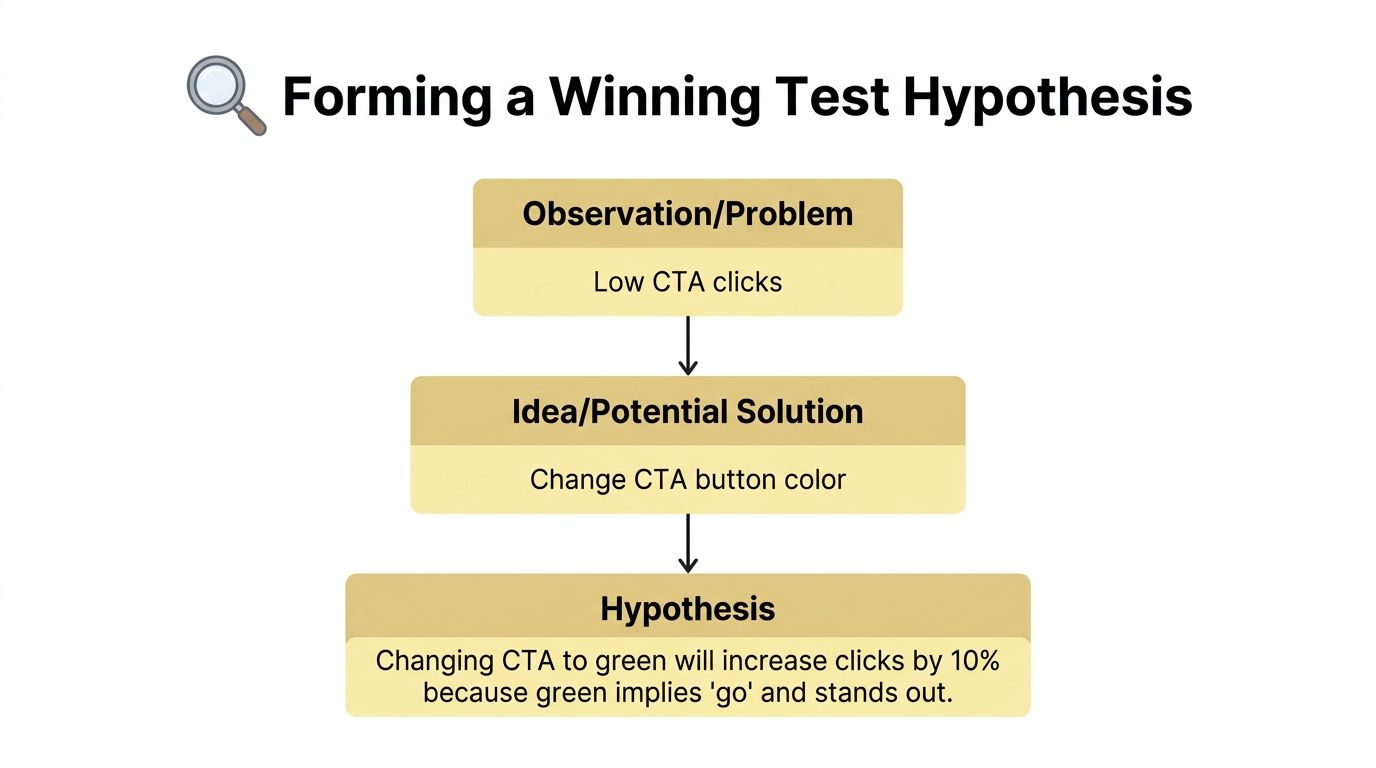
A useful hypothesis gives your test a job. It connects a real friction point on the page to one specific change and one measurable action you want more visitors to take.
A simple format is enough:
Because I see [evidence], I believe changing [element] for [reason] will increase [primary conversion metric].
For a coaching business, that often sounds like this:
Because discovery call applicants keep asking whether the program includes accountability, I believe changing the hero section to lead with weekly accountability support will increase applications.
Or this:
Because webinar visitors leave before they reach the registration form, I believe moving the form higher on the page will increase sign-ups.
Where coaches should look for evidence
You do not need to be highly technical to form a strong test. You need pattern recognition.
The best clues usually come from places coaches already use every week:
Discovery call notes
Look for repeated objections, hesitations, and phrases prospects use to describe what they want.Client intake forms
Pay attention to outcome language in the client's own words. That copy often works better than polished branding.Sales emails and DMs
Pre-sale questions show you where trust breaks down or where the offer still feels vague.Behavior on the page
Analytics, heatmaps, and session recordings can show whether people stop scrolling, miss the form, or click on elements that are not clickable. Hotjar's guide to landing page optimization gives a solid overview of the kinds of behavioral signals worth reviewing.Traffic source context
A visitor from Instagram often needs less background than someone landing cold from search. If you send people from your link in bio page, that audience may already know your story and need the page to get to the offer faster.
A mindset coach might assume her audience wants “confidence.” Her intake forms may show that what they in fact want is to stop second-guessing simple decisions. That shift matters. It changes the headline, the examples, and the call to action.
Choose one metric and one variable
Pick one primary conversion metric before you touch the page. Then test one meaningful variable at a time.
For coaches, the primary metric is usually straightforward:
| Page type | Best primary metric |
|---|---|
| Discovery call page | Call bookings |
| Webinar page | Registrations |
| Program application page | Completed applications |
| Lead magnet page | Email opt-ins |
Keep your test clean. If you change the headline, hero image, form length, and button text in the same variation, you may get a lift, but you will not know what caused it. That makes the next test harder, not easier.
There is a trade-off here. Testing one variable at a time can feel slow, especially when your page has several obvious problems. But for a coach without a full CRO team, clarity beats speed. A smaller, interpretable win is more useful than a messy result you cannot trust.
Examples of better and worse hypotheses
Weak hypothesis
“Let's make the page better by improving the design.”
That gives you nothing to test. The problem is unclear, the change is broad, and the expected outcome is missing.
Strong hypothesis
“Because prospects say the offer sounds interesting but unclear, changing the headline from a broad transformation claim to a specific outcome will increase discovery call bookings.”
Weak hypothesis
“Let's try a shorter page.”
Page length is not the actual issue on its own. The question is what content is helping the sale and what content is slowing it down.
Strong hypothesis
“Because prospects already know me from Instagram and do not need a long backstory, shortening the webinar registration page to focus on outcomes and logistics will increase sign-ups.”
Weak hypothesis
“Let's add more testimonials.”
Strong hypothesis
“Because visitors ask whether this program works for coaches at their stage, adding testimonials from clients who were early in business will increase application starts.”
Use this gut check before you launch anything: can you point to the evidence, name the exact element you are changing, and say which client-enrollment action should improve? If not, tighten the hypothesis first.
Prioritizing Your Landing Page Test Ideas
Once coaches understand split testing, they often create the opposite problem. They generate too many ideas.
You may have a list like this: test the hero image, rewrite the CTA, add testimonials, shorten the form, change the page layout, lead with pain points, lead with outcomes, change the button color, add FAQ, remove FAQ. That's normal. The question is where to start.
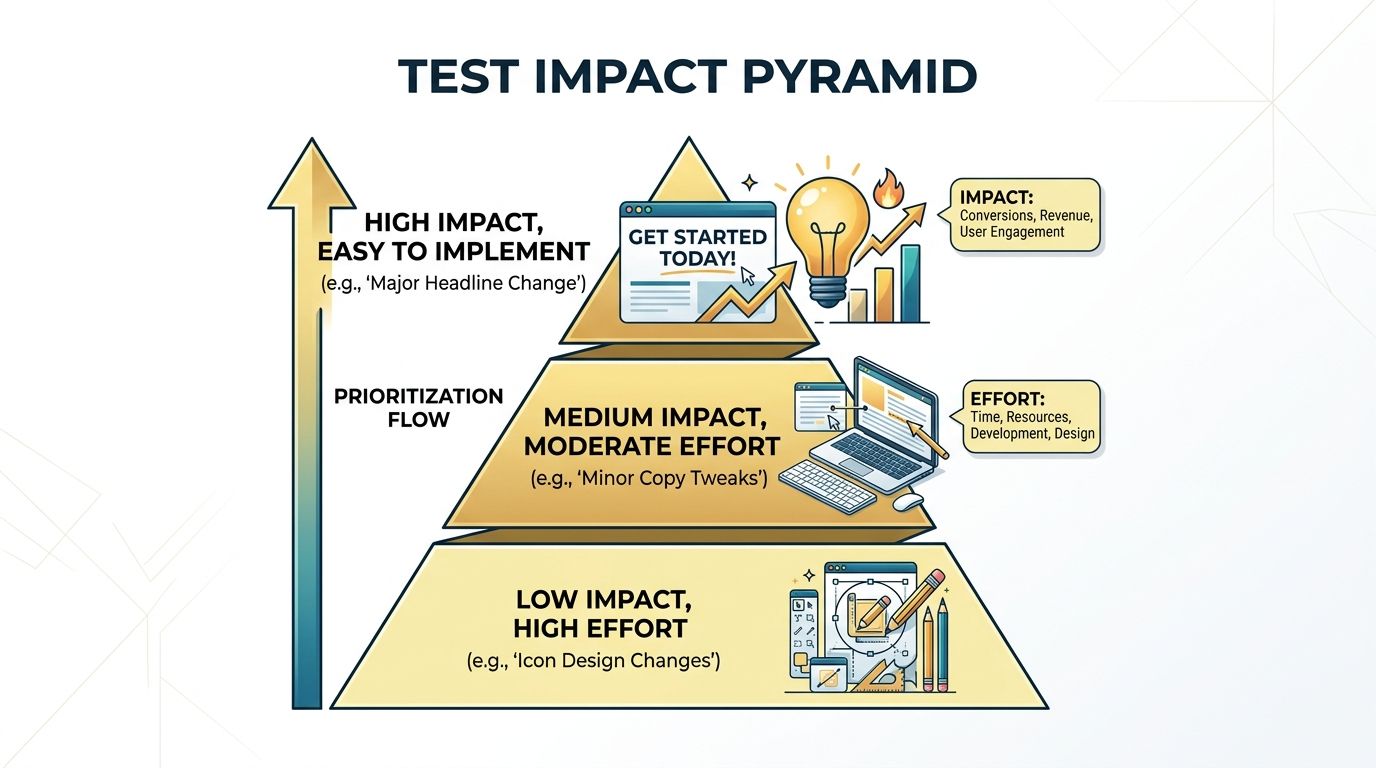
I like to think in a Test Impact Pyramid. The higher you go, the more a change can alter the buying decision. The lower you go, the more likely you are polishing details before the core message works.
Top of the pyramid
Start with the biggest levers first.
These include:
Value proposition
What are you really helping the client achieve, and how specifically are you saying it?Offer framing
Are you selling a vague transformation or a clearly structured path?Audience fit
Does the page call out who this is for in plain language?
A business coach might replace “Achieve seven-figure leadership” with “Build a repeatable sales process before you hire a team.” The second is narrower, but often stronger because it helps the right buyer self-identify.
A life coach might replace “Transform your life from the inside out” with “Stop abandoning your goals every time stress spikes.” Again, more specific. More grounded.
Middle of the pyramid
This layer shapes first impressions fast.
Focus on:
- Headline and subhead
- Hero section structure
- Primary call to action
- Trust elements near the top of the page
A coach selling a webinar might test “Save your seat” against “Join the free workshop.” Or test a page that leads with a bold promise against one that leads with a problem the buyer already feels.
A health coach, for example, might compare:
| Version | Hero angle |
|---|---|
| A | “Feel better in your body” |
| B | “Build eating habits you can keep when life gets busy” |
Version B usually sounds less glamorous. It often sounds more believable too.
Bottom of the pyramid
These elements matter, but they rarely deserve first priority:
- Button color
- Minor spacing edits
- Icon swaps
- Small visual refinements
These aren't useless. They're just not where coaches should begin if the page has a positioning problem.
A good gut check is this: if your audience still isn't clear on the offer, trust level, or next step, don't spend your best energy on tiny cosmetic tests.
If you use a link in bio page to drive traffic from social, this prioritization matters even more. Those visitors arrive with limited patience. They need the main promise to click immediately.
The fastest way to waste a month is to test small design details on a page with a muddy offer.
Setting Up Your Split Test Correctly
You do not need to be a tech person to run a clean split test. You need one clear setup, one conversion goal, and the discipline to leave it alone long enough to learn something useful.
For coaches, that usually means testing a page for one offer at a time. A webinar registration page. A discovery call page. A sales page for a group program. If you try to test all three at once, the result gets muddy fast.
Start with a true control and one real variation
Set up two versions of the same landing page.
- Control: your current page
- Variation: the new version based on your hypothesis
Send traffic to each version evenly so the comparison is fair. Many testing tools default to a 50/50 split, which works well for most coach-led businesses.
The bigger mistake is not the software. It is changing too much at once.
If your hypothesis is that a stronger promise will get more discovery call bookings, test the headline and keep the rest of the page consistent. If your hypothesis is that shorter pages convert better for cold ad traffic, test page length and leave the CTA, testimonials, and form setup alone. A split test should answer one question clearly.
Protect the test from avoidable noise
A valid result depends on stable conditions. Coaches often sabotage tests without realizing it by editing the page mid-run, changing traffic sources, or judging the outcome based on a handful of conversions.
Keep these rules in place:
Change one meaningful variable
Test one clear difference tied to your hypothesis.Track one primary conversion
Pick the action that matters most, such as booked calls, webinar signups, or program applications.Do not edit the pages after launch
Copy changes, new testimonials, or layout tweaks during the test make the result harder to trust.Keep traffic comparable
Do not send warm email traffic to one version and cold Instagram ad traffic to the other.
That last point matters more than many coaches expect. A page shown to people who have followed you for six months will behave differently from a page shown to someone who clicked a free training ad five minutes ago.
Use plain-English rules for the numbers
Testing tools love statistical language, and that is where many smart coaches start doubting themselves.
Use simpler questions.
- Did both pages get a fair amount of traffic?
- Did enough people convert to make the result worth trusting?
- Did one version win on the main goal by a meaningful margin?
That is the practical version of making data-driven decisions without turning every launch into a math project.
If your current site makes testing hard, the setup problem may be the platform, not you. A coaching website builder can make it easier to duplicate pages, change one element, and track conversions cleanly.
Good split testing is boring on the setup side. That is a good sign. If the structure is simple and controlled, you give yourself a real chance to find out which page gets more clients to take the next step.
Interpreting Results Without a Data Science Degree
You launch a test for your webinar sign-up page, open the dashboard two days later, and one version is ahead. Now the coaching brain spiral starts. Is that enough data? Are you overthinking it? Are you supposed to know what “significance” means before you can choose the page that gets more discovery calls?
You do not need to be technical to read a split test well. You need a clear decision process and the discipline to stay focused on the goal.
Start with the action that drives revenue. If the page is meant to book discovery calls, sell a group program, or fill a webinar, judge the test by that conversion first. A version that gets more scroll depth but fewer applications did not win.
What to check before you call a winner
Use a simple review order.
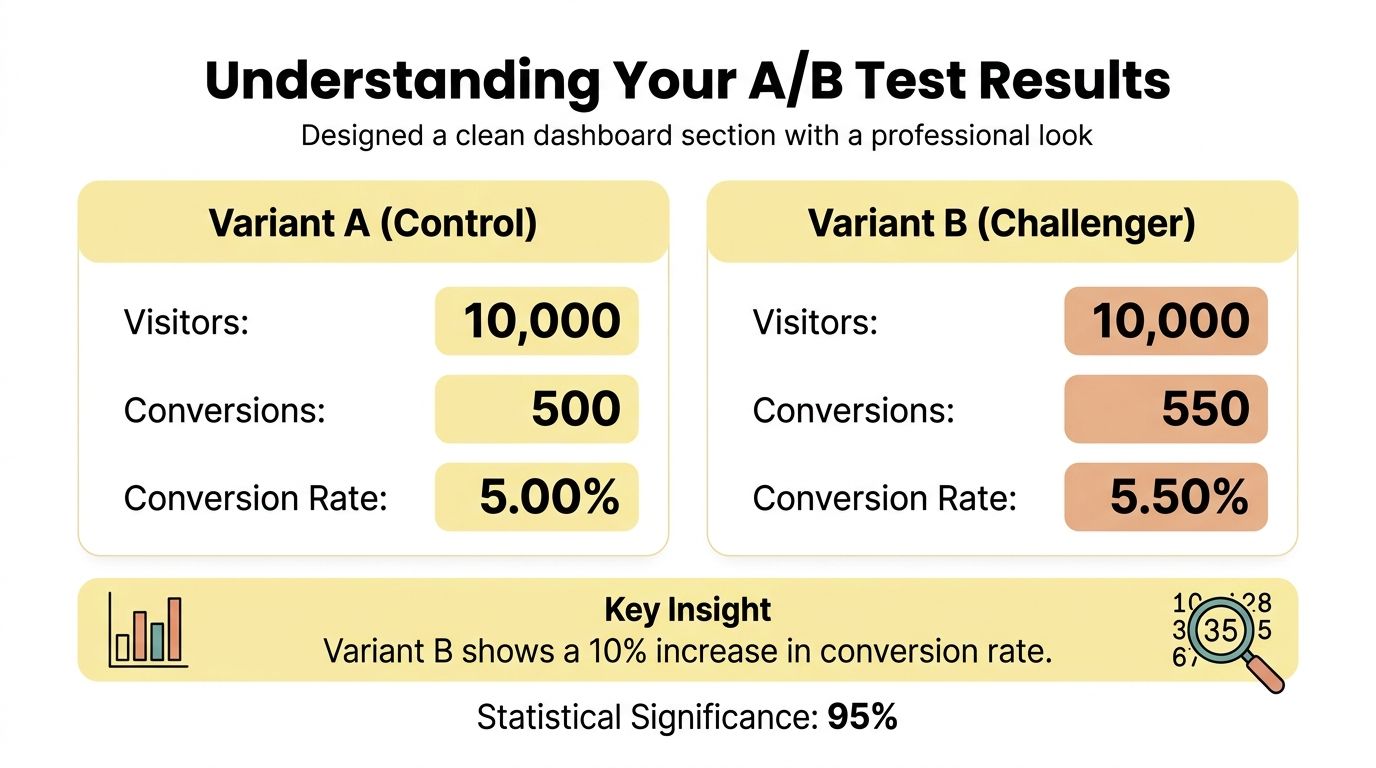
Primary conversion rate
Which page produced more of the main action?Total visitors per version
A result based on a small traffic split can change fast.Total conversions per version
Ten extra visitors can swing a low-conversion test. A larger pool is more trustworthy.Secondary behavior signals
Bounce rate, scroll depth, and time on page help explain what happened. They should not outweigh the main conversion goal.
If you want a practical gut-check on whether you have enough data, use a sample size calculator before or during the test. VWO's A/B test significance calculator is useful for checking whether the gap is large enough to trust or whether you need more traffic.
This is the part where many coaches get impatient. They see a temporary lead and want relief. They want to stop the test, pick a winner, and get back to client work.
Hold the line.
Short-term movement is common, especially if you sell through mixed traffic sources. A warm email click from people who have followed you for months behaves differently from colder traffic coming from Instagram ads or a podcast mention. If one version looks strong for a day or two, that may reflect timing more than persuasion.
A better question is, “Would I feel comfortable betting next month's lead flow on this result?” If the answer is no, keep running the test until the pattern is more stable.
Read the result like a coach, not a statistician
A winning page is not only a better page. It is evidence about what your buyers needed to hear.
If the version with a clearer program promise wins, your audience may have been confused about the outcome.
If the shorter form wins, friction was likely blocking action.
If the version that speaks to burnout, overwhelm, or inconsistency beats the version that leads with credentials, your prospects may care more about feeling understood than being impressed.
That interpretation matters because it shapes your next move. You are not collecting random test wins. You are building a sharper message for future launch pages, webinar registrations, and sales pages.
I also tell coaches to separate “lost test” from “bad idea.” Sometimes a variation fails because the page's main problem sits elsewhere. Changing a button label will not fix a weak offer. Testing more testimonials will not rescue a headline that does not match buyer intent.
For that reason, behavioral reporting can still help after the winner is clear. The discipline behind B2B SaaS marketing analytics is useful here because it trains you to look at user behavior in sequence, not as isolated metrics. That is valuable even if your business sells coaching packages, not software.
The point is simple. You do not need a data science degree to interpret a split test. You need enough data to trust the pattern, one primary goal to judge the result, and the confidence to translate numbers into buyer insight.
Rolling Out Your Winner and Avoiding Common Pitfalls
You ran the test, picked a winner, and now a familiar doubt shows up. What if the result was a fluke? What if you break the page by changing it? That hesitation keeps a lot of coaches stuck with a half-finished experiment while paid traffic, webinar signups, or discovery call leads keep flowing to the old version.
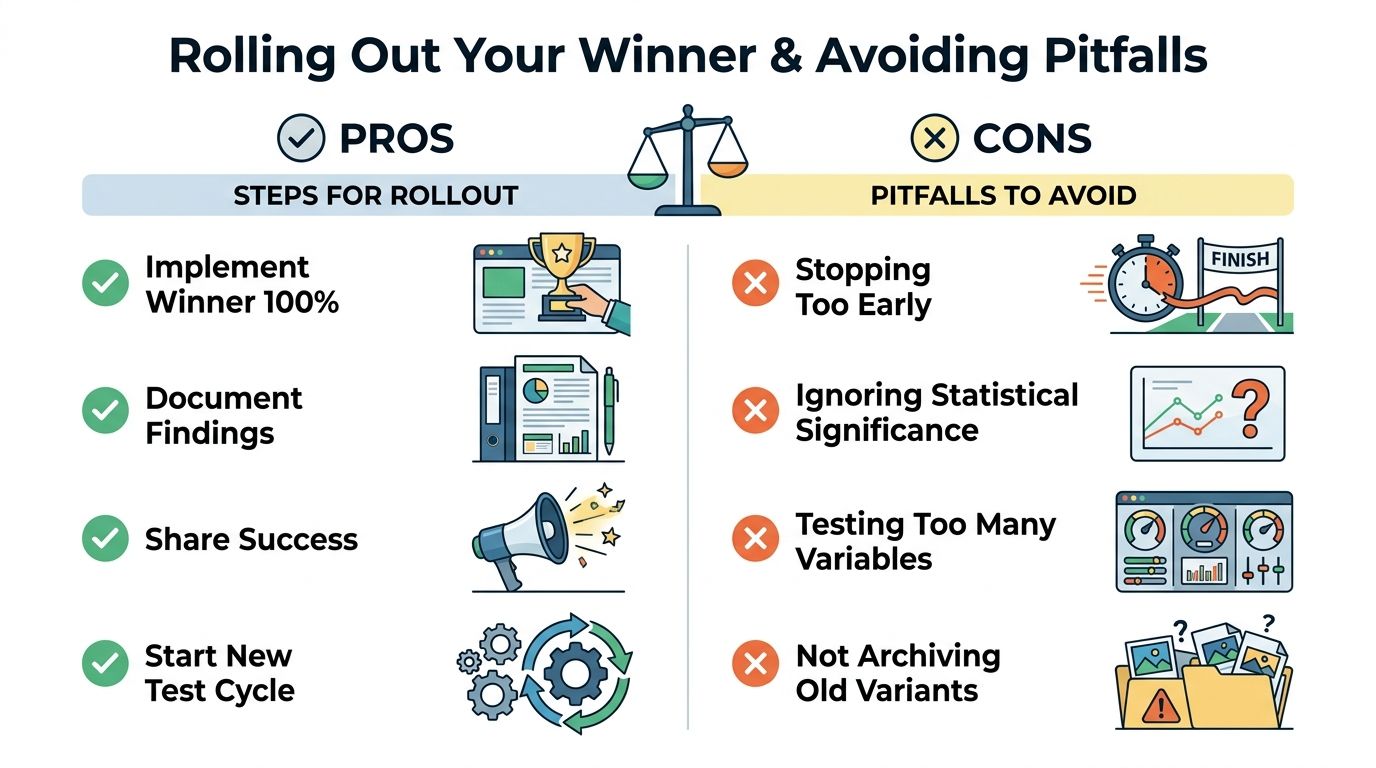
Once you trust the result, publish the winning version as your main page. Then record what changed, why you tested it, and what the result suggests about buyer behavior. That note matters later when you build your next workshop registration page or rewrite the sales page for a coaching package. Without it, you end up testing the same idea again six weeks from now.
Keep the rollout clean. Remove the losing version from active traffic, check that your form, calendar, payment link, and thank-you page still work, and watch conversion volume for the next several days. A winner in a test should still perform after rollout, but technical mistakes can erase the gain fast.
Here's the rollout mindset in one view.
The seven mistakes coaches make most often
Changing multiple things after the test ends
If headline B won, do not also swap the hero image, shorten the form, and rewrite the CTA on rollout day. You will not know what caused the next result.Treating a winner like a permanent truth
A page that wins for a webinar registration may lose on a high-ticket program application page. Buyer intent changes across offers and traffic sources.Rolling out without checking the full funnel
Coaches often verify the page and forget the next step. Test the confirmation email, scheduler, payment page, and any automation tied to the lead.Letting opinion overrule the result
You may prefer the version that sounds more polished or more “on brand.” Your prospects care about clarity, trust, and relevance to their problem.Reading too much into one win
If a shorter page wins, that does not automatically mean your audience hates detail. It may mean they had enough information already from your ad, email, or webinar.Ignoring seasonality and promotion context
A page tested during a warm launch to your email list can behave differently from the same page used with cold Instagram or YouTube traffic.Stopping the process after one good result
One winning test can help. A simple testing habit helps more because it compounds into a clearer offer, stronger messaging, and lower acquisition costs over time.
Build a simple operating rhythm
You do not need a complicated CRO system to do this well. You need a repeatable process you can maintain between client calls and content deadlines.
Archive the test
Save the control, the variation, the hypothesis, the traffic source, and the final result.Write the lesson in plain English
Example: “Coaches signing up for a discovery call responded better to an outcome-focused headline than a credentials-focused one.”Publish the winner carefully
Push the winning page live, then click through the full path yourself on desktop and mobile.Choose the next highest-impact question
Test the next likely conversion blocker, such as the offer promise, CTA framing, page length, or form friction.
The coaches who improve fastest are rarely the most technical. They stay consistent, keep records, and let real buyer behavior correct their assumptions.
If you want a simpler way to run your coaching business after the lead comes in, Coachful helps you manage onboarding, scheduling, payments, client progress, notes, and program delivery in one place so you can spend less time stitching tools together and more time turning new inquiries into committed clients.