A Website for Coaches That Actually Gets Clients

Coachful

You're probably in one of two places right now.
Either you already have a coaching website and it feels dead. It looks acceptable, it has your photo, your bio, maybe a services page, but it doesn't consistently bring in good-fit clients. Or you don't have one yet because every option feels like a trap. Too expensive, too technical, too many tools, too many opinions.
Both situations create the same frustration. You know your coaching changes people. But online, that value can get flattened into a few vague paragraphs, a contact form, and a calendar link buried in the footer.
A strong website for coaches should do more than announce that you exist. It should help strangers trust you, help qualified leads take the next step, and help paying clients move smoothly through onboarding, scheduling, payment, and follow-through. When that happens, your website stops being a side project and starts acting like part of your practice.
Your Coaching Website Is More Than a Digital Brochure
A lot of coaches build websites the way people used to build brochures. Home. About. Services. Contact. A few polished phrases. A stock-looking template. Then they wonder why the site feels invisible.
The problem usually isn't effort. It's the mental model.
If you treat your site like a digital business card, it will behave like one. It will sit there, look polite, and ask visitors to do all the work. They have to figure out whether you're credible, whether you understand their situation, what you offer, how to book, what happens next, and whether working with you will feel organized or chaotic.
That's too much friction.
What a modern coaching site actually does
A good website for coaches acts more like an operating system than a brochure. It has a job to do at every stage of the client journey:
- Attract the right people through clear messaging and searchable content
- Build trust quickly through credentials, ethics, boundaries, and proof
- Guide action with one obvious next step
- Reduce admin work through intake, scheduling, payment, and follow-up systems
- Support delivery with client resources, forms, and progress visibility
That shift matters more now because coaching is not a tiny side market anymore. Independent industry reporting that summarizes ICF data says global coaching revenue was estimated at $5.34 billion in 2025, up about 60% from 2019, with 122,974 coaches worldwide in 2025, a 54% increase from 2019 (coaching industry growth data). A growing market creates opportunity, but it also means your site has to do more than look professional.
Practical rule: If your website only describes your work, you still have a brochure. If it helps people start, pay, prepare, and stay engaged, you have a business asset.
What coaches often get wrong
Many coaches pour energy into the homepage headline and almost none into the systems behind it. That leads to common failures:
Too many paths
One page asks visitors to book a call, subscribe to a newsletter, follow on Instagram, download a guide, and browse three coaching packages. Confused people delay.Weak operational design
A prospect is interested, but now they have to email you for details, wait for a reply, coordinate times manually, request an invoice, and ask where materials live.No visible trust structure
In a field where many people use the title “coach” without shared standards, prospects look for signals that you're credible, ethical, and clear about scope.
A better question is not, “What should my website say about me?”
It's, “What should this website help a client do, from first visit to ongoing engagement?”
When you ask that question, your decisions get simpler. You stop chasing trendy design tricks. You start building a system that supports trust, action, and continuity.
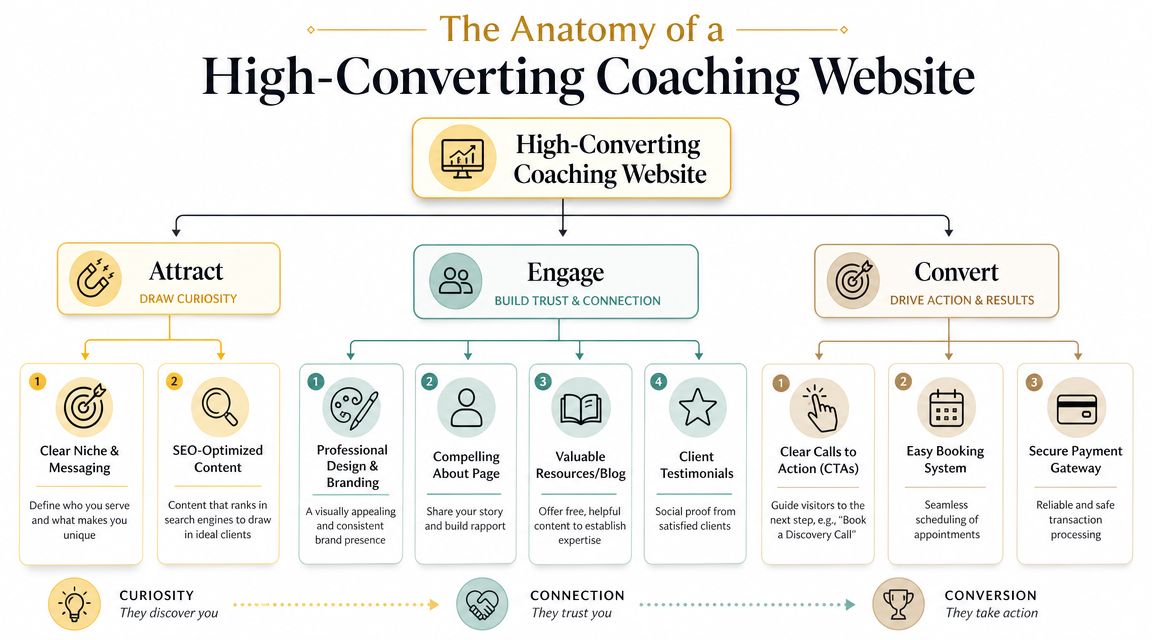
The Anatomy of a High-Converting Coaching Website
Most coaching websites don't fail because they're ugly. They fail because the pages don't have clear jobs.
A visitor lands on your site with a private question in mind. Can this person help me? Your pages need to answer that question in sequence. Not with hype. With clarity.
The pages that carry the business
Here's the simplest useful structure for most coaching practices.
| Page | Primary Goal |
|---|---|
| Home | Show who you help, what problem you solve, and what action to take next |
| About | Build trust and personal fit |
| Services or Programs | Translate your offer into a clear transformation and process |
| Blog or Resources | Demonstrate expertise and attract search traffic |
| Contact or Booking | Remove friction from taking the next step |
That list looks basic. The difference is in how each page behaves.
Home page
Your home page is not where you tell your whole story. It's where you orient the visitor fast.
Someone should know within seconds whether your work is for them. If you coach founders, say founders. If you coach career changers, say career changers. If you support executives through leadership transitions, say that.
Good home pages usually include:
- A specific headline that names the audience and the core problem
- A short supporting paragraph that explains the outcome without jargon
- One primary call to action such as “Book a discovery call”
- Light proof elements like testimonials, credentials, or recognizable context
- A simple route to programs, resources, and booking
What doesn't work is clever language that sounds grandiloquent but says nothing. “Realize your fullest potential” is easy to write and hard to trust.
About page
Your About page has one psychological job. Help the reader feel safe enough to continue.
Because coaching is lightly regulated and fragmented, people often rely on website signals to judge legitimacy. Clear presentation of qualifications, ethics, and testimonials helps build trust in that environment (trust signals for coaching websites).
That means your About page should include more than your origin story.
Consider these elements:
- Who you work with
- Why this work matters to you
- Relevant training or certifications
- Your coaching philosophy
- Scope and boundaries
- A next step
People don't read an About page asking, “How impressive are you?” They read it asking, “Can I trust you with something important?”
A practical example:
Weak version: “I'm passionate about helping people thrive.”
Stronger version: “I work with mid-career professionals who look successful on paper but feel misaligned, overextended, or stuck in roles they've outgrown.”
The second version feels grounded because the reader can place themselves inside it.
Services and program pages
Here, many coaches accidentally write a menu instead of an offer.
Your services page should not just list session length, package names, and pricing. It should help a buyer understand the journey.
Useful sections often include:
Who this is for
Name the situations, not just the demographics.What changes through the work
Focus on outcomes the client can recognize in daily life.How the process works
Explain the rhythm. Sessions, support between sessions, resources, check-ins.What happens next
Discovery call, application, consult, or direct booking.
If you offer several services, resist the urge to make every option equally prominent. Too much choice slows action.
Resources and contact
A blog or resource center shows people how you think before they ever speak to you. It's especially valuable for coaches with nuanced work that takes explanation.
Your contact or booking page should do the opposite of what many coaches do. It should reduce effort, not create another layer. Keep the path short. Make it obvious. Don't ask for more than you need.
Turn Your Website into Your Best Business Partner
A visitor lands on your site at 9:30 p.m. They are finally ready to do something about the problem that has been draining them for months. They read your offer, feel understood, and decide to reach out. Then the process falls apart. They have to email for availability, wait for a reply, ask how payment works, and search old messages for the intake form once you send it.
That is not a website problem. It is an operations problem.
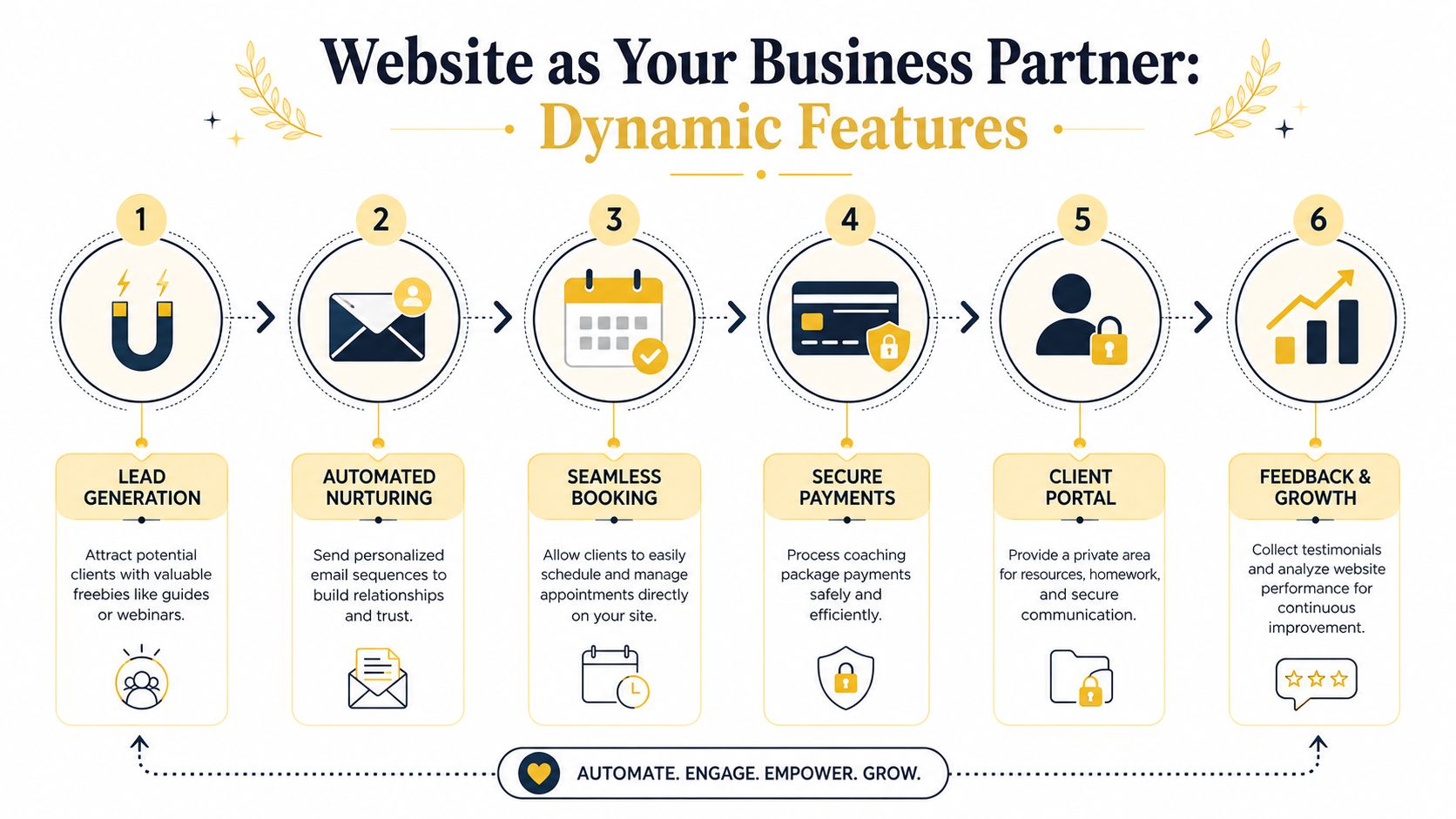
The strongest coaching websites do more than explain your work. They handle the repetitive parts of running it. Booking, intake, payment, reminders, session access, and follow-up all belong inside the client journey. If those pieces live in six different tools, your website acts like a brochure. If they work together, your website starts acting like part of your practice.
Scheduling is part of the sale
Coaches often treat scheduling as admin. Clients experience it as part of your professionalism.
An email-based booking process creates drag at the exact moment someone is trying to commit. I have seen this happen often. Interest is high when someone finishes reading a strong services page. Interest drops fast when the next step is vague or delayed.
A built-in scheduling flow does practical work for both sides:
- Captures intent while the client is ready
- Shows your availability and boundaries clearly
- Reduces rescheduling emails and calendar confusion
- Sets the tone for an organized coaching relationship
The trade-off is simple. Automated scheduling feels less custom than handling every inquiry by hand. It also saves hours, reduces drop-off, and gives clients a faster path to action. For most coaching businesses, that is the better deal.
Payments should not feel separate from coaching
Payment friction creates trust friction.
If a client books through your site but then gets a manual invoice, a separate payment link, and unclear terms, the experience feels stitched together. A polished homepage cannot compensate for that. Clients notice when the business side feels improvised.
A better flow is straightforward:
- The client chooses the right session or package
- They complete the intake form
- They pay, or place a card on file if that fits your model
- They receive confirmation, logistics, and next steps automatically
This saves time, but that is only part of the value. It also reduces uncertainty. Clients know what happens, when it happens, and what they are agreeing to.
A client portal improves follow-through
Many articles about a website for coaches stop at design and copy. That misses one of the highest-value parts of the site.
A client portal gives people one reliable place to manage the working relationship. That usually includes:
- Intake forms and agreements
- Session links and upcoming appointments
- Notes, goals, and action steps
- Resources, worksheets, and recordings if you use them
- Messages or updates between sessions
Without that structure, the experience spreads across inboxes, calendars, PDFs, shared docs, and payment tools. Some clients stay on top of it. Many do not. Then coaches end up resending links, repeating instructions, and reconstructing context before each session.
A disorganized digital experience lowers a client's confidence in the container you are providing.
That matters more than coaches sometimes realize. Clients are not only evaluating your insight. They are also responding to the reliability of the process around that insight.
Your website should reduce manual work every week
Operational improvements are rarely flashy. They are still some of the highest-return changes you can make.
A well-set-up coaching website can:
- Route leads to the right offer
- Collect the information you need before the first session
- Send reminders and reduce no-shows
- Keep client materials in one place
- Make renewals and ongoing engagement easier to manage
That is why I advise coaches to evaluate website decisions based on workflow, not just appearance. Good copy gets attention. Good systems protect your time and improve the client experience after the yes.
For coaches who want to connect site, scheduling, onboarding, and client management in one place, an all-in-one coaching platform can make more sense than patching together separate tools. The right choice depends on your business model, your budget, and how much technical maintenance you want to handle yourself.
If you are also refining how you bring in new clients, these effective marketing strategies for coaches are useful because they connect promotion with the systems required to support demand.
What this looks like in practice
The payoff shows up in ordinary moments.
A lead books a consult without sending three emails. A new client completes intake and payment in one flow. An ongoing client reviews goals before the session instead of asking you to resend notes. You spend less time coordinating logistics and more time coaching well.
That is what a business partner does. Your website should do some of that work too.
Speaking Your Ideal Client's Language
Most coaches aren't bad at writing. They're too close to their own work.
You know the nuance. You know the methodology. You know how much care goes into the process. But your potential client isn't reading your site with that context. They're reading while stressed, skeptical, overloaded, and hoping someone finally understands what they haven't been able to name well.
That's why effective copy feels less like performance and more like recognition.
Start with the client's present-tense reality
Weak coaching copy speaks from the coach's point of view.
It says things like:
- I help people transform
- My mission is to uplift
- I'm passionate about growth
- I offer a whole-person approach
None of that is false. It's just not where your reader lives.
Your reader lives in concrete tension:
- “I'm successful, but I dread my workday.”
- “My team depends on me, but I'm losing confidence.”
- “I know what I should do, but I'm still not doing it.”
- “I've outgrown this version of my life and don't know what comes next.”
Write from there.
A simple structure that works
One reliable way to write a services page is this sequence:
Name the problem clearly
Show the reader you understand the situation.Add emotional and practical stakes
What does this problem cost them if it continues?Introduce your coaching as the response
Not as magic, but as a process.Show what engagement looks like
Sessions, support, structure, expectations.Offer one next step
Book, apply, or inquire.
Here's a simple example.
I help leaders maximize their potential and lead with confidence.
Better version:
“You may be the person everyone relies on, yet still second-guess key decisions, avoid hard conversations, and carry pressure you rarely admit out loud. Coaching gives you a structured place to think clearly, lead more directly, and stop managing every challenge alone.”
The second version sounds more human because it mirrors real internal dialogue.
Write the sentence your ideal client has been saying privately, not the slogan you think a professional coach is supposed to use publicly.
Your bio should build authority and rapport
A strong bio doesn't read like a résumé pasted onto a webpage. It answers three questions:
- Why should I trust you?
- Why do you care about this work?
- What will it feel like to work with you?
A useful formula is: relevant background + coaching lens + who you help now
For example: “I'm a leadership coach who works with managers and executives navigating growth, conflict, and role transition. Before coaching full time, I spent years inside demanding team environments where strong performers often had support for strategy but very little support for judgment, communication, and self-leadership.”
That communicates authority without sounding inflated.
Friction hides in copy too
Research on professional-services websites shows that reducing friction through clear calls to action and mobile-first layouts improves lead completion. Confusing copy and extra clicks increase abandonment (conversion friction on service websites).
So apply that principle to your writing:
- Use plain labels such as “Book a discovery call”
- Keep buttons consistent across the site
- Trim long blocks into shorter, scannable sections
- Avoid jargon that forces interpretation
If someone has to reread your offer three times to understand it, the copy is doing too much work and too little helping.
Attracting Dream Clients While You Sleep with SEO
Search can become one of the steadiest ways to bring qualified people to a coaching site, but only if you stop treating SEO like a technical mystery.
For coaches, SEO is usually simpler than people assume. You do not need to become an analyst. You need to publish pages and articles that match what your ideal clients are already trying to solve.
This visual shows the path from visibility to inquiry.
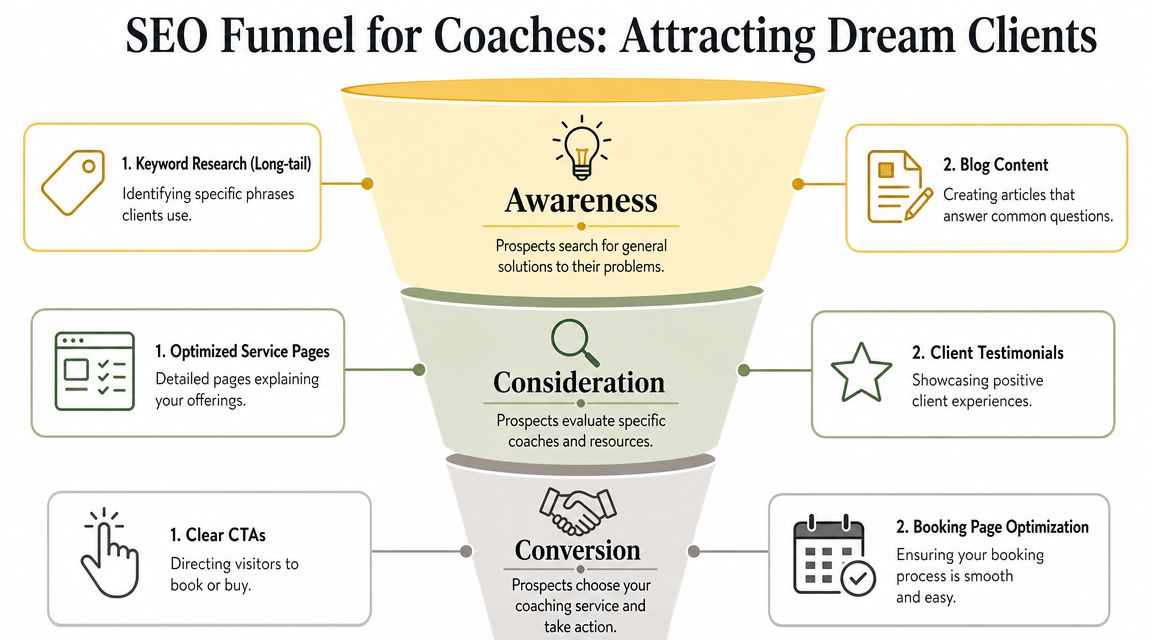
Go after specific searches, not broad labels
Many coaches want to rank for phrases like “life coach” or “business coach.” Those terms are broad, competitive, and often weak in intent.
Specific searches are usually more useful. Think in terms of the problems, moments, and decisions your clients face.
Examples:
- executive coach for new leaders
- career coach after burnout
- confidence coaching for women at work
- how to prepare for a leadership transition
- what does executive coaching help with
These phrases align better with real buyer intent because they describe a situation, not just a category.
Publish content that answers buying questions
A blog or resource section becomes powerful when it helps the right reader move from curiosity to decision.
Strong topics often fall into a few buckets:
Problem-aware content
“Why high performers still procrastinate on important decisions”Solution-aware content
“How executive coaching works during role transitions”Decision content
“How to choose a coach when you need structure, not motivation”
Organizations often look for a clear business case before they invest in coaching. Industry summaries of ICF research report that organizations typically see about $5 to $7 for every $1 invested in coaching, and 86% of companies report at least breaking even (coaching ROI figures). If you coach leaders, teams, or companies, content that speaks to outcomes and implementation will attract more serious buyers than inspirational blogging alone.
Here's a useful explainer on the topic:
Optimize the conversion pages too
SEO doesn't end at blog posts. Your service pages, booking pages, and testimonials page all contribute to whether search traffic becomes inquiry volume.
A practical rhythm looks like this:
- Choose one specific client question
- Write one useful article
- Link naturally to the relevant service page
- Make the next step obvious
- Keep the booking flow simple
If you want a practical companion on the traffic side, this guide on how to improve organic traffic is worth reading because it focuses on the habits that support discoverability over time.
SEO works best for coaches who are willing to teach in public before someone hires them in private.
That's the trade-off. It takes patience, but it creates a quieter and more durable path to discovery than constantly chasing attention elsewhere.
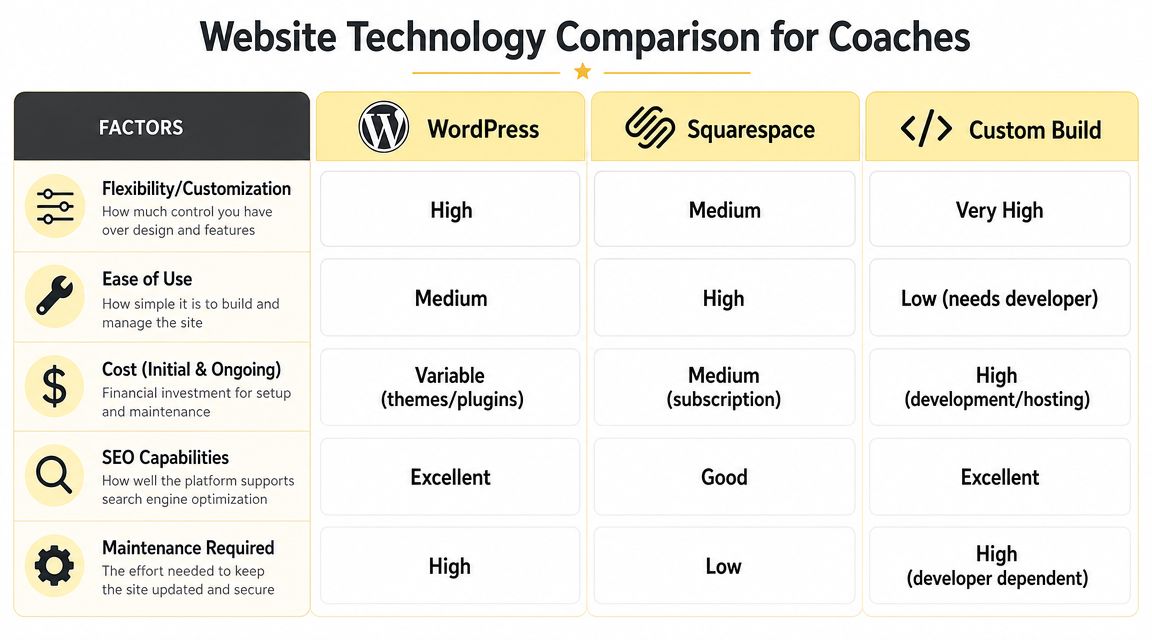
The Smart Way to Choose Your Website Technology
Most coaches don't struggle because there are no good tools. They struggle because each tool solves a different problem, and the marketing around them blurs the differences.
The right platform depends on what kind of business you're building. A solo coach with one flagship offer needs something different from a coaching school, and both need something different from a consultant who wants deep customization.
DIY builders
Wix and Squarespace appeal to coaches for an obvious reason. They reduce setup pain.
You can choose a template, edit pages visually, connect a domain, and get something live without hiring a developer. For many coaches, that's enough at the start.
They tend to work well when:
- your offers are simple
- your booking flow is straightforward
- you want low maintenance
- you don't want to manage plugins or custom infrastructure
The downside shows up later. Once you want more advanced workflows, deeper integrations, or a stronger client experience after the sale, you may start bolting on external tools.
WordPress
WordPress gives you far more flexibility. That's why many mature content-driven businesses use it.
If blogging, search visibility, custom landing pages, and plugin-based expansion matter to you, WordPress can be a strong fit. But flexibility has a cost. You have to manage updates, theme quality, plugin conflicts, and general site hygiene.
WordPress is often right for coaches who:
- want strong control over content architecture
- care a lot about SEO content production
- are comfortable learning systems or hiring help
- don't mind assembling their own stack
It's often wrong for coaches who already feel overwhelmed by tech.
All-in-one systems
Some coaches don't need a website platform alone. They need a practice platform that includes a website.
That distinction matters. If your real pain is the handoff between marketing and delivery, an integrated setup can save a lot of friction. Instead of piecing together pages, scheduling, payments, forms, and client management across separate apps, you run more of the journey in one place.
If that's the direction you're considering, a dedicated website builder for coaches makes more sense than a generic site tool because it's designed around coaching workflows rather than just page design.
A simple way to decide
Use this filter:
- Choose a DIY builder if speed and simplicity matter most.
- Choose WordPress if content control and customization matter most.
- Choose an integrated coaching system if operations and client experience matter most.
The wrong platform is not the one with fewer features. It's the one that creates the most work in the parts of the business you already avoid.
A beautiful site you can't maintain becomes stale. A flexible system you never finish becomes expensive. A simple setup that clients can use often beats a more impressive setup that constantly needs fixing.
Your Final Website Launch Checklist
Launching a website feels like the finish line, but in practice it's a quality-control moment. Small mistakes can block leads for weeks. Broken forms, weak mobile spacing, unclear buttons, missing confirmations. None of those problems are dramatic, but they all cost trust.
Before you publish, run the site like a visitor would. Better yet, ask a friend or colleague to complete the same path without your help.
Test the conversion path end to end
Don't just click around the homepage. Test the full journey.
Use this checklist:
- Check every button to make sure it goes where you expect
- Submit every form and confirm the message arrives
- Book a test session through your scheduler
- Complete a test payment if payment is built in
- Review confirmation emails for clarity and tone
A lot of coaches test pages visually but never test the practical flow. The practical flow is what pays you.
Review the site on a phone
Many coaches write and edit from a laptop, then barely look at the mobile experience. That's risky because mobile friction changes how people feel about your professionalism fast.
Review:
- Headlines so they don't break awkwardly
- Buttons so they're easy to tap
- Spacing so nothing feels cramped
- Forms so they're short and readable
- Images so they load cleanly and don't dominate the page
If the site feels tiring on a phone, simplify it.
Make trust visible
Before launch, scan your site specifically for trust signals.
Ask:
- Are your qualifications easy to find?
- Is your scope of practice clear?
- Do testimonials feel credible and relevant?
- Is your privacy or contact information easy to locate?
- Does the site feel coherent from page to page?
These details often influence whether a visitor books, especially when they're comparing several coaches in one sitting.
Set up a simple review habit
You do not need an elaborate analytics setup on day one. You do need a habit of paying attention.
Track things like:
- which pages people visit most
- where inquiries come from
- which calls to action get used
- where people seem to drop off
If you want help checking the basics before or after launch, these tools for website analysis can help you spot issues in structure, performance, and conversion flow.
Announce the site with purpose
Once the site is live, don't just post “my new website is up.”
Give people a reason to visit:
- Share a new resource they can use
- Invite the right audience to a discovery call
- Send past contacts to an updated services page
- Reconnect with referral partners who should know how to describe your work now
Launch day matters less than what happens in the first few weeks after launch. Watch how real people move through the site. Tighten weak spots. Clarify the offers. Remove anything that creates hesitation.
A website for coaches is never finished in the artistic sense. It becomes stronger by getting more useful.
If you want a website that doesn't stop at design, Coachful gives coaches one place to handle website pages, onboarding, scheduling, payments, and client management in a connected workflow. That kind of setup makes sense when you want your site to support the full coaching journey, not just the first click.