
Welcome Email Sequence for Coaches: 5 Emails to Copy
A welcome email sequence is the short set of automatic emails a new subscriber gets in their first week or two on your list. For coaches it does five jobs: deliver what they signed up for, introduce you as a person, give one real piece of help, show what working with you looks like, and invite them to a next step. Five emails, one job each, is the simplest version that works.
Below is a complete five-email welcome sequence you can adapt, written for a fictional dating coach who works with single people over 40, with subject lines, preview text and full bodies. After it: timing, how to personalize by signup source, what to measure and the mistakes that make welcome emails feel like spam.
If you'd rather not write it yourself, Coachful's team writes and sets up email sequences for free on every Coachful plan. You'll find how to request one near the end.
Five emails, five jobs
| When | Job | The ask | |
|---|---|---|---|
| 1. Delivery | Right away | Give them what they signed up for | Reply with one answer |
| 2. Story | Day 2 | Introduce you and why you do this | None |
| 3. Help | Day 4 | One useful idea they can use this week | Try it |
| 4. Proof of approach | Day 7 | Show what working with you looks like | Soft mention of the call |
| 5. Invitation | Day 10 | A clear, low-pressure next step | Book a call |
After email five, subscribers move onto your regular newsletter. The welcome sequence is the introduction, and the newsletter is the ongoing relationship.
The full sequence, ready to adapt
Our example coach, Lucia, helps people over 40 start dating again after divorce or a long relationship. Her lead magnet is "The First Date Back", a one-page guide to the first date after years away. Swap in your own details as you read.
Email 1: Delivery (sent immediately)
Subject: Your guide to the first date back
Preview text: Plus the one question I'd like you to answer
Body:
Hi [first name],
Here's your guide: [link]. It's one page, so you can read it on your phone tonight.
Before you open it, one thing. Almost everyone I work with tells me the hardest part is deciding to go at all, more than the date itself. If that's you, start with the box in the top corner.
I'd love to know: how long has it been since your last first date? Just hit reply. I read every one, and I'll use the answers to decide what to write about next.
Lucia
Email 2: Story (day 2)
Subject: I was 46 and terrified of a coffee
Preview text: Why I started doing this work
Body:
Hi [first name],
Six months after my divorce, a friend set me up for coffee. I changed outfits four times, sat in the car for ten minutes, and nearly drove home.
The coffee was fine. Nice, even. But what struck me was how much of that fear was about things that had nothing to do with him: the apps, the rules that seemed to have changed, the voice in my head saying I'd missed my chance.
That's what I work on with clients now. Less about tactics, more about getting back to feeling like yourself on a date.
More on that soon. For now, how did the guide land?
Lucia
Email 3: Help (day 4)
Subject: The 20-minute rule
Preview text: A small change that makes first dates easier
Body:
Hi [first name],
Here's something you can use this week. Make your first date short on purpose: one drink or one coffee, and tell them up front you have about an hour.
A short first date takes the pressure off both of you. If it goes well, you leave wanting more, which is a good feeling to end on. If it doesn't, it's over before it gets awkward.
Try it once and tell me how it went. I'm curious.
Lucia
Email 4: What working together looks like (day 7)
Subject: What happens in the first month
Preview text: A look inside how I coach
Body:
Hi [first name],
A few of you have asked what coaching with me actually involves, so here's the first month in plain terms.
Week one, we look at what you want, honestly, without the "shoulds". Week two, your profile and photos, if you're using apps, or where to meet people if you're not. Weeks three and four, we prepare for real dates and talk through them afterwards.
Most people tell me the talking-through part is what helps most. Having someone to debrief with makes dating feel less like a test.
If you ever want to talk about whether this would help you, I keep a few free 20-minute calls open each week. No pressure either way.
Lucia
Email 5: Invitation (day 10)
Subject: Want to talk it through?
Preview text: A free 20-minute call, if it would help
Body:
Hi [first name],
This is the last email in this little welcome series. From here you'll get my regular Sunday note, which you can leave whenever you like.
Before that, an invitation. If you're thinking about dating again and would like a plan that fits your life, book a free 20-minute call: [link]. We'll talk about where you are, what's getting in the way, and one step you could take next. If coaching would help, I'll explain how it works. If it wouldn't, I'll tell you that too.
Either way, I'm glad you're here.
Lucia

Timing and sending rules
- Send email one within minutes. If the guide takes an hour to arrive, people forget they asked for it.
- Space the rest two to three days apart. Daily feels like a launch; weekly loses momentum.
- Send at the same time of day. Morning works for many audiences, but test it against your own open times.
- Stop the sequence when someone books or buys. Nobody wants an invitation to a call they already booked.
- Pause it when someone replies. If they're talking to you, the automation can wait.
- Write from a real person, with a reply address you actually read.

Personalize by where they signed up
If you have more than one way onto your list, make email one match the door they came through. Someone who took a quiz needs their result; someone who joined from a workshop needs the recording; someone who signed up from your newsletter page doesn't need a guide at all. Emails two to five can often stay the same.
A simple rule: one welcome email per signup source, then a shared sequence. That keeps the work manageable.

Measure what matters
- Replies to email one. The best early signal. Replies mean people are reading, and each one is the start of a real conversation.
- Clicks on the call link in emails four and five.
- Calls booked from the sequence.
- Unsubscribes by email. If one email has far more unsubscribes than the others, rewrite it.
Open rates are useful for comparing your own emails over time, but privacy features in some email apps inflate them, so lean on replies and clicks.
Mistakes that make welcome emails feel like spam
- A pitch in email one. Deliver first.
- Newsletter-style emails with six links and four images. Write like a person.
- No reply invitation, so your list stays a broadcast channel forever.
- Generic subject lines like "Welcome to my community!" Say what's inside.
- Never updating it. Reread your welcome sequence every few months; it's the email new people see most.
For more subject line ideas, see 40 coaching newsletter subject lines with preview text. If your sequence follows a lead magnet, our guide to turning a lead magnet into discovery calls focuses on that specific path.
Building the sequence in Coachful
Coachful's email sits in the same account as your funnels, leads, calendar and clients, which is what makes the sending rules above possible.
- Triggers. A sequence can start when someone completes a funnel, submits a form, is added to a list or tag, or enrolls in a program.
- Steps. Emails, waits from minutes to weeks, conditions (opened, clicked, has a tag, is in a program) and A/B splits.
- Stop rules. Exit conditions end the sequence early, for example when someone buys. The sequence pauses automatically when a contact replies.
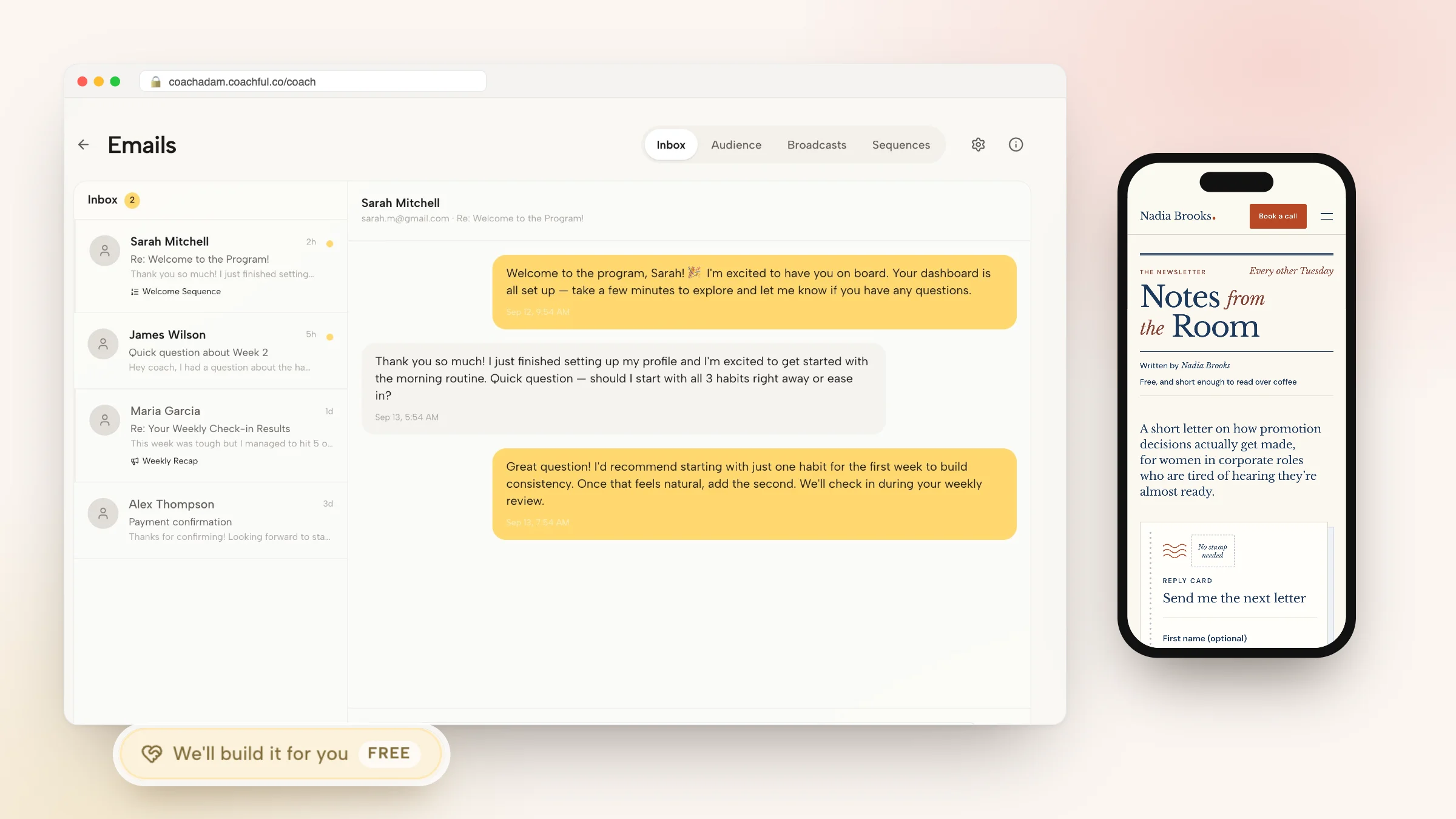
- Replies. Replies land in your Coachful inbox, linked to the person and the email that started the thread.
- Compliance. Every marketing email carries your business name, address and an unsubscribe link, and you can require double opt-in.
- Templates and looks. Starter templates include a welcome email, and a choice of looks styles your words without rewriting them. You can send from your own domain.

Have our team write and set up your welcome sequence, free
On every Coachful plan, the Coachful team will write and set up a welcome email sequence for you at no extra cost. In the app it's labeled as a complimentary gift.
How to ask. Open Create, choose "We'll build it for you" and pick "Email sequence or newsletter" under "What should we build?". If you want the signup page built too, use Fill in a form on the Funnels page and include the emails in the journey.
What to include. Who your subscribers are and what the sequence should achieve, what they signed up for, the next step you want to invite them to, and a few lines about your story. Paste any emails you've written before, and link to newsletters you like reading. The form takes up to eight links and ten files, including a voice memo if talking is easier than writing (video files aren't accepted).
What happens next. The team replies by email with next steps, usually within about 24 hours. That's typical, not a guaranteed deadline. The sequence is built in your own account, so you can reword any email later.
Recently. For a business mentor for beauty professionals, the team rewrote the follow-up emails behind a free start-up guide so they now lead into the mentorship's sales page. A real-estate and money coach got a free nine-day bootcamp with its own signup funnel and emails.
What it doesn't include. The team won't invent your story, results or testimonials; anything personal is left for you to fill in. It doesn't include managing your list or sending newsletters for you every week. See the full scope on the free white-glove service page.

Once the welcome sequence is running, keep the relationship going with our guide on how to start a coaching newsletter, and if you still need something to sign up for, read how to create a lead magnet for coaches. For more on coaching people back into dating, see Coachful for dating coaches.
Frequently asked questions
What is a welcome email sequence?
It's a short series of automatic emails sent to new subscribers in their first week or two. It delivers what they signed up for, introduces you, offers real help and invites them to a next step, before they join your regular newsletter.
How many emails should a welcome sequence have?
Three to five is the usual range. Five gives you room for delivery, your story, one useful idea, a look at how you work and an invitation. Three works if you'd rather keep it tight.
How often should welcome emails be sent?
Send the first immediately, then space the rest two to three days apart. That keeps you present while people still remember signing up, without feeling like a sales launch.
What should the first welcome email say?
Deliver what they signed up for in the first line, add one tip on how to use it, and ask a simple question they can answer by replying. Keep it short and personal, signed with your name.
Can Coachful write my welcome email sequence for free?
Yes. On every Coachful plan, the team writes and sets up email sequences at no extra cost. Open Create, choose "We'll build it for you" and pick "Email sequence or newsletter". The team replies by email, usually within about 24 hours.
Should a welcome sequence sell?
Gently, and late. Use the first emails to deliver and build trust, show what working with you looks like in email four, and make a clear invitation in the last one. A pitch in email one usually costs more than it earns.












