
How to Start a Coaching Newsletter People Actually Read
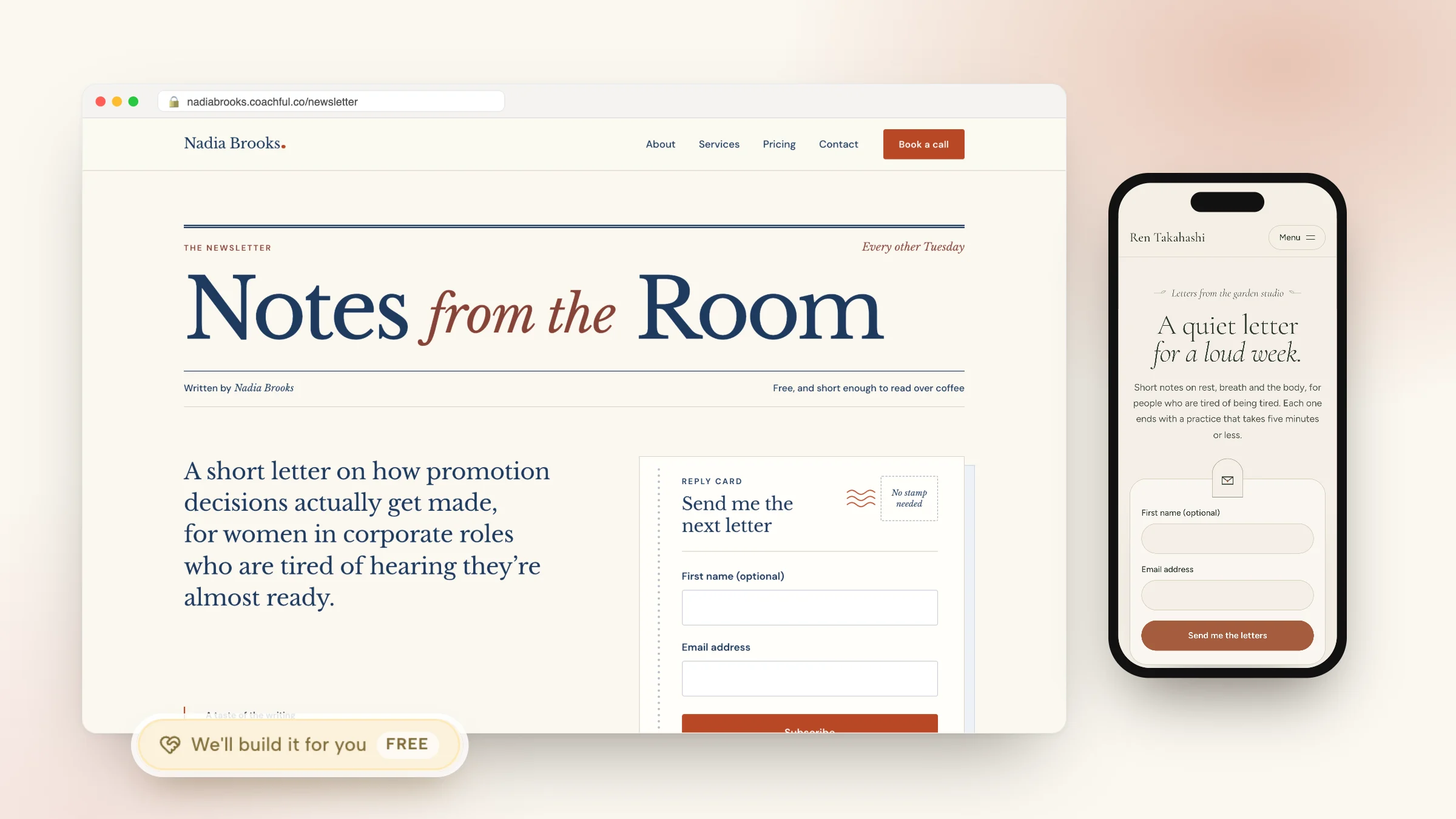
A coaching newsletter is a regular email you send to people who've asked to hear from you: past clients, leads, people who downloaded something once. Done well, it's the quietest marketing you'll ever do. Every week or two you show up in their inbox with something useful, they remember you exist, and when they're ready for coaching, you're the first person they think of.
Starting one comes down to a handful of decisions and one first issue. This guide walks through both, with a full sample issue from a fictional burnout coach who works with teachers, a 12-week topic plan, signup page copy and the numbers worth tracking.
If you'd like help getting it off the ground, Coachful's team sets up newsletters and email sequences for free on every Coachful plan, from the signup page to the first issues' structure. More on that below.
Decide what the newsletter is for
Every coaching newsletter does some mix of three things. Pick the one that matters most, because it shapes everything else.
- Stay remembered. For coaches who get most clients from referrals and past clients. The newsletter keeps you top of mind.
- Warm up leads. For coaches with a lead magnet or a quiz. The newsletter turns subscribers into discovery calls over months.
- Support clients between sessions. For coaches whose clients benefit from a weekly nudge. This one can be sent to clients only.
Our example coach, Anjali, left teaching after twelve years and now coaches teachers through burnout. Her newsletter's job is warming up leads: teachers who downloaded her "Sunday Night Dread" worksheet but aren't ready to book a call.
Pick a format you can keep up
The best format is the one you'll still be writing in six months.
| Format | What it looks like | Time to write |
|---|---|---|
| One idea | A single idea, a story and one thing to try | About an hour |
| Letter | A personal note about what you've been noticing | About an hour |
| Q&A | One question from a reader or client, answered properly | About an hour |
| Roundup | Three short items: an idea, a link, a question | Thirty minutes to an hour |
| Mini-lesson | A short teaching piece with a worksheet or exercise | Two hours or more |
Anjali picks "one idea". It fits her voice, it's short enough for a tired teacher to read on a Sunday afternoon, and she can write it in an hour.
Choose a cadence and a send day
Weekly is ideal if you can sustain it; every two weeks is fine. Monthly is the minimum, and even then people may forget who you are between issues. Whatever you choose, keep it steady. Readers notice patterns, and a newsletter that arrives every Sunday becomes part of someone's week.
Pick a day that fits your readers' lives. Anjali sends on Sunday at 3pm, when teachers are starting to think about Monday. Your readers might be more receptive on a Tuesday morning or a Thursday evening.

Name it and write the one-line promise
Give the newsletter a name and a sentence that says what readers get. Keep the name simple; the promise does the work.
Name: The Sunday Reset
Promise: One short email every Sunday afternoon to help teachers start the week with less dread and more energy.
Stuck on names? Our list of newsletter names for coaches has formats you can borrow.
The signup page and the welcome
A newsletter signup page needs four things: the name, the promise, a sample of what it looks like and a form.
- Headline: The Sunday Reset: a calmer start to every school week.
- Subheadline: One short email every Sunday afternoon from a former teacher. One idea, one small thing to try, no lesson plans required.
- Sample: link to a recent issue, or paste its first paragraph.
- Form: First name and email.
- Button: Send me the Sunday Reset
- Under the button: Unsubscribe any time with one click.
Then a short welcome email that says what to expect and when, and asks one question. If you already offer a lead magnet, the welcome can come through a short sequence first; our guide to a welcome email sequence has a full five-email version.
A sample first issue
Subject: The 15-minute Sunday rule
Preview text: Why the dread starts at 4pm, and what to do about it
Hi [first name],
For most of my teaching years, Sunday was two days in one. Morning was mine. Then around 4pm the dread arrived, and the rest of the day disappeared into grading, planning and worrying about a parent email I hadn't opened yet.
The one change that helped me most: I gave Monday prep exactly 15 minutes on Sunday, with a timer. Not an evening. Fifteen minutes. I'd write down the three things Monday needed, check one email, and close the laptop.
The work didn't shrink. But it stopped spreading across my whole Sunday, and I stopped arriving on Monday already tired.
This week, try it once. Set a timer for 15 minutes on Sunday, write three things down, then stop. Hit reply and tell me how it went. I read every reply.
See you next Sunday,
Anjali
P.S. If Sunday dread has become every-day dread, I run free 20-minute calls for teachers. You can book one here: [link].
Notice the shape: a story, one idea, one thing to try, a reply invitation and a single quiet mention of coaching in the P.S. That shape can carry a newsletter for years.

A 12-week topic plan
Plan topics a quarter at a time so you never stare at a blank screen on a Saturday night.
| Week | Topic | Type |
|---|---|---|
| 1 | The 15-minute Sunday rule | One idea |
| 2 | What to say when you're asked to take on one more thing | Script |
| 3 | Reader question: "How do I stop checking email at night?" | Q&A |
| 4 | The difference between tired and burnt out | One idea |
| 5 | A five-minute reset between classes | Exercise |
| 6 | Why I left, and what I'd tell myself in year three | Story |
| 7 | Grading without losing your weekend | One idea |
| 8 | A client story (with permission): one semester, three changes | Story |
| 9 | Reader question: "Is it me, or is it the school?" | Q&A |
| 10 | The one meeting you can probably skip | One idea |
| 11 | Spring break: how to actually rest | One idea |
| 12 | What working together looks like | Invitation |
For more angles, see 15 newsletter ideas for coaches, and for subject lines, 40 coaching newsletter subject lines with preview text.
Getting clients without sounding salesy
- A P.S. in most issues, one line, linking to a call or your offer.
- One fuller invitation a month or quarter, like week 12 above, explaining what coaching with you looks like.
- Reader questions as content. They show you're listening, and the people who ask are often close to booking.
- Replies as conversations. When someone replies, answer personally. Many coaching clients start with a reply to a newsletter.
As your list grows, you can send different versions to leads and clients; our guide to segmenting a coaching newsletter by client stage explains how.
What to measure
- Replies. The truest sign people are reading.
- Clicks on the one link in each issue.
- Unsubscribes per issue. A few every time is normal; a spike means a topic missed.
- Calls booked from the P.S. and invitation issues.
- List growth per month, by source.
Newsletter mistakes
- Starting weekly, then disappearing for two months. Choose a cadence you can keep.
- Writing for other coaches instead of clients.
- Five links, three images and a banner. One idea, one link.
- Waiting for a big list before starting. Your first ten readers are the ones who'll tell you what works.
- Never asking for anything, so the newsletter stays a hobby.
Running your coaching newsletter in Coachful
Coachful's email sends from the same account as your leads, clients and programs, so your audiences stay current without exporting lists.
- Broadcasts. Write an issue, choose the audience (everyone, a program, a tag, a list, a segment, newsletter subscribers and more), preview who's included, then send now or schedule it.
- Looks and templates. Starter templates include a newsletter, and you can save your own. A look styles the email around your words without rewriting them.
- Signup. New Funnel has a Newsletter signup template, and your link-in-bio page can carry a lead form too. Existing lists can be imported from a CSV file.
- Results. Each broadcast records delivered, opened, clicked, replied, bounced and unsubscribed counts, plus conversions such as bookings and purchases.
- Replies. Replies land in your Coachful inbox, linked to the person.
- Rules. Every marketing email carries your business details and an unsubscribe link, and you can send from your own domain.


Want help starting it? Our team will set it up free
On every Coachful plan, the Coachful team will set up your newsletter at no extra cost; the app labels it a complimentary gift. Start on the Create page: choose "We'll build it for you" and pick "Email sequence or newsletter" under "What should we build?". If you want a signup page as well, say so in the request, or use Fill in a form on Funnels and choose "Grow my email list".
The more of your voice you send, the more the result sounds like you. Tell the team who reads it, what you want it to do, how often you'd like to send and a few topics you care about, then paste past emails or posts you've written. You can link to up to eight newsletters you enjoy reading and attach up to ten files, such as your logo, photos, notes or an audio memo (video files aren't accepted).
The team replies by email with next steps, usually within about 24 hours, which is a typical time rather than a guarantee. Everything is set up inside your own account, so you write and send future issues with the normal editor. Recent requests give a sense of the range: an author and speaker had five pages built from the coach's own copy document and photos, plus a free community signup page, and a somatic coach leaving Kajabi had the homepage and About page rebuilt, with the contact form now feeding Coachful so new contacts land in the same place as newsletter signups.
Two limits worth knowing. The team doesn't write and send your newsletter every week or manage your list long term, and it won't invent stories or results for you: anything personal is left for you to fill in. The free white-glove service page lists everything that's included.

A newsletter grows faster with a good signup spot on social media; see our guide to link in bio for coaches. Burnout and life coaches like Anjali can see the coaching side of the platform on Coachful for life coaches.
Frequently asked questions
How do I start a coaching newsletter?
Decide what it's for, pick a format and a cadence you can sustain, give it a name and a one-line promise, set up a signup page and welcome email, plan twelve weeks of topics and send the first issue. Then keep the day steady.
How often should a coaching newsletter go out?
Weekly if you can keep it up, every two weeks if not. Monthly is the minimum. Consistency matters more than frequency, because readers come to expect your email on a particular day.
What should I write about in a coaching newsletter?
One idea per issue that helps your ideal client with a problem they have this week, often with a short story and one thing to try. Reader questions, client stories (with permission) and occasional invitations to work with you round it out.
How long should a coaching newsletter be?
Most work best at 200 to 500 words, readable in two or three minutes. A short email that gets read every week beats a long one that gets saved for later and forgotten.
Can Coachful set up my coaching newsletter for free?
Yes. On every Coachful plan, the team sets up newsletters and email sequences at no extra cost. Open Create, choose "We'll build it for you" and pick "Email sequence or newsletter". The team replies by email, usually within about 24 hours.
How do I get subscribers for my coaching newsletter?
Put a signup link in your social bio and email signature, offer it at the end of posts and podcast appearances, pair it with a free lead magnet, and invite past clients and contacts personally. Grow it steadily rather than all at once.












