10 Names for Newsletters Coaches Can Use

Coachful
What should a prospect feel before they read a single sentence of your newsletter? That question exposes the gap in conventional naming advice. A clever label may sound polished, but the best newsletter name makes a promise about progress, perspective, support, or challenge.
You may be wondering, “What if my name sounds generic, overpromises, or attracts the wrong audience?” That concern is valid. Names such as “The Weekly Digest” explain a format, but they rarely explain why a busy executive, founder, or life-coaching client should care. Newsletter naming has moved from corporate labels such as “Company Update” and “Industry Digest” toward personality-driven identities that signal a distinct voice and niche, as this overview of newsletter naming trends explains.
The strongest names for newsletters connect an emotional promise to a repeatable content system. They make the reader think, “This is for the problem I'm facing, and I understand what I'll get.” Concise, descriptive, time-aware names are also common in independent naming data. LOGO.com recorded 386,969 business name searches and 89,325 selections in the 12 months to September 2026, with “news” and “publishing” appearing among newsletter-adjacent searches, as shown in its newsletter naming data.
This list organizes ten names by the promise they make: momentum, structure, authenticity, accountability, insight, transformation, challenge, ambition, demonstration, and sustainability. Each idea includes its psychological appeal, best-fit audience, trade-offs, examples, and a practical way to use it. The same principle applies when you're crafting a marketable book title. Your title should help the right person recognize the value before they invest attention.
1. The Momentum Letter
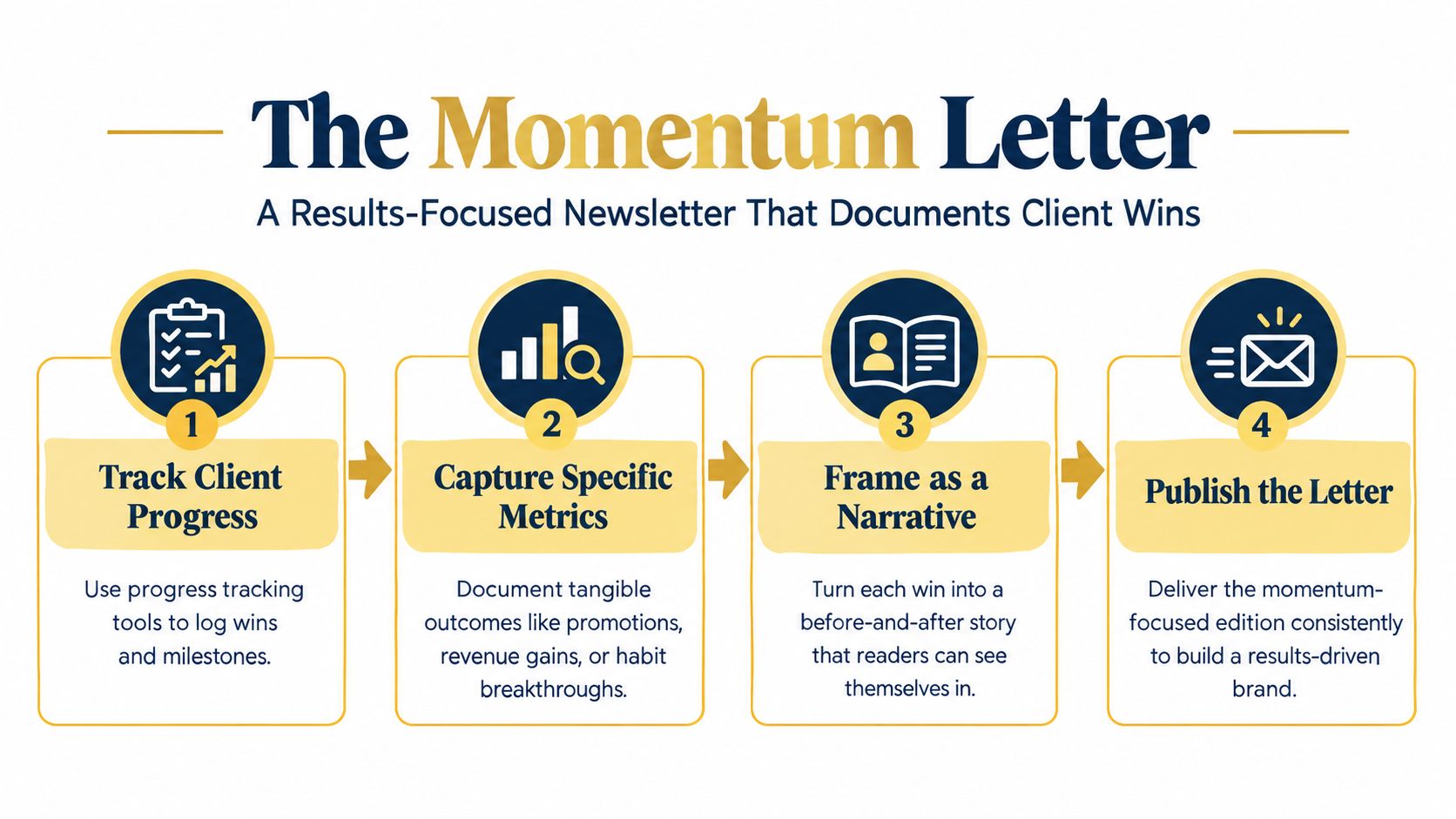
The Momentum Letter tells readers that coaching creates movement. It speaks to the coach's private worry: “Am I moving the needle for my clients?” Instead of presenting yourself as someone who delivers thoughtful conversations, you position your work around visible progress, completed milestones, stronger decisions, and changed behavior.
The name fits executive, life, and business coaches who can share patterns of forward motion without exposing private client details. An executive coach might send “3 Client Breakthroughs This Week” and describe how clients prepared for promotion conversations, delegated a difficult responsibility, or made a decision they'd delayed. A life coach could focus on habit breakthroughs. A business coach could discuss how clients improved sales processes, clarified an offer, or created operating discipline.
The word “momentum” also reassures prospects who fear they'll remain stuck. They don't need another source of inspiration that fades after reading. They want evidence that small actions can accumulate into meaningful progress.
Build the newsletter around proof of movement
Use a consistent structure so the name earns credibility:
- Starting point: Describe the situation in general terms, such as indecision, inconsistent follow-through, or unclear priorities.
- Movement: Explain the action, conversation, or decision that changed the direction.
- Evidence: Share a behavioral shift, completed milestone, or practical result without revealing identifying details.
- Reader application: Give subscribers one question or action they can use that week.
Coachful's progress tracking and milestone features can help you collect the material behind this system. You can also use its broadcast email workflow for sending messages to your client list when you need to communicate with current clients.
Don't turn the newsletter into a parade of dramatic victories. Micro-progress matters. A client who finally keeps a commitment, has a difficult conversation, or finishes a long-delayed task gives readers a believable picture of momentum.
2. The Breakthrough Blueprint
Do your prospects need another burst of motivation, or do they need to see how you create real progress? The Breakthrough Blueprint makes a promise of structure. It positions your coaching as a defined process with decisions, stages, and review points, rather than a service built on improvisation or personal charisma.
That promise fits business and executive coaches especially well. Prospects with complex problems want to understand how you work before they book a call. “Blueprint” gives them a mental map and makes your method easier to evaluate. It also supports conversion because readers can recognize where their own situation fits.
Match the name to a specific niche and repeatable system. A career coach might publish “The 5-Stage Decision Framework for Major Career Pivots.” A business coach could use “How to Move from Stuck to Strategic in 6 Weeks.” An executive coach might test “From Imposter Syndrome to Executive Presence in 90 Days,” only if the delivery model and claim can support that expectation. “The Values Alignment Blueprint, Finding What Matters” suits a coach whose work begins with priorities and decisions.
The title should reflect a method you already use. If your process moves from diagnosis to goal setting, experimentation, and review, show those phases plainly. Do not create an impressive-sounding framework that your sessions cannot deliver. Coachful's session notes and goal-tracking features can help you capture recurring questions and organize the method you already practice. Its broadcast email workflow for sending messages to your client list can distribute each issue to current clients.
Build each edition around one stage, one obstacle, and one practical tool. The subject line might name the decision readers are avoiding, while the body explains the relevant phase and gives them a question, worksheet, or decision tool. End with the next checkpoint: what should they observe before the following issue?
Test the promise before committing. Send three issues to a small audience and ask whether readers can identify the method, apply one step, and explain who the newsletter is for. Use diagrams or a staged lead magnet when they clarify the path. Protect private coaching exchanges. The newsletter should demonstrate logic, sequence, and a credible route from confusion to action.
3. Coaching Unfiltered
Would a polished newsletter make a coach look credible, or merely distant? Coaching Unfiltered makes authenticity its promise. It shows readers the difficult decisions, imperfect attempts, uncomfortable lessons, and human work behind meaningful change.
That promise suits coaches whose niche depends on trust, such as life coaches supporting personal change, business coaches advising under pressure, or executive coaches working through complex relationships. The name also differentiates the newsletter from generic advice. Readers know they will see how judgment develops in real situations, not just a polished conclusion.
Use the name only when every issue follows a clear content system. Start with a responsibly described moment, explain the tension or mistake, identify the principle that changed your approach, and finish with an experiment the reader can try. A subject line such as “The Worst Advice I Gave a CEO and Why It Backfired” creates interest, while the article must deliver a useful lesson rather than a confession.
A life coach might publish “When My Client Quit, I Had to Quit Too, Here's What I Learned.” A business coach could examine a recommendation that failed in practice. An executive coach might discuss ending a coaching relationship and the judgment that decision required. These stories convert attention into trust only when they reveal a repeatable coaching principle and show how readers can apply it.
Protect the person behind the lesson
Authenticity has boundaries. Coachful's private notes can help you record reflections after sessions, but those notes must remain private. Remove identifying details, alter irrelevant circumstances when needed, and request written permission if recognizable details are necessary. Never use a client's pain as marketing material.
The reader should finish with better judgment, not concern about your ethics. Test the name and promise with a small group by asking whether the issue felt honest, whether the lesson was useful, and whether they can explain who the newsletter serves. If readers remember only the drama, revise the format. If they can name the principle and connect it to your coaching niche, Coaching Unfiltered is earning its place.

4. The Accountability Loop
Can your newsletter make readers act, review what happened, and try again? The Accountability Loop promises that kind of progress. It suits coaches whose niche depends on follow-through, including business coaches helping clients execute plans, life coaches building habits, and executive coaches strengthening leadership behavior.
The name differentiates your newsletter from advice-only self-help. “Loop” signals a repeatable system: choose an outcome, take a measurable action, review the result, adjust the approach, and recommit. That structure builds credibility because readers see how coaching handles missed commitments instead of pretending every plan works immediately.
Use the promise as an editorial rule. Each issue should feature one commitment, one observable checkpoint, one honest review, and one next action. A business coach might send “My Q4 Goal Audit, What Worked, What Didn't, and Why.” A life coach could write “Why I Failed at My Meditation Habit and How I'm Rebuilding It.” An executive coach might share “The Accountability System I Use With Myself and the Template I'm Sharing.”
Keep personal examples bounded. Do not disclose confidential client information or use a client's struggle to create drama. Model accountability through your own goals, generalized coaching patterns, or a clearly fictionalized scenario. Readers need to recognize the method, not investigate the person behind it.
Coachful's milestones and progress tracking can support the operational side of this content. Its guidance on segmenting a coaching newsletter by client stage can help you adapt prompts for new clients, active participants, and readers maintaining progress after a program.
Write subject lines around the next turn in the loop: “What did your plan reveal?” or “The review that changes your next move.” Test the name with a small audience. Ask whether they expect practical follow-through content, can identify the coaching niche, and would reply with their own progress. If they expect generic productivity tips, sharpen the promise.
5. The Insight Exchange
What can readers learn from the patterns you notice in coaching conversations? The Insight Exchange promises useful discovery, not a lecture. It positions you as a practitioner who observes recurring questions, assumptions, and turning points, then converts those observations into clearer decisions for a specific audience.
“Exchange” also supports credibility. You share professional perspective, while readers test the idea against their own experience. That makes the name a strong fit for executive coaches examining workplace behavior, life coaches exploring recurring personal barriers, and business coaches studying decisions, objections, or growth habits.
Use the promise as your content system. Build each issue around one observed pattern, explain where it appears in your niche, show what it may mean, and give readers a question they can apply privately. An executive coach might publish “The 3 Communication Patterns I See in Every Client Promotion.” A life coach could write “What 50+ Clients Revealed About Limiting Beliefs and How to Spot Yours.” A business coach might explore “The 5 Objections That Disappear Once Entrepreneurs Understand This One Thing.” Treat these as editorial models, not universal findings. Your own practice must support the themes you discuss.
Protect confidentiality while demonstrating expertise. Use generalized patterns, your own observations, or clearly fictionalized scenarios. Coachful can help organize session information, and its guidance on segmenting a coaching newsletter by client stage can help you adapt the same insight for new clients, active participants, and readers maintaining progress after a program. Do not make a small set of private conversations sound representative of everyone.
A reliable issue might ask: What pattern keeps appearing? Where does it show up? What could explain it? Does the reader recognize it? Leave room for examination instead of turning every observation into an instruction.
Use subject lines that sound discovered: “The Question High Performers Avoid,” “Why Clarity Often Arrives After the Decision,” or “The Pattern Behind Repeated Delegation Problems.” Test the name with a small audience. Ask whether readers expect niche-specific insight, practical application, and a chance to respond with their own interpretation. If they expect generic advice, narrow the promise.
6. The Transformation Digest
Use The Transformation Digest only when your coaching examines lasting change, not just quick wins. “Transformation” promises a deeper shift in how readers think and act. “Digest” makes the format feel curated and organized, giving subscribers a clear body of ideas instead of disconnected inspiration.
The name fits coaches who want to combine empathy with evidence-informed thinking. It answers the prospect's question, “What transforms people?” Your answer should connect coaching observations with credible research, established frameworks, and the conditions that help people change. Research claims need real sources. Your experience can illustrate a principle, but it cannot replace evidence for a scientific claim.
Match the promise to a defined niche. A life coach might serve people rebuilding habits after burnout. An executive coach could focus on leaders changing how they make decisions. A business coach might address belief changes that affect growth. Possible subject lines include “Why Willpower Fails and What Sustains Lasting Change,” “The 4 Stages of Leadership Transformation and Where Most Coaches Miss It,” and “What Neuroscience Reveals About Belief Change and How I Use It With Clients.”
Build a repeatable editorial system around the change process: awareness, decision, experimentation, integration, and maintenance. Use progress tracking to identify where clients tend to stall, then develop issues around those specific obstacles. Each issue can connect a change principle, a practice, a friction point, and a reflection without forcing every edition into the same visible template.
Explain why your method includes particular exercises, milestones, and follow-up. Prospects trust the work more when they understand its reasoning. They do not need every program detail. They need to see that transformation has conditions, stages, and a process.
Test the name with a small audience before committing. Ask whether it suggests useful, evidence-aware guidance for their specific challenge, or vague personal reinvention. Review replies and sign-up behavior, then narrow the promise if readers expect motivation without practical direction.
Transformation also includes setbacks, revisions, and quiet progress. Let the content show that complexity while giving readers a clear next step.
7. The Straight Talk Roundup
Talk Roundup promises candor, range, and useful friction. Direct talk gives you permission to challenge comforting explanations, while “roundup” signals a curated set of observations rather than one rigid doctrine. Use this name for a coach serving high-achievers who have already tried standard advice and want sharper interpretation.
Lead with a problem your niche recognizes but rarely names. For executive clients, that might be “Stop Saying You're Bad at Delegation, Here's What's Happening.” A wellness coach could write “The Self-Care Advice That's Keeping You Stuck.” A networking coach might use “Why Your Network Isn't Working and It's Not About Effort.” Each subject line creates tension, then earns attention by offering a compassionate explanation and a practical next step.
Build the editorial system around four moves: identify the assumption, examine the evidence from coaching practice, explain the cost of keeping it, and give readers a better question or behavior. The issue can move from a client pattern to a reframing, an exercise, and a small experiment. That rhythm keeps the newsletter useful without making every edition look identical.
Ask questions that expose the issue without humiliating the reader. “What would change if delegation were a design problem rather than a character flaw?” invites reflection and protects your credibility. Use session insights carefully. Remove identifying details, avoid presenting one client's experience as universal, and explain why your recommendation fits the stated problem.
Validate the name before building a brand around it. Show it to people in your niche and ask what promise they hear: challenge, judgment, or practical clarity. Track replies and sign-ups from a sample issue. Keep the name if it attracts readers who want direct coaching; choose a gentler promise if it lowers conversion among clients who need a more contemplative voice.
8. The Next Level Letter
What does the next version of your work, leadership, business, or life require? The Next Level Letter promises a clear answer, making it a strong choice for readers who have outgrown their current methods and face greater complexity.
The name fits executive coaches, business coaches, and practitioners who serve capable people entering a new stage. A founder with a viable company may need executive leadership skills. A successful individual contributor may need to influence through others. A high-performing client may need boundaries and recovery systems instead of another productivity tactic.
Subject lines should name the capability behind the ambition: “The 3 Skills Your Current Role Isn't Teaching You,” “You've Mastered Your Role, Now Comes the Harder Part,” “From Founder to CEO, The Capabilities No One Teaches You,” or, for a life coach, “The Invisible Ceiling You Can Break Through and How You Will.”
Make progression visible. Define each issue around five questions:
- Current level: What can the reader already do?
- Emerging demand: What does the next environment require?
- Capability gap: What remains undeveloped?
- Practice: Which behavior builds that capability?
- Evidence: What observable change shows progress?
Coachful's milestone features can organize this sequence, giving readers a clear path through the stages rather than a collection of motivational essays. Each edition should move from a real demand to a practical exercise, then show how the reader can recognize improvement.
Confidentiality matters when you use client progression. Get permission, remove identifying details, and focus on the capability gained rather than presenting a polished transformation story.
Test the promise before building the brand. Show the name and a sample subject line to people in your niche, then ask what they expect: specific advancement, vague ambition, or pressure to perform. Track replies and sign-ups from the sample issue. Keep the name if it attracts readers ready to invest in defined growth. Change it if “next level” sounds inflated. Ambition earns trust when every issue shows the work, the milestone, and the evidence of progress.
9. The Coaching Clinic
What can a prospect learn from watching you coach a real dilemma? The Coaching Clinic answers that question by demonstrating your method instead of promising results. Readers see how you listen, frame a problem, ask useful questions, and help someone reach a clearer conclusion. That demonstration builds credibility while protecting the value of private coaching.
The promise is practical: bring a complicated decision, leave with a better way to examine it. A business coach could send “Client Scenario, Should I Fire My Business Partner?” A life coach might use “A Reader Asks How Do I Find My Purpose?” An executive coach could publish “The Delegation Conversation I Had Yesterday and the Thinking Behind My Questions.” Match the clinic to one niche and repeat a recognizable format, such as dilemma, context, coaching questions, possible experiments, and reflection.

Demonstrate questions, not just answers
Examine each scenario through five lenses:
- Decision: What must the reader decide?
- Facts: Which details are known, and which are interpretations?
- Constraint: What fear, value, or assumption shapes the choice?
- Options: What alternatives have not been considered?
- Experiment: What safe action could test the next move?
Explain the coaching principle behind your questions, then give readers one question to use on their own situation. The newsletter demonstrates value without presenting your verdict as a diagnosis or suggesting that an email can replace a full coaching relationship.
Use anonymized scenarios carefully. Ask permission when a client could recognize the story, even after removing the name. Change unnecessary details, avoid individualized claims about strangers, and invite reader-submitted questions when confidentiality is uncertain.
Validate the name before designing the brand. Show prospective subscribers the title and one sample subject line. Ask whether they expect a live case examination, generic advice, or a sales pitch. Measure replies and sign-ups from that sample. Keep The Coaching Clinic if it attracts readers who want to observe your process before committing. Change it if “clinic” sounds clinical or implies treatment beyond your role.
10. The Sustainable Growth Journal
Can your coaching help readers keep progressing after motivation fades? The Sustainable Growth Journal makes that promise directly. It suits life, business, and executive coaches whose audience wants progress that survives busy periods, stress, shifting priorities, and lost momentum.
The name answers a private concern: “What if I improve for a while and then slide back?” It positions you around systems and support, not another speech about discipline. That makes the promise credible, provided every issue shows how sustainable change works in practice.
Match the name to a repeatable content system. A life coach could send “Why Your New Year's Resolutions Fail by February and the System I Use Instead.” A business coach could examine “Scaling Fast With Scaling Sustainably, Which One Works?” An executive coach could write “How the Best Leaders Maintain Performance Without Burnout, It's All Systems.” Each subject line should lead to a practical examination of routines, pressures, and choices, not a sweeping claim.
Build every issue around one support structure. Routine gives an action a reliable place in the week. Reminder reconnects the reader with the behavior. Review exposes drift before it becomes discouragement. Recovery explains what to do after a missed commitment. Resource supplies a template or form of support that reduces friction.
Coachful's automation and reminder features offer concrete examples of how a coaching workflow can support follow-through. Its email marketing tools for coaches can connect newsletter lessons with programs, follow-up, and client communication. Keep the technology in its proper role. Automation can support consistency, but it cannot replace care, judgment, or a coaching relationship.
Before designing the brand, test the promise. Show prospective subscribers the title and one subject line, then ask whether they expect systems advice, personal coaching, or a sales pitch. Track replies and sign-ups. Keep The Sustainable Growth Journal if readers want durable progress. Change it if “journal” sounds too personal or passive for your niche.
Top 10 Newsletter Name Comparison
| Newsletter | 🔄 Implementation Complexity | ⚡ Resource Requirements | 📊 Expected Outcomes | ⭐ Ideal Use Cases | 💡 Key Advantages |
|---|---|---|---|---|---|
| The Momentum Letter | Medium, consistent tracking + storytelling | Medium, client metrics, templates | 📊 Builds visible proof of progress; ⭐⭐⭐ | Coaches with frequent measurable client wins | 💡 Positions you as outcomes-driven; repurpose progress data |
| The Breakthrough Blueprint | Medium–High, codify methodology into repeatable steps | Medium, framework docs, visuals, case examples | 📊 Demonstrates reproducible results; ⭐⭐⭐ | Coaches selling programs or frameworks (business/executive) | 💡 Converts methodology into monetizable courses/programs |
| Coaching Unfiltered | Low–Medium, sourcing authentic stories, careful editing | Low, anecdotal content, reflection notes | 📊 Deepens trust and relatability; ⭐⭐ | Coaches aiming to build rapport via vulnerability | 💡 Easy content flow; pairs honesty with actionable lessons |
| The Accountability Loop | Medium, regular follow-ups and modeled accountability | Medium, tracking tools, reminders, templates | 📊 Drives retention and follow-through; ⭐⭐⭐ | Coaches focused on habit change and follow-through | 💡 Creates engagement loops and community participation |
| The Insight Exchange | Medium, pattern recognition and anonymized synthesis | Medium, note-tagging, trend analysis | 📊 Curates high-level patterns and learning; ⭐⭐⭐ | Coaches who synthesize cross-client learnings | 💡 Positions you as a curator of collective wisdom |
| The Transformation Digest | Medium–High, combines research + case evidence | High, research curation, evidence, case studies | 📊 Signals deep change and authority; ⭐⭐⭐ | Coaches selling high-investment transformation programs | 💡 Blends science + practice to justify premium pricing |
| The Real Talk Roundup | Low, curated myths + concise reframes | Low, session examples, short takes | 📊 High engagement and shareability; ⭐⭐ | Coaches who challenge high-achiever narratives | 💡 Highly clickable content when paired with compassion |
| The Next Level Letter | Medium, design progression frameworks and milestones | Medium, case studies, milestone tracking | 📊 Attracts ambitious, investment-ready clients; ⭐⭐⭐ | Executive/business coaches targeting promotions/scale | 💡 Natural fit for premium positioning and upsells |
| The Coaching Clinic | Medium, anonymized scenarios + deep coaching work | Medium, anonymization, transcripts, templates | 📊 Demonstrates process and skill in action; ⭐⭐⭐ | Coaches proving their approach to skeptical prospects | 💡 Lets readers experience your coaching style without full buy-in |
| The Sustainable Growth Journal | Medium, systems content and long-term examples | Medium–High, systems templates, automation demos | 📊 Encourages lasting behavior change and retention; ⭐⭐⭐ | Coaches focused on habits, systems, and long-term results | 💡 Differentiates from motivation-focused content; supports retention |
Choose the Promise You Can Keep
The right name starts with the audience you want to attract, not with a list of attractive words. Identify the person who should look forward to your emails. Is it a life-coaching client rebuilding confidence, an executive preparing for greater responsibility, a founder making difficult decisions, an L&D buyer evaluating a coaching program, or a course creator looking for a structured method?
Then define the transformation your work can support. If you help people build follow-through, The Accountability Loop is more honest than a broad name about success. If you help leaders work through complexity, The Next Level Letter may fit better than a title focused on motivation. If your strongest differentiator is careful diagnosis and questioning, The Coaching Clinic lets your name demonstrate that method.
Match the emotional promise to your actual delivery model. A newsletter called The Momentum Letter needs regular evidence of progress. The Breakthrough Blueprint needs a visible process. Coaching Unfiltered requires candor with boundaries. The Sustainable Growth Journal needs content about systems, not only exciting outcomes.
Your name should also be clear, memorable, and easy to say. Independent naming guidance recommends concise, specific titles and warns against vague or difficult-to-pronounce options. Another guide recommends keeping a newsletter name under three syllables and securing a matching .com domain, as described in this newsletter naming resource. Treat those as practical tests rather than rigid laws.
Avoid names that sound clever in a strategy document but awkward in an inbox. Many naming lists repeat formulas such as “Digest,” “Report,” “Insider,” “Brief,” “Weekly,” and “The [Topic].” Those structures can work when your wording adds a distinctive point of view. They fail when the title could belong to any coach in your market. The analysis of creative newsletter names makes the useful distinction between a name that is merely descriptive and one that is memorable, sayable, ownable, and repeatable.
Test the name where readers will see it
Don't approve a name only because a colleague likes it. Ask a small group of people from your intended audience:
- Would a life coach, executive, L&D buyer, or course creator understand the subject immediately?
- Does the name suggest the right problem and audience?
- Does it leave room for future offers, programs, or formats?
- Can someone repeat it after hearing it once?
- Does it sound credible beside your name?
- Does it create the right expectation about tone and frequency?
Mailchimp recommends surveying readers on memorability, relevance, and professional impression. An independent guide also recommends a recall test with 8 to 12 readers and checking how the name appears in sender lines, headers, mobile inboxes, domains, and social handles, as outlined in its newsletter naming guidance. Test the exact display environment. A name that looks elegant on a landing page may be truncated or confusing in a mobile inbox.
Write sample subject lines beneath each finalist. Test at least these patterns:
- Specific result: “The decision that cleared my client's next move”
- Contrarian insight: “Why more accountability can reduce follow-through”
- Client question: “How do I lead without becoming controlling?”
- Framework: “The three-part review for stalled goals”
- Progress update: “What changed after one week of consistent practice”
The subject line should sound natural after the newsletter name. If The Insight Exchange is followed by a shallow promotional headline, the brand promise breaks. If The Coaching Clinic is followed by a vague announcement, the reader can't tell what case you'll examine.
Choose one name, define three recurring newsletter sections, and connect the publishing rhythm to your existing planning, milestone, resource, and follow-up workflows in Coachful. Your name becomes credible through repetition. Each issue should deliver the same kind of value, in a recognizable voice, for the audience you deliberately chose.
Coachful brings client onboarding, scheduling, payments, messaging, programs, milestones, progress tracking, session notes, reminders, and client resources into one coaching workspace. Use it to connect your newsletter promise with the workflows that support real client progress, then visit Coachful to build a more consistent publishing and coaching system.