
Life Coach About Me Page: Structure and 3 Sample Drafts
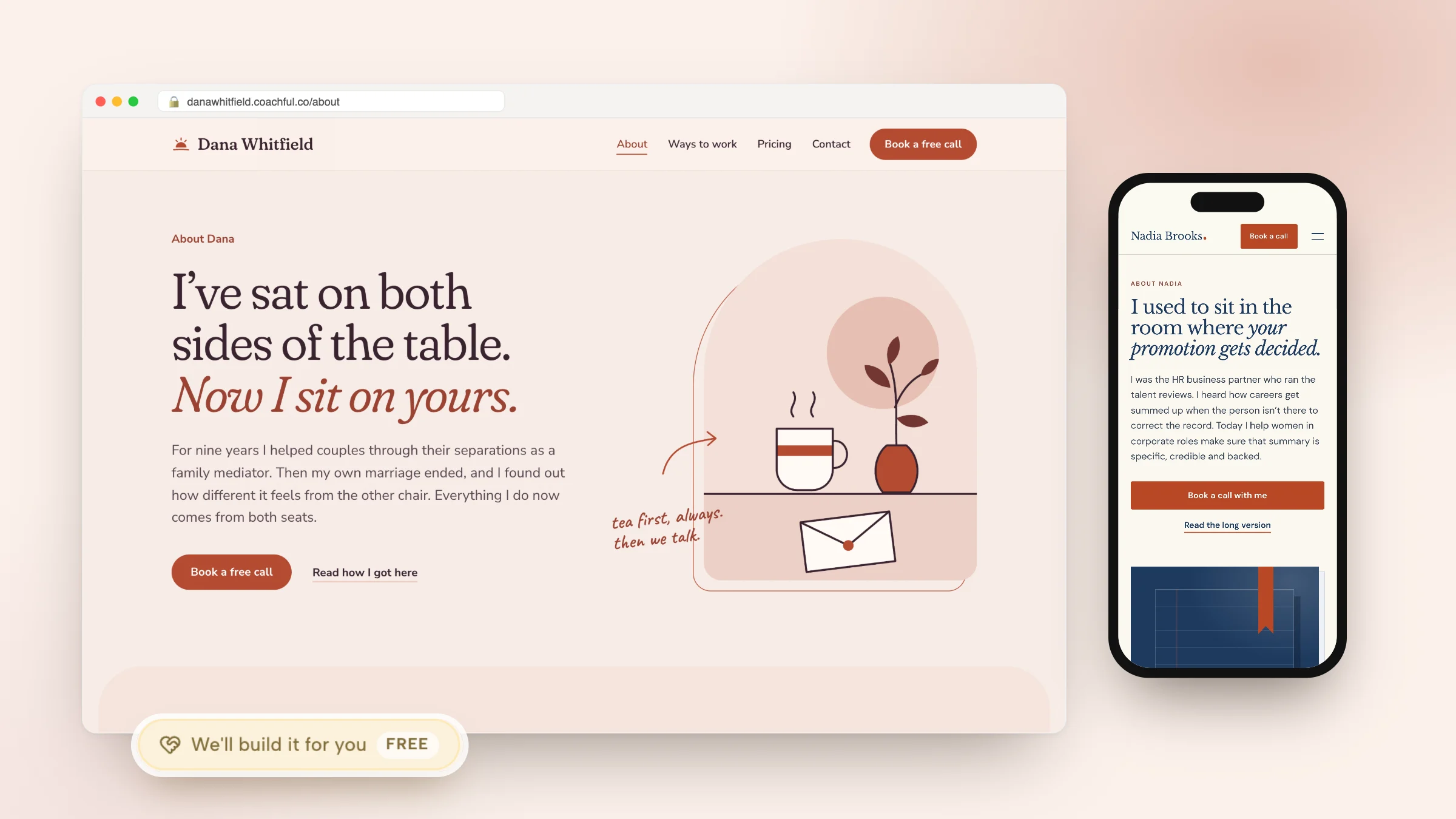
Your life coach About me page is usually the second page people read, right after the homepage and right before they decide whether to book a call. They are not reading it to learn your life story. They are checking three things: does this person understand what I am going through, can they actually help, and would I like talking to them?
This guide gives you a structure that answers those three questions, headline formulas, prompts for writing your story, and three complete sample About page drafts for different kinds of life coaches. If writing about yourself is the part you keep putting off, Coachful's team will write and build the page for you, free on any plan, from your bio, notes or a voice memo. We usually reply with next steps within around 24 hours.
What an About me page has to do
Most About pages are written for the coach: training, certifications, a timeline from childhood. The ones that book calls are written for the reader, with the coach as evidence.
- Recognition. The reader sees their own situation in your words in the first few lines.
- Credibility. One or two reasons you are qualified, said plainly.
- Warmth. A sense of what you are like in a session: your pace, your humor, your values.
- A next step. A clear, low-pressure invitation to talk.
If a sentence does none of these, cut it.
The structure that works
Coachful's designed About page templates, written for fictional sample coaches, follow a structure worth borrowing. Here is the Hearth template's About page, written for a sample life coach who helps people rebuild after a breakup, a divorce or a big move:

Read top to bottom, it has seven blocks:
- A headline that is a point of view, not "About me". Hearth's: "I've sat on both sides of the table. Now I sit on yours."
- A short intro of two or three sentences and a photo, with a button to book.
- The story, headed "The short version: I had to start over too", in three short paragraphs.
- Beliefs: "Four things I hold onto with every client", each one a sentence or two.
- How you work: "What an hour with me actually looks like", in plain steps.
- Training and background, kept to a short list.
- A warm close: "If some of this sounds familiar, come and say hello", with the booking button again.
Other templates use the same bones in a different voice. The Editorial template, for a sample career strategist, opens with "I used to sit in the room where your promotion gets decided" and follows with "Four things I'll probably say on our first call".

Write the headline first
The headline sets the tone for everything under it. Three formulas that work for life coaches:
- The shared experience: "I have been where you are, [in specific words]." Example: "I left a 20-year career at 46 with no plan. It turned out fine, eventually."
- The belief: "[Something you believe that your client needs to hear]." Example: "Starting over is a skill, and you can learn it."
- The promise of the relationship: "[How you will be with them]." Example: "Honest questions, no lectures, and a plan you can keep."
Avoid headlines that could belong to any coach: "Hi, I'm Sam!", "My journey", "Passionate about helping you thrive".
Your story in three paragraphs
Answer these three prompts, one paragraph each, and you have the core of the page:
- What happened? The experience that connects you to your clients' problem. Be specific: a year, a place, a moment.
- What did you learn? The insight you now bring to clients, in one or two sentences.
- What do you do now, and for whom? Who you work with and what changes for them.
Keep the hardest parts of your story as brief as you are comfortable with. Readers need to know you understand; they do not need every detail. If you want help naming your approach, our guide on how to write a coaching philosophy pairs well with this section.

Three sample About page drafts
These are fictional coaches. Copy the shape, not the facts. Credentials are in brackets on purpose: only ever list training you actually have.
Sample 1: a life coach for new empty-nesters
Headline: The house got quiet. You do not have to.
Intro: I'm Maria. I help parents whose children have just left home work out what the next twenty years are for, without guilt and without rushing.
Story: The week my youngest moved out, I cleaned the fridge three times. I had spent eighteen years being needed, and I did not know who I was when nobody needed a lift. It took me two years, a lot of bad pottery and one very good coach to find out.
What I learned is that this stage deserves as much planning as any other big beginning, and a lot more kindness.
Now I work with parents, mostly mothers in their late forties and fifties, who are ready to put themselves back at the top of the list.
What I believe: You are allowed to miss them and enjoy your life. Small experiments beat big decisions. Your partner may be on a different timeline, and that is normal.
How I work: Twelve weeks, one call a week, with a short exercise between calls and a message thread for the days in between.
Training: [Your coaching certification]. [Any relevant background, such as years in teaching or counseling.]
Close: If the quiet is getting loud, book a free 20-minute call. We will just talk.
Sample 2: a life coach for people leaving a long career
Headline: I taught for 22 years. Leaving was the hardest lesson.
Intro: I'm David. I coach people who are leaving a long career, by choice or not, and want the next chapter to mean something.
Story: I loved teaching until I didn't. For three years I told myself the tiredness would pass. When I finally left, I had a pension, a lot of opinions about photocopiers and no idea what I was good at outside a classroom.
It turned out I was good at the same things: listening, explaining, noticing when someone is stuck. I just needed to see them as skills instead of a job title.
Now I help teachers, nurses, civil servants and anyone else with a long first career find out what transfers and what they actually want.
What I believe: Your experience counts, even if your CV doesn't say so. Money worries are real and belong in the plan. A direction is enough to start; passion can come later.
How I work: Eight sessions over four months, with worksheets that turn your past into a list of things you can offer.
Training: [Your coaching certification]. [Your previous career, briefly.]
Close: Not sure if coaching is for you? Book a free call and ask me anything.
Sample 3: a direct life coach for overstretched founders
Headline: You built the business. Now it runs you.
Intro: I'm Sam. I coach founders and owners who are successful on paper and exhausted in real life.
Story: I ran a small agency for nine years. It grew every year, and so did my working week, until I was answering client emails at my daughter's school concert. Something had to change, and for once it was going to be me.
I sold the agency, trained as a coach and spent the next years learning why capable people build lives they do not want to live in.
Now I help founders draw a line: fewer hours, clearer priorities, and a business that does not fall apart when they take a week off.
What I believe: Fewer hours usually lead to better decisions. Boundaries belong in the business plan. If you cannot take a week off, something in the business needs fixing.
How I work: Direct, practical, a bit blunt. Fortnightly calls, a shared plan, and I will ask about the plan.
Training: [Your coaching certification]. [Your business background.]
Close: If that sounded uncomfortably familiar, book a 30-minute call. Bring your calendar.
Credentials, photos and proof
- Credentials. List the training that matters to your audience, briefly. A long list reads as insecurity. Never list anything you have not completed.
- Photos. One clear portrait near the top and one more relaxed photo further down. Natural light, real clothes, a real smile.
- Testimonials. One or two short quotes from real clients, with their permission, near the closing button. If you have none yet, leave them out; the page still works.
- Numbers. Only if they are true and meaningful: "Coaching since 2019" is fine. "Hundreds of lives transformed" is not.
For shorter versions of the same material, see our life coach bio examples.
Have the Coachful team write and build your About page
If you would rather talk than write, let us do the writing. In Coachful, open Website and press Fill in a form on the Want us to build it for you? card. Under pages, write something like "A new About page, and tidy up my homepage", and in materials, send what you have.

Useful material for an About page:
- Your current bio, LinkedIn summary or CV.
- A voice memo answering the three story prompts above. Audio files are accepted; video files are not.
- Two or three photos of you.
- Your training and certifications, exactly as they should appear.
- Real testimonials, if you have them.
Recent builds include an author and speaker whose five pages were built from the coach's own copy document and photos, and a somatic coach leaving Kajabi whose homepage and About page were rebuilt from the old theme, with testimonials and numbers that had been images turned into real text.
The team replies by email with next steps, usually within around 24 hours, a typical turnaround rather than a guaranteed deadline. The policy matters most on this page in particular: nothing gets invented. No fake credentials, testimonials or numbers; anything missing is left for you to fill in. The page is built in your Coachful account, so you can change any line later. See the guide to the free white-glove service for everything else it covers.

Before you publish
- Read it aloud. Rewrite any sentence you would not say to a client.
- Check that the first three lines are about the reader's situation.
- Make sure there is a booking button near the top and again at the end.
- Give the page an SEO title and description, such as "About Maria Lopez, life coach for empty-nesters".
- Look at it on your phone.
- Link to it from your homepage, your link in bio and your email signature.
Building the rest of the site too? Start with our guide to a free website for life coaches, and see how the About page fits your wider coaching brand. Coachful's life coaching page shows the booking, programs and client app that sit behind it.
Frequently asked questions
What should a life coach About me page include?
A headline that speaks to the reader's situation, a short intro with a photo, your story in about three paragraphs, a few beliefs about how you coach, what working with you looks like, a short list of training, and a clear invitation to book a call, ideally with the booking button near the top and again at the end.
How long should an About me page be?
Long enough to answer whether you understand the reader, can help and would be good to talk to. For most life coaches that is 400 to 800 words, broken into short sections. Every sentence should do one of those jobs.
Should I write my About page in first or third person?
First person. Coaching is a personal relationship, and "I" reads warmer and more direct than "Maria is a certified coach who...". Keep third person for speaker bios and press kits.
What if I do not have testimonials yet?
Leave the section out. Your story, your approach and a clear invitation to talk are enough to book first calls. Never write or borrow a testimonial; add real ones as clients give them.
Can Coachful write my About me page for free?
Yes. The Coachful team writes and builds website pages, including About pages, at no extra cost on any plan. Send your bio, photos and a voice memo of your story, and the team builds it in your account without inventing credentials, testimonials or numbers. Coachful itself is a paid subscription with a free trial.
Should I include my certifications on my About page?
Yes, briefly. List the training that matters to your clients in a short section near the end, exactly as it appears on your certificates. Lead with your story and approach; credentials support them.












