
How to Become a Certified Life Coach: The ICF Path in 2026
How to become a certified life coach, in one sentence: complete a coach training program, then earn a credential from an independent body, most often the International Coaching Federation's Associate Certified Coach (ACC). For the ACC, the ICF asks for 60 hours of coach-specific education, 100 hours of coaching with at least 8 clients (75 of them paid), 10 hours of mentor coaching over at least three months, a performance evaluation and a passing score on the ACC exam. The application costs $175 for ICF members on the accredited-program path, as the ICF listed it in October 2026.
Certification is voluntary. You can legally coach without it in most countries, and our main guide on how to become a life coach covers that route. This page is for people who have decided they want the letters after their name and want to know how to become a certified life coach without wasting hours that don't count.
While your hours build, the practice has to exist somewhere. Coachful's team will build your coaching website, first offer and first program for free on every plan, so your first paid clients have somewhere to book.
What "certified life coach" can mean
The phrase covers three very different things, and clients rarely know the difference. You should.
| What you hold | Who issues it | What it proves |
|---|---|---|
| Certificate of completion | Any course provider | You finished the course |
| Program certification | A training school, after its own assessment | You met that school's standard |
| ICF credential (ACC, PCC, MCC) | The ICF, independently of your school | Your education, logged coaching hours, mentor coaching and recorded coaching were checked against a published standard |
All three can honestly be called "certified." Only the last one was checked by someone who didn't sell you the training. Our explainer on certificates of completion goes deeper, and the rest of this guide follows the ICF route, since it's the credential most corporate buyers and coaching platforms recognize.
Step 1: Choose your ICF path before you choose a school
The ICF sorts applicants by how their education was delivered. Your path sets the fee and the wait, so decide it first. These are the ACC figures as the ICF's ACC page listed them in October 2026:
| Path | Who it's for | Fee, ICF member | Fee, non-member | Estimated review |
|---|---|---|---|---|
| Level 1 or Level 2 | Graduates of an ICF-accredited program | $175 | $325 | 4 weeks |
| Portfolio | Education from non-accredited programs or continuing education courses | $475 | $625 | 14 weeks |
The ICF describes Level 1 programs as 60 to 124 hours of coach-specific education, leading to the ACC, and Level 2 as 125 to 175 hours, leading to the PCC. On the Portfolio path, at least half your education hours must be synchronous (live with faculty), and you document the breakdown yourself.
The practical rule: if you think you'll want a PCC within a few years, a Level 2 program covers the ACC and the PCC education in one go. If you only want the ACC, Level 1 is enough. The Portfolio path costs more and takes longer to review, so it mostly makes sense for coaches who already trained elsewhere.
Step 2: Check a program before you pay for it
Search the ICF's own directory of accredited coaching education rather than trusting a badge on a sales page. Then ask the school, in writing:
- Which ICF level is the program accredited at, and is the accreditation current?
- How many hours are live, and on which days and times?
- Will I coach real people and get feedback on recorded sessions?
- Are the 10 mentor coaching hours included, or extra?
- What is the total cost, including materials, mentor coaching and any assessment fees?
- What happens if I have to pause or drop out?
Our guide on seven checks before you enroll covers how to compare programs, and what to do if certification isn't the right purchase yet.

Step 3: Start logging coaching hours the week training starts
This is where most people lose months. The ICF's experience requirements set out which hours count, and the rules are stricter than people assume:
- Hours only count after your coach education starts. The ICF defines that start as a course of at least 30 hours, with at least 24 on the Core Competencies. Years of informal coaching before then don't count.
- 75 of your 100 hours must be paid. Barter counts as paid, including peer coaching in exchange for coaching. Pro bono hours count toward the other 25.
- 25 hours must fall within the 18 months before you apply. A long break can quietly reset your eligibility.
- Practice inside class usually doesn't count, unless it's with a real client, outside the classroom and separate from your training credits.
- Coaching your own direct reports doesn't count.
- Group coaching counts once, not per person, for groups of 15 or fewer, and each participant counts as a client.
Keep a log from your first session: client name and contact, dates, paid or pro bono hours, and group size for group sessions. Our ICF coaching log template shows the columns, the pro bono rule explains the unpaid allowance, and group coaching hours covers the 15-person rule.

Step 4: Book mentor coaching early
The ACC needs 10 hours of mentor coaching spread over at least three months, with at least three of those hours one-to-one. Your mentor must hold a PCC, an MCC or a renewed ACC. The three-month minimum can't be compressed, so start it while your hours are still building rather than after.
One change to plan around: the ICF says that from January 1, 2027, credential candidates must work with a mentor coach who holds its new Mentor Coach Specialization (MCS). If you're starting mentor coaching now, ask your mentor whether they hold or are applying for the MCS, and check with the ICF how hours completed before that date are treated. Our guide to ICF mentor coaching covers what a good mentor does.
Step 5: Pass the performance evaluation and the ACC exam
The performance evaluation is a recording of you coaching a real client, assessed against the ICF Core Competencies. A few practical notes:
- Get the client's written consent to record and to share the recording with the ICF.
- Pick a session where the client brings a real topic and you can let them do most of the talking.
- Review a few of your own recordings first. Most new coaches discover they ask two questions at once or fill silences too quickly.
The ACC exam then tests how you'd apply the competencies and the ICF Code of Ethics to coaching situations. The ICF's self-paced ethics course is free for members and non-members, and it's a sensible way to prepare.

Step 6: Apply, then wait
Once your education, hours, mentor coaching and evaluation are in place, you apply on your path and pay the fee. The ICF estimates four weeks of review for the Level 1 and Level 2 path and 14 weeks for Portfolio. You can keep coaching paying clients the whole time; nothing in the process asks you to stop.
A realistic part-time timeline looks like this. These are typical patterns built from the ICF's minimums, not measured averages:
| Stage | The ICF minimum | Typical part-time pace |
|---|---|---|
| 60 hours of education | Set by your program's timetable | 2 to 4 months |
| 100 coaching hours, 8 clients | No minimum time | About 12 to 18 months alongside a job |
| 10 hours of mentor coaching | At least 3 months | Runs alongside your hours |
| Review | 4 or 14 weeks | 4 weeks on an accredited program |
For the week-by-week arithmetic, see how long it takes to become a life coach. The step that slows most people isn't the hours; it's the eight distinct clients, which come from discovery calls that convert.

Keeping your certification
An ICF credential isn't permanent. According to the ICF's renewal pages, ACC holders renew every three years with 40 continuing coach education credits, 24 of them in the Core Competencies (including 3 in ethics, which the free ethics course covers), plus 10 hours of mentor coaching. The ICF lists the ACC renewal fee at $175 for members and $275 for non-members. Check the current rules before your renewal date, because they change.
Is it worth becoming a certified life coach?
It depends on who you plan to sell to. Coachful's 2026 Coaching Business Report, drawing on the ICF Global Coaching Study 2025, puts the average income of ACC holders at $63,000 a year, 21 percent more than coaches without a credential. Some of that gap is experience, since a credential takes paid hours to earn.
The same report notes that 73 percent of coaches say clients and organizations expect certification, and that in consumer coaching, outcomes and testimonials carry more weight than credentials. Put simply:
- Selling to individuals: a credential helps trust; testimonials and a clear niche help more.
- Selling to employers, coaching platforms or organizations: a credential is often on the procurement form, and the PCC is the level many buyers treat as standard. Our comparison of ACC, PCC and MCC covers when to aim higher.
What a credential won't do is find clients for you. For the income side, see life coach salary data, and for costs, what it costs to become a life coach.

Set up the practice your coaching hours come from
Seventy-five paid hours means you need paying clients during training, which means a way for them to find you, book and pay. That's the part to set up in a weekend, not a season.
A Coachful membership includes the website, booking, payments, programs and client app, and it keeps the hours side tidy:
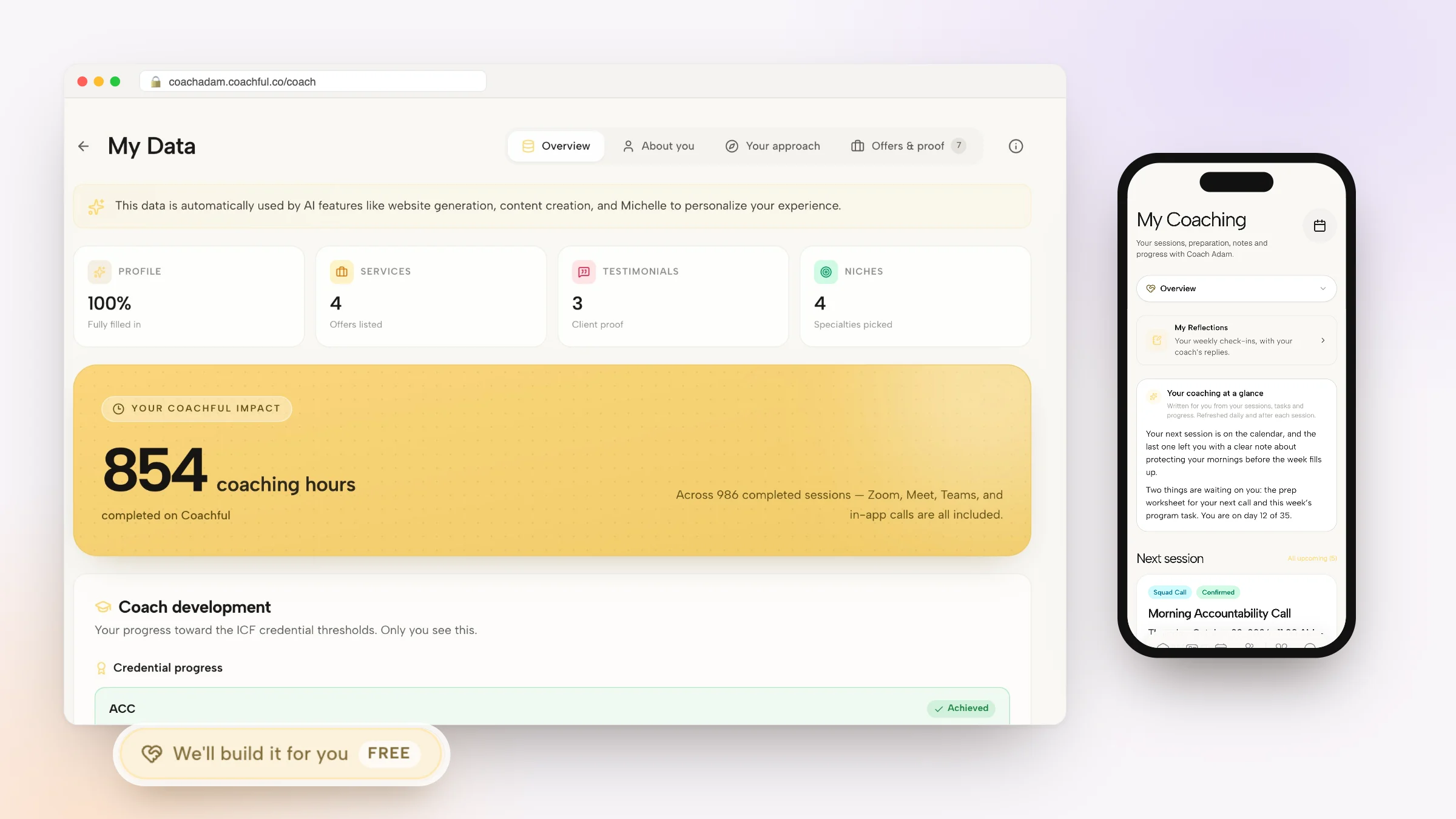
- Hours tracking. Completed sessions count toward the ICF ACC, PCC and MCC thresholds in hours and distinct clients, and you can export an ICF client coaching log with paid and pro bono hours. You can also log a past session by hand.
- Booking and payment in one step, with intake questions that land on the client record, and two-way Google, Apple and Outlook calendar sync. See booking for coaches.
- Agreements sent for e-signature before the first session, which is also where your recording consent belongs.
- Private feedback on your own sessions. When you turn it on, Michelle, the AI assistant, scores your recorded sessions against the ICF Core Competencies. It's a self-development aid, not an ICF assessment and not a substitute for mentor coaching.
The Coachful page for life coaches shows the full setup.
And you don't have to build the website or the first offer yourself. Coachful's team builds them, along with a first program, for free on every plan, inside your own account.

Choose We'll build it for you · FREE under Create, or click Fill in a form on the Website page. Tell the team which pages you want and what they should do, and attach up to 10 files, such as your training certificate, a photo and notes on your offer. The team replies by email with next steps, usually within about 24 hours. Your credential will only appear if you hold it: nothing gets invented, including testimonials and prices. See what the free build includes.

Frequently asked questions
How long does it take to become a certified life coach?
Part time, most people take about 12 to 18 months to reach the ICF ACC: two to four months of training, then the 100 coaching hours, with at least three months of mentor coaching running alongside. Review takes about four weeks on an accredited program. These are typical patterns, not ICF requirements.
How much does it cost to become a certified life coach?
The ICF's ACC application costs $175 for members or $325 for non-members on the accredited-program path, and $475 or $625 on Portfolio, as listed in October 2026. Tuition is the larger cost and varies widely by program, so compare total prices, including mentor coaching.
Can I become a certified life coach online?
Yes. Many ICF-accredited programs run online, and the ICF counts synchronous online classes as live education. Check the program's accreditation level in the ICF's own directory and ask how many hours are live.
Do practice sessions with classmates count toward ICF hours?
Usually not. The ICF says coaching inside a training program generally doesn't count unless it's with a real client, outside the classroom and separate from your training credits. Peer coaching exchanged outside class counts as paid, because the ICF treats barter as paid.
What is the difference between a certified life coach and a credentialed coach?
A certified life coach has been certified by a training school or course. A credentialed coach holds an ICF credential, such as the ACC, which the ICF awards after independently checking education, logged coaching hours, mentor coaching and a recorded session.
Is ICF certification required to be a life coach?
No. Life coaching isn't regulated in most countries, and ICF credentials are voluntary. Many coaches work with individual clients without one. Corporate buyers and some coaching platforms do ask for a credential, often a PCC.
Do I need to renew a life coach certification?
ICF credentials renew every three years. For the ACC, that means 40 continuing education credits, including 3 in ethics, plus 10 hours of mentor coaching, and a renewal fee the ICF lists at $175 for members.
Will Coachful build my coaching website while I'm getting certified?
Yes. Coachful's team builds coaching websites, offer pages and programs for free on every plan. Fill in the form from Create or the Website page and the team replies with next steps, usually within about 24 hours. Coachful is a paid membership; the build costs nothing extra.












