
How Much Does It Cost to Become a Life Coach? Real Costs
The cost to become a life coach depends mostly on one decision: whether you pay for accredited coach training. Without it, you can start for very little, since no license is required and the core study material is free. With it, tuition is the biggest line by far, and the International Coaching Federation's ACC application adds $175 to $625 depending on your path and whether you're a member, as the ICF listed its fees in October 2026.
We won't print a single "typical" training price, because we haven't found an independent survey of program prices we trust, and quotes vary too much for one range to mean anything. Instead, this guide breaks the cost into categories, gives you the fees that are published, and shows how to work out your own total and how long it takes to earn back. For the steps themselves, see our guide on how to become a life coach.
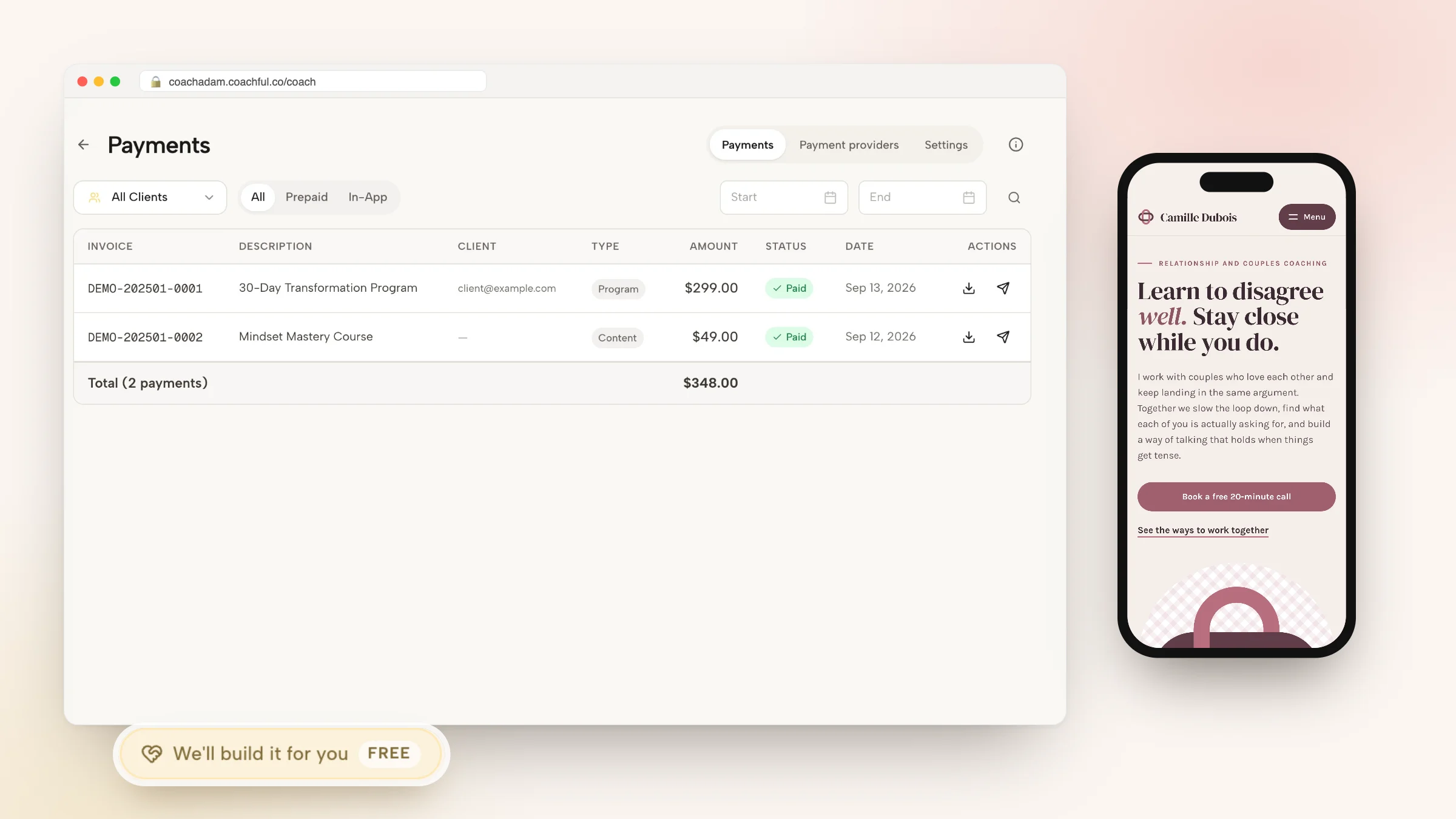
This page covers the cost of becoming a coach: training, the credential and your time. For the cost of running the business (registration, software, branding and marketing), our line-by-line startup budget is the better read. One line you can cross off either list: Coachful's team builds your coaching website, first offer and first program for free on every plan.
Every cost of becoming a life coach, by category
| Cost | Required? | What it costs | How to keep it down |
|---|---|---|---|
| Coach training tuition | Only if you want an ICF credential or structured training | Set by each program; ask for the total in writing | Compare totals, not module prices; check what's included |
| Mentor coaching (10 hours) | For an ICF credential | Included in some programs, billed separately in others | Ask before you enroll; group mentor hours can cover up to 7 of the 10 |
| ICF credential application | For an ICF credential | ACC: $175 to $625 (table below) | Use an accredited program to stay on the lower-fee path |
| ICF membership | No | Set by the ICF; lowers application and renewal fees | Join if the fee saving and resources are worth it to you |
| Books and study | No | Low, or nothing with a library | The ICF Code of Ethics and ethics course are free |
| Practice clients | Yes, in practice | Your time; up to 25 ACC hours can be pro bono | Barter, such as peer coaching exchanges, counts as paid |
| Business registration | Usually | Varies by state, city and country | Start simple; see our business license checklist |
| Insurance | Not legally, for most coaches | Quoted by insurers | Compare cover, not just price; see life coach insurance checks |
| Website, booking and payments | Yes, to take clients | A software membership, plus card processing per payment | One platform instead of five; free build service |
| Your time | Yes | About 170 hours for an ACC, before admin | Overlap training, coaching and mentor coaching |
Two of those lines surprise people. Mentor coaching is often sold separately from tuition, so a program can look cheaper than it is. And the time line is real money if it replaces paid work.
ICF credential fees
These are the application fees as the ICF published them on its credential pages in October 2026. They change, so check the ICF's own pages before you budget.
| Credential and path | ICF member | Non-member | Estimated review |
|---|---|---|---|
| ACC, Level 1 or Level 2 path | $175 | $325 | 4 weeks |
| ACC, Portfolio path | $475 | $625 | 14 weeks |
| PCC, Level 2 path | $375 | $525 | 4 weeks |
| PCC, Portfolio path | $750 | $900 | 18 weeks |
| MCC, Level 3 or Portfolio | $675 | $825 | 18 weeks |
Then there's keeping it. The ICF lists the ACC renewal fee, due every three years, at $175 for members and $275 for non-members, and renewal needs 40 continuing education credits plus 10 hours of mentor coaching. The ICF's ethics course, which covers the 3 ethics credits, is free.
The cheapest path is usually the one that avoids paying twice. ICF fees for each credential are separate, and an ACC doesn't shorten the PCC route. If a corporate buyer will want a PCC from you within a couple of years, a Level 2 program and a direct PCC application can cost less than collecting the ACC on the way. Our comparison of ICF ACC, PCC and MCC works through examples.

Questions to ask a program before you pay
Tuition is where most of the money goes, so get the total, in writing, before you commit. Ask:
- What is the full price, including materials, assessments and any certification fee?
- Are the 10 hours of mentor coaching included? If not, what do they cost?
- Which ICF level is the program accredited at, and is that current? Confirm it in the ICF's education directory.
- Is there a payment plan, and does it cost more than paying upfront?
- What's the refund policy if you need to stop part way?
- How many hours are live, and how much homework is expected each week?
- Does the program include observed coaching with feedback, and a recorded session review before the ICF evaluation?
A cheap program that leaves you on the Portfolio path, paying for mentor coaching separately and waiting 14 weeks for review, can end up costing more than a pricier one that includes everything. Our seven checks before you enroll go deeper.
The cost nobody adds up: your time
For an ACC, the ICF minimums alone add up to about 170 hours: 60 hours of education, 100 hours of coaching and 10 hours of mentor coaching. Add homework, session preparation, notes and the time spent finding clients, and the real figure is higher.
Seventy-five of those 100 coaching hours must be paid, so part of the time pays you back as you go. The other 25 can be pro bono, and that's where the opportunity cost sits. If you're giving up paid work to train, count those hours at your current rate. That's the number to weigh against tuition.

Three ways to start, three cost profiles
Rather than invent typical budgets, here's which cost lines each route triggers, and when.
| Route | Pay upfront | Pay later, if at all | Best for |
|---|---|---|---|
| Start uncertified | Registration, website and booking, maybe insurance | Training and credential, once clients or buyers ask | Coaches selling to individuals in a niche from their own experience |
| Coach while you train | Tuition, plus the basic practice setup in month one | Mentor coaching and the ICF application, in months 4 to 12 | Most people who want a credential within a year or so |
| Credential first | Tuition, mentor coaching and the application | The practice setup, after training ends | Rarely the best order: the ACC needs 75 paid hours anyway |
The middle route usually costs the least overall, because paid coaching during training starts paying for the training. If you're leaning toward the first route, our guide to becoming a life coach without certification covers the free way to learn.
How long until it pays for itself
Divide your total cost by what you clear per session. Coachful's 2026 Coaching Business Report puts newer life coaches at $50 to $100 a session and experienced ones at $100 to $200, both practitioner estimates.
| If your total cost is | Sessions to recover it at $75 | At $150 |
|---|---|---|
| $1,000 | 14 | 7 |
| $5,000 | 67 | 34 |
| $10,000 | 134 | 67 |
The totals are example inputs for the arithmetic, not typical prices. Sessions are rounded up, before tax and running costs.
Packages shorten the payback. The same report puts a typical three-month life coaching package of eight sessions at $1,200 to $2,500, from practitioner reports and a verified sample of published rates. Two or three package clients can cover what a hundred single sessions would. See what life coaches charge for the full pricing picture and life coach salary data for what income looks like by year.

Ways to cut the cost without cutting quality
- Use the free ICF material first. The Code of Ethics, the Core Competencies and the ethics course cost nothing and are what every accredited program teaches from.
- Pick the right level once. Level 1 if the ACC is your goal; Level 2 if you'll want a PCC.
- Check what mentor coaching costs before you enroll, and whether group hours are an option.
- Charge from the start. Paid hours during training fund the training and count toward the 75.
- Don't pay for a designer yet. A clean, honest website with one offer and a booking button is enough to start.
- Ask an accountant about deductions. In some countries, training and business costs can reduce your tax bill; the rules depend on where you live.

Set up your practice without a setup bill
The practice side is the one cost you can keep almost flat. A Coachful membership includes the website, booking, payments, programs and client app, so you're not paying for a scheduler, a site builder, a course tool and a community app separately. Payments go to your own Stripe or Razorpay account with a 0% Coachful platform fee, and card processing is the only per-payment cost. More on how payments work, and the Coachful page for life coaches shows the full setup.

Coachful isn't free; it's a paid membership with a free trial to start. The build service is free. Coachful's team builds your website, first offer page and first program on every plan, inside your account, so you don't pay a designer or lose weekends to it.

Choose We'll build it for you · FREE under Create, or Fill in a form on the Website or Funnels page. Say what you want built and what it should do, and attach up to 10 files (a photo, your offer notes, a logo if you have one) and up to 8 links. The team replies by email with next steps, usually within about 24 hours, though that's typical, not guaranteed. The team doesn't design logos, record videos or run ads, and nothing gets invented: no credentials, testimonials or prices you haven't given them. See what the free build covers.

Frequently asked questions
How much does it cost to become a certified life coach?
Tuition for an ICF-accredited program is the largest cost and varies by program, so ask for a written total. On top of tuition, budget for 10 hours of mentor coaching if it isn't included, and the ICF's ACC application fee of $175 to $625, depending on path and membership.
Can I become a life coach for free?
You can learn and start for almost nothing. No license is required, and the ICF's Code of Ethics, Core Competencies and ethics course are free. An ICF credential can't be earned for free, because it needs accredited or documented training and an application fee.
How much does ICF certification cost?
As listed in October 2026, the ACC costs $175 for members or $325 for non-members on the Level 1 or Level 2 path, and $475 or $625 on Portfolio. The PCC costs $375 or $525 on the Level 2 path, and the MCC $675 or $825. Training and mentor coaching are extra.
Is mentor coaching included in life coach training?
Sometimes. Some accredited programs include the 10 mentor coaching hours the ICF requires, and others charge for them separately. Ask before you enroll, and check whether the mentor will meet the ICF's 2027 requirement for a Mentor Coach Specialization.
What does it cost to start a life coaching business?
Beyond training, you'll need business registration, a website, booking and payments, an agreement and possibly insurance. Our coaching startup budget lists each line. Coachful includes the website, booking, payments and programs in one membership and builds the first version for free.
Is life coach certification worth the cost?
It depends on your buyers. Coachful's 2026 report, drawing on the ICF 2025 study, puts ACC holders at $63,000 a year on average, 21 percent above uncredentialed coaches, while noting that individual clients weigh outcomes and testimonials more than credentials. Employers often require one.
How long does it take to earn back the cost of becoming a life coach?
Divide your total cost by what you clear per session. At $75 a session, $5,000 takes about 67 sessions; at $150, about 34. Selling three-month packages shortens it, since one package typically brings in $1,200 to $2,500.
Does Coachful charge for the website build?
No. The build service is free on every plan: Coachful's team builds your website, first offer page and first program inside your account. Coachful itself is a paid membership, and you can start with a free trial.












