
Life Coach Salary in 2026: What Life Coaches Really Earn
The typical life coach salary in 2026 is $47,000 to $72,000 a year, based on PayScale, ZipRecruiter and Glassdoor data compiled in Coachful's 2026 Coaching Business Report. Most life coaches charge $75 to $200 a session, and across all coaching, people in their first year typically earn $20,000 to $30,000 while they build a client list.
Those numbers are a fair starting point and a poor forecast. Most life coaches are self-employed, so a "salary" is really whatever is left from a year of selling sessions, after costs and tax. Below is every range with its source, what each source can and can't tell you, and the arithmetic to estimate your own life coach earnings. If you haven't started yet, our guide on how to become a life coach covers training and setup; this page is about the money.
One early cost you can skip: Coachful's team builds your coaching website, first offer and first program for free on every plan, so setup doesn't eat the months when income is thinnest.
What the life coach salary figures actually measure
No large public study measures what life coaches take home. The US Bureau of Labor Statistics does not collect data specifically on life coaches, as its Career Outlook profile of the job puts it. What exists is a patchwork, and each piece measures something slightly different:
| Figure | Range | Source | What it really measures |
|---|---|---|---|
| Life coach annual income | $47,000 to $72,000 | PayScale, ZipRecruiter, Glassdoor | Self-reported pay and posted roles; skews toward employed and hybrid coaches |
| Life coach session rate | $75 to $200 an hour | PayScale and practitioner reports | The price of a session, not income |
| US median, all coaching | $71,719 a year | ICF Global Coaching Study 2025, PayScale | Every niche, including executive coaching billed to employers |
| Global average, all coaching | $49,283 a year | ICF Global Coaching Study 2025 | Coaching revenue per coach practitioner worldwide |
| Global median, all coaching | $52,800 a year | ICF Global Coaching Study 2025, PayScale | The middle coach worldwide, all niches |
All figures compiled in Coachful's 2026 Coaching Business Report for Q2 2026, US dollars, before tax and business costs.
Two of those caveats matter more than they look. Coachful's notes on the report's sources flag that PayScale data is self-reported and skews toward employed and hybrid coaches, and that ZipRecruiter tracks posted roles, so it under-represents self-employed practice income. A life coach running their own practice is the person those sources see least clearly.
The ICF Global Coaching Study is the only large survey of coach practitioners, and it covers all coaching. It's why the all-coaching medians sit above the life coaching band: they include executive and leadership coaches whose fees are set against a company's training budget rather than a household's.

Life coach earnings by years in practice
Experience moves income more than anything else in the data. The report breaks the whole profession down by career stage:
| Years coaching | Annual income | Sources | What usually changes |
|---|---|---|---|
| Under 1 year | $20,000 to $30,000 | PayScale, practitioner reports | Finding the first clients; most stay here longer than planned |
| 1 to 4 years | $40,000 to $65,000 | PayScale, ZipRecruiter | The first repeatable package drives the steepest climb |
| 5 to 9 years | $65,000 to $100,000 | PayScale, Salary.com | Capacity becomes the limit, so group work starts to pay |
| 10 to 19 years | $90,000 to $180,000 | PayScale, ICF 2025 | Referrals replace marketing and clients stop shopping around |
| 20 years and up | $120,000 to $300,000+ | PayScale, ICF 2025 | The fee buys a track record nobody newer can copy |
All coaching niches, from Coachful's 2026 Coaching Business Report. Life coaching sits toward the lower end of each band.
For life coaching specifically, the report has session rates by stage, which are practitioner estimates rather than study findings: newer life coaches typically charge $50 to $100 an hour, experienced coaches $100 to $200, and the top of the niche $200 to $500. When Coachful collected the published rates of 18 life coaches in 2026, they ran from $50 to $980 a session, with most between $100 and $250. Eighteen coaches is a small sample, so treat it as evidence of the spread.
Why does life coaching sit lower than career or business coaching? The report's one-line answer: it's "the easiest niche to enter and the hardest to monetise, because the outcome is the least measurable." It rates life coaching's saturation as extremely high. A client can put a number on a new job or a revenue jump; "I feel like myself again" is real, but harder to price.
Where most life coaches sit in the profession
A single average hides how spread out coaching income is. The report sorts the whole profession into bands, using the ICF 2025 study, PayScale and practitioner estimates:
| Where a coach sits | Annual income | Typical profile |
|---|---|---|
| Bottom 25% | Under $25,000 | Part-time, early stage |
| 25th to 50th percentile | $25,000 to $55,000 | Established part-time |
| 50th to 75th percentile | $55,000 to $95,000 | Full-time practice |
| 75th to 90th percentile | $95,000 to $160,000 | Strong niche, package-based |
| Top 10% | $160,000 to $500,000 | Premium positioning, business clients |
| Top 1% | $500,000 to $1,000,000+ | Executive or enterprise focus |
Half the profession earns under about $55,000, and much of that half coaches part time by choice. The report's label for the band above $95,000 is "strong niche, package-based": coaches there tend to sell multi-month engagements to a defined audience, not single hours. Our guide to being a part-time life coach is worth reading if the second-income band is your plan.

Do certified life coaches earn more?
On average, yes, though the gap isn't all down to the certificate. The ICF Global Coaching Study 2025, as compiled in the report, gives these averages across all coaching:
| Credential | Average annual income | Compared with no credential |
|---|---|---|
| ICF ACC | $63,000 | 21% more |
| ICF PCC | $78,000 | 50% more |
| ICF MCC | $95,000 | 83% more |
| EMCC or equivalent | $68,000 | 31% more |
Higher credentials take years of paid hours to reach (a PCC needs 500 coaching hours, an MCC 2,500), so part of the premium is simply experience. The report adds that 73 percent of coaches say clients and organizations expect certification, but that in consumer coaching, client outcomes and testimonials carry more weight than credentials. For a life coach selling to individuals, the credential is a trust signal; for one selling to employers, it's often a requirement. Our guide on how to become a certified life coach walks through the ACC path, and ICF ACC vs PCC vs MCC compares the levels.

Life coach pay by region
Where your clients live matters more than where you live, since most life coaching now happens on video. These all-coaching bands come from the ICF 2025 study and PayScale:
| Region | Annual income, all coaching | What drives it |
|---|---|---|
| North America | $80,000 to $120,000 | The deepest corporate market, so more employer-paid work |
| Western Europe | $60,000 to $80,000 | Strong credentialing culture, shorter contracts |
| Oceania | $55,000 to $70,000 | A small home market that pushes coaches toward overseas clients |
| Asia Pacific | $30,000 to $50,000 | Fast growth against lower local price ceilings |
| Latin America | $25,000 to $40,000 | Cross-border work carries much of the upside |
| Eastern Europe | $20,000 to $35,000 | Billing international clients changes the sum most |
Notice that North America's band sits above the US median in the first table. They're different cuts of different data, which is exactly why you should treat every published figure as a range to sanity-check your plan against, not a number you'll be paid.
How to estimate your own life coach salary
Because no source measures self-employed life coach income directly, the most reliable estimate is the one you build yourself. The formula is short:
Session rate × paid sessions a week × working weeks a year = revenue. Then subtract costs and tax to get pay.
- Pick your rate from your stage. A newer life coach is usually in the $50 to $100 band, an established one $100 to $200.
- Count paid sessions, not booked ones. Free discovery calls, practice clients and no-shows don't pay.
- Use 44 to 46 working weeks. Holidays, illness and slow summers are real. A self-employed coach has no paid leave.
- Multiply. At $150 a session, eight paid sessions a week across 46 weeks is $55,200 of revenue.
For a capacity check, the ICF 2025 study, as compiled in the report, puts the average coach practitioner at 12.4 clients in 2025, up from 11.2 in 2023. If your plan needs 30 weekly clients in year one, the plan is the problem.

Three illustrative life coaching practices
The figures below are worked examples, set inside the report's ranges to show how format changes income. They aren't measured incomes.
| Practice | How it sells | The sum | Yearly revenue |
|---|---|---|---|
| Side practice | Single sessions at $100, about three a week | $100 × 3 × 44 weeks | $13,200 |
| Part-time package practice | Six client places on a three-month package at $1,800, filled about three-quarters of the time | 6 places × 4 packages a year × $1,800 × 0.75 | $32,400 |
| Full-time mixed practice | Ten places on a $2,400 three-month package at 85% full, plus a group of ten at $150 a month for ten months | (10 × 4 × $2,400 × 0.85) + (10 × $150 × 10) | $96,600 |
The full-time example lands in the report's "full-time practice" to "strong niche" bands, and it gets there on about ten one-to-one clients at a time, which is close to the average client load. The difference from the side practice isn't hours worked. It's packaging and fill rate.
From revenue to take-home pay
Revenue isn't salary. Before you compare your number with an employed job, take out:
- Tax. In the US, self-employed people pay self-employment tax of 15.3 percent for Social Security and Medicare on net earnings, on top of income tax. Other countries have their own versions. Set money aside from every payment.
- Payment processing. Card processors charge a fee on each payment.
- Software, insurance and training. Booking, payments, a website, liability insurance, mentor coaching or supervision.
- Unpaid hours. Marketing, discovery calls, notes and admin take real time that no client pays for. Plan your week with them in it.
- Slow months. A cash reserve keeps a quiet month from becoming a crisis. Our guide to a cash reserve for slow months shows how much to hold.
If you want to work backwards from the pay you need, how to set a coaching revenue target turns a take-home figure into sessions and packages, and the financial setup after your first payment covers accounts and tax.

How life coaches raise their earnings
- Sell packages, not hours. Practitioner reports put packaged work at 40 to 60 percent more per hour than single sessions. A $150 single session and a $1,800 eight-session package works out at $225 a session inside the package.
- Coach people with a budget. Coachful's report, citing the ICF 2025 study, finds nearly six in ten coaching clients worldwide are employer-sponsored. A life coach who works with managers, founders or a company's staff prices against a training budget, even when the coaching looks similar.
- Add a group. Group life coaching typically runs $100 to $300 a month per person, according to the report. Ten people on one call changes the hourly sum.
- Raise prices for new clients first. Keep existing clients on their rate until renewal; our life coach pricing guide covers how to set and move a rate.
- Keep clients longer. A renewal costs you no marketing. Build the next step into the last month of every package.
For worked offers with inclusions, see 12 life coaching package examples.

Set up a life coaching practice that pays you
The fastest way to lift your effective salary early on is to stop paying, in money and evenings, for five separate tools. A Coachful membership includes the website, booking, payments, programs and client app, so a client can find you, book, pay and do the work between sessions in one place.
- Payments go to your own Stripe or Razorpay account with a 0% Coachful platform fee, as one-time payments, subscriptions or payment plans. More on how payments work.
- Booking runs from your availability, with paid sessions, session credits and reminders, and two-way Google, Apple and Outlook calendar sync.
- Programs carry weekly goals, tasks, habits and check-ins into a client app on iPhone and Android.
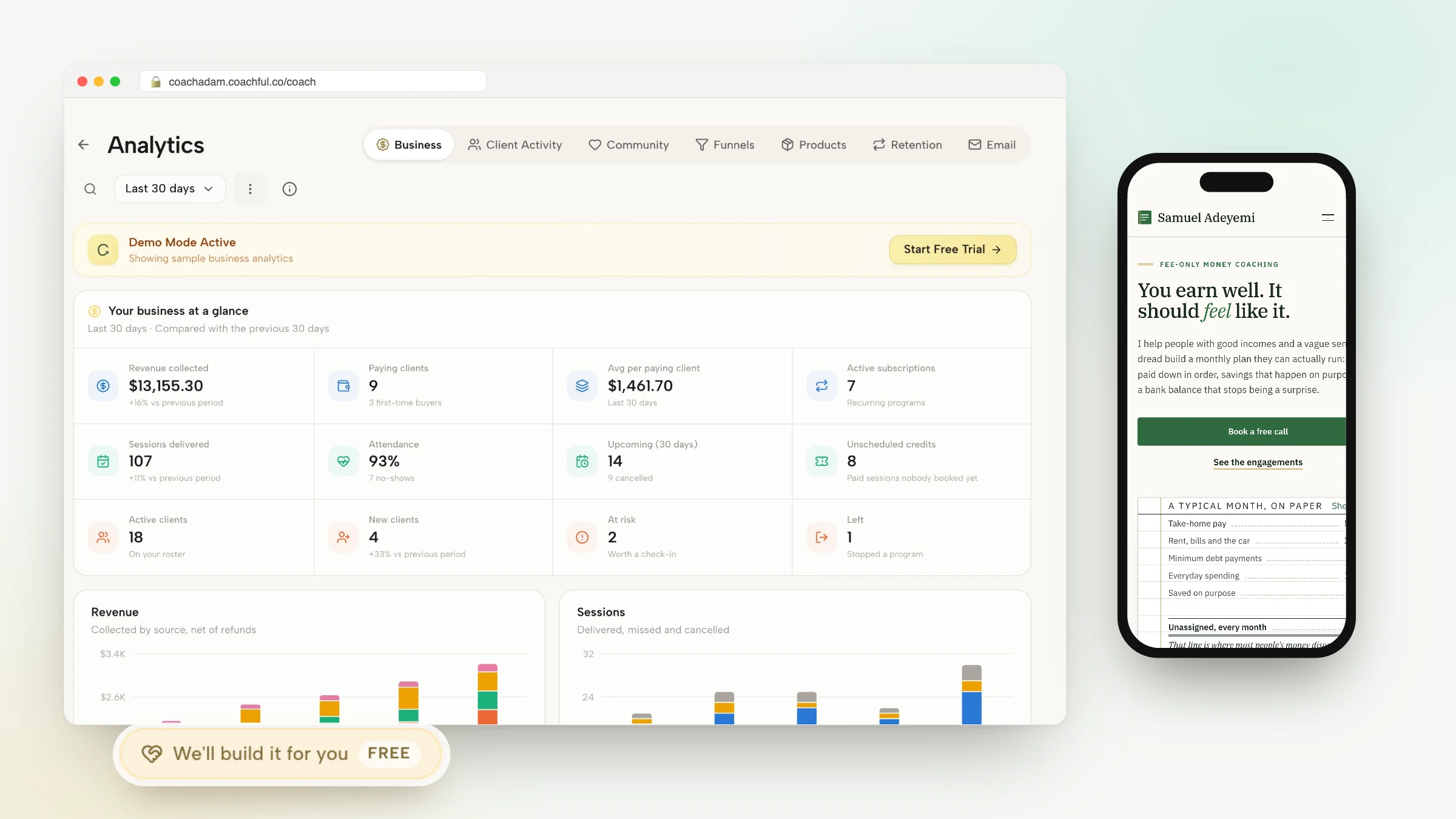
- Analytics show revenue collected, paying clients and average revenue per paying client, the number that tells you what your price really earns.
The Coachful page for life coaches shows the full setup, and our plan for starting a life coaching business puts it in order.
You also don't have to build any of it yourself. Coachful's team builds your website, your first offer page and your first program for free on every plan, inside your own account. Coachful itself is a paid membership, and you can start with a free trial.

Open Website and click Fill in a form on the "Want us to build it for you?" card, or pick We'll build it for you · FREE under Create. Say which pages you want, what they should do and what visitors should do next, and attach up to 10 files and 8 links. The team replies by email with next steps, usually within about 24 hours, which is typical rather than guaranteed. Nothing gets invented: no credentials, testimonials or prices you don't have. The team doesn't design logos, record videos or run ads. See everything the free build covers.

Frequently asked questions
How much do life coaches make a year?
Coachful's 2026 Coaching Business Report puts life coaches at $47,000 to $72,000 a year, from PayScale, ZipRecruiter and Glassdoor data. Those sources skew toward employed coaches, so a self-employed life coach can earn well below or well above the band depending on packaging, niche and how full the practice is.
How much do life coaches make per hour?
Most life coaches charge $75 to $200 a session, based on PayScale data and practitioner reports. Newer coaches tend to charge $50 to $100 and the top of the niche $200 to $500, both practitioner estimates. The hourly rate isn't hourly pay: unpaid admin and marketing hours sit behind every paid one.
How much does a new life coach make in the first year?
Across all coaching, the report puts first-year coaches at $20,000 to $30,000 a year (PayScale and practitioner reports). Many new life coaches start part time alongside a job, so the first-year figure often reflects a handful of clients rather than a full week.
Can a life coach make six figures?
Some do. In the report's profession-wide bands, the 75th to 90th percentile earns $95,000 to $160,000 and is described as "strong niche, package-based." Getting there usually means multi-month packages, a niche with a budget and referrals, rather than more single sessions.
Do certified life coaches earn more than uncertified ones?
On average, yes. The ICF 2025 study, as compiled in the report, puts ACC holders at $63,000 a year, 21 percent more than coaches without a credential, and PCC holders at $78,000. Part of the gap is experience, since higher credentials require hundreds of paid hours.
What is the average life coach salary in the US?
For life coaches specifically, salary data puts the band at $47,000 to $72,000. Across all US coaching, the report gives a median of $71,719 (ICF 2025 and PayScale), which includes executive coaches paid by employers. The BLS doesn't publish a separate figure for life coaches.
Is life coaching a good career financially?
It can be, with clear eyes. The report calls life coaching the easiest niche to enter and the hardest to monetise. Coaches who do well tend to pick a specific audience, sell three-month packages rather than single hours and build referrals over several years.
Will Coachful build my life coaching website for free?
Yes. Coachful's team builds coaching websites, offer pages and programs for free on every plan, inside your account. Fill in the form from the Website page or Create, and the team replies with next steps, usually within about 24 hours. Coachful is a paid membership; the build itself costs nothing extra.












