
How to Start a Life Coaching Business: A 30-Day Plan
How to start a life coaching business in one paragraph: choose one group of people going through one change, package about three months of coaching around that change, set up a way for them to book, sign and pay, then start conversations with people who already know you. You can do all of that in about 30 days, part time, and the plan below takes you through it week by week.
This is the life-coach-specific version. Our general 10-step plan for starting a coaching business covers any niche; this one deals with the problem that's particular to life coaching, which is that the outcome is hard to see and the market is crowded. If you haven't trained or decided on certification yet, start with how to become a life coach and come back.
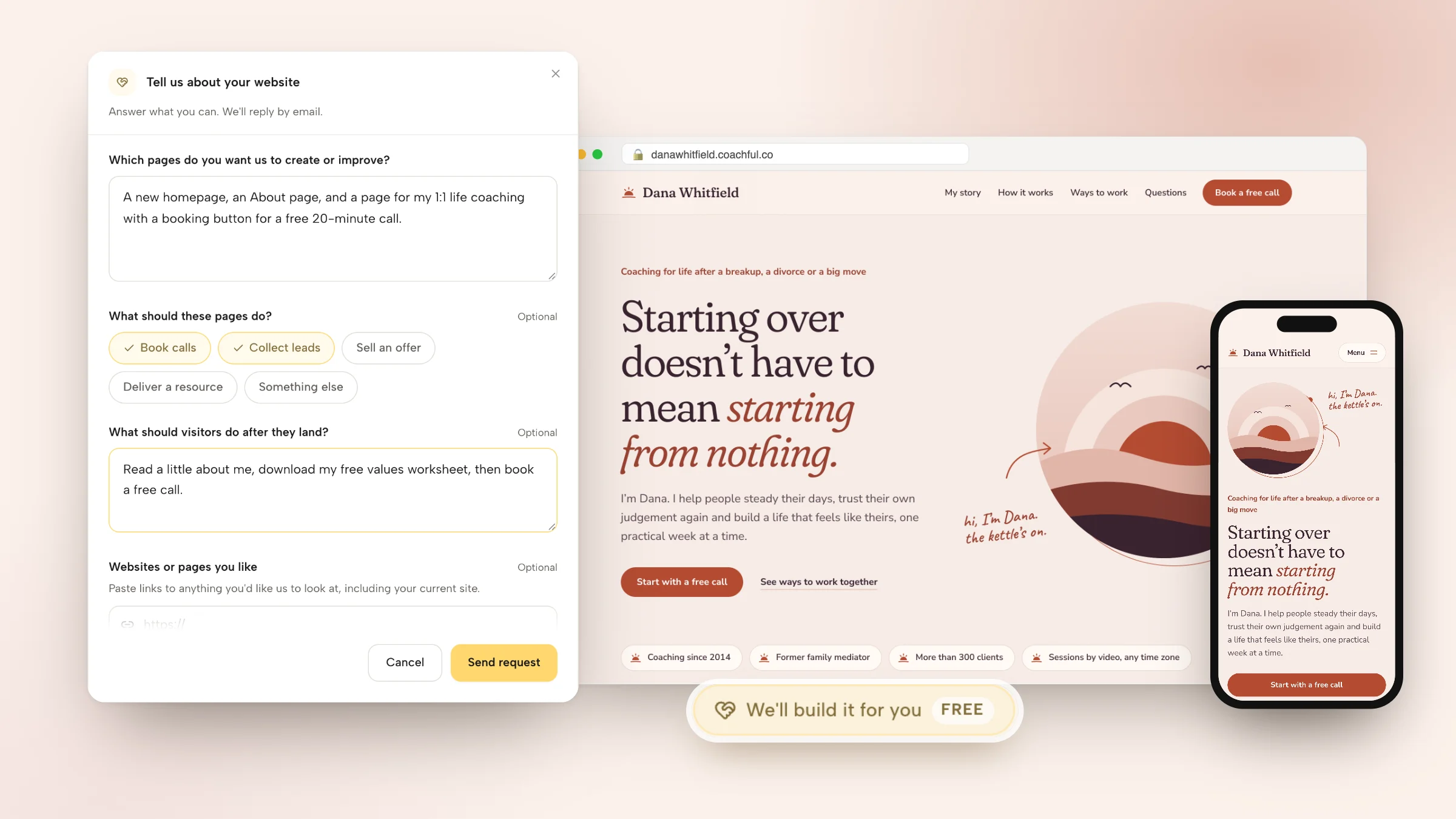
Week three is setup, and it's the week you can mostly hand over: Coachful's team builds your coaching website, first offer and first program for free on every plan.
Why life coaching businesses stall
Coachful's 2026 Coaching Business Report calls life coaching "the easiest niche to enter and the hardest to monetise, because the outcome is the least measurable." It rates the niche low on barriers to entry and extremely high on saturation, based on the ICF Global Coaching Study 2025 and practitioner reports. Most life coaches feel this in the first month: friends say "that sounds great," and nobody books.
The fix isn't a better logo or a cleverer Instagram grid. It's making the change visible. "I'm a life coach" asks a stranger to imagine what you do. "I help people in the first year after a divorce get their weeks back" lets the right person recognize themselves in one line. Every step in this plan is about making that recognition easier.
Week 1, days 1 to 7: pick a niche and name the change
Choose who, using a life transition
Life coaching niches work best when they're built around a transition people can date: a divorce, a move, an empty nest, a layoff, a diagnosis in the family, a big birthday, a return to work after children. Transitions have a "before" and an "after," which gives your coaching an outcome people can picture.
Fill in this sentence: "I help [specific people] who are [in this situation] to [reach this change], without [the thing they fear]."
- "I help women in their 40s who've stepped back from their careers decide what's next, without starting from zero."
- "I help new managers who were promoted from the team lead their old peers, without becoming someone they don't like."
- "I help people who've just moved countries build a life there in their first six months, without waiting to feel ready."
The strongest niches come from your own history, and the report's background-to-niche framework points the same way: coaches from psychology or personal development backgrounds tend toward life, mindset and relationship coaching. Our list of 60 coaching niches has more ideas.
Test it with five conversations
Before you build anything, talk to five people who fit the sentence. Ask what they've already tried, what they'd pay to fix and what words they use for the problem. Write their words down; they become your headlines. If three of the five say "I'd do that," you have a niche. If not, adjust and repeat. Our guide to validating a niche with a paid pilot is the stricter version.

Week 2, days 8 to 14: build one package and price it
Don't open with a menu of sessions. Open with one core package that has a start, an end and a promise about the change. The report's market data for life coaching gives you a frame, from practitioner reports and a verified sample of published rates:
| Package shape | Sessions and length | Typical price | Role in a new business |
|---|---|---|---|
| Starter | 4 × 60 minutes over 4 weeks, with email support | $400 to $600 | A lower-commitment first step |
| Three-month program | 8 × 60 minutes over 3 months, with email and worksheets | $1,200 to $2,500 | Your core offer |
| Six-month deep dive | 12 to 16 sessions over 6 months, with chat and accountability | $2,500 to $5,000 | Later, for clients who renew |
| Group coaching | Group calls and a community | $100 to $300 a month per person | Once you have a waiting list |
A new life coach will often price near the bottom of the core range and raise it after the first few clients. Practitioner estimates put newer life coaches at $50 to $100 a session and experienced ones at $100 to $200, so an eight-session package at $1,200 is a reasonable first number for many people. Our 12 life coaching package examples show complete inclusions, and what life coaches charge explains how to set your own rate.
Write the package as a one-page description: who it's for, what changes, what's included, how long, the price and the payment plan. That page becomes your sales page, your discovery-call script and your agreement's scope section.

Do the legal and money basics the same week
- Register the business the simple way for where you live, and check local permits with our US business license checklist.
- Know your boundaries. No license is needed to coach, but therapy and clinical work are off-limits; our guide to whether you need a license to be a life coach sets out the lines.
- Write a coaching agreement from our agreement template.
- Open a separate account for business money, and set a tax percentage aside from every payment. The financial setup after your first payment covers the rest.
- Decide on insurance. Not legally required for most coaches, but common.
Week 3, days 15 to 21: set up the practice
A new life coaching business needs four pages and four tools, and nothing else yet:
| You need | The minimum version |
|---|---|
| Home page | Your niche sentence as the headline, one paragraph on the change, one button to book a call |
| About page | Why you do this work, the relevant parts of your story, how you coach |
| Work with me page | Your one package, the price and the payment plan |
| Booking page | A free 20- or 30-minute call with two or three intake questions |
| Payments | One-time and payment-plan checkout for the package |
| Agreement | Signed before the first session |
| A place for the work | Where weekly actions, check-ins and notes live between sessions |
| An email list | Even a small one, with a free resource that suits your niche |
Our About page guide has sample drafts, and the life coach website examples show what strong first screens look like. Keep it plain. A clear page with one offer books more calls than a beautiful one with seven.

Week 4, days 22 to 30: land the first three clients
Your first clients will almost certainly come from people who already know you, or know someone who knows you. That's normal for a new life coaching business, and it's the fastest route.
- Make a list of 50 people: friends, former colleagues, neighbors, people from your community or faith group, past clients from a previous career.
- Send a short personal note to each, not a broadcast. "I've started coaching people who are [situation]. If anyone you know is going through that, I'd be grateful for an introduction." Our elevator pitch examples help with wording.
- Offer conversations, not pitches. A free 20-minute call where the person leaves with one useful idea, then a clear invitation if it's a fit.
- Find two referral partners, people who meet your ideal clients first: a therapist who refers coaching-ready clients, a divorce mediator, an HR manager. Our guide to referral partners for life coaches lists who to ask first.
- Run one free workshop, online or at a library or community center, on the exact problem in your niche sentence.
A discovery call that converts has a simple shape: what's happening now, what they want instead, what's in the way, what they've tried, then your package, explained as the path from now to instead. Ask for the decision on the call, and offer the payment plan before they ask.

After day 30: what to measure
For the first six months, track five numbers every week: conversations started, calls booked, calls converted, active clients and revenue collected. They tell you where the business is stuck. Lots of conversations and few calls means the offer isn't clear. Lots of calls and few clients means the call or the price needs work.
For a sense of scale, the ICF Global Coaching Study 2025, as compiled in the report, puts the average coach practitioner at 12.4 clients. You don't need that many to have a real business, and our guide to setting a coaching revenue target shows how many you do need for the income you want. For what that income tends to look like over time, see life coach salary data.

Set up your life coaching business in Coachful
Week three is where most new life coaches lose a month, wiring together a website, a scheduler, a payment tool, an e-signature app and somewhere to keep notes. A Coachful membership includes all of it, and the client gets one app instead of five links:
- A website from 30 designed homepage templates, filled in with your name, offers and links, on your own domain. See the coach website builder.
- Booking with intake questions and two-way Google, Apple and Outlook calendar sync.
- Payments for one-time packages and payment plans, through your own Stripe or Razorpay account with a 0% Coachful platform fee.
- Agreements sent for e-signature before session one.
- Programs with weekly goals, tasks, habits and check-ins, delivered in a client app on iPhone and Android, plus more than 40 ready-to-film program templates to start from.
- Email sequences that welcome new leads and follow up after a free resource.
The Coachful page for life coaches shows the full setup.

Hand week three to Coachful's team
Coachful's team builds your website, your first offer page and your first program for free on every plan, inside your own account. Coachful itself is a paid membership, and you can start with a free trial.
Open Website and click Fill in a form on the "Want us to build it for you?" card, or pick We'll build it for you · FREE under Create. Paste in your niche sentence and your one-page package description. Say what the pages should do (book calls, collect leads, sell an offer) and what visitors should do after they land. Attach up to 10 files and up to 8 links, such as a photo and pages you like. For a funnel, the form also asks who it's for, the journey people should follow and where traffic comes from.

The team replies by email with next steps, usually within about 24 hours; that's typical, not guaranteed. Recent requests have ranged from a five-page site for a coach starting with no site, logo or prices, where every button led to a free 20-minute consultation, to a new homepage with three clear paths: book a call, join a free community, enroll in the program. Nothing gets invented: no credentials, testimonials or prices you haven't provided. The team doesn't design logos, record videos or run ads. See everything the free build covers.

Frequently asked questions
How do I start a life coaching business with no experience?
Start with training or a structured self-study plan, coach a few people pro bono for feedback and testimonials, then pick a niche from your own life experience. Many life coaches have no coaching background; a specific niche and honest proof matter more to individual clients than years in business.
How much does it cost to start a life coaching business?
It can be low if you skip certification at first: registration, a website, booking and payments, and an agreement. Training is the biggest optional cost. Our guide to the cost to become a life coach breaks it down.
Do I need a certification to start a life coaching business?
No. Life coaching isn't regulated in most countries, and certification is voluntary. It helps with trust and is often required by employers who buy coaching. Coachful's 2026 report notes that individual clients weigh outcomes and testimonials more than credentials.
What should my first life coaching package be?
A three-month package of about eight 60-minute sessions with support between calls. The 2026 report puts that shape at $1,200 to $2,500 for life coaches, based on practitioner reports and a verified sample of published rates. Offer a payment plan alongside the upfront price.
How do life coaches get their first clients?
Mostly through people who already know them: personal notes to a list of 50 contacts, free 20-minute calls, introductions from referral partners and a free workshop on the niche's core problem. Social media and ads tend to work better once you have testimonials.
How many clients does a life coach need to make a living?
It depends on price and costs. At $1,800 per three-month package, ten clients at a time, renewed or replaced each quarter, bring in $72,000 a year before costs and tax. The ICF 2025 study, via the report, puts the average coach at 12.4 clients.
Should a life coaching business be an LLC?
Many life coaches start as sole proprietors and form an LLC or limited company later. The right structure depends on where you live, your liability concerns and tax. Ask a local accountant, and check local license rules with our business license checklist.
Can Coachful build my life coaching website and first program for free?
Yes. The team builds your website, offer page and first program on every plan, inside your account, usually replying within about 24 hours of your request. Coachful is a paid membership; the build itself costs nothing extra.












