Coaching Skills: The Core Skills Every Coach Needs
Coaching skills are the abilities a coach uses to help someone think more clearly and then act: agreeing what each session is for, building trust, staying present, listening closely, asking questions that move the client's thinking, sharing direct observations, turning insight into commitments, and holding the ethical lines that keep coaching safe. The International Coaching Federation's Core Competencies group these skills into four domains. Research points to one skill above the others: the quality of the working relationship between coach and client is consistently linked to client outcomes.
Every coach has a session they replay at night: the one where they talked too much, rescued the client from a hard question or let the hour drift. Coaching skills are what close the gap between knowing the theory and doing it live. This guide maps the core skills, shows what beginner and skilled versions sound like, covers what research says about which skills matter, gives you a scoring rubric and a 90-day practice plan, and shows where software can take the admin off your plate.
One practical note before the skills. If your website, programs or intake forms are eating the time you would rather spend practicing, Coachful's team builds them for you as part of a free white-glove service, covered at the end.
The core coaching skills, at a glance
| Skill | Beginner version | Skilled version | ICF competency |
|---|---|---|---|
| Contracting the session | "What do you want to talk about?" | Agrees the outcome for this session, how the client will know it was useful, and checks back when the topic shifts | Establishes and Maintains Agreements |
| Building trust and safety | Warm and encouraging | Invites disagreement, respects the client's way of seeing things, makes it safe to say the uncomfortable thing | Cultivates Trust and Safety |
| Presence | Following a plan for the session | Follows the client, comfortable with silence and not knowing, responds to the whole person | Maintains Presence |
| Active listening | Waiting to ask the next question | Reflects and summarizes, notices emotion, energy and what is not said, builds each question on what was just said | Listens Actively |
| Powerful questions | Several questions at once, often leading | One short, open question in the client's own words that moves their thinking | Evokes Awareness |
| Direct communication | Hints, or advice disguised as a question | Shares an observation or reframe plainly and without attachment, then asks what the client makes of it | Evokes Awareness |
| Designing actions | Assigns homework | Partners with the client to design their own next steps and how they will be accountable | Facilitates Client Growth |
| Ethics and boundaries | Knows the rules exist | Contracts confidentiality clearly, notices when coaching is not the right help and refers | Demonstrates Ethical Practice |
| Reflective practice | Reviews a session when it went badly | Reviews regularly, seeks feedback and supervision, keeps learning | Embodies a Coaching Mindset |
The ICF says it introduced its current competency framework in 2025, after a job analysis of more than 3,000 coaches, organized in four domains: Foundation, Co-Creating the Relationship, Communicating Effectively, and Cultivating Learning and Growth (ICF Core Competencies). The ICF's 2025 update kept these eight competencies and revised the detail beneath them. Our sibling guide to the ICF core competencies goes competency by competency, and the coaching code of ethics covers the ethics skill.
Three existing guides go deeper on parts of this list: communication skills in coaching (listening, questions, feedback and contracting with examples), characteristics of a good coach (the qualities clients notice) and coaching techniques (25 techniques with the question behind each).
Coaching skills in the moments that test them
Skills show up most clearly when a session gets difficult. These are the moments coaches ask about most, with the skill each one tests:
| Moment | Skill it tests | Where to go deeper |
|---|---|---|
| The first session with a new client | Contracting, trust | How to run a first coaching session |
| The client says "I don't know" | Presence, questions | Nine responses to "I don't know" |
| A long silence | Presence | Silence in coaching |
| The client cries | Trust and safety, ethics | What to do when a client cries |
| The client talks without pause | Contracting, direct communication | Handling a talkative client |
| The client keeps telling the same story | Direct communication, questions | How to challenge a coaching client |
| The session is ending | Designing actions | How to end a coaching session |
For questions to practice with, Coachful's coaching questions bank sorts 200 questions by moment, and our guide to the levels of listening explains the listening model many training programs teach.
What the research says about which skills matter
- The relationship comes first. A meta-analysis of 27 samples covering 3,563 coaching processes found a moderate, consistent link between the quality of the coach-client working alliance and client outcomes (r = .41), and a negative link with unintended negative effects of coaching (r = −.29). The link held regardless of the type of client, the coach's expertise and the number of sessions (Graßmann, Schölmerich and Schermuly, Human Relations).
- Coaching works, on average. A meta-analysis of 17 workplace coaching studies found positive effects overall (δ = 0.36), with effects on skill-based, affective and individual results. Effects were stronger for internal coaches than external ones, and format, face to face or blended, made no difference (Jones, Woods and Guillaume, Journal of Occupational and Organizational Psychology, 2016). A 2023 meta-analysis reached the same broad conclusion (Cannon-Bowers and colleagues, 2023).
- Specific plans made together get followed. A meta-analysis of 21 studies found that if-then planning after imagining the goal and the obstacle improved goal attainment, more when the plan was made with another person (g = 0.47) than from written materials (g = 0.28) (Wang, Wang and Gai, 2021). That is the "designing actions" skill in research form.
The practical reading: trust, presence and listening are not soft extras. They are the skills most consistently tied to whether coaching works, and the ones worth practicing first.
How to assess your own coaching skills
It is easy to overrate your own listening and to miss how often you slip into advice. Evidence beats impressions, so build in at least three of these:
- Record sessions, with consent. Listen back to ten minutes a week. Count your questions, note how many were leading, and time how long you talk.
- Score yourself against a rubric. Use the one below, or Coachful's Good Coach Scorecard for a quick self-check.
- Get mentor coaching. ICF credential applications include ten hours of mentor coaching; our guide to ICF mentor coaching explains how it works and what to look for.
- Use supervision. Supervision looks at you as a practitioner, not just your technique. See what coaching supervision is.
- Practice with peers. Coach, client and observer in rotation, with structured feedback. Our peer coaching group agenda gives you a format.
- Reflect in writing. A ten-minute review after sessions, using our reflective practice template.
| Score | What it looks like in a recording |
|---|---|
| 1 | You talk more than the client; questions are mostly closed or leading; the session has no agreed outcome |
| 2 | You agree a topic but not an outcome; frequent advice; few reflections |
| 3 | A clear session outcome; mostly open questions; some reflections; actions agreed, often suggested by you |
| 4 | You build on the client's words; comfortable silences; you share observations plainly; the client designs the actions |
| 5 | All of level 4, plus you notice and name patterns, emotion and energy shifts, check the agreement mid-session and adapt to the person in front of you |
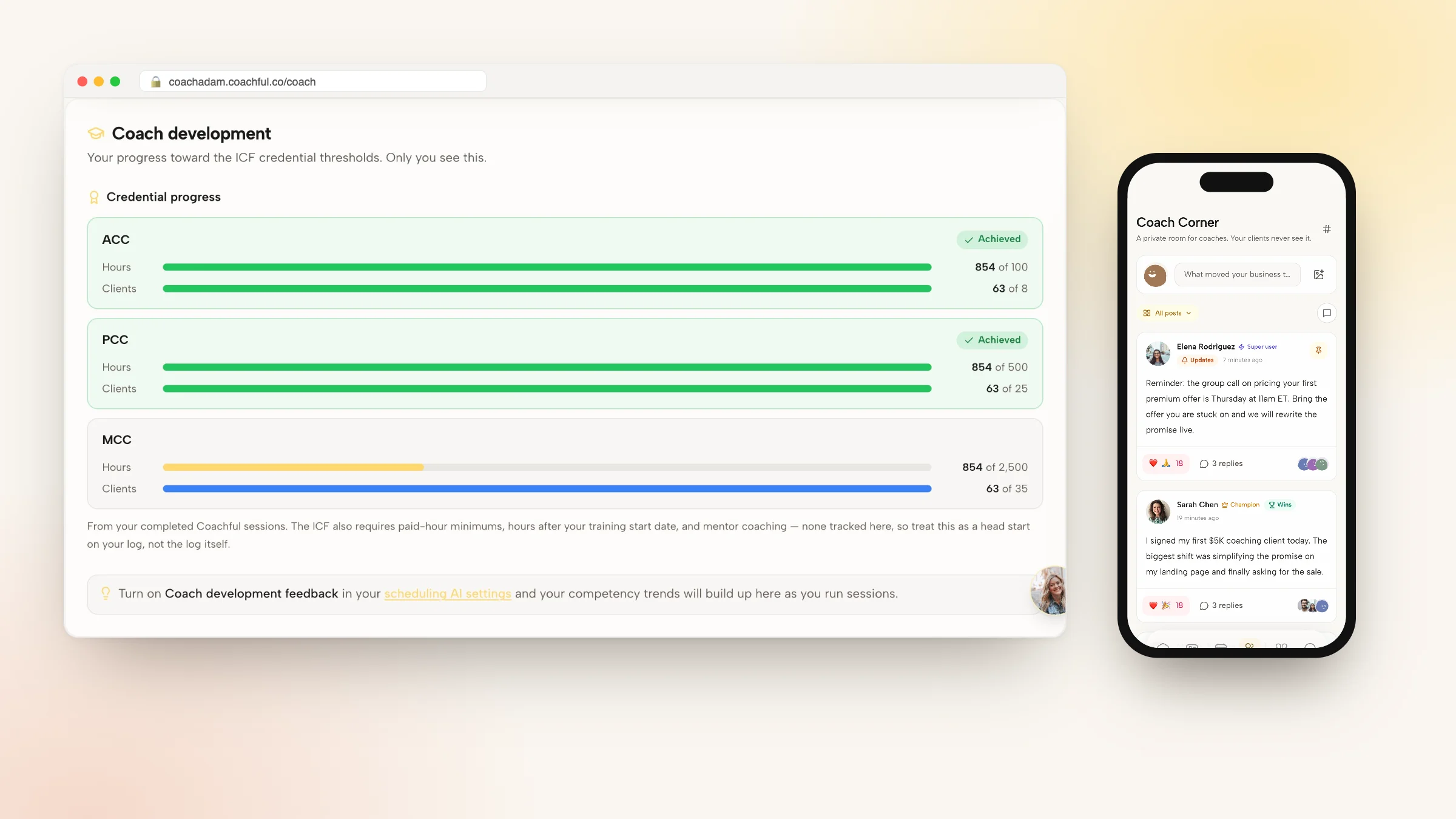
If you run sessions on Coachful, you can turn on coach development feedback: Michelle, Coachful's AI assistant, scores your own recorded sessions privately against ICF Core Competencies 3 to 8. It is a self-development aid, not an ICF assessment, and it does not replace mentor coaching.

The same page counts your completed coaching hours and distinct clients against the ICF ACC, PCC and MCC thresholds, which helps when you are building toward a credential. See ICF hour tracking for how it works.

A 90-day plan to improve your coaching skills
| Weeks | Focus | Practice |
|---|---|---|
| 1 to 2 | Baseline | Record two sessions with consent; score them on the rubric; note your talk-time |
| 3 to 4 | Listening | One reflection before every new question; summarize at the midpoint of each session |
| 5 to 6 | Questions | One question at a time, under ten words, using the client's words; ban "why don't you..." |
| 7 to 8 | Agreements and actions | Agree the session outcome in the first five minutes; let the client name the action and how they will report back |
| 9 to 10 | Direct communication | Share one observation per session plainly ("I notice you've mentioned your manager four times"), then ask what the client makes of it |
| 11 to 12 | Review | Record and score two more sessions; compare with weeks 1 to 2; take the results to a mentor coach or supervisor |
Two weeks per skill is enough to notice the habit, not to master it. Repeat the cycle with whichever skill scored lowest.
Coaching skills for managers
Many of these skills transfer directly to managing people: contracting a one-to-one, listening before solving, asking rather than telling, and letting the person design the next step. Two things do not transfer cleanly. A manager has authority over pay and promotion, so trust and confidentiality work differently, and sometimes a manager needs to direct rather than coach. A useful habit is to say which mode you are in: "I'm going to coach on this one" or "This one I need to decide." Our guides to leadership coaching and team coaching cover coaching inside organizations.
Where software helps your coaching skills
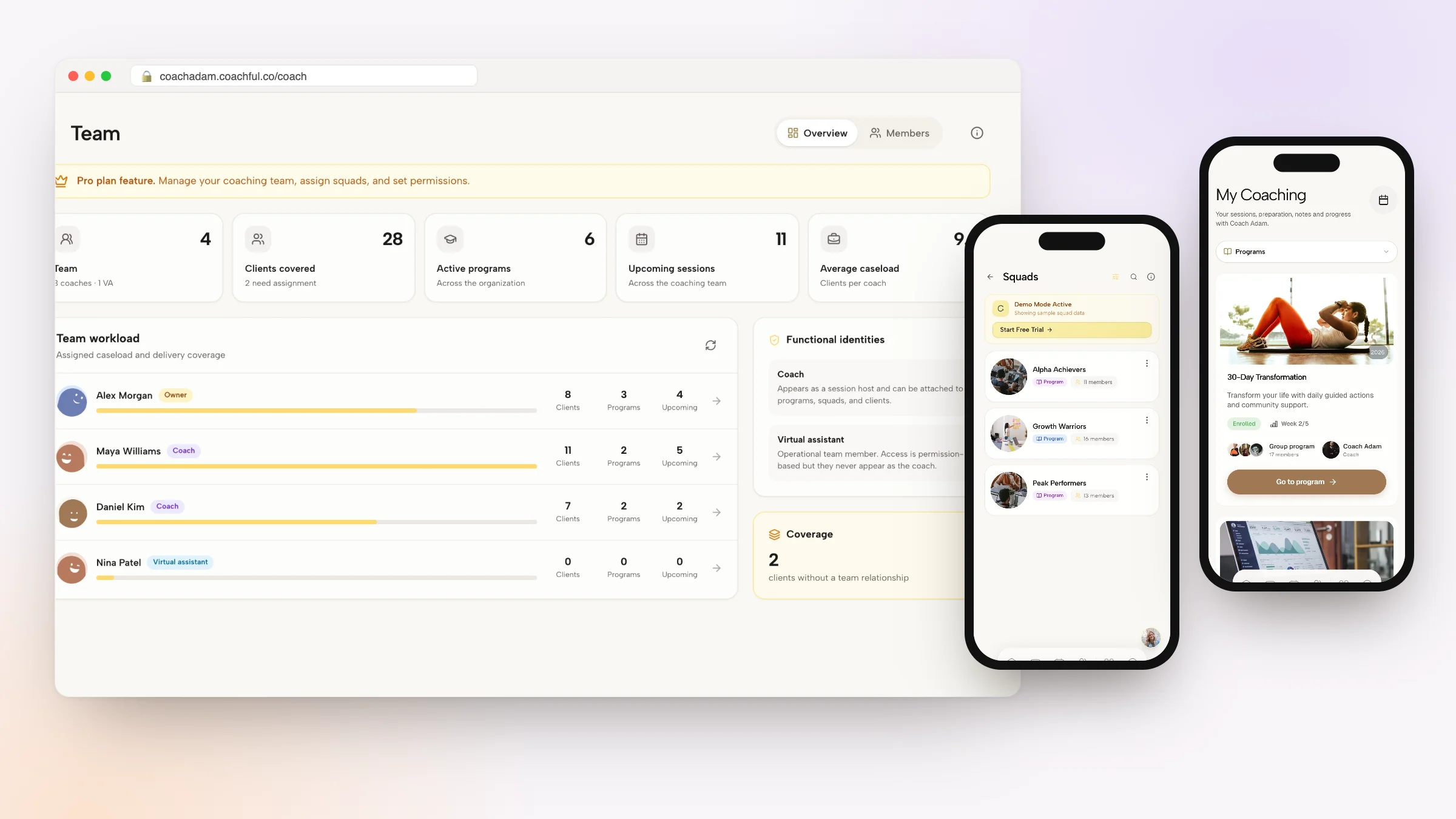
Software cannot listen for you, but it can carry the parts of good practice that happen outside the session: the follow-through, the record and the between-session contact. A few examples from Coachful:
- Notes written for the client. A running summary on the client's page shows them the thread across sessions, which is a written form of reflecting back.
- Check-ins and forms. Short check-ins between sessions mean you arrive knowing what happened, so the first ten minutes go on the work.
- Messaging with agreed limits. Clear reply times protect the boundary skill as well as the client.
- A room for peers. Coach Corner is a community where coaches on Coachful compare notes and ask questions; clients never see it.


See the AI coaching assistant page for what Michelle does and does not do, and our page for life coaches for the client side.
Spend the time on skills, not website builds
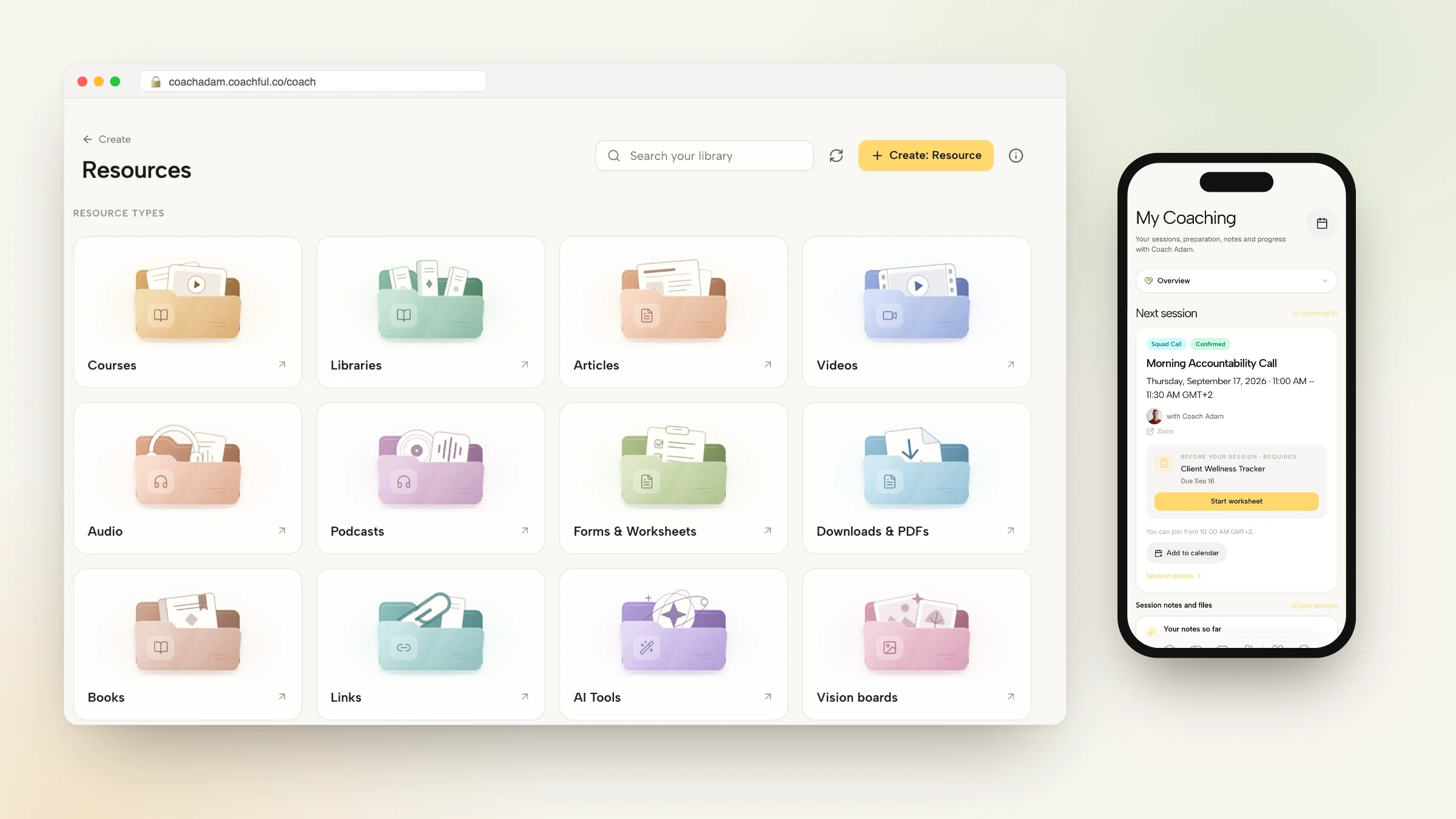
Coachful's white-glove service is free on every plan. Choose We'll build it for you · FREE on the Create page, pick what you need (a website, a funnel, a program, a course outline, forms and worksheets, an email sequence and more) and answer a few questions, with up to 8 reference links and 10 files such as your logo, photos or old pages. The team replies by email, usually within about 24 hours, and builds it inside your account so you can edit it later. Coachful does not record your videos, and nothing gets invented: credentials, testimonials and prices you have not supplied are left for you to fill in.

Frequently asked questions
What are the most important coaching skills?
Contracting the session, building trust, presence, active listening, powerful questions, direct communication, designing actions with the client, and ethical practice. Research ties the quality of the coach-client relationship most consistently to outcomes, so trust, presence and listening are the place to start.
How can I improve my coaching skills?
Record sessions with consent and score them against a rubric, work with a mentor coach, use supervision, practice in a peer group and write a short reflection after sessions. Focus on one skill for two weeks at a time, then re-score to see what changed.
What are the ICF core competencies?
They are the ICF's framework for coaching practice, organized in four domains: Foundation, Co-Creating the Relationship, Communicating Effectively, and Cultivating Learning and Growth. There are eight competencies, from Demonstrates Ethical Practice to Facilitates Client Growth. The ICF's 2025 update kept all eight and added and revised sub-competencies beneath them.
Can you learn coaching skills without a certification?
Yes. Many skills can be practiced through books, peer groups and recorded sessions. Accredited training adds structured feedback and observed practice, and ICF credentials require training hours, coaching experience and mentor coaching. See how to become a life coach for the routes.
How long does it take to develop good coaching skills?
Basic competence can come within months of regular practice with feedback; mastery takes years. ICF credentials reflect this: the ACC requires 100 or more coaching hours, the PCC 500 and the MCC 2,500. See ICF ACC vs PCC vs MCC.
What coaching skills do managers need?
Listening before solving, asking open questions, agreeing what a one-to-one is for, giving direct feedback and letting people design their own next steps. Managers also need to be clear when they are coaching and when they are deciding, because their authority changes the relationship.
Will Coachful build my coaching website for free?
Yes. The white-glove build is free on every Coachful plan. Request it from the Create page, describe what you need and attach your materials; the team usually replies within about 24 hours and builds it in your own account.