How to Handle a Talkative Coaching Client: 7 Respectful Moves

Coachful
Editorial Team
How do you interrupt a coaching client without making them feel silenced? Explain the purpose of the pause, reflect what you have heard, and return a choice to the client. You are helping them use the conversation, not claiming your turn to speak.
If you are searching for what to do when a coaching client talks too much, start by questioning the label. A long answer may be useful thinking aloud. The problem is not the number of words; it is losing the connection between the conversation and what the client wants from it.
This guide offers seven respectful moves, example phrases and a worked scenario. The scripts, diagrams and scenarios are original practice illustrations, not client transcripts or a validated intervention. Adapt them to your training, the relationship and the client's communication preferences.
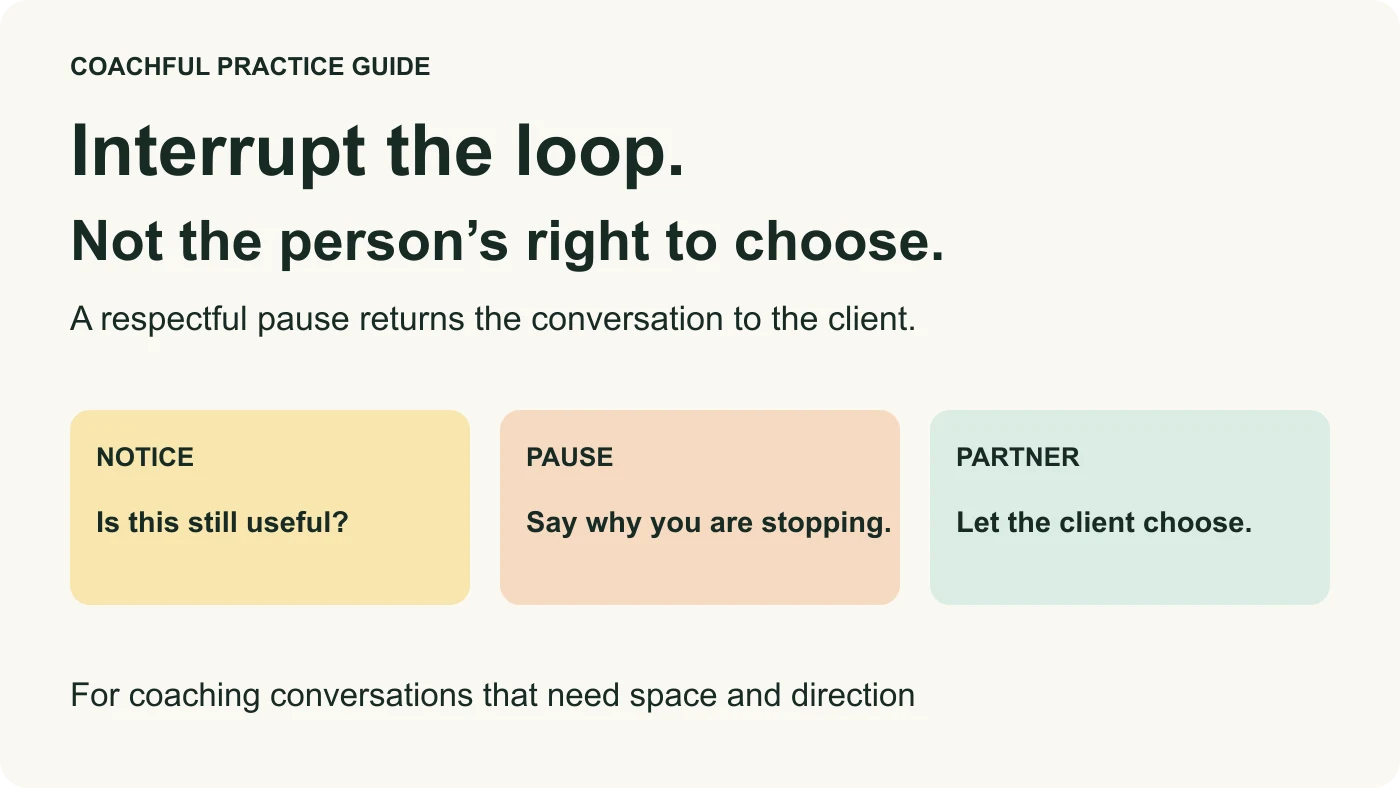
Cover illustration: notice usefulness, explain a pause, then return the choice.
First, distinguish useful talking from a conversation that needs a check
You are twelve minutes into a call. Your client is explaining three colleagues' opinions, last month's meeting and something that happened in their previous job. You can follow the story, but you no longer know what they want to work on. You worry that interrupting is rude, so you keep nodding.
That is the moment to check the partnership, not diagnose the speaker.
- Keep listening when the client is making new connections, considering different possibilities or finding words for something important.
- Check together when you cannot understand how the detail relates to the agreed purpose. You may be missing a connection.
- Offer a pause when an account keeps repeating, the client asks for help finding a focus or the remaining time needs a shared decision.

Do not use a fixed speaking ratio as a verdict. A client can speak for most of a useful session. A coach can also derail a session with frequent, supposedly helpful interruptions.
The leadership-coaching resource hosted by NYU describes interruption as a coaching skill while recognising that thinking aloud can serve the client. The practical question is whether your intervention helps their work, not whether you are uncomfortable with a long answer.
1. Agree how you will manage focus before you need to interrupt
A surprise correction can feel personal. A jointly agreed way to pause makes it easier to discuss the process without making the client the problem.
At the beginning of the relationship, or the next session, ask how they prefer you to signal that you have noticed something worth checking. Do they want a short verbal pause, a visible gesture on video or a question at a natural break? Make room for them to say that a particular signal would be distracting.
You might say:
“Sometimes I may want to pause us to reflect something back or check where we're heading. How would you like me to do that? You can always ask me to wait or slow down.”

Then agree today's purpose. “What would make this conversation useful?” is a starting point, not a demand for an instant polished goal. If the client needs time to find the focus, agree to explore that together.
Permission to interrupt is not permanent permission to override them. Notice how each interruption lands and invite feedback. If your interventions repeatedly leave the client frustrated, review the agreement rather than insisting that they already consented.
2. Ask for a pause, then show that you were listening
Wait for a natural break where possible. In a video call, leave room for connection delay; apparent talking over may be a technical problem rather than a conversational habit.
Make the interruption brief. A useful sequence is pause, reflect, return the choice:
“Could we pause for a moment? I hear two pressures: wanting the security of your current role and wanting something different. Which would help to explore now?”

The reflection matters. “Let's get to the point” tells the client that you are impatient. Naming what you actually heard gives them something to confirm, correct or develop.
Do not add three interpretations and five questions. Your intervention should open a space, not occupy it. If the client says, “I need to finish this part,” ask whether they want to finish the thought before you check your understanding.
If you cannot find a pause, you can still speak calmly: “I'm going to pause us because I've lost the connection to the decision you wanted to explore. Can you help me understand it?” Own your difficulty following rather than declaring that their story is irrelevant.
3. Replace the complete history with one useful example
A broad question invites a broad answer. “Tell me about your career” may produce a very long response because you asked for one. Before blaming the client for too much context, look at your question.
Invite a specific recent moment that relates to their aim. Ask, “Which example best shows what you want us to understand?” Do not insist on a one-sentence answer if the client needs a different way to organise their thinking.
In our hypothetical scenario, a client named Morgan wants to decide whether to explore a new role. Morgan begins describing every job change they have considered. You ask which recent moment made the question important. Morgan chooses yesterday's unanswered recruiter message.

Now you can ask what mattered at the point of replying: what Morgan wanted, what they expected, what they were uncertain about and what choice they saw. You are still listening to Morgan's experience, but through an example they chose rather than an exhaustive chronology.
If Morgan says an earlier event is essential, explore the connection. Do not use “one example” as an excuse to exclude information that matters. A focused conversation can contain necessary context; it does not need every detail in chronological order.
4. Check a change of topic instead of automatically steering back
A client begins with a career decision and moves into a concern about disappointing their partner. That may be a detour. It may also be central to the decision. You cannot tell from the topic change alone.
Ask how the new thread connects, then invite a choice about the remaining time:
“We started with whether to reply to the recruiter, and now we're discussing what a change would mean at home. How do those connect for you? Where would you like us to focus next?”

If the new focus matters more, agree a revised outcome. If the client wants to return, summarise the useful connection and return together. Do not make them feel that changing direction is failing the session.
This approach fits the emphasis on partnership and agreements in the ICF Core Competencies. It is also consistent with exploratory research examining agenda-setting in first business-coaching sessions: agendas are negotiated in interaction, not simply announced by the coach. That study does not prove that any script here will work for every client.
For a broader discussion of listening, reflection and directness, see our guide to communication skills in coaching. Here, the specific task is checking a conversation that has become difficult to navigate.
5. Protect the ending without making the clock a threat
Waiting until the final minute creates an abrupt choice: cut the client off or run over. Name the remaining time early enough for the client to participate in how it is used.
For example: “We have ten minutes left. Would you like to keep exploring this, pull together what you're noticing, or identify what you want to carry forward?” If a different choice would help, discuss it.

The illustrated ten-minute window is a practical prompt, not an assessment standard. You might use part of it for reflection, part for an agreed next step and part for closure. The client need not leave with assigned homework to justify the time.
When Morgan introduces a large new issue near the end, acknowledge its importance without opening a conversation you cannot responsibly finish: “That sounds important. What would help us leave a useful note for next time?” Agree what can be addressed now and what needs another conversation.
Be honest about the finish. Do not invent another waiting client to make a boundary sound legitimate. If you have repeatedly run over, own the reset: “I've let our calls go beyond the agreed time. I'd like us to protect a proper ending within the session from now on.”
6. Move optional background into brief preparation, not compulsory paperwork
If the opening repeatedly becomes a long recap, offer an alternative way to share background before the call. That might be a few bullet points, a short written note or a preparation prompt. Ask what is manageable; do not turn the client into an administrator.
Three optional prompts are enough to test:
- What happened since we last met that you want me to know?
- Which example would you like us to explore?
- What would make our conversation useful?
Explain how you will use the answers and reconfirm the focus live. Preparation is an aid to the conversation, not a contract that prevents the client changing their mind.

The pictured Coachful My Coaching → Sessions view shows upcoming appointments with preparation statuses and Prepare actions. It illustrates how preparation can sit beside a session. It does not show these exact three prompts or prove that an automated process will solve a conversational difficulty.
Written preparation is not automatically more accessible. Some clients prefer to organise their thoughts aloud, use assistive tools or respond in another agreed format. Ask about preferences without inferring a diagnosis from their speaking style. Avoid collecting sensitive information you do not need.
7. Review the repeated pattern without turning it into an identity
If several sessions leave little room for reflection, review the process with the client. Describe an observation, ask about its usefulness and choose an experiment together.
“We used much of today explaining the background, and had little time to explore the decision you brought. How useful was that balance for you? Would you like us to try a different approach next time?”

The answer might surprise you. The client may value the chance to speak, feel rushed by your questions or not understand what kind of conversation you are offering. Each answer calls for a different adjustment.
Choose one small experiment: begin with a short written outline, use one example at a time, agree a pause signal or check the focus midway. Review whether it helped. Do not announce a permanent new rule before you understand the problem together.
If you need support, take the process question to appropriate supervision or mentor coaching, protecting confidentiality. If the client's needs exceed your competence or the agreed service, consider appropriate referral. Talkativeness alone is not a reason to label, diagnose or dismiss a client.
A worked example: interrupting without taking over
Here is a hypothetical career-coaching exchange. Morgan wants to explore the recruiter message but has begun recounting several previous workplaces.
Morgan: “And before that manager, there was another one who had the same problem. Actually, I should explain how that team was set up...”
Coach: “Could we pause? I've heard how much the working environment matters to you. I'm less clear which part you want help thinking through today.”
Morgan: “I'm trying to work out if I'd just find the same thing somewhere else.”
Coach: “So is the useful question whether a new role could meet different needs, rather than whether to send a reply today?”
Morgan: “Yes. I need to know what I would be looking for.”
Coach: “Shall we use the time left to explore those needs?”
The coach does not force Morgan to answer the original question. The interruption makes room for Morgan to clarify it. The resulting focus belongs to the client.
A different answer could have been, “No, I need you to understand this history first.” Then the next move would be to explore what understanding Morgan needs from you and how to use the time available, not repeat the interruption more firmly.
What not to say to a talkative coaching client
- “You're rambling.” Try naming your uncertainty about the connection to the client's aim.
- “We need to be productive.” Ask what would make the remaining time useful to them.
- “You always avoid the real issue.” Offer an observation tentatively and check it. Do not claim to know their motive.
- “Give me the short version.” Invite the example or detail that would most help you understand, while allowing a different communication need.
- “Other people must find this difficult too.” Stay with what you have actually observed in this relationship unless the client chooses to explore a wider pattern.
You can be direct without being contemptuous. A respectful interruption still has a purpose the client can understand, room for correction and a choice about what follows.
Frequently asked questions
Is it acceptable to interrupt a coaching client?
Yes, when it serves the client's work and is handled as part of the partnership. Explain why you are pausing, show what you have heard and give the client room to respond. Interrupting to show expertise or reclaim airtime is a different thing.
What if my client says they just need to talk?
Ask what being heard would provide and whether that is what they want from this session. A client may use a conversation to understand their own thinking. Agree the purpose and boundaries rather than insisting that every session must produce an action list.
What if they become upset when I interrupt?
Pause the intervention and ask how it landed. Acknowledge the impact and apologise where appropriate: “I interrupted before you had finished. I'm sorry. What would help now?” Revisit preferences and the working agreement. Do not defend the interruption simply because your intention was helpful.
Should I tell a coaching client they talk too much?
Prefer a specific observation to a label. “We spent much of the session on background and did not reach the question you wanted to explore” gives you something to discuss together. “You talk too much” does not explain what needs to change or whose need it serves.
Can software keep a talkative client on track?
Software can support preparation and continuity. It cannot decide when a pause is appropriate, interpret a client's needs or repair a conversation. Keep the relational judgement with the coach and client.
Try one change in the next session
Do not arrive with seven new interventions. Agree one way to pause, use it when it serves the client, then ask whether it helped. The aim is not a quieter client; it is a conversation they can use.
If your first experiment is improving preparation, Try the interactive demo to explore Coachful's client session experience. Compare how appointments and preparation are presented with the brief, optional preparation you want to offer. The tool can support the setup; it does not replace the conversation.
Sources and practice boundaries
Professional context comes from the 2025 ICF Core Competencies. Practical perspectives include the NYU-hosted leadership-coaching resource on interrupting and Elias Scultori's discussion of a verbose client, which distinguishes extended speech that supports insight from speech that may need a check.
The agenda-setting paper is an exploratory analysis of five first business-coaching sessions, not a trial of these seven moves. The example phrases and graphics here are educational suggestions, not clinical advice, guaranteed outcomes or ICF assessment criteria. The Coachful screenshot contains sample interface content, not a real client's results.