Scaling Questions in Coaching: 15 Examples and Follow-Ups

Coachful
Editorial Team
Your client says their confidence is a four. Now what? A scaling question earns its place in coaching only when you explore what the number means and what the client wants to do with it. Asking for a score, nodding, and moving on gives you a number without a useful conversation.
Scaling questions invite a client to place a specific experience on an agreed scale, commonly 0 to 10 or 1 to 10. They can help you discuss confidence, priorities, progress, or readiness. They are conversation tools, not diagnostic tests, objective performance scores, or proof that coaching caused a result.
This guide gives you 15 example questions, the follow-ups that make them useful, a worked conversation, and a reusable note template. The examples are hypothetical. Adapt the wording to the person rather than treating the list as a questionnaire.
What is a scaling question in coaching?
A scaling question turns a broad description into a client-defined reference point. Instead of stopping at “I want to feel more prepared,” you agree what preparedness would look like, ask where the client places themselves today, and explore their reasons.
In Coert Visser’s account of the scaling question, the approach includes defining the scale, locating the present position, exploring what is already working, and describing a small step forward. It comes from the solution-focused tradition. The practical value is in those surrounding questions, not the apparent precision of the rating.
A four might mean “I know my material but have not rehearsed aloud.” Another person’s four might mean “I have rehearsed but do not trust my manager’s reaction.” Those need different conversations. Never assume that matching numbers mean matching experiences.

How do you ask a good scaling question?
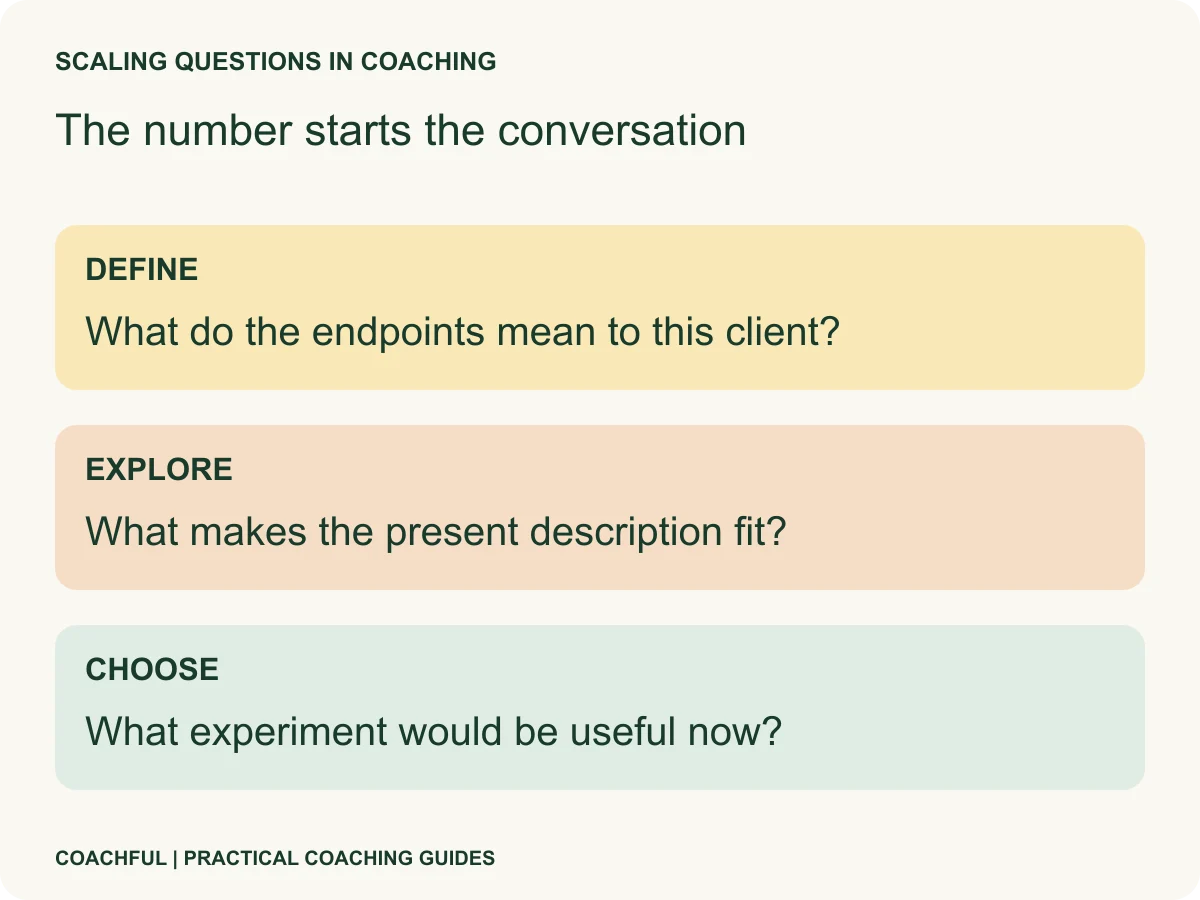
Use this sequence as a flexible guide, not a mandatory script:
- Choose one subject. Confidence in delivering tomorrow’s presentation is clearer than “How are things?”
- Agree the anchors. Ask the client what the low and high ends mean in this situation.
- Invite a current rating. Accept a range, a fraction, or a refusal to use numbers.
- Explore the meaning. Ask what makes that description fit and what is already helping.
- Describe a useful difference. Let the client choose a worthwhile next position or a way to maintain what is working.
- Agree an experiment and review. Identify something they can try and how they will judge its usefulness.
For example: “If zero means you do not yet have a workable plan for the conversation, and ten means you have a plan you feel ready to try, where would you put yourself today?” Follow with “What makes that number fit?” Do not turn their answer into your assessment.
The scale should describe something relevant and understandable. “Ten means you never feel nervous again” is not a useful anchor for a presentation. “Ten means prepared enough to present and handle a difficult question” leaves room for ordinary nerves.
15 scaling questions coaches can adapt
Each starting question below needs agreed anchors. The follow-ups are invitations, not additional questions to fire at the client without a pause. Pick the example that fits the session’s purpose.
1. Confidence about a specific action
Ask: “On our agreed scale, how confident are you about asking your manager for feedback this week?” Follow up: “What makes that rating fit? What preparation would make this easier to attempt?”
Use this when there is a concrete action under discussion. Confidence about an action is different from a global judgment about being “a confident person.” Keep the question small enough to explore.
2. Importance of a goal
Ask: “How important is changing this situation to you right now?” Follow up: “What gives it that importance? What else is competing for your attention?”
A low rating is information, not a motivation problem you must fix. The goal may belong to someone else, or the client may reasonably have a more urgent priority.
3. Confidence in the proposed plan
Ask: “How confident are you that this plan fits the week you actually have?” Follow up: “Which part feels realistic? What would you change before committing?”
Ask separately from importance. A client can care deeply about finding a job while having little confidence in a plan to submit ten applications after long working days. More encouragement does not repair an unrealistic plan.

4. Progress toward a defined outcome
Ask: “Using the outcome we described, where would you place yourself today?” Follow up: “What have you noticed that supports that rating?”
Keep the client’s original definition visible. If “progress” has changed from getting promoted to deciding whether the role is desirable, acknowledge the change before comparing scores.
5. Clarity about a decision
Ask: “How clear are you about what you need to know before choosing?” Follow up: “What is clearer already? Which unanswered question matters most?”
This avoids asking the client to rate whether option A is objectively better than option B. You are exploring their decision process, not turning a difficult choice into a numerical verdict.
6. Readiness to try an experiment
Ask: “How ready do you feel to try this once, without promising to keep it forever?” Follow up: “What would make the experiment small enough to try?”
Use this for a reversible action within the client’s control, such as testing a different meeting opening. Do not describe an irreversible career or financial decision as a harmless experiment.
7. What is already helping
Ask: “You chose four. What is already present that makes it four?” Follow up: “Which of those supports could you use again?”
The familiar alternative is “Why four rather than two?” That can surface existing resources, but it can also sound as though you are challenging the rating. Use neutral wording if comparison feels dismissive or confusing.

8. A recent exception
Ask: “Was there a recent moment when you would have placed yourself a little higher?” Follow up: “What was different, and which parts were within your influence?”
Do not assume a better moment exists. If it does, distinguish helpful conditions from repeatable actions. A quiet week at work may have helped, but the client cannot necessarily arrange another one.
9. A useful next position
Ask: “What would a small, worthwhile improvement look like on this scale?” Follow up: “What would you be doing or noticing differently?”
One point higher is a convenient prompt, not a law. Half a point, staying steady during a difficult week, or choosing a different goal may be more useful than chasing an arbitrary increase.

10. Support available for the next step
Ask: “How supported do you feel in taking this particular step?” Follow up: “What support is already available? What would you like to request, and from whom?”
Do not turn this into a judgment of the client’s relationships. Focus on practical help relevant to the action, such as rehearsal time, information, or a colleague’s feedback.
11. Satisfaction with a specific arrangement
Ask: “How satisfied are you with how your working week is currently arranged?” Follow up: “Which part fits you? Which change would make the biggest practical difference?”
Break down an answer that combines several issues. Satisfaction with workload, flexibility, and the work itself can differ. One score should not conceal three different conversations.
12. Ability to maintain a helpful change
Ask: “How confident are you about keeping this boundary during next week’s busy period?” Follow up: “What might test it? What would help you respond?”
This is useful when the client has already made a change and wants to sustain it. Maintaining a workable position can be a legitimate aim. Progress does not have to look like a rising line every week.
13. Usefulness of the session
Ask: “How useful has today’s conversation been for the outcome you wanted?” Follow up: “What was useful? What would you prefer us to do differently?”
Make disagreement safe. If you defend the session after a low rating, you teach the client that the question was asking for praise. Feedback about your work is not a score the client must improve.
14. A perspective the client wants to consider
Ask: “If you considered this from your colleague’s perspective, where do you think they might place the clarity of the plan?” Follow up: “What are you basing that on? What would you need to ask them directly?”
Label this as speculation. Imagining another person’s view can generate a question to investigate; it is not evidence of what that person actually thinks.
15. Readiness to continue independently
Ask: “How ready do you feel to continue working on this without our regular sessions?” Follow up: “What can you now do for yourself? What support, if any, would you want next?”
Use this in a review or ending conversation, not as a sales device. A lower rating does not automatically mean the client should buy more coaching. Explore their preferences and other appropriate options.
A worked example: turn a four into a useful conversation
The following fictional exchange concerns a client preparing to lead a team meeting. It illustrates question selection, not a promised outcome.
Coach: “What would prepared enough look like for Thursday?”
Client: “I would know the decision we need and be able to ask people to stay with it.”
Coach: “If zero is no workable preparation yet, and ten is prepared enough in the way you described, where are you today?”
Client: “Four. I know the decision, but I usually let the discussion wander.”
Coach: “What already helps you hold the discussion?”
Client: “An agenda helps. I have not sent one this time.”
Coach: “What would a small, useful difference look like?”
Client: “Sending the decision question beforehand and practicing how to interrupt politely.”
Coach: “Which of those would you like to work on now?”
Client: “The interruption. I know how to send an agenda.”
Notice the coach does not declare that the client is now a five. The conversation produces a client-chosen rehearsal. At the next session, the useful review is what happened in the meeting and what the client learned, not whether they delivered the desired score.

What should you do with low, unchanged, or falling ratings?
If the client chooses zero, do not ask why they are not lower. Ask what zero means to them and whether they want to explore the subject, describe a manageable next step, or use a different approach. Do not manufacture a strength they must agree with.
If the rating is unchanged, ask whether the underlying situation is unchanged too. The client may have maintained a boundary under harder conditions or learned that the original goal was wrong. Equally, they may be telling you the approach is not helping. Leave room for that answer.
If the number falls, check the definition before interpreting the movement. “Has your sense of what ten means changed?” can reveal a new standard. If the anchors are unchanged, explore the actual experience without blaming the client or insisting that setbacks are secretly progress.
These ordinary coaching scales must not replace a clinical assessment, safeguarding process, or emergency response. Stay within your competence. A serious safety concern requires the appropriate procedure, not another confidence question.

Common mistakes that make scaling questions unhelpful
- Combining subjects. “How motivated and confident are you?” mixes two different things. Ask separately.
- Using your own anchors. Your definition of success may not be the client’s. Check before rating.
- Demanding ten. A workable next step does not require perfect confidence or satisfaction.
- Interrogating the number. Curiosity becomes pressure if every answer earns another challenge.
- Comparing clients. One person’s seven is not another person’s seven.
- Claiming numerical proof. A self-rating alone does not establish competence, clinical improvement, or coaching return on investment.
- Ignoring a dislike of numbers. Offer words, a sketch, or a description instead.
Denise Corey’s coaching guide uses a 1-to-10 formulation, while Visser describes 0 to 10. You do not need to argue for one universally correct lower bound. Choose understandable anchors, agree them, and preserve their meaning when reviewing the same question.

A reusable scaling-question note template
Keep enough context to understand the rating later. A bare “confidence: 4” is not enough. Use a record appropriate to your confidentiality agreement, retention policy, and applicable duties.
- Subject and situation: confidence in leading Thursday’s decision meeting.
- Client-defined anchors: zero is no workable preparation; ten is prepared enough to name the decision and guide discussion.
- Current description: four; knows the decision but worries about redirecting colleagues.
- Existing resources: agendas have helped; has previously chaired a shorter discussion.
- Chosen experiment: rehearse one respectful interruption and send the decision question beforehand.
- Review: discuss what happened, what helped, and whether the same scale still fits.

If you are evaluating how you will manage the surrounding coaching work, use fictional client details to explore the interactive Coachful demo. Bring this example and check whether the working environment suits your practice before choosing a platform. The software is secondary: the useful record is the client’s meaning, decision, and next experiment, not just the number.
Frequently asked questions
Are scaling questions open or closed questions?
The initial rating asks for a constrained answer. The follow-ups open the conversation: what the number means, what is helping, and what the client wants to try. Asking only for a number misses that exploratory part.
Should I ask a scaling question in every session?
No. Use one when a client-defined reference point helps with the session’s purpose. Do not interrupt a useful conversation to complete your routine, and do not require a rating to prove the session was valuable.
What if a client says “six or seven”?
Accept the range. Ask what distinguishes those descriptions for them, if that is useful. Forcing a single integer adds precision to the record without necessarily adding understanding.
Can a rating go down even when the client has learned something useful?
Yes. Their standards or understanding may have changed. It can also reflect a genuine difficulty or an unhelpful approach. Explore the explanation rather than choosing the interpretation that makes coaching look successful.
Can I use a visual scale instead of spoken numbers?
Yes, if it suits the client’s preferences and access needs. A line, labeled positions, or plain-language stages can provide a reference point. Agree what the positions mean and offer a nonvisual alternative.
Sources and scope
This is a practical coaching guide, not a clinical protocol or a validated assessment instrument. The example questions, dialogue, note, and diagrams are original educational illustrations. The solution-focused sequence is informed by Coert Visser’s account; Denise Corey provides a contrasting 1-to-10 coaching formulation. Neither source establishes guaranteed outcomes from using these prompts.
For a broader menu of interventions, see 25 coaching techniques. For the structure of a whole conversation, see coaching models. A scale is one move inside the conversation, not a substitute for listening.