Confidence Coaching Questions: 35 Prompts That Lead to Action

Coachful
Editorial Team
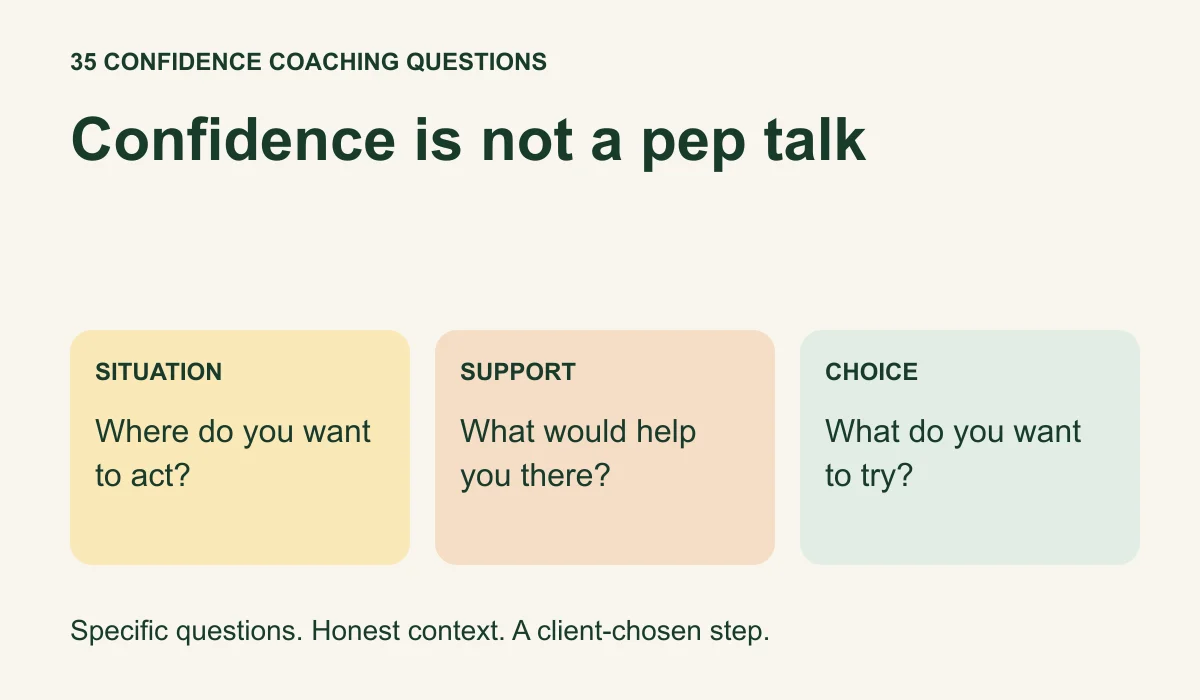
Your client says, “I need more confidence,” and you can already feel the session drifting toward a pep talk. Start by asking where they want to do something differently, not how to make them feel confident everywhere.
Useful confidence coaching questions connect a specific situation, an honest account of the difficulty, and a small action the client chooses. They do not require clients to deny risk, adopt your definition of confidence, or become a louder version of themselves.
The 35 original prompts below are grouped by the job they do in a conversation. Use a few that fit the client's answers, not all 35 as an interview. The scenarios are hypothetical illustrations, not client stories or evidence of results.
How to use confidence coaching questions without turning them into a script
Agree what the client means by confidence before assuming it is the issue. Someone who hesitates to present may need rehearsal, clearer expectations, an accessible meeting format, or protection from a hostile colleague. A question about their mindset cannot substitute for those things.
Ask one question, listen, and use the client's own language in your next response. If an answer changes the direction of the session, follow the answer rather than finishing the category. Silence is thinking time, not a cue to ask three more questions.
This approach fits the emphasis on client partnership, listening, reflection, and client-owned action in the ICF Core Competencies. The prompts are editorial practice suggestions, not a validated assessment, a treatment protocol, or questions endorsed individually by ICF.
Choose your starting point by what is missing: a concrete situation, a useful definition of progress, recognition of existing capability, a fair reading of risk, appropriate support, a manageable experiment, or a thoughtful review.
1. Make “more confidence” specific
Confidence is too broad to be a session agenda by itself. A person can feel capable doing their work and uncertain explaining it to a new manager. Narrowing the setting avoids treating one difficult experience as a description of their entire personality.
- In which particular situation do you want to feel more able to act?
- What happens just before you begin to doubt yourself there?
- What do you do in that moment, and what would you prefer to do?
- Where is this less difficult, even slightly?
- Which part of this situation would be most useful to explore today?
Listen for: a place, a moment, and a choice. “At work” is still broad. “When my manager asks for my recommendation in the weekly review” gives you something the client can examine.
Hypothetical example: a client says they are not confident at work, then explains that they comfortably handle customer calls but avoid giving an opinion in internal meetings. The work is not automatically “become more confident.” It may be understanding what changes when colleagues are the audience.
Do not make the exception into an argument. Saying they are confident with customers does not prove that their difficulty with colleagues is imaginary.

2. Define progress without demanding fearlessness
A client may picture confidence as never feeling nervous. Explore what they actually want to be able to choose or do, while leaving space for feelings to matter. The goal is not to tell them that discomfort is irrelevant.
- What would you be doing differently in that situation if this work were useful?
- Which part of that change matters to you, rather than to someone else?
- What would a small but worthwhile improvement look like?
- What would you want to be able to do even if some uncertainty remained?
- How would you recognise progress without relying only on other people's approval?
Listen for: a client-owned standard. “Everyone thinks I am impressive” depends on other people's reactions. “I can explain my recommendation and ask for clarification” describes a contribution they can practise.
Hypothetical example: a career client wants to feel completely relaxed in interviews. They decide a more useful immediate aim is to finish an answer without apologising for taking thinking time. That does not make relaxation unimportant. It gives the next conversation a concrete focus.
Watch for borrowed ideals. Speaking quickly, maintaining constant eye contact, networking at every event, or appearing extroverted need not be the client's definition of confidence. Ask about their preferences, communication needs, and context.

3. Notice capability without forcing positive thinking
“Tell me why you are amazing” can land badly when someone feels uncertain. Ask about actual experiences and what the client contributed. Specific evidence gives you a more useful conversation than either blanket praise or blanket self-criticism.
- When have you handled a situation with something in common with this one?
- What did you do that helped, even if the outcome was imperfect?
- Which skill from that experience could be useful here?
- What feedback have you received that you have not fully considered?
- What can you reasonably trust yourself to do, and what still needs practice?
Listen for: actions rather than flattering labels. “I am resilient” may be meaningful, but “I asked for a second explanation and finished the task” tells you what happened. Let the client decide whether that action transfers to the new situation.
Hypothetical example: a business owner says they cannot handle objections. They remember calmly asking a supplier to explain an unexpected charge. The transferable skill might be asking a direct question, not a sudden discovery that every sales conversation will be easy.
If the client cannot find an example, do not turn remembering a success into a test they can fail. They may need a skill-building opportunity rather than a search for a hidden strength.

4. Examine predictions without dismissing real risk
A confidence conversation often contains a prediction: “They will think I am incompetent,” or “If I disagree, I will lose the relationship.” Treat it as something to understand, not something you must immediately disprove.
- What do you expect will happen if you take that step?
- Which parts of that expectation come from something you have observed?
- What remains uncertain about how the situation might unfold?
- What other explanations fit the information you currently have?
- What would you need to know or put in place before deciding whether to proceed?
Listen for: the difference between a prediction, an observation, and a genuine constraint. These can coexist. A client may underestimate their skill while accurately describing an unsafe or discriminatory environment.
Hypothetical example: a manager predicts that asking a question will expose a knowledge gap. They also describe a senior leader who ridicules questions publicly. It would be careless to turn that into “just challenge your limiting belief.” Explore safer information sources and the client's options.
Permission to proceed is not the predetermined answer. Choosing not to take a risk, gathering information, or seeking specialist support can be a considered decision. Do not grade willingness to act as proof of confidence.

5. Identify support, preparation, and boundaries
Sometimes the useful next question is not deeper. It is practical. Does the client know what is expected? Have they had a chance to practise? Is someone asking them to take responsibility without giving them authority?
- What preparation would make this situation more manageable?
- Who could offer useful information, feedback, or practical support?
- Which part would benefit from rehearsal rather than more discussion?
- What boundary or adjustment would help you participate on your terms?
- What is outside your control that we need to account for?
Listen for: something the client actually needs, not just something they can think differently about. Coaching can help them decide what to request. It does not give them control over whether another person agrees.
Hypothetical example: a new leader feels hesitant presenting unfamiliar financial information. They choose to ask a finance colleague to check their interpretation and rehearse the opening. More encouragement would not have supplied the missing technical feedback.
If you offer a practice exercise or an observation, ask permission and explain the shift. A client who wants to explore a decision may not want an unsolicited performance critique.

6. Choose a small, informative experiment
Once the situation is understood, invite a step the client genuinely wants to try. An experiment is useful when it helps answer a question. It is not an assignment designed to prove they are committed enough.
- What is the smallest action that would teach you something useful about this situation?
- What would make that step manageable enough for you to choose it?
- When and where could you try it?
- What might get in the way, and how would you like to respond?
- What would you like to notice and bring back afterwards?
Listen for: a clear action, an appropriate setting, and a learning question. “Be more visible” is not an experiment yet. “Ask one clarification question in a meeting I consider safe” is something the client can decide whether to try.
Hypothetical example: an independent coach avoids introducing their work because they expect to sound pushy. They choose to explain it briefly to a trusted colleague and ask which part was unclear. This tests their wording, not whether the colleague will buy.
Check that the step fits the client's capacity and circumstances. If they hesitate, explore that hesitation. Do not simply shrink the task until they feel obliged to agree.

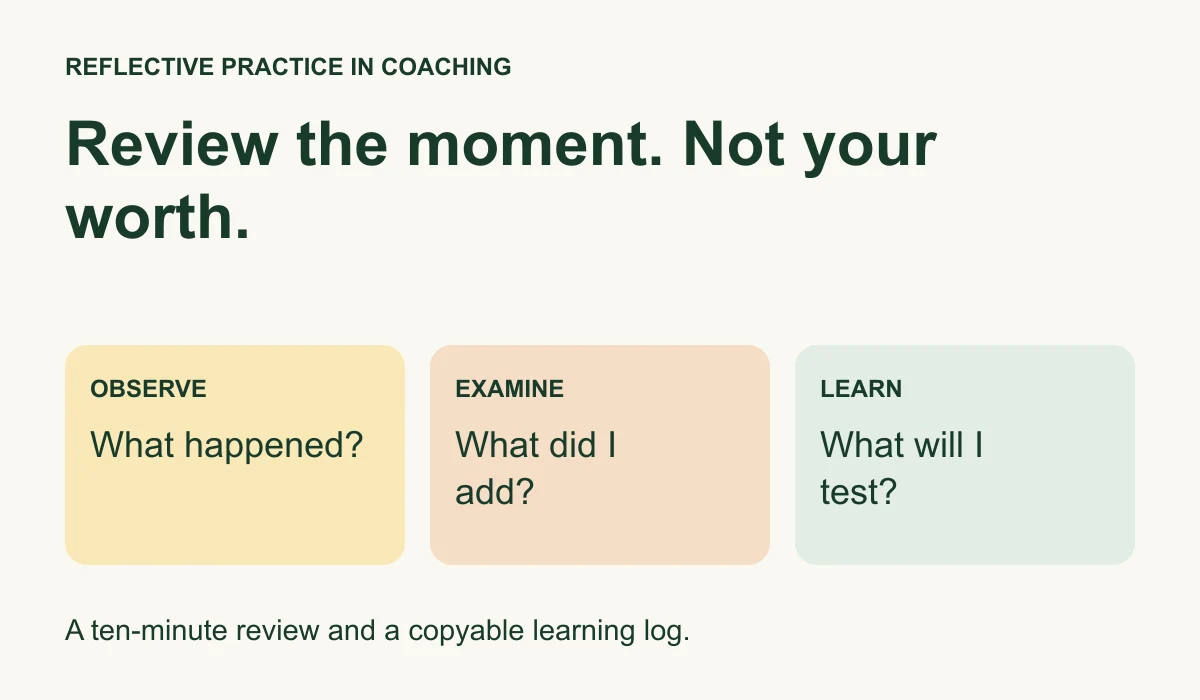
7. Review what happened without grading the person
The next session is not a pass-or-fail check. An action may go badly, go well, change shape, or not happen. Explore what the experience tells the client about the task, the context, the support, and their own choices.
- What happened when you tried the step, or considered trying it?
- What was different from what you expected?
- What did you do that you want to recognise?
- What does this suggest about the support, practice, or adjustment you need next?
- What would you like to repeat, change, or stop?
Listen for: an accurate account, not a forced success story. “I spoke and felt nervous” is different from “I failed because I was nervous.” Ask what the client makes of that difference rather than supplying a triumphant interpretation.
Hypothetical example: a client planned to state a preference in a team discussion but stayed quiet because the agenda changed. The next step might be requesting time on the next agenda, choosing another setting, or deciding the issue no longer matters. Repeating the original assignment is not automatically useful.
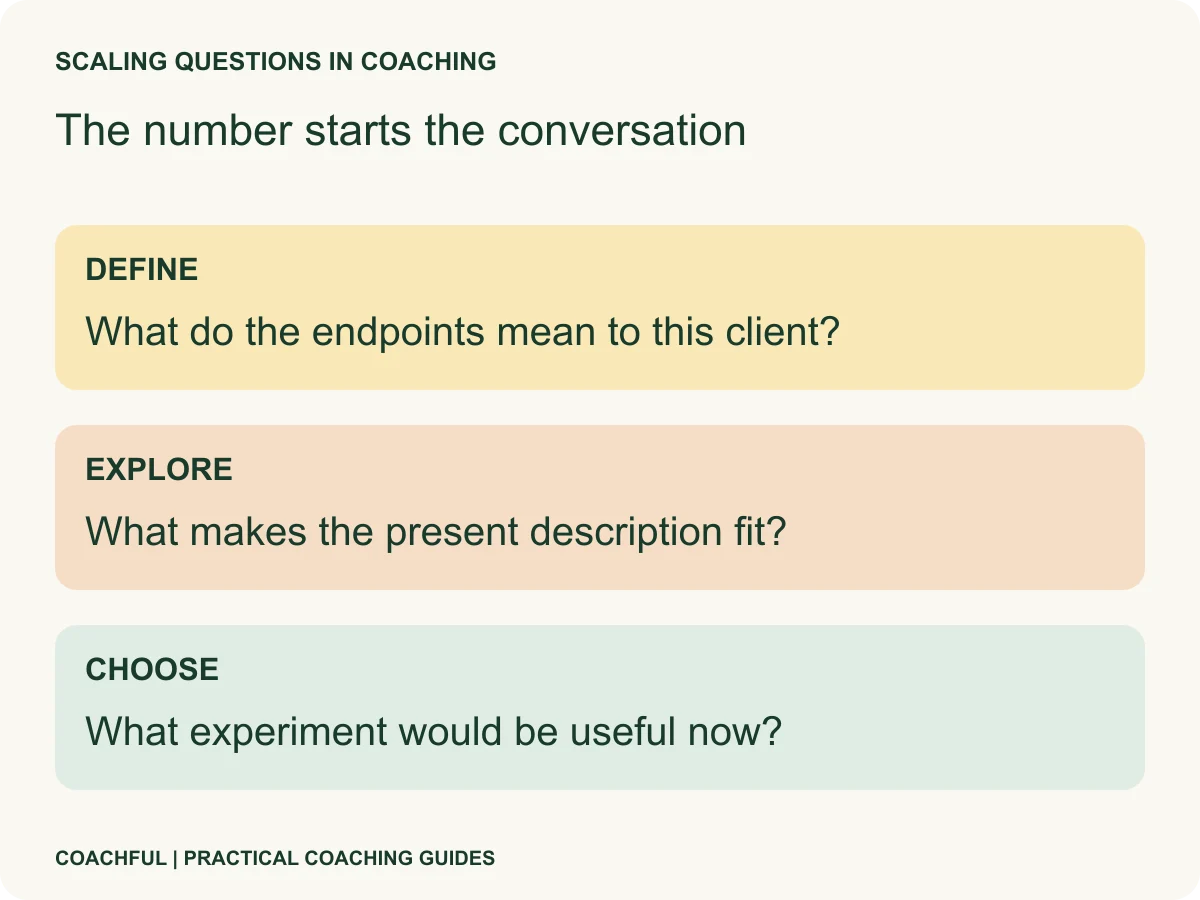
A confidence rating can add context if the client finds it helpful, but it is not an objective measure of ability. Record what the rating refers to and compare it with their own account of what happened.

A short worked example: from self-doubt to a chosen step
Consider a fictional client, Alex, who says, “I need confidence before I can contribute in meetings.” You agree to explore one recurring project meeting, not Alex's personality or entire career.
You begin with question 3, asking what Alex currently does and would prefer to do. Alex describes waiting until someone else makes the point they had prepared. Question 7 establishes that contributing matters to Alex, not just to a manager demanding a more outgoing style.
Question 16 surfaces a prediction: the idea may be challenged. You do not promise it will be welcomed. Question 21 opens a practical option: prepare the recommendation and one reason for it, then check the relevant figures with a colleague.
Alex chooses a manageable experiment using question 26: contribute that recommendation when the agenda reaches the project. The learning question is whether preparation helps them explain their reasoning, including when someone disagrees.
At review, question 32 invites the difference between expectation and experience. No outcome is predetermined in this example. If the meeting becomes hostile, the response should address that context, not insist Alex repeat the exercise until they enjoy it.
Keep the record small enough to be useful
You do not need a dossier of every doubt. Agree what to record and keep it relevant: the situation, the client's preferred change, the step they chose, the support they need, and what they want to review. Avoid diagnostic labels or treating an informal confidence rating as a psychological test.
For example: “Project meeting. Explain one recommendation and its reasoning. Check figures with colleague first. Review what preparation helped and what happened when questioned.” That is a usable next-session reference without reducing the client to “low confidence.”
If you use Coachful, a goal with milestones can provide a practical home for the agreed action. The screenshot below illustrates that structure with a sample habit goal, not a confidence-coaching result. Its completion percentage describes the sample goal; it is not a confidence score or evidence that coaching worked.

Once you have chosen a question and agreed a step, the next practical decision is how the client will find and revisit it. Try the Coachful interactive demo to explore whether its goal and client-work experience suits that handoff. Software can support the record; it cannot replace listening or professional judgement.
When confidence questions are not the right intervention
Do not assume a difficult experience is merely a confidence problem. Persistent distress, requests for treatment, or concerns outside your competence require a scope conversation and appropriate professional support, not a more forceful prompt.
The ICF Code of Ethics provides the professional framework for agreements, confidentiality, competence, and accountability. Follow the obligations relevant to your qualifications, location, and engagement. This article is coaching-practice guidance, not mental-health or legal advice.
Frequently asked questions
What is a good first question for confidence coaching?
Ask where the client wants to feel more able to act. A particular setting gives both of you something to explore. Then agree which part matters today, rather than assuming the client's whole life needs confidence work.
How many questions should I ask in one session?
There is no target. Ask enough to support the agreed purpose, with time for answers and reflection. One prompt followed carefully can be more useful than moving through every category on this page.
Can these questions be used for career or leadership coaching?
Yes, when confidence is the client's chosen topic and the work fits your competence. Adapt the situation and vocabulary, not the client's identity. Explore role expectations, skills, access, and workplace conditions alongside personal interpretations.
Are confidence and self-esteem the same coaching topic?
Not necessarily. A client may use confidence to mean ability in a specific situation, while another means their broader sense of worth. Ask what they mean and agree your scope. Do not diagnose either from a phrase.
Where can I find broader coaching prompts?
Use the Coachful coaching questions bank for general session moments, or explore life coaching exercises when a structured activity would help. This confidence list is for a more specific task: understanding a chosen situation and deciding what to try or change.
Sources and scope
The professional boundaries and client-centred approach draw on the ICF resources linked above. PositivePsychology.com's guide to coaching questions provides additional practitioner context on open questions, assumptions, and avoiding disguised advice. The 35 prompts, grouping, diagrams, and fictional examples here are original editorial material, not copied assessment items. No outcome, improvement rate, or guaranteed confidence gain is claimed.