Reflective Practice in Coaching: A 10-Minute Review Template

Coachful
Editorial Team
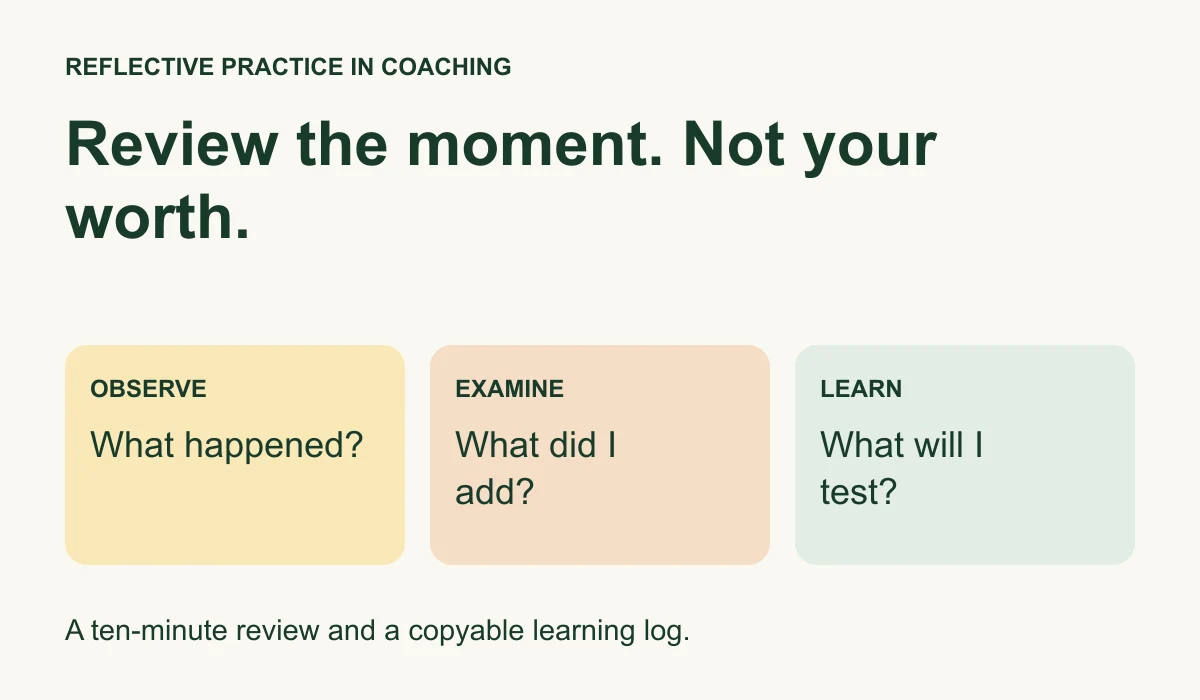
How do I know whether I coached well, rather than simply having a pleasant conversation? Start by reviewing one specific moment, separating what you observed from what you assumed, and choosing one change you can examine next time. Reflective practice is not giving yourself a score for being a good coach.
You can begin with a ten-minute review after a session: two minutes on the agreed purpose, three on a significant moment, three on your response and alternative explanations, and two on your next learning step. That timing is a suggested routine, not a professional requirement or a research-validated protocol.
This guide gives you a repeatable review, a copyable reflection template, a worked example and a way to notice patterns without building a second dossier about your clients. It focuses on the coach reviewing their own practice, not on asking clients to complete reflection homework.
What is reflective practice in coaching?
Reflective practice in coaching means deliberately examining your coaching experience to learn from it. You look at what happened, how you participated, what you may have overlooked and how that understanding could influence a future choice. A useful reflection leads to a better question or a testable adjustment, not necessarily an immediate answer.
There is a difference between remembering a session and examining it. “We talked about her promotion and it went well” is a memory and a judgement. “I offered a planning exercise before checking whether she wanted the promotion” identifies a coaching choice you can explore.
The Institute of Coaching’s guidance on reflection practice describes learning before, during and after a task, and offers questions about the coach, the client, the conversation and the partnership. You do not have to answer every possible question after every appointment.

Keep those three moments connected. Before a session, notice an assumption you might bring. During it, remain available to the client rather than auditing yourself constantly. Afterwards, examine a moment with enough distance to consider another interpretation.
Reflective practice, session notes and supervision are different jobs
A session record supports the coaching engagement. A reflection log supports your learning. The first might capture an agreed focus, a decision and a next action. The second might examine your urge to rescue the client, your reaction to disagreement or the way you handled silence.
Neither is a replacement for the other. A private reflection such as “I wanted this person to approve of me” does not belong automatically in a client-facing recap. Equally, an important agreement should not exist only in your personal learning notebook.
Supervision adds another person’s perspective on your practice. Solo reflection can help you arrive with a precise question, but cannot guarantee that you will spot your own blind spots. If you need professional support with a recurring pattern, competing responsibilities or an ethical uncertainty, see our guide to coaching supervision. For competency-focused feedback, consider the different purpose of mentor coaching.
A ten-minute reflective practice routine for coaches
Use the following timing as a starting constraint. It is there to stop a review becoming an hour of replaying the conversation, not to rush a complex concern. A significant issue may need more time and outside support.

1. Revisit the agreed purpose: two minutes
Write what the client wanted from the session in their terms. Then identify what evidence you have about its usefulness. The client saying “I know which conversation I want to have” tells you something different from your own sense that the energy improved.
Ask: What did the client want, and how did we check that? If you never established the purpose clearly, record that gap rather than inventing an objective in hindsight. Your next learning step may be to agree a more useful focus at the beginning.
Do not reduce every session to an action completed. Depending on the agreed purpose, useful work might involve understanding a dilemma, noticing a conflict or deciding not to proceed. The question is whether you checked with the client, not whether you produced a tidy ending.
2. Describe one significant moment: three minutes
Choose a short exchange or decision point, not the entire hour. A moment could be an interruption, a long pause, an unexpected change of topic, a question that opened something useful or an intervention you regretted.
Describe it as carefully as your information allows: “After I asked about next steps, the client paused and said they were unsure.” That is more useful than “The client resisted accountability.” If you are working from memory, mark reconstructed wording as approximate rather than presenting it as a transcript.

Then write the interpretation separately. You might have read the pause as reluctance, yet it could also reflect thoughtfulness, disagreement with the goal, tiredness or a question that was unclear. You do not need to decide which explanation is true without the client.
3. Examine your contribution: three minutes
Ask what you noticed in yourself and what you actually did. Did you fill the silence? Offer options? Change the subject? Decide the client needed a firmer challenge? Your internal response matters because it may have influenced the next move.
Consider at least one alternative explanation. A coach who feels bored might have missed a subtle shift, might be tired, or might be participating in a repetitive conversation. Boredom is information to examine, not evidence of the client’s lack of commitment.
Include something that worked. If you made a brief observation and the client corrected it, the correction may have helped you understand them better. Do not abandon a useful practice simply because being corrected felt uncomfortable.
4. Choose a learning step: two minutes
Finish with one question or adjustment you can examine. “Be more present” is too broad to review. “When I notice myself preparing advice, pause and check what kind of support the client wants” gives you a recognisable choice.
Your learning step is not an instruction for the client. You cannot decide, privately, that they will practise assertiveness or change their goal. Anything affecting the coaching agreement belongs in a conversation with them.
Six reflection questions worth keeping beside your log
Use one or two questions that fit the moment. Answering a long checklist mechanically can become another way to avoid the uncomfortable part of the review.
- Whose agenda was I following? Notice whether the client’s purpose, your preferred method or a sponsor’s expectations directed the conversation.
- What did I observe, and what did I add? Separate words and actions from labels such as unmotivated, defensive or ready.
- Where did my reaction influence my next move? Examine impatience, reassurance, excitement or the urge to demonstrate expertise.
- What information did I fail to invite? Consider context, access needs, conflicting priorities or a correction the client might have offered.
- What supported the client’s thinking? Name a specific intervention and the response you observed, without claiming more than you know.
- What should I repeat, change or take for support? Turn reflection into a deliberate next decision, including the decision not to act yet.

These are editorial prompts, not an assessment tool. There is no pass mark, and a difficult session does not establish that you are a poor coach. The useful distinction is between a concrete moment you can examine and a sweeping verdict about either person.
A worked example: when your helpfulness takes over
Hypothetical example: a career-coaching client says they have not contacted a potential employer. The coach quickly offers three networking-message structures. The client chooses one, but the coach leaves wondering why the conversation felt oddly flat.
A vague review says, “I need to motivate this client.” A more useful review begins with the agreed purpose: the client wanted to decide whether to pursue this employer at all. The coach moved into execution before checking the decision.

Observation: the client said they were uncertain; the coach offered message structures; the client selected one. Interpretation: the coach assumed a writing problem was preventing action. Reaction: the coach felt pressure to deliver something practical.
An alternative explanation is that the client did not want the opportunity, or had reservations they had not explored. That remains a possibility, not a conclusion. A useful next-session opening might be: “Last time I moved quite quickly into drafting messages. Would it be useful to revisit whether this opportunity is one you actually want?”
The learning experiment concerns the coach’s behaviour: before offering a method, check the decision the client wants help making and whether advice is welcome. Success is not the client sending the message. The review asks whether the coach made the choice explicit and what happened next.
Copyable coaching reflection log template
You can use this in a private notebook or an appropriately protected professional-learning record. Keep it brief and avoid unnecessary identifying details. It is not designed as a client-visible session summary.
Session reference: [A minimal reference appropriate to your records policy.]
Agreed purpose: [What the client wanted to explore or achieve.]
Significant moment: [A short description; mark approximate recollections.]
My response: [What I noticed in myself and what I did.]
My interpretation: [The explanation I initially gave the moment.]
Another possibility: [What else could account for it; what I do not know.]
What helped: [A specific intervention and observed response.]
Learning step: [One adjustment, question or support need.]
Review: [When and how I will revisit the learning.]
For the hypothetical example, the learning step could read: “Before proposing a tool, ask which decision the client wants to work on.” The review could read: “After the next three suitable sessions, note whether I checked that decision and what the client clarified.” Three sessions is a suggested learning window, not a requirement.
If your training provider supplies a reflection format, use its stated requirements for that course or assessment. This template does not establish eligibility for any credential, supervision credit or continuing education.
Keep private learning separate from client records
A reflection log can still contain sensitive personal information. Replacing a name with an initial does not make a distinctive employer, role and incident unidentifiable. Ask what detail you genuinely need to learn from the moment.

Use access controls and retention arrangements appropriate to your responsibilities and agreements. Do not assume a section labelled “notes” is private to you. Check exactly who can access, export or receive it before storing personal reflections about a client.
Recording a call is not a prerequisite for starting reflective practice. If a recording, transcript or technology-assisted review is proposed, clarify its purpose, permission, access, transfer, storage and deletion before proceeding. A convenient tool does not settle those questions.
When reflection reveals something that changes the engagement, discuss it with the client and record the resulting agreement in the appropriate client record. For the operational distinction, see our session notes template and record retention and deletion guide. These are related tasks, not reasons to copy your private log into a shared space.
Turn the review into one observable experiment
The common failure is collecting thoughtful notes that never influence a session. Choose a change small enough to recognise while coaching, and flexible enough not to pull attention away from the client.

For example, if you repeatedly stack several questions together, your experiment might be to ask one short question and wait. Afterwards, record whether you did it and what you noticed. Do not interpret a longer client answer as proof that the change caused better coaching.
Keep context in the review. A question that was useful in one session may not fit another client or moment. Reflective practice should make you more responsive, not more loyal to a technique because it worked once.
If your experiment changes session structure, contact arrangements or something the client has agreed to, discuss that change with them. Your personal development plan is not permission to conduct undisclosed exercises on clients.
Review patterns weekly, not your worth after every call
Once a week, look across a small set of reviews. Ask which situation keeps prompting the same response in you. You might notice that you rush toward plans when clients discuss uncertainty, or become unusually deferential when someone has a senior title.

Use concrete entries rather than counting positive and negative sessions. Three different moments of premature advice suggest a question worth examining, not a diagnosis of your style. A small log cannot establish why a pattern exists or whether it occurs across your whole practice.
Bring recurring uncertainties to appropriate professional support. For a skill question, you may want observation and competency-focused feedback. For a relational, ethical or systemic question, a trained supervisor may be useful. Legal, safeguarding or clinical concerns can require different expertise and timely action; do not leave an urgent issue waiting for your weekly review.
Where Coachful fits, and where it does not
Reflect first, then decide what belongs in ongoing client work. Your private learning might be “I avoid checking whether the goal still fits.” The client-facing follow-through is to revisit that goal together and capture what you actually agree.
If you are choosing how to organise that follow-through, try the interactive Coachful demo and explore the Clients and Sessions areas using sample data. Use the walkthrough to consider the operational side of your practice, not to upload a real reflection log or assume a particular view is suitable for confidential supervision material.
Software does not decide whether you coached well. The immediate next step is smaller: take one recent moment, write the observation and your interpretation on separate lines, and choose one question to carry forward.
Frequently asked questions
How often should a coach do reflective practice?
Start with a short review after selected sessions and a regular look across entries. Choose a cadence you can sustain and check any relevant training, employer or professional requirements. This guide’s ten-minute routine is a practical suggestion, not a universal standard.
Which reflective model should I use?
Use a structure that helps you describe an experience, examine your participation and identify a learning step. If your course requires a named model, follow that requirement. More headings do not automatically create better reflection; precise observation matters more than completing a complicated form.
Can I reflect without a session recording?
Yes. Begin with a brief remembered moment and label uncertainty honestly. Recordings can support some kinds of review, but require appropriate permission and information-handling arrangements. Do not reconstruct precise quotations from memory or assume a recording is necessary for every review.
How do I stop reflection becoming self-criticism?
Describe a choice rather than judging your character, include what supported the client, and finish with a bounded question or learning step. If the review becomes repetitive distress rather than useful examination, stop the loop and seek support suited to what you need.
Is private reflection the same as coaching supervision?
No. Private reflection is your own review of your work. Supervision brings a collaborative professional relationship and another perspective. A reflection log can help prepare for supervision, but does not automatically replace it or satisfy a body’s supervision requirements.
Sources and scope
The Institute of Coaching’s Building Your Reflection Practice: Self-Coaching Questions for Coaches informs the discussion of reflection before, during and after coaching and the value of varied reflective questions. The ten-minute routine, template, diagrams and hypothetical example here are original editorial guidance, not an official model or a validated measure of coaching effectiveness.