What to Do When a Coaching Client Cries: 8 Practical Steps

Coachful
Editorial Team
My coaching client has started crying. Should I say something, stop the session, or keep coaching? Start by slowing down, leaving room for the client, and asking what would help. Tears alone do not tell you that coaching has failed, that a breakthrough has happened, or that the person needs therapy.
Your job is not to stop the tears. It is to respond respectfully, preserve the client's choices, and recognise when their needs exceed your competence or the coaching agreement. A quiet pause may be useful; a safety concern needs a different response.
This guide offers eight practical steps for ordinary emotional moments in life, career, executive and business coaching. It is not a clinical assessment, treatment method or crisis-response protocol. The example language is hypothetical, not a client transcript or a promise of an outcome.
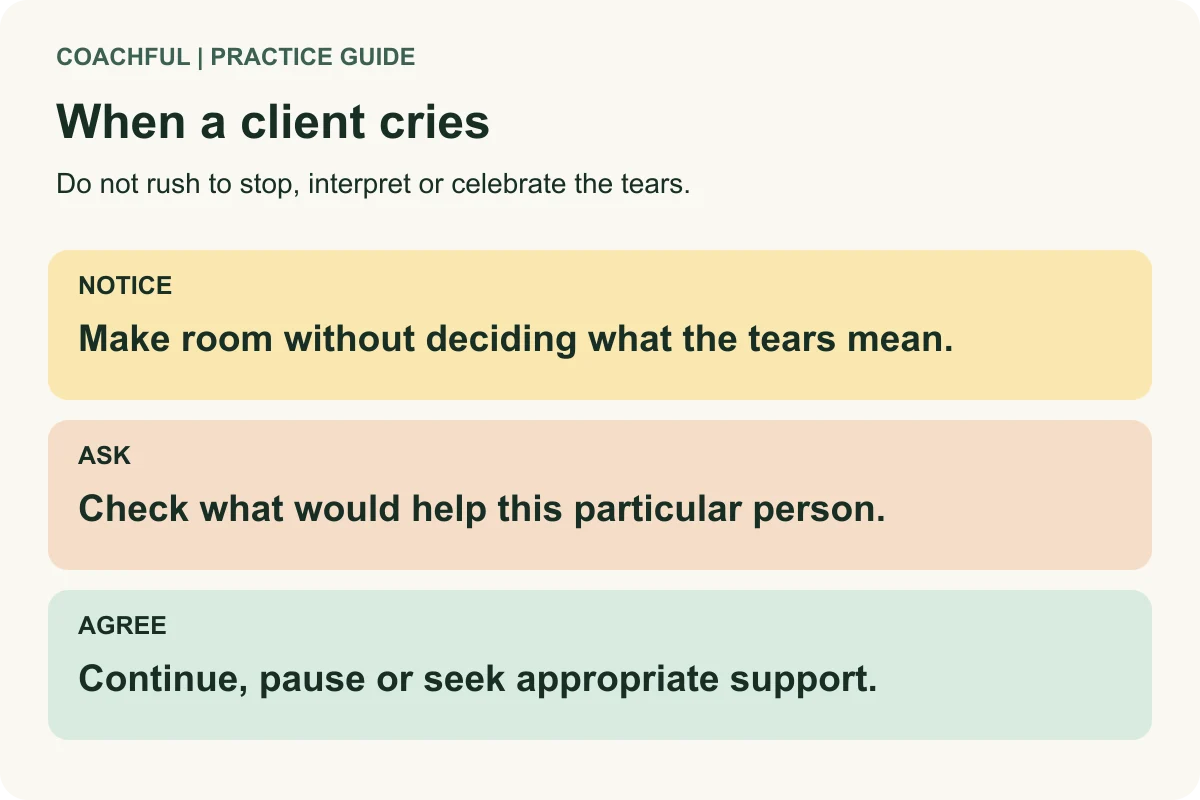
Cover diagram: notice the moment, ask what helps, and agree whether to continue. The amount of crying is not a measure of coaching quality.
1. Pause your question, not your attention
A client is explaining why they have not applied for a promotion. Their voice changes, they stop speaking, and tears appear. You can feel a second question forming. Do not add it automatically.
Give them a little room without staring, looking alarmed, or immediately looking away. Keep your manner attentive. You do not need an unusually solemn voice. Ordinary warmth is enough.
“We can take a moment. I'm here.”
Then leave space. There is no universal number of seconds to count. Some clients want quiet; others find unexplained silence uncomfortable. If you are unsure, check rather than turning silence into a test they must pass.
A useful private question is: am I about to speak because the client needs something, or because I want this moment to feel less awkward? The urge to produce a brilliant question can be your discomfort wearing a professional outfit.
The ICF Core Competencies emphasise listening, ethical boundaries and remaining present in emotionally charged conversations. That supports making room for emotion, not assuming every emotional moment requires an intervention.

2. Separate what you notice from the story you invent
Tears can accompany frustration, relief, sadness, anger or an experience the client cannot yet name. You do not know which simply by watching. Even a familiar client can mean something different this week.
“You've gone quiet” describes an observation. “You're grieving the career you never had” supplies a meaning. The second may sound insightful while being completely wrong.
“I noticed you became quiet when we mentioned the promotion. What would you like me to understand?”
Ask one question, not a bundle of questions about the tears, their childhood and their manager. The client can answer, say they do not know, or decline to explain. They do not owe you a complete interpretation before the session can move on.
Do not describe tears as resistance, emotional release or proof that you have reached the real issue. Those labels can turn your interpretation into the agenda. Let the person tell you what matters, including that they would rather not discuss it.
Likewise, do not infer meaning from gender, culture, seniority or how readily someone cries. An executive's tears are not inherently more significant than a life-coaching client's, and a client who never cries is not necessarily avoiding anything.

3. Offer a small choice instead of a rescue
The familiar impulse is to reassure: “Don't worry, everything will work out.” You cannot know that. Another impulse is to say “It's okay” repeatedly until the client stops. That can accidentally make stopping the price of continuing.
Offer a manageable choice tied to the present moment:
“Would you prefer a moment of quiet or a short break?”
If they would like to keep talking, follow that preference while remaining attentive to your scope. If neither option fits, invite their suggestion. You are not delivering a menu they must choose from correctly.
In person, make tissues accessible without insisting they use them. Ask before offering physical contact, and consider whether touch belongs in your professional relationship at all. On video, ask whether they want a moment away from the screen rather than instructing them to turn the camera off.
Do not prescribe breathing exercises, body-focused practices or trauma-processing techniques merely because the client is upset. A technique outside your training does not become appropriate because you found an appealing script. Even an ordinary practical offer should be something the person can decline.
If the client apologises, a simple response is enough: “You don't need to apologise to me. Would a pause help?” Avoid telling them that tears are good, necessary or something they should allow to continue.

4. Decide whether to continue, pause or seek other support
Crying is not the decision rule. Consider what the client is asking for, whether they want to continue, the coaching agreement, and whether you have the competence to support the work. Do not diagnose from a single moment.
- Continue by agreement: the client wants to continue, the conversation remains within your competence and agreed scope, and there is no identified urgent safety concern. They do not have to be entirely tear-free.
- Pause or end today's coaching: the client wants a break or does not want to continue. Agree a practical ending without requiring an insight or homework task first.
- Discuss additional professional support: their needs appear beyond what you are qualified or contracted to provide, or the pattern raises concerns you cannot responsibly address through coaching alone.
- Respond to immediate danger: stop ordinary coaching and follow the applicable emergency procedure. Referral for a future appointment is not a substitute for urgent help.
If you are concerned about self-harm, ask directly and calmly whether the client is thinking of harming themselves. Do not avoid a necessary question to protect the atmosphere. Follow your training and local procedures, and seek qualified help rather than trying to complete an improvised risk assessment.
The ICF guidance on a client considering suicide says to contact local emergency services immediately when you believe there is imminent danger of self-harm, and stay with the person, including by phone or video, until help arrives. Do so where safe and consistent with the situation. Do not wait for supervision or the next scheduled session.
For non-emergency scope decisions, the ICF referral-to-therapy guide provides fuller professional guidance. Neither the diagram below nor a tearful moment establishes whether someone has a mental health condition.

5. Re-agree the conversation before returning to the goal
Once the client indicates they want to continue, do not snap straight back to the question you had planned. The useful focus may have changed. Equally, do not insist that the tears must now become the subject of the entire session.
“Would it help to stay with this, return to the promotion decision, or focus on something else?”
Consider this hypothetical career-coaching exchange:
Client: “I'm embarrassed. I wasn't expecting to cry. I still want to work out whether to apply.”
Coach: “We can stay with that decision. What would make the rest of our time useful?”
Client: “I want to separate whether I want the role from whether I'm afraid of being rejected.”
Coach: “Which would you like to explore first?”
The coach does not explain the client's emotion or promise confidence. The client chooses a focus. That is the practical difference between acknowledging emotion and taking ownership of it.
If the client says “I don't want to go there,” respect that. You can clarify what they do want to work on without treating their boundary as a challenge to overcome. The ICF discussion of uncomfortable coaching conversations explicitly distinguishes useful challenge from pushing a client in a direction they decline.

6. Handle video, privacy and connection problems explicitly
On a video call, crying can make small uncertainties feel larger. Has the sound failed, or is the client choosing silence? Are they alone, or has someone entered the room? Do not assume the answer from a frozen image.
Check the practical issue without demanding personal details: “Can you still hear me?” or “Do you have enough privacy to continue?” A client crying in a shared office may need a break, not a deeper question.
If they want the camera off, agree how you will stay in contact and when to check in. A short pause with an agreed return is different from silently leaving them unsure whether you are still there. If they want to end, agree the next contact rather than insisting they remain visible.
Before remote work begins, establish a connection-failure plan and the information your applicable safety procedure requires. Handle location and emergency-contact information according to your agreements, local duties and data practices. Do not improvise a universal policy from a blog post.
If a connection drops during a known urgent safety concern, use the established emergency and reconnection procedures immediately. Do not treat a failed video call as evidence that the person is safe or as permission to wait for an email reply.

7. Close without forcing a positive ending
A tearful session can leave the coach determined to rescue the last five minutes. Suddenly there is a list of affirmations, a large action plan, and a cheerful summary the client never endorsed. Resist the urge to manufacture a tidy ending.
Name the remaining time early enough to make a real choice: “We have about ten minutes left. How would you like to use them?” This is an illustrative phrase, not a rule about session timing.
If the conversation is continuing appropriately, ask what the client wants to take from it. An action may be useful, but it is not mandatory. They might choose to think about the decision before setting a task.
Agree any follow-up specifically: what you will send, what they want to do, and when you will next speak. Avoid vague promises such as “Message me any time” if you do not provide continuous support. State your normal availability and relevant support boundaries clearly.
When additional professional support is appropriate, discuss the practical next step without presenting a referral as a rejection. For example: “This sounds like it needs support beyond my coaching role. Shall we talk about how you could access that?” Do not claim the referral guarantees care or that your own sessions should automatically continue.
For immediate safety concerns, the emergency response takes priority over the booked end time. An ordinary closing checklist is not the relevant tool.

8. Record the agreement, then review your own response
Document what is necessary for the coaching relationship and your professional responsibilities. That can include the agreed focus, a requested break, a scope conversation and the next contact. Follow applicable legal, organisational and professional requirements for safety-related records.
Avoid speculative labels such as “unstable,” “attention-seeking” or “finally had a breakthrough.” A useful routine note might read: “Client requested a short break, then chose to continue discussing the promotion decision. Agreed to revisit their decision criteria next session.”
This is an illustrative ordinary-session note, not a template for documenting an emergency. Do not omit necessary safety information in pursuit of minimal notes. Conversely, do not collect a detailed emotional history simply because the session felt important.
Separate your own reflection from information you need to share with the client. Did you rush to reassure? Avoid the moment? Push for disclosure? Promise more availability than you can sustain? Those are useful questions for coaching supervision, with client confidentiality protected.
Do not automatically share the emotional details with a sponsor, manager, peer group or AI service. Use the relevant agreements and professional requirements, and do not assume a software feature makes a particular disclosure appropriate.

What should you avoid saying to a crying coaching client?
Avoid “Don't cry,” “Everything happens for a reason,” and “This means we're making progress.” Each tells the client how to feel or what their emotion means. Also avoid “I know exactly how you feel”: you do not, and your own story can quietly replace theirs.
You do not need a more sophisticated replacement for every awkward phrase. A pause followed by “What would help right now?” often leaves more room than a polished interpretation. If your wording lands badly, acknowledge it: “That sounded like I was asking you to stop. I'm sorry. What would you prefer?”
Frequently asked questions
Is crying in a coaching session normal?
People can cry while discussing work, relationships, decisions or relief. Tears are not inherently inappropriate in coaching. They do not establish that the session is useful, safe, clinical or outside scope; attend to what the person says and needs.
Should I end the session when a client cries?
Not automatically. Ask whether they want to continue, pause or finish, and consider competence, scope and safety. Respect a request to stop. Immediate danger calls for the appropriate emergency response, not simply ending the appointment.
Does a client crying mean they need a therapist?
No. Tears alone are not a diagnosis or referral criterion. Discuss additional qualified support when their needs exceed your coaching competence or agreement. Do not let the absence of tears reassure you when other serious concerns are present.
Can I cry too?
A coach may feel moved, but the client should not have to comfort or manage the coach. Keep your response proportionate, return attention to the client, and seek your own professional support if your reactions interfere with the work.
Make the next contact clear, not more complicated
After a difficult moment, the useful administrative task is usually small: preserve the agreed next step, confirm the next contact, and avoid making the client explain everything again in a follow-up message. Keep sensitive information limited to what belongs in the appropriate record.
If you are evaluating how to organise routine coaching follow-up, try the Coachful interactive demo with a fictional appointment and next step. Test whether the experience suits your practice before entering real client information. Software is not a replacement for supervision, clinical support or an emergency plan.
Sources and scope
This is educational coaching-practice guidance, not medical advice, legal advice, crisis training or a validated intervention. The example phrases and diagrams are original editorial teaching aids. Primary professional references are the ICF Core Competencies, ICF referral-to-therapy guidance, and the ICF articles linked beside the relevant claims. Your training, local obligations and professional agreements govern actual decisions.