Enneagram Coaching: How to Use It Without Boxing Clients
Enneagram coaching uses the Enneagram, a model of nine personality types, as a lens for self-awareness and growth. Each type is described by a core motivation and a habitual pattern of attention, and coaches use the model to help clients notice what drives them, how they react under stress and what growth might look like. It is popular in leadership development, faith communities and couples work, while research on its reliability and validity is mixed at best.
This guide covers where the Enneagram came from, the nine types and how coaches use them, what a systematic review of 104 samples found, a session that uses the model without boxing the client in, with dialogue and 11 questions, who it suits, the ethical lines, and training routes. If you coach on Coachful, our team will build the reflection worksheets and program in this guide in your account for free.
Where the Enneagram came from
The nine-pointed symbol was used by the spiritual teacher G. I. Gurdjieff in the early 20th century, but not for personality types. The modern personality system comes mainly from Oscar Ichazo, who founded the Arica Institute, first based in Chile and later in the United States, and from the Chilean psychiatrist Claudio Naranjo, who studied with Ichazo in 1970 and taught his own version, mainly at the Esalen Institute in California. Jesuit students of Naranjo brought it into Christian spirituality programs at Loyola University in Chicago.
From there it spread through books: Don Richard Riso's Personality Types (1987), Helen Palmer's The Enneagram (1988) and, later, Riso and Russ Hudson's The Wisdom of the Enneagram (1999). Riso and Hudson developed the Riso-Hudson Enneagram Type Indicator (RHETI) in 1993 and created The Enneagram Institute in 1997. The summary of this history in the Wikipedia entry on the Enneagram of Personality is a reasonable starting point.
The nine Enneagram types, as coaches use them
Names vary between schools. The descriptions below are the common ones, phrased as starting points for a conversation rather than conclusions.
| Type | Common names | Pattern often described | A coaching question |
|---|---|---|---|
| 1 | Reformer, Perfectionist | Focus on doing things right; strong inner critic | "What would good enough look like here?" |
| 2 | Helper, Giver | Focus on others' needs; may neglect own | "What do you need from this situation?" |
| 3 | Achiever, Performer | Focus on success and image | "Who would you be if nobody were watching?" |
| 4 | Individualist, Romantic | Focus on identity, meaning and what's missing | "What's already here that you value?" |
| 5 | Investigator, Observer | Focus on knowledge; protects time and energy | "What would you do if you knew enough already?" |
| 6 | Loyalist, Loyal Skeptic | Focus on security and what could go wrong | "What do you trust in yourself here?" |
| 7 | Enthusiast, Epicure | Focus on options and avoiding discomfort | "What happens if you stay with this one thing?" |
| 8 | Challenger, Protector | Focus on control and strength | "Where could you let someone else lead?" |
| 9 | Peacemaker, Mediator | Focus on harmony; may lose own priorities | "What do you want, separate from what keeps the peace?" |
Teachers also group the types into three "centers" (head: 5, 6, 7; heart: 2, 3, 4; gut: 8, 9, 1) and describe "wings" (the influence of neighboring types) and "lines" (how a type is said to shift under stress or security). These secondary ideas have the least research behind them.

What the research says about the Enneagram
- The main review. A 2021 systematic review in the Journal of Clinical Psychology examined 104 independent samples and found "mixed evidence of reliability and validity". On the positive side, some factor analyses partly matched the theory, subscales related sensibly to the Big Five personality traits, and several studies reported the Enneagram helped personal or spiritual growth. On the negative side, factor analyses typically found fewer than nine factors, no study derived the nine types from clustering, and there was little support for wings and lines.
- A recent test in medical training. In a 2026 study, 88 residents took the 144-question RHETI during an educational session. Six months later, fewer than a quarter of those who responded agreed it had improved their communication, professionalism or well-being, and types did not cluster by specialty.
- Professional opinion. According to the Wikipedia summary, a Delphi poll of psychologists rated the Enneagram as discredited for personality assessment, with at least a quarter of respondents agreeing.
So the Enneagram is not a validated assessment, and its type tests should not be treated like one. It can still be a useful conversation tool, the way a metaphor or a values card sort is: clients often find the descriptions give them words for patterns they recognize. The rule that follows is simple. Use it for reflection the client chooses, never for decisions about the client.
How to run an Enneagram coaching session without boxing the client in
- Ask why they want it. Self-understanding, a relationship, a team? This shapes everything.
- Let the client self-identify. If they use a test, treat the result as a hypothesis. Ask them to read two or three type descriptions and say which fits, and where it doesn't.
- Move from type to motivation. The useful question isn't "what type are you?" but "what drives this behavior?"
- Bring it to a real situation. A recent conflict, decision or stress point.
- Notice the pattern in action. What did their attention go to? What did they avoid?
- Explore the cost and the gift. Every pattern has strengths and a price.
- Choose a growth practice. One small, observable behavior that loosens the pattern.
- Keep the type out of the action plan. The plan is about behavior, not about "being a better Three".
A short sample dialogue
Sofia, a nonprofit director, says she's "obviously a Two". Illustrative, not a transcript.
Sofia: I'm a Two. That's why I can't say no to the board.
Coach: Which parts of the Two description fit you, and which don't?
Sofia: The helping fits. The part about wanting to be needed, less so. I mostly want things to go smoothly.
Coach: Tell me about the last time you said yes when you wanted to say no.
Sofia: The chair asked me to take on the gala. I felt the room go tense, and I said yes so it would relax.
Coach: So the yes was about the tension in the room. What did it cost you?
Sofia: My strategy work. Again.
Coach: What could you say next time the room goes tense?
Sofia: "Let me look at my calendar and come back to you tomorrow."
Notice the coach never argued about her type, or confirmed it. The useful material was the pattern: saying yes to relieve tension.
11 Enneagram coaching questions
- What made you curious about the Enneagram?
- Which description fits you best, and where doesn't it fit?
- What do you notice your attention goes to first in a new situation?
- What do you tend to avoid, and what does avoiding it protect?
- When you're stressed, what changes in how you act?
- What does this pattern give you that you'd want to keep?
- What does it cost you, and the people around you?
- Tell me about a recent moment the pattern showed up.
- What would a small step outside the pattern look like this week?
- Who would notice if you did it?
- What would you like to be true about you, whatever your type?
The Johari window is a good partner exercise, because it adds other people's view of the client, and our guide to values clarification works well after type exploration.

Who Enneagram coaching suits, and who it doesn't
It suits clients who already like the Enneagram and want to use it well; leaders and couples looking for a shared, non-blaming language for differences; people interested in its spiritual roots; and teams that have agreed, voluntarily, to explore it together.
It suits less well clients skeptical of personality typing (respect that and use another tool); situations involving hiring, promotion or performance decisions; and clients who use their type as a reason not to change ("I'm an Eight, I'm just blunt").
Ethical lines for Enneagram coaches
- Never use it to select, promote or exclude people. It isn't validated for that, and using it that way could be unfair to the people affected.
- Don't type people who aren't in the room. "Your boss is clearly a One" is gossip with a framework.
- Keep team typing voluntary. No one should have to share their type with colleagues.
- Be clear about its status. Tell clients it's a reflection tool with mixed research support, not a scientific test.
- Respect the spiritual framing, or leave it out. Some schools present the Enneagram as a spiritual path. Ask whether the client wants that.
Enneagram coaching training routes
We checked these on the organizations' own sites in October 2026:
- The Enneagram Institute. Created in 1997 by Don Richard Riso and Russ Hudson; it offers authorized workshops taught by Riso-Hudson Certified and Authorized Teachers, and runs the RHETI.
- The Narrative Enneagram. An educational nonprofit co-founded by Helen Palmer and David Daniels, MD. It offers a professional certification track, reports more than 1,680 certified teachers and practitioners, and describes itself as an International Enneagram Association accredited school.
Enneagram certification qualifies you to teach or use the Enneagram, not to coach. Pair it with accredited coach training; see the ICF credentials and our checklist on whether a certification is worth it.
Running Enneagram coaching inside Coachful
The Enneagram works best as ongoing reflection on real situations, not as a one-off test result. This is how coaches set that up in Coachful, all included in your membership.
A reflection worksheet, not a type test
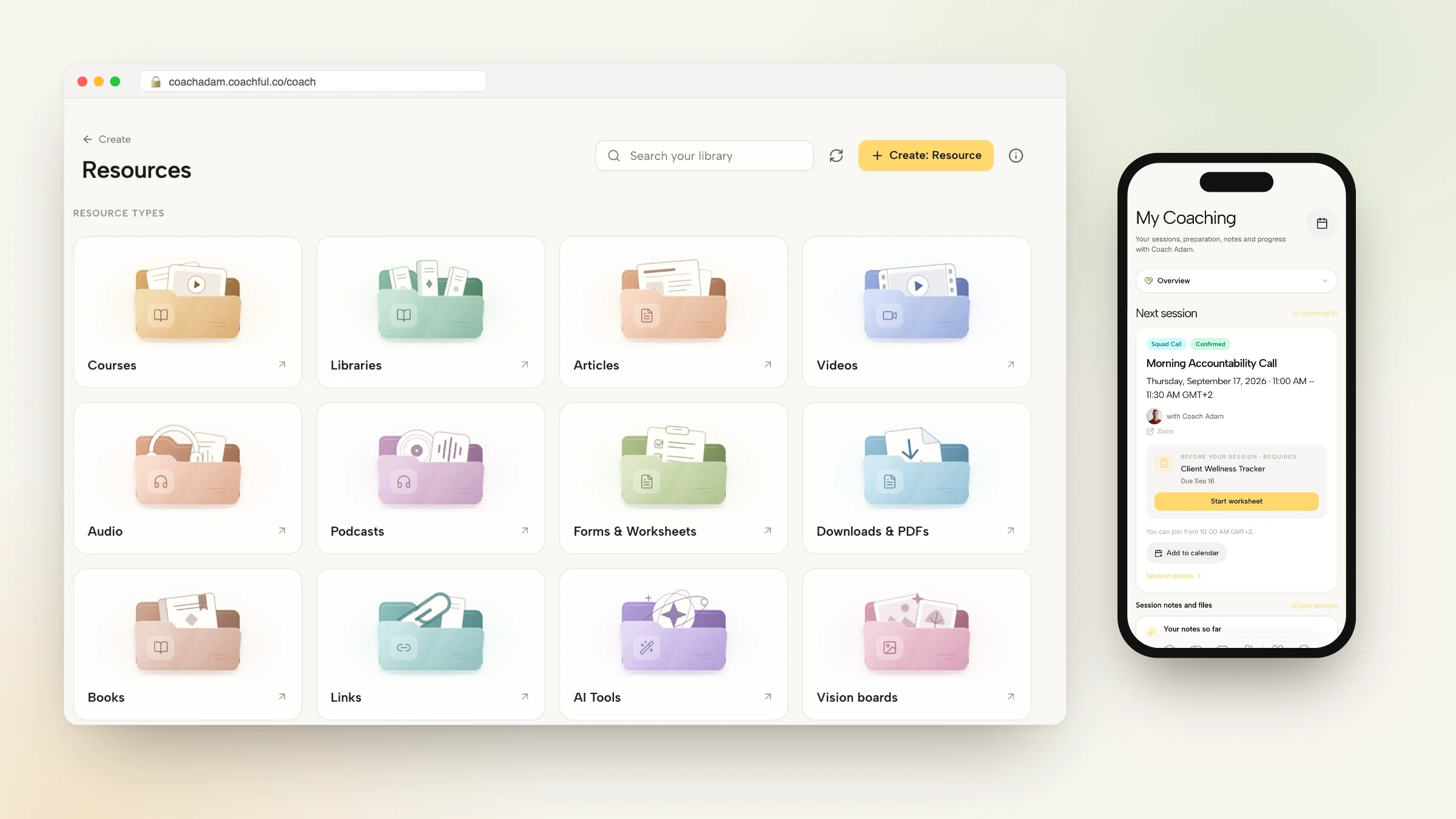
In Create > Resources > Forms & Worksheets, build a worksheet that asks clients which type description fits, where it doesn't, and what they notice under stress. Set it as a Worksheet so they keep a saved copy and can revisit it. If you use a published type indicator, follow its license and keep it separate.
Prep before each session
Attach a short prep question to your session type ("When did your pattern show up this week?"), so clients arrive with a real moment. It appears on their session card under Before your session.

Growth practices as habits
The growth practice ("ask for a day before saying yes") works as a habit with a reminder, so you both see whether it's happening.

Team cohorts
For team programs, enrolling a team in a group program gives them a squad with a feed, group chat and calls, while each person keeps an individual record. Keep type sharing optional in the group.

Prepare with Brain
Brain's Prepare for a client shortcut pulls together a client's recent sessions and progress, so you can look for the pattern across weeks rather than relying on the type label.

Have the Coachful team build your Enneagram program
Coachful's white-glove service is free on every plan. From Create > We'll build it for you, ask the team to build your reflection worksheets, a nine-week program or a team workshop series. Attach your existing materials. The team replies by email, usually within about 24 hours, and builds it in your account so you can edit it. Read what the free white-glove service includes, and see our pages for relationship coaches and executive coaches.

Related: VIA character strengths coaching, a strengths model with more research behind it, and personality development coaching.
Frequently asked questions
What is Enneagram coaching?
It is coaching that uses the Enneagram's nine personality types as a framework for self-awareness. Coaches use type descriptions to help clients notice their motivations and habits, especially under stress, and to choose small growth practices.
Is the Enneagram scientifically valid?
Not well established. A 2021 systematic review of 104 samples found mixed evidence of reliability and validity, typically fewer than nine factors, and little support for wings and lines. It can be useful for reflection, but it is not a validated assessment.
Should I use the Enneagram in hiring or team selection?
No. It isn't validated for selection or performance decisions. Use it only for voluntary self-reflection and communication, and never require anyone to share their type.
How do I find my Enneagram type?
Read the type descriptions and notice which motivation fits best, ideally with a coach or teacher. Tests like the RHETI can suggest a starting point, but treat any result as a hypothesis to check against your experience.
What is the difference between the Enneagram and VIA strengths?
The Enneagram sorts people into nine types based on motivation and has mixed research support. The VIA classification describes 24 character strengths everyone has in different degrees and has a larger research base. Many coaches find VIA easier to defend.
How do I become an Enneagram coach?
Train as a coach first, then add Enneagram study with an established school, such as The Enneagram Institute's authorized workshops or The Narrative Enneagram's professional certification. Their certification covers the Enneagram, not coaching itself.
Will Coachful build an Enneagram coaching program for me for free?
Yes. The white-glove service is free on every Coachful plan. Ask from Create > We'll build it for you and the team will build reflection worksheets, prep questions or a full program in your account, usually within about 24 hours.