
Personality Development Coaching: Can You Really Change?
Personality development coaching helps you change specific, everyday patterns in how you think and act, such as speaking up in meetings, staying calm under criticism, following through on plans or being more open to new things, so that how you show up matches who you want to be. A coach turns a broad wish like "be more confident" into small behaviors you practice every week and get feedback on. Research shows that personality traits can shift modestly with sustained, targeted effort. Coaching is not treatment for personality disorders, depression or anxiety.
People usually arrive at this after hearing the same feedback for years: too quiet, too blunt, too disorganized, too cautious. They half believe personality is fixed and half hope it isn't. The research lands in an encouraging middle: you will not become a different person, but you can become noticeably more of the person you want to be. This guide covers what personality development means, what the evidence says about changing traits, how a coach works, where a therapist is the better choice, what personality tests can and cannot tell you, costs and how to choose a coach.
What "personality development" actually means
The phrase gets used two ways. In everyday use, it means a bundle of social and professional skills: confidence, communication, presence, manners and self-presentation. In psychology, personality means your typical patterns of thinking, feeling and behaving, and the most widely used model is the Big Five, which measures five traits on a continuous scale and underlies most modern personality research (overview).
Good coaching uses both: the Big Five to understand your starting point, and practical skills to change what other people actually see.
| Big Five trait | What it describes | What people often want to change | A behavior a coach might practice with you |
|---|---|---|---|
| Openness | Curiosity, imagination, interest in new ideas | Trying new things instead of defaulting to the familiar | One new experience a week, chosen in advance |
| Conscientiousness | Organization, reliability, follow-through | Finishing what you start, being on time | A ten-minute plan for tomorrow every evening |
| Extraversion | Sociability, assertiveness, energy around people | Speaking up, starting conversations | Making one point in the first ten minutes of each meeting |
| Agreeableness | Warmth, cooperation, trust | Being kinder in disagreement, or less of a pushover | Asking one genuine question before giving your view |
| Emotional stability (low neuroticism) | Calm under stress, recovering from setbacks | Worrying less, reacting less sharply | A pause-and-name routine when criticism lands |
Can you really change your personality?
More than most people assume, and less than self-help promises. Four lines of research are worth knowing:
- Personality changes naturally across life. A meta-analysis of 92 longitudinal samples found that people increase in social dominance especially between ages 20 and 40, and that four of six trait categories changed significantly in middle and old age (Roberts, Walton and Viechtbauer, 2006).
- Interventions change trait scores. A review of 207 studies, mostly of therapy, found marked changes in personality trait measures over an average of 24 weeks (d = .37), mainly in emotional stability and then extraversion, and the changes held at follow-up. Nonclinical interventions showed increases too (Roberts and colleagues, 2017).
- Wanting to change helps, and planning helps more. In two 16-week randomized experiments, people who set goals to increase a Big Five trait tended to increase on it, in self-reports and daily behavior. Training them to form specific if-then plans, called implementation intentions, helped them get there (Hudson and Fraley, 2015).
- Other people noticed the change. In a randomized trial with 1,523 participants, a three-month smartphone coaching program produced self-reported trait changes in the direction people wanted. Friends, family and partners also detected changes for people who wanted to increase a trait (d = 0.35), though not for those who wanted to decrease one (Stieger and colleagues, 2021). A one-year follow-up found the changes held, and for people reducing neuroticism they kept improving (Stieger and colleagues, 2024).
Put plainly: small, deliberate changes in behavior, repeated for months, add up to changes other people can see. That is very close to what a coach helps you do.
How a personality development coach works
A coach's job is to make the change specific enough to practice. A typical process:
- Name the pattern. What do people say about you, what do you notice yourself, and where does it cost you?
- Pick one or two traits. Trying to change everything at once is how people end up changing nothing.
- Translate the trait into behaviors. "More assertive" becomes "state my view before asking what others think, in two meetings a week".
- Plan for the moment. If-then plans of the kind Hudson and Fraley tested: "If my manager criticizes my work, then I will ask one clarifying question before responding."
- Run weekly experiments. Try the behavior, note what happened and how it felt, adjust.
- Get outside feedback. Ask two or three trusted people what they notice, at the start and again after a couple of months.
Here is how a twelve-week engagement can be paced:
| Weeks | Focus | Between sessions |
|---|---|---|
| 1 to 2 | Strengths, feedback you have received, what you want to be different | A personality questionnaire; ask two people for honest feedback |
| 3 to 4 | Choose the trait, write the behaviors and if-then plans | Try one behavior three times a week |
| 5 to 8 | Practice in harder situations, rehearse in session | Log each attempt: situation, what you did, what happened |
| 9 to 10 | Review the log, adjust, add a second behavior | Ask the same people what they have noticed |
| 11 to 12 | Consolidate, plan how to keep going without sessions | Write your own maintenance plan |
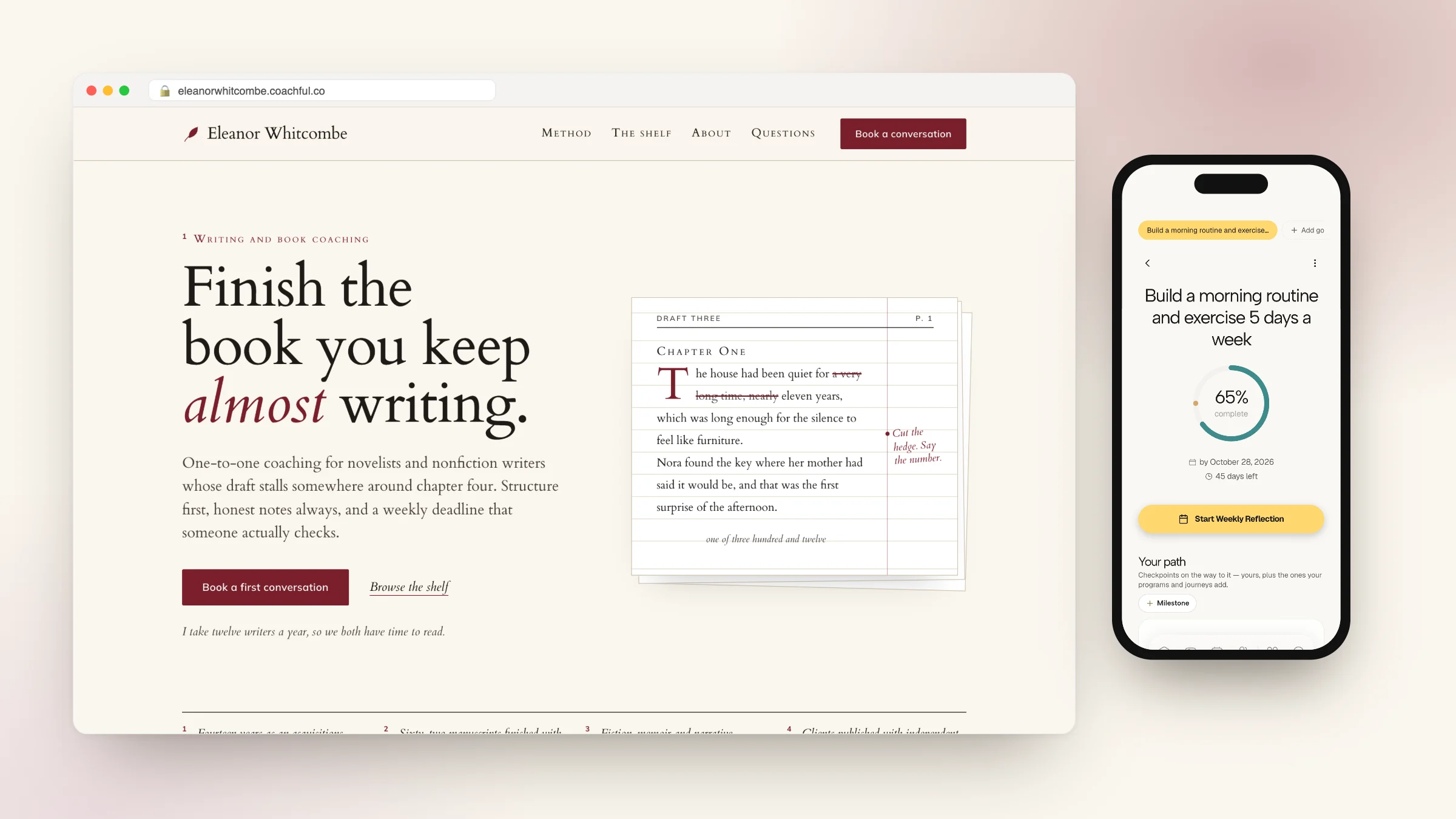
A dated goal with a weekly reflection keeps the experiments honest.

Daily habits make the new behavior visible. Seeing a streak build is surprisingly persuasive on the days you feel like the old you.

Coach notes written for the client help you see the thread across sessions, which matters when change is slow.

Some coaches structure the whole twelve weeks as a journey with steps, so you can see how far you have come.

For exercises you can try now, see our guides to the Johari window feedback exercise and strengths-based coaching questions.
See a licensed professional when...
- The pattern is causing serious, long-running problems in relationships, work or your safety, or people close to you have suggested therapy. Some long-standing patterns are personality disorders, which are diagnosed and treated by clinicians.
- Shyness has become fear. If you avoid situations where you might be judged, such as meeting new people, speaking up or eating in front of others, it may be social anxiety disorder, which NIMH estimates affected 7.1 percent of US adults in the past year. CBT is the well-studied treatment (NIMH).
- Low mood, intense mood swings, anger you cannot control or self-harm are part of the picture.
- You have thoughts of harming yourself. In the US, call or text 988 to reach the 988 Suicide and Crisis Lifeline.
Personality tests: useful, with limits
Many coaches start with a questionnaire. That can be a good conversation starter, as long as the result is treated as a snapshot rather than a verdict.
- Big Five measures are the research standard. Their five factors have been replicated across cultures and predict outcomes such as job performance and academic success.
- The Myers-Briggs Type Indicator is popular but has well-documented reliability problems: between 39 and 76 percent of people get a different type when retaking it after only five weeks (overview).
- Strengths and type systems such as the Enneagram or VIA Character Strengths can help start a reflective conversation. Our sibling guides to Enneagram coaching and VIA character strengths coaching cover what the research says about each.
A red flag: a coach who builds the whole program on your four-letter type, or who tells you a type explains what you can and cannot do.
What personality development coaching costs
Personality development coaching is usually sold as life or confidence coaching. Coachful's 2026 Coaching Business Report, which compiles published research and practitioner reports for the second quarter of 2026, gives these life coaching benchmarks:
| What you buy | Typical price | Source |
|---|---|---|
| One session | $75 to $200 | PayScale and practitioner reports |
| A newer coach | $50 to $100 an hour | Practitioner estimate |
| Four-week starter, four sessions | $400 to $600 | Practitioner reports |
| Three months, eight sessions | $1,200 to $2,500 | Practitioner reports and verified published rates |
| Group coaching | $100 to $300 a month | Practitioner reports |
US dollars, Q2 2026, from coachingrates.com. Practitioner figures are estimates.
Because the research points to months of practice rather than a few insights, a three-month block is a sensible minimum. A group program can work well for social and communication goals, since the group gives you people to practice with. More on value in is a life coach worth it.
How to choose a personality development coach
What to look for
- Coach training, such as an ICF credential (ICF credentialing), and some grounding in psychology.
- A behavioral method. Ask how they turn a trait into practice. You want to hear about specific behaviors, plans and feedback, not just mindset.
- Clear referral lines. They should be able to tell you when they would suggest a therapist.
Questions to ask
- What would we work on in the first month, given what I have told you?
- Which questionnaires do you use, and how much weight do you put on them?
- How do you get feedback from people around me?
- How will we both know, by week eight, whether I am changing?
Red flags
- Promises to transform your personality in a weekend or a few sessions.
- Advice to fake a personality you do not want ("just act like an extrovert").
- Labels presented as destiny, from any test.
- Pressure to buy a long, expensive package on the first call.
If confidence is the core goal, our confidence coaching questions are a good way to test how a coach thinks, and the sibling guide to social skills coaching covers conversation and friendship goals in more depth.
Find a personality development coach on Coachful
Coachful's Find a Coach directory is public and you can browse without signing up. Search "confidence", "personal growth" or "personality" to find coaches whose headline or bio mentions them, or browse the Mindset and Lifestyle categories. The Find My Coach quiz asks what you want to improve, where you are right now, whether you prefer a structured, flexible, high-accountability or gentle style, and your monthly budget.

Profiles show each coach's background, credentials and method where they have added them, their programs and prices, and a way to book a discovery call or send a message.

Are you a personality development or confidence coach?
Our guide on how to become a mindset coach covers training and first clients. Coachful's pages for confidence coaches and mindset coaches show the goals, habits, journeys and notes this work runs on, and the team will build your website or program for you at no extra cost through the free white-glove service.

Frequently asked questions
What is personality development coaching?
It is coaching that helps you change specific patterns in how you think and behave, such as confidence, assertiveness, follow-through or calm under pressure. A coach turns the trait into behaviors, plans for difficult moments and gathers feedback from people around you over several months.
Can a coach really change my personality?
A coach cannot change it for you, but research shows traits shift with sustained effort. In a randomized trial of 1,523 people, a three-month coaching program produced changes that friends and family could detect for people who wanted to increase a trait, and the changes held a year later.
How long does personality development take?
Months rather than weeks. The studies above ran for 16 weeks to three months, and a review of 207 intervention studies measured change over an average of 24 weeks. A three-month coaching block is a reasonable minimum to see a difference.
How much does a personality development coach cost?
It is usually priced like life coaching: $75 to $200 a session, or $1,200 to $2,500 for a three-month package of eight sessions, according to Coachful's 2026 Coaching Business Report. Group coaching typically costs $100 to $300 a month.
Is personality development coaching the same as therapy?
No. Therapy treats conditions such as anxiety disorders, depression and personality disorders. Coaching works with people who are basically well and want to change everyday patterns. If a pattern is causing serious distress, see a licensed therapist.
Which personality test should I take before coaching?
A Big Five questionnaire is the research standard and a good starting point. Treat type-based tests such as the Myers-Briggs as conversation starters only; many people get a different type when they retake it a few weeks later.
Can an introvert become more outgoing?
Yes, within limits. Studies show people who set goals to increase extraversion tend to increase on it. You do not need to become the loudest person in the room; most people want to be able to speak up and connect when it matters, which is very learnable.












