
How to Become a Mindset Coach: Training, Science and Pay
The mindset coaches who last tie belief change to behavior and evidence, and that's the most useful thing to know about how to become a mindset coach. The practical route is coach training (an ICF-accredited program is the most recognized), grounding in the psychology of beliefs and behavior change, practice with real clients, and a market narrow enough that people can tell what you help with. There's no license for mindset coaching and no credential specific to it. Clients pay for change they can see: a decision made, a habit kept, a fear walked through.
This guide starts with what the research on mindset actually shows, because it's more mixed than the posters suggest. Then it covers coaching beliefs through experiments, where coaching stops, training, choosing a market in a crowded niche, a three-month program, pricing and tools. When you're ready to launch, Coachful's team will build your mindset coaching website for free on every plan.
What the research on mindset actually says
"Mindset" in coaching usually traces back to Carol Dweck's work on fixed and growth mindsets, popularized in her book Mindset. The research since then is more nuanced, and knowing it makes you a better coach.
- Overall effects are weak. Two meta-analyses by Sisk and colleagues in Psychological Science in 2018 looked at 273 studies of mindset and achievement (365,915 people) and 43 studies of mindset interventions (57,155 people). Both found weak overall effects, though students from low-income backgrounds or at academic risk might benefit.
- Context decides a lot. A national US experiment led by Yeager, with Dweck among the authors, published in Nature in 2019, found that a short online growth mindset intervention of under an hour improved grades among lower-achieving secondary school students, and that the school environment shaped whether the effect held.
- Coaching itself has decent evidence. A 2014 meta-analysis in the Journal of Positive Psychology by Theeboom and colleagues found significant positive effects of coaching on well-being, coping, performance, work attitudes and goal-directed self-regulation.
Put together: telling people to "believe in themselves" does little on its own. Changing what people believe about a specific ability, in an environment that supports trying, and then helping them act on it, does more. That's a coaching job.

Coach mindset through experiments, not affirmations
A belief like "I'm bad with money" or "I can't speak in meetings" doesn't change because someone argues with it. It changes when the client collects evidence against it. The core loop:
| The belief | A small experiment | Evidence to log |
|---|---|---|
| "If I raise my prices, everyone will leave" | Quote the new price to the next two enquiries only | What they said and whether they booked |
| "I freeze when I speak in meetings" | Make one prepared point in the first ten minutes of one meeting | What happened, how it felt, what anyone said |
| "I always quit after two weeks" | Commit to a version so small it can't fail, for 14 days | Each day done, and what got in the way |
| "People like me don't get promoted" | Ask one senior person what they'd need to see | Their answer, word for word |
A short example of how that sounds in a session:
Client: I know I should raise my rates, but I just can't.
Coach: What do you expect would happen if you did?
Client: People would say no.
Coach: All of them, or some?
Client: Probably some.
Coach: What would be a small enough test that you'd actually do it this week?
Questions like these are the craft. Our guides to reframing without forced positivity and coaching questions for imposter syndrome give you more of them, and the sibling article on cognitive-behavioral coaching explains the model behind the experiments.
Where mindset coaching stops
Beliefs are also central to therapy, which is where the confusion starts. Cognitive behavioral therapy is a clinical treatment; coaches borrow its tools for people who aren't unwell. Refer to a licensed therapist when the "mindset problem" is really depression, an anxiety disorder, trauma, an eating disorder or thoughts of self-harm, or when your experiments keep running into distress rather than discomfort. Have a crisis line and a referral list in your intake materials, and read our guide to an emergency escalation protocol before you need it.
Training: build skill, not a "mindset certification"
You'll see many programs sold as mindset coach certifications. Ask what each is accredited by and how much observed coaching it includes. The options that hold up:
| Route | What it is | Best for |
|---|---|---|
| ICF-accredited coach training | Core coaching competencies; the ACC credential needs 60 hours of education and 100 coaching hours, the PCC 125 and 500 | Almost everyone; it's the credential clients and companies recognize |
| Positive psychology study | For example, the University of Pennsylvania's Master of Applied Positive Psychology, a one-year, nine-course, low-residency degree with on-site weekends in Philadelphia and online | Coaches who want the research base in depth |
| Short courses in a method | Motivational interviewing, cognitive-behavioral coaching, positive psychology coaching | Adding specific tools to general coach training |
Be careful with programs built on neuro-linguistic programming. NLP is popular in mindset marketing, and the research support for it is thin; our sibling piece on NLP coaching is honest about that. For the general path, see how to become a life coach, which covers the ICF route step by step, and log your hours from the first session using our ICF coaching log template.
Choose a market in a crowded niche
Coachful's 2026 Coaching Business Report rates life coaching, where most mindset coaches sit, as extremely saturated: "easy to enter, hard to monetise." The fix is specificity. "Mindset coach" tells nobody what changes; these do:
- Founders who second-guess every hire and decision.
- Women who want to speak up and set boundaries at work.
- Athletes and performers who freeze in competition.
- People in midlife reinventing a career or a life.
- New coaches and freelancers who can't sell without apologizing.
The report's own background-to-niche table links psychology and personal development backgrounds to life, mindset and relationship coaching, so if that's your history, use it in your positioning. Our list of coaching niches has more starting points.
What mindset coaches charge
Coachful's rates data has no separate figure for mindset coaching, so the life coaching band applies: $75 to $200 an hour (PayScale and practitioner reports), with practitioner estimates of $50 to $100 for newer coaches, $100 to $200 for experienced ones and $200 to $500 at the top. Annual figures run $47,000 to $72,000 (PayScale, ZipRecruiter and Glassdoor).
| Package | Sessions | Typical price |
|---|---|---|
| Starter | 4 × 60 minutes over 4 weeks | $400 to $600 |
| 3-month program | 8 × 60 minutes, with worksheets | $1,200 to $2,500 |
| 6-month deep dive | 12 to 16 sessions, chat and accountability | $2,500 to $5,000 |
| Group coaching | Group calls and community | $100 to $300 a month |
Life coaching packages from practitioner reports compiled in Coachful's 2026 Coaching Business Report.
Experiments take weeks to produce evidence, so a three-month program is the natural first offer. More on life coaching rates and in our sibling explainer what mindset coaching is, which you can send to prospects.

A first three-month mindset program, week by week
| Weeks | Focus | Between sessions |
|---|---|---|
| 1 to 2 | The goal, the belief in the way, and what evidence would change it | Notice and note each time the belief shows up |
| 3 to 6 | Two or three small experiments, each reviewed in session | Run the experiment, log what happened |
| 7 to 9 | Bigger experiments, built on what worked | A weekly four-minute review |
| 10 to 12 | The new belief in the client's own words, a plan for setbacks, what comes next | A written list of the evidence they've collected |
The last row is what clients remember: a page of proof, in their own handwriting or app, that they did the thing they believed they couldn't. Build the program so that page exists by week twelve. Our guide to creating a life coaching program has the full structure.
The tools a mindset coaching practice runs on
Mindset work dies between sessions if the experiment lives only in a notebook. In Coachful, the Life & Mindset power-up is included in your membership and keeps it in the client's app:
- A weekly review that takes about four minutes: wins, the lesson, next week's focus and one word.
- Journal prompts, one a day in the client's private journal; they choose what to share.
- Wins and proof: a running list of evidence you can celebrate, which is exactly what belief change needs.
- Experiments, a life map, and values and beliefs tools.
- Editions for confidence and boundaries, midlife and reinvention, purpose and meaning, and classic life coaching.
Alongside it: habits with reminders, goals with milestones, vision boards, courses, a community feed, booking and payments through your own Stripe account. See the Coachful page for mindset coaches and our guide to a mindset coach website.


Get your mindset coaching website built for free
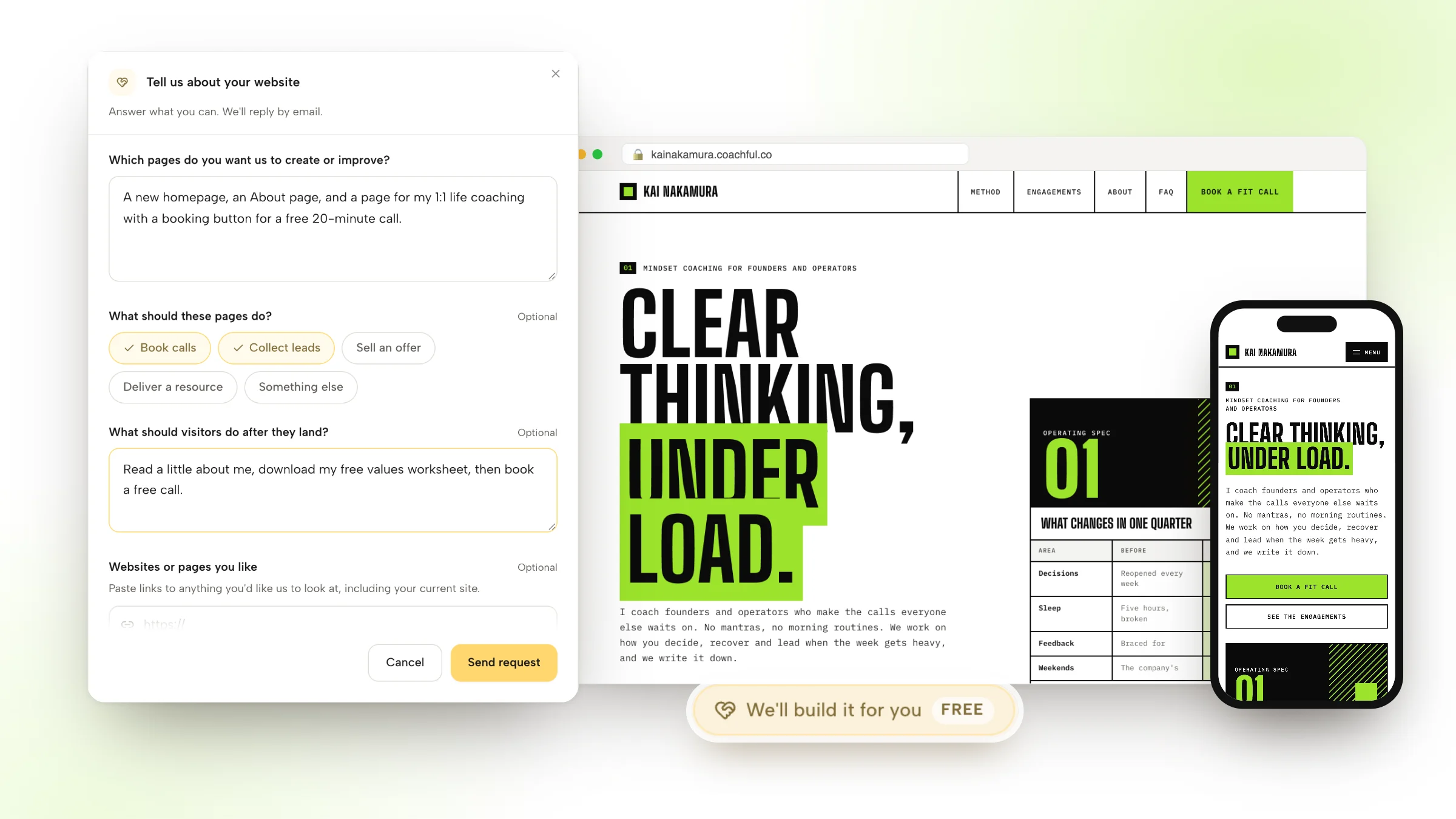
Mindset coaching websites drift into abstraction fast, full of "potential" and "breakthroughs". The ones that convert name one person and one change. Coachful's team builds yours for free on every plan, inside your own account. Coachful itself is a paid subscription, and you can start with a free trial.

Click Fill in a form on the "Want us to build it for you?" card on the Website page, or choose We'll build it for you · FREE under Create. Tell the team which pages you want and what visitors should do; add up to 8 links and up to 10 files, such as a worksheet you'd like to give away. The team replies by email with next steps, usually within about 24 hours, typical but not guaranteed. A recent build for a life-purpose coach moving from another coaching tool showed the coach's three programs as one pine drawn at three heights, taken from the coach's emblem, with descriptions and FAQ adapted from the old pages. Nothing is invented. Logos, video and ads aren't included. Here's what the free build covers.
Finding your first mindset coaching clients
- Coach one belief in public. A post that walks through a real (anonymized) experiment does more than a quote card.
- Offer a values or beliefs worksheet as a lead magnet; our guide to creating a lead magnet covers the funnel.
- Run a short group on one theme, such as "speaking up in meetings", and invite finishers to one-to-one work.
- Find referral partners who meet your clients first: therapists finishing treatment with clients, business coaches, HR teams.

Frequently asked questions
Do you need a certification to be a mindset coach?
No. Mindset coaching isn't licensed and has no specific credential. ICF-accredited coach training and an ICF credential are the most recognized way to show coaching skill, and many coaches add study in positive psychology or cognitive-behavioral methods.
What does a mindset coach do?
A mindset coach helps clients notice the beliefs holding them back, test those beliefs with small experiments, and build evidence and habits that support the change they want. Good mindset coaching is tied to behavior, not only to positive thinking.
Is growth mindset backed by science?
Partly. Large meta-analyses in 2018 found weak overall effects of mindset interventions on achievement, with possible benefits for disadvantaged and at-risk students. A 2019 national US experiment found a short intervention improved grades for lower-achieving students in supportive schools.
What is the difference between a mindset coach and a therapist?
A therapist is licensed to treat mental health conditions such as depression and anxiety. A mindset coach works with people who aren't unwell on beliefs, decisions and follow-through, and refers clients whose difficulty is clinical.
How much do mindset coaches make?
Coachful's rates data uses the life coaching band: $75 to $200 an hour and $47,000 to $72,000 a year (PayScale, ZipRecruiter, Glassdoor). Three-month programs typically sell for $1,200 to $2,500.
How long does it take to become a mindset coach?
Coach training takes several months part time, and reaching the 100 coaching hours for an ICF ACC credential usually takes about a year. You can coach paying clients while you build the hours.
Will Coachful build my mindset coaching website for free?
Yes. Coachful's team builds coaching websites, sales pages and lead-magnet funnels for free on every plan. Fill in the form from the Website page or Create and the team replies with next steps, usually within about 24 hours. Coachful is a paid subscription; the build costs nothing extra.












