NLP Coaching: What It Is and What the Evidence Says
NLP coaching is coaching that uses techniques from neuro-linguistic programming, a set of communication and change methods created by Richard Bandler and John Grinder in the 1970s. In practice that means precise questions about language, outcome framing, reframing, "anchoring" a state to a cue, and modeling people who are good at something. The plain truth about the evidence: NLP's core theory has not held up in research, and controlled trials of NLP as a whole are few and weak.
That does not make every NLP technique useless. Several of them overlap with methods that do have support elsewhere. This guide separates the two: where NLP came from, what each technique claims, what studies found, which pieces are worth keeping, a session you can run with a sample dialogue and 11 questions, and how to choose training in a field nobody regulates. If you coach on Coachful, our team will build the worksheets and check-ins in this guide in your account for free.
Where NLP came from
Richard Bandler was a student at the University of California, Santa Cruz, where he ran a Gestalt therapy group; John Grinder was a linguistics professor there. Together they studied how three well-known therapists spoke and worked: Fritz Perls (Gestalt therapy), Virginia Satir (family therapy) and Milton Erickson (hypnotherapy). They tried to describe the language patterns behind their results so others could copy them.
The first book, The Structure of Magic (1975), set out the "Meta Model", a way of questioning vague language. Frogs into Princes (1979), drawn from their workshops, popularized ideas such as representational systems and eye-accessing cues. From there NLP spread into sales, coaching, therapy and self-help, and split into many schools. As the Wikipedia entry on NLP notes, the name is not trademarked or centrally regulated, so anyone can issue an NLP certificate.
The main NLP techniques coaches use
| Technique | What NLP claims | What we'd keep |
|---|---|---|
| Meta Model questions | Vague language (deletions, distortions, generalizations) hides the real problem; precise questions recover it | Keep. Specific questions ("Always?", "Who exactly?") are standard good coaching and close to Socratic questioning |
| Well-formed outcomes | Goals work when stated positively, sensory-specific, in the client's control and checked for side effects | Keep. It overlaps with goal-setting practice that has research support |
| Reframing | Changing the meaning or context of an event changes the response to it | Keep, but understand it as cognitive reappraisal, which is studied in cognitive behavioral work |
| Anchoring | A gesture or word linked to a strong state can recall that state later | Use lightly as a habit cue. Little direct evidence for the strong version |
| Rapport by mirroring | Matching posture, pace and words builds rapport | Optional. The coaching relationship matters, but mechanical mirroring can feel manipulative |
| Representational systems and eye cues | People prefer a sensory channel, and eye movements reveal how they are thinking | Drop. Studies have not supported it |
| Swish pattern and "fast phobia cure" | Rapid mental imagery techniques remove unwanted responses or phobias | Do not use on phobias or trauma; refer to a licensed clinician |
| Modeling | Study how skilled people do something, then teach the sequence | Reasonable as a learning habit, though not evidence of anything on its own |
What the evidence says about NLP, plainly
NLP has been studied for about 50 years, and the findings point in one direction.
- The theory. Reviews by Christopher Sharpley in 1984 and 1987 found little support for the idea that people have a preferred representational system or that matching it improves rapport. Tomasz Witkowski's 2010 review of 35 years of research concluded that NLP's theoretical claims were not supported and called it pseudoscientific.
- Eye movements. A 2012 PLoS ONE paper ran three studies on the NLP claim that eye direction reveals lying and found no support. A 2023 eye-tracking study found that thinking does move the eyes in patterned ways, but not in the directions NLP predicts.
- Health outcomes. A 2012 systematic review in the British Journal of General Practice found 10 experimental studies. Four of the five randomized trials found no difference between groups, and risk of bias was high or uncertain across all of them. The authors concluded there was little evidence that NLP improves health outcomes, while noting this reflected the limited quality of the research.
- Expert opinion. Delphi polls of psychologists led by John Norcross in 2006 and 2010 rated NLP among discredited interventions for mental health and addiction treatment.
- The positive studies. A 2015 meta-analysis of NLP psychotherapy reported an effect of 0.54, but most included studies were observational and the lead author was affiliated with an NLP association. Since 2021, small hospital trials, mostly from nursing researchers in Turkey, have reported benefits for comfort, fear or pain, such as a 2025 trial after cesarean birth. They are short-term, and the "NLP" tested varies between trials.
For coaching specifically, we could not find a well-controlled trial of NLP coaching as a complete method. So the fair position is this: some NLP-derived techniques are useful conversation tools, and the overall framework should not be sold as science. If a training brochure says NLP "rewires the brain" or is "proven", ask for the study.

What to keep, and what to drop
The techniques worth keeping have one thing in common: they make the conversation more precise without claiming to read the client's mind. Asking "What specifically happens when you freeze?" is useful whatever you believe about neurology. Telling a client "you looked up and left, so you're constructing that memory" is not.
Several NLP tools also have better-researched relatives. Reframing sits close to the cognitive reappraisal used in cognitive behavioral coaching. Meta Model questions overlap with Socratic questioning and clean language questions. The well-formed outcome sits next to the goal work in our SMART goals template. If you like an NLP technique, learning its evidence-based cousin makes you a better coach and gives you a more honest way to describe it.
A session using NLP-derived tools, step by step
- Agree the outcome for the session. Ask what the client wants by the end of the hour.
- Get specific. Use Meta Model questions on the vaguest, most absolute words: always, never, everyone, can't, should.
- Find the exception. Ask for a time the problem didn't happen. Exceptions are evidence the client can use.
- Frame the outcome. State it in the positive, in the client's control, with how they will know they have it.
- Check the side effects. Ask what they might lose if they got it. NLP calls this an "ecology check".
- Offer a reframe, as a question. "What else could this mean?" Let the client pick or reject it.
- Choose a cue for practice. A simple physical or verbal cue the client links to a steadier state before the situation. Treat it as a habit, not magic.
- Agree one action and record it.
A short sample dialogue
Priya is a project manager. Illustrative, not a transcript.
Priya: I always freeze in leadership meetings. Everyone thinks I'm out of my depth.
Coach: Always? Has there been a leadership meeting where you didn't freeze?
Priya: The budget one last month, actually. I'd prepared numbers.
Coach: And "everyone thinks you're out of your depth." Who, specifically?
Priya: Honestly? I'm thinking of one director. And I don't know that she thinks it.
Coach: So what do you want instead, said as what you'd be doing?
Priya: I want to make one clear point in the first ten minutes of every meeting.
Coach: How will you know you've done it?
Priya: I'll have said it out loud and written it in my notes after.
Coach: Anything you'd lose if you started speaking up?
Priya: The safety of being invisible. Which I'm ready to lose.
11 NLP-style coaching questions
- What specifically happens when you "freeze"?
- Always? Can you think of a time it didn't happen?
- Who, specifically, thinks that?
- How do you know they think that?
- What stops you? And what would happen if you did?
- What do you want instead, said in the positive?
- How will you know when you have it: what will you see, hear or feel?
- Which part of this is within your control?
- What might you lose if you got this?
- What else could this mean?
- When you have done this well before, what were you doing differently?
Notice that none of these require you to accept NLP's theory. They are precise, open questions, and you can use them inside any model, including GROW.

Who NLP coaching suits, and who it doesn't
It can suit clients who like structure and quick, practical tools; performance situations such as sales calls, presentations and interviews; and clients whose language is full of absolutes ("never", "everyone", "I can't") that dissolve once questioned.
It is a poor fit for clients looking for evidence-based treatment of anxiety, phobias, trauma, depression or addiction, who need a licensed clinician; skeptical clients who will rightly ask what the evidence is; and anyone who would feel handled by mirroring or embedded suggestions. Rapport built on technique tends to break the moment the client notices it.
Scope and ethics cautions
- No clinical promises. Some NLP marketing promises to cure phobias in one session. Coaches should not treat phobias, trauma or other mental health conditions; refer to a licensed professional.
- Be careful with "hypnotic" language. Milton-Model patterns are designed to be indirect. Using them to steer a client toward your preferred answer, or toward buying, crosses an ethical line. Professional codes such as the ICF Code of Ethics exist for exactly this kind of situation, and our coaching code of ethics guide covers it in plain English.
- Describe it honestly. "I use precise questioning and outcome-focused techniques, some drawn from NLP" is accurate. "Scientifically proven NLP" is not.
NLP training and certification: what to check
Because NLP is unregulated, a "Master Practitioner" certificate tells you little until you know who issued it and what it required. The UK's Association for NLP, a membership body, says on its site that NLP is "not regulated by law in the same way as some professions", and describes the usual ladder: introduction, diploma, Practitioner, Master Practitioner, Trainer and Master Trainer. The International NLP Trainers Association sets a minimum of 130 hours over at least 15 days for its Practitioner and Master Practitioner levels, with a written test (over 80% correct) and a practical demonstration; fully online courses need 130 hours of live teaching. We checked both on their own sites in October 2026.
An NLP certificate is not a coaching credential. If you want one, look at ICF credentials and our comparison of ACC, PCC and MCC. Some NLP courses are approved for ICF Continuing Coach Education units, which count toward renewing a credential, not earning one.
How to run these tools inside Coachful
The useful parts of NLP coaching are questions and practice, which is what Coachful is set up to carry between sessions. All of this is included in your membership.
A well-formed outcome worksheet
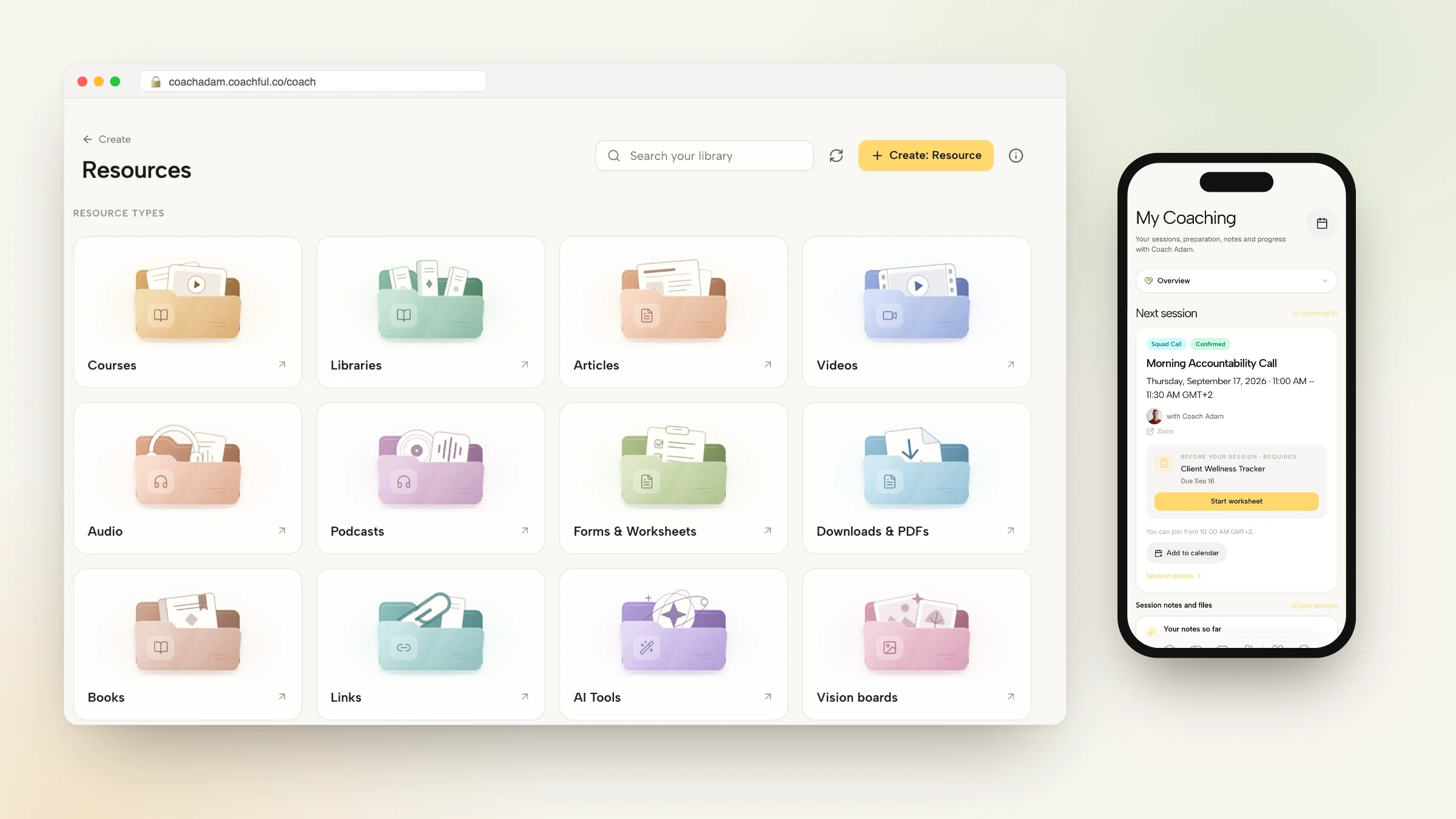
In Create > Resources > Forms & Worksheets, build a worksheet with six prompts: What do you want, in the positive? How will you know you have it? Where, when and with whom? What is in your control? What might you lose? What is the first step? Set it as a Worksheet so the client keeps a saved, reviewable copy.
Ready-made reframing templates
Tools > Explore includes editable templates that fit the reframing part of this work, such as Fact versus story (observation, interpretation, evidence, alternative) and Limiting beliefs. Edit the wording and assign them like any worksheet.
Turn the outcome into a goal
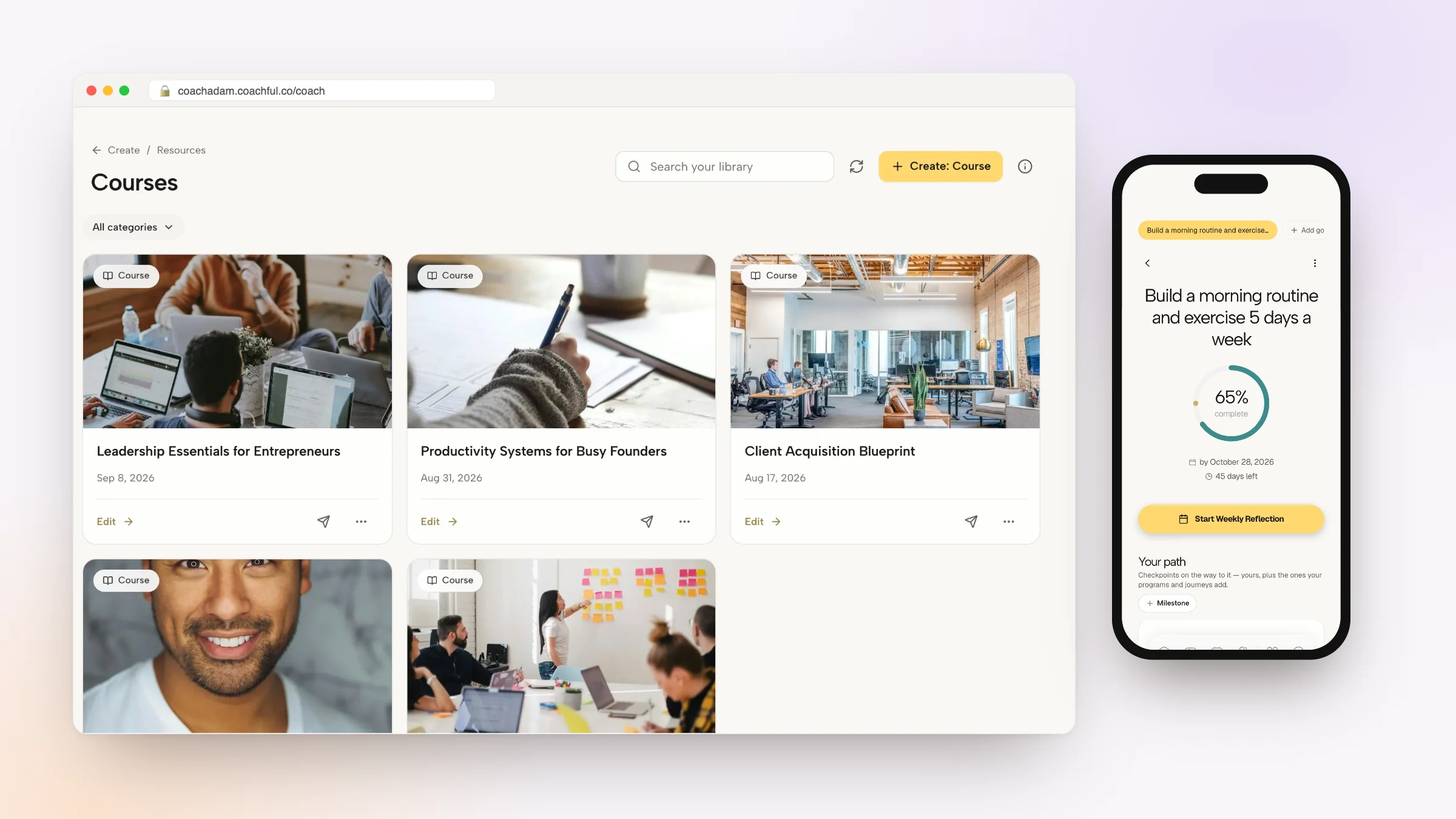
Save the outcome as a client goal with a deadline and milestones. The client sees progress on their phone and can start a weekly reflection from the goal itself.
A short reframe check-in
A coaching flow can include a Reframe Input step, where the client writes down a thought, followed by your own question asking what else it could mean. Add a Habit Check step if the client is practicing a cue before a trigger situation.

Keep the client's exact words
Language work depends on exact phrasing, so write the client's words into your shared session notes ("I want to make one clear point in the first ten minutes"). The client's My Coaching page pulls those notes into a summary and lists what to do next.

Prepare with Brain
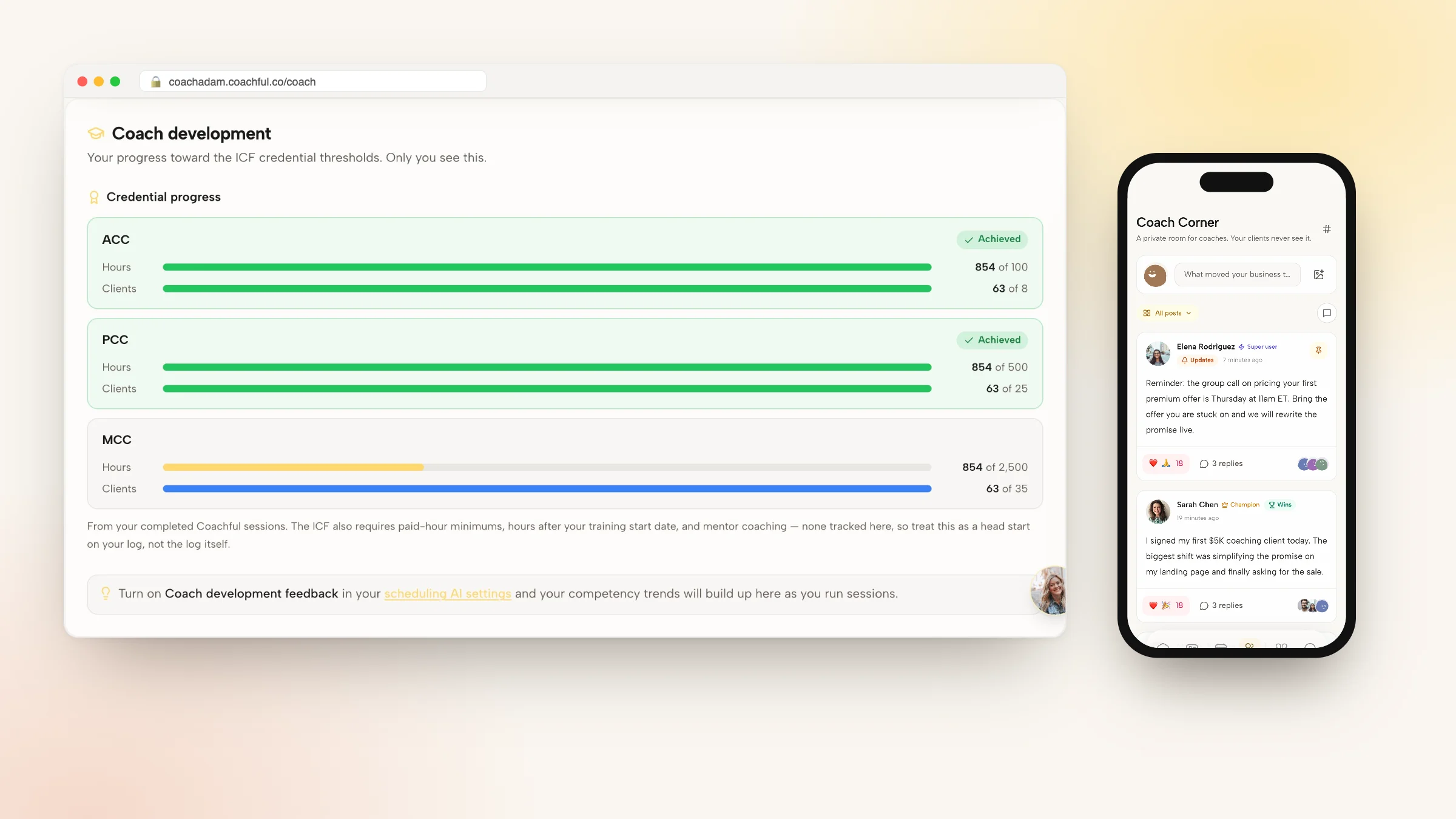
Before a session, Brain's Prepare for a client shortcut gathers the client's context and progress, which helps you spot the absolute words that keep coming back.

Want the worksheets built for you?
Coachful's white-glove service is free on every plan. Use Create > We'll build it for you, describe the worksheet, check-in or program you want, and add any material you already use. The team replies by email, usually within about 24 hours, and builds it in your account so you can edit it. Nothing gets invented, so claims about NLP stay the way you write them. Read how the free white-glove service works, and see our pages for confidence coaches and sales coaches.

Frequently asked questions
What is NLP coaching?
NLP coaching uses neuro-linguistic programming techniques inside coaching sessions: precise Meta Model questions, well-formed outcomes, reframing, anchoring a state to a cue, and modeling skilled people. It was developed from Bandler and Grinder's work in the 1970s and is used mostly for performance, confidence and communication goals.
Is NLP scientifically proven?
No. Reviews since the 1980s have not supported NLP's core theory, a 2012 systematic review found little evidence for health outcomes, and studies of eye-movement claims found no support. Some individual techniques resemble better-studied methods, such as cognitive reappraisal and goal setting, which is a different thing from NLP being proven.
Is NLP coaching a scam?
Not necessarily. Many coaches use NLP-derived questions well. The problem is overclaiming: promises to rewire the brain, cure phobias quickly or read thoughts from eye movements. Judge a coach or course by what they promise, how they describe the evidence and whether they refer clinical issues on.
Do I need NLP certification to be a coach?
No. NLP certification is not a coaching credential and is not regulated. If you want a recognized coaching credential, look at ICF-accredited training and the ACC, PCC or MCC credentials. Some NLP courses carry ICF Continuing Coach Education units.
What is the difference between NLP and CBT in coaching?
Both work with how a client interprets events. Cognitive behavioral approaches have decades of controlled research behind them; NLP mostly does not. CBT-based coaching tests thoughts against evidence and uses behavioral experiments, while NLP leans on language patterns, imagery and anchoring.
How long does NLP practitioner training take?
It varies widely because nobody regulates it. The International NLP Trainers Association requires at least 130 hours over a minimum of 15 days for its Practitioner level. Some other courses advertise a few days or self-paced video only.
Can Coachful build an NLP-style worksheet or program for me?
Yes. The white-glove service is free on every Coachful plan. Ask from Create > We'll build it for you and the team will build an outcome worksheet, a reframing check-in or a full program in your account, usually within about 24 hours.