Cognitive Behavioral Coaching: ABC Model, Steps, Evidence
Cognitive behavioral coaching is coaching that helps clients notice the thoughts that drive their reactions, test those thoughts against evidence, and try new behavior to see what actually happens. It borrows the methods of cognitive behavioral therapy (the ABC model, thought records, behavioral experiments) and applies them to goals, performance and everyday stress in people who are not clinically unwell. Of all the approaches in this series, it has the most research behind it.
This guide covers where cognitive behavioral coaching came from, the core models, how it differs from CBT, what the studies show, a session with sample dialogue and 12 questions, who it suits, where coaching ends and therapy begins, and the training routes. If you coach on Coachful, our team will build the thought records, check-ins and program in this guide in your account for free.
Where cognitive behavioral coaching came from
Two therapists laid the foundations. Albert Ellis developed rational emotive behavior therapy in the 1950s and set it out in Reason and Emotion in Psychotherapy (1962); his ABC model says it is not the event that upsets us but what we believe about it. Aaron Beck developed cognitive therapy, described in Cognitive Therapy and the Emotional Disorders (1976), with its focus on automatic thoughts and thinking errors.
Coaching psychologists then adapted the methods for non-clinical clients. Michael Neenan and Windy Dryden's Life Coaching: A Cognitive-Behavioural Approach (2002) and Neenan and Stephen Palmer's Cognitive Behavioural Coaching in Practice (2012) made the case in the UK, while Anthony Grant and colleagues in Australia ran some of the first randomized trials of coaching, many using a cognitive-behavioral, solution-focused approach.
The core models of cognitive behavioral coaching
The ABCDE model
| Step | What it is | Example |
|---|---|---|
| A: Activating event | The situation or trigger | My manager asks for the draft report by Friday |
| B: Belief | What I tell myself about it | "If it isn't perfect, she'll think I'm not up to the job" |
| C: Consequence | Feelings and behavior that follow | Anxiety; I keep rewriting and miss Friday |
| D: Dispute | Questioning the belief | "What's the evidence? What did she say about my last draft?" |
| E: Effective new outlook | A more accurate, more useful belief | "A draft is meant to be improved. Sending it on time shows I'm reliable" |
Common thinking traps, and the coaching question for each
| Thinking trap | Sounds like | Coaching question |
|---|---|---|
| Catastrophizing | "If I fail this pitch, my business is over" | "What's the most likely outcome, not the worst?" |
| All-or-nothing | "Either it's perfect or it's worthless" | "What would a 70% version look like, and would it do the job?" |
| Mind reading | "They think I'm a fraud" | "What have they actually said or done?" |
| Should statements | "I should be further along by now" | "Says who? What would you prefer, rather than demand?" |
| Labeling | "I'm lazy" | "What did you do, and what does it show beyond that label?" |
| Discounting the positive | "That win was just luck" | "What part of that result came from you?" |
Behavioral experiments
The most useful tool in cognitive behavioral coaching is not arguing with a thought. It is designing a small test. If a client believes "If I say no to my director, she'll be annoyed with me for weeks", the experiment is to decline one small request and record what happens. Results change beliefs faster than debate does.

Cognitive behavioral coaching vs CBT
| Cognitive behavioral coaching | Cognitive behavioral therapy | |
|---|---|---|
| Who it's for | Functioning people with goals, performance blocks or everyday stress | People with diagnosable conditions such as depression, anxiety disorders or insomnia |
| Starting point | A goal the client wants to reach | Symptoms the client wants relief from |
| Who delivers it | Coaches and coaching psychologists | Licensed clinicians |
| Focus | Thinking that gets in the way of action | Thinking and behavior that maintain a disorder |
| Regulation | Coaching is largely unregulated | Regulated health care in most countries |
What the research says about cognitive behavioral coaching
- The therapy evidence base is large. A review of 106 meta-analyses of CBT found the strongest support for anxiety disorders, somatoform disorders, bulimia, anger control problems and general stress. That is clinical research, and it doesn't transfer automatically to coaching, but it shows the methods are well tested.
- Coaching trials. In a randomized trial, 41 executives in a public health agency received 360-degree feedback, a leadership workshop and four cognitive-behavioral, solution-focused coaching sessions over 10 weeks. Compared with controls, coaching raised goal attainment, resilience and workplace well-being and reduced depression and stress (Grant, Curtayne and Burton, 2009). A 10-week group life coaching program using the same approach increased goal striving, well-being and hope in 56 adults compared with a waitlist (Green, Oades and Grant, 2006).
- Meta-analysis. A 2021 meta-analysis of 20 studies of cognitive-behavioral and positive psychology coaching (Wang, Lai, Xu and McDowall, Journal of Work-Applied Management) found large effects on goal attainment (g = 1.29) and moderate effects on self-efficacy (g = 0.59). Cognitive-behavioral coaching was linked to better self-regulation and work satisfaction, though the popular approaches did not differ significantly from each other, and integrative approaches did best.
The limits: many coaching trials are small, often with waitlist controls and self-reported outcomes, and much of the early work comes from a small group of researchers. Still, compared with most coaching approaches, cognitive behavioral coaching stands on firm ground.
How to run a cognitive behavioral coaching session
- Set the agenda. Review last week's experiment, then agree one topic for today.
- Pick a specific situation. One recent, concrete moment works better than a general pattern.
- Map the ABC. What happened, what did you tell yourself, what did you feel and do?
- Rate the belief. How strongly do you believe it, from 0 to 100?
- Examine it. Evidence for, evidence against, what you'd tell a friend.
- Build an alternative. A belief that is both more accurate and more useful. Re-rate the original.
- Design an experiment. A small action that tests the old belief, with a prediction written down.
- Agree homework. Usually a thought record and the experiment, with a date.
- Summarize. Ask the client to put the key learning in their own words.
A short sample dialogue
Grace is a policy analyst who has rewritten the same report for two weeks. Illustrative, not a transcript.
Coach: When you picture sending the draft, what goes through your mind?
Grace: That my manager will see it's not good enough and stop trusting me with big projects.
Coach: How strongly do you believe that, from 0 to 100?
Grace: Eighty.
Coach: What happened the last time you sent her a draft?
Grace: She sent comments and said the structure was clear. She gave me this project after that.
Coach: So what's the evidence against the eighty?
Grace: That she's seen my drafts and keeps giving me work. Maybe forty, then.
Coach: Would you be willing to test it? Send the draft on Thursday as it is, and predict what she'll say.
Grace: I predict she'll ask for big changes. I'll write that down and send it Thursday.
12 cognitive behavioral coaching questions
- What went through your mind just before you felt that?
- How strongly do you believe that thought, from 0 to 100?
- What's the evidence for it? And against it?
- What would you say to a friend who thought this?
- What's the worst that could happen, the best, and the most likely?
- If the worst happened, how would you cope?
- Is this thought helping you get what you want?
- What's another way of looking at this?
- What would a 70% version look like?
- What small experiment could test this belief this week?
- What do you predict will happen, and how will we know?
- What did you learn from the result?
Our guides to perfectionism coaching and procrastination coaching apply these questions to two of the most common topics, and Socratic questioning goes deeper on examining beliefs.

Who it suits, and who it doesn't
It suits clients held back by self-criticism, perfectionism, procrastination, imposter feelings or fear of rejection; performance situations such as presentations, sales and interviews; leaders under pressure who want practical tools; and clients who like structure and homework.
It suits less well clients who want to explore meaning, identity or purpose without a specific block (narrative or Co-Active approaches may fit better), people who find homework a burden, and anyone whose difficulties are clinical.
Where coaching ends and therapy begins
Cognitive behavioral coaching uses therapy tools, so the scope line matters more here than with most approaches.
- Refer when the thinking is a symptom. Persistent low mood, panic attacks, intrusive thoughts, disordered eating, substance problems or thoughts of self-harm are for a licensed clinician. A useful test from our coaching models guide: is the thinking unhelpful, or is the person unwell?
- Don't call it therapy. "I use cognitive behavioral coaching techniques" is accurate. "I offer CBT" implies a clinical service.
- Screen at intake. A couple of intake questions about current mental health support and well-being help you spot when coaching isn't the right service. See our guide to coaching intake forms.
Cognitive behavioral coaching training routes
One example we checked on its own site in October 2026: the Centre for Coaching in London, established in 2001, with coaching psychologists Stephen Palmer and Siobhain O'Riordan as course co-directors. Its five-day Certificate in Coaching introduces the cognitive behavioral approach and is listed as approved by the British Psychological Society, and its Association for Coaching accredited Advanced Diploma includes more than 100 hours of training. Courses are taught live on Zoom.
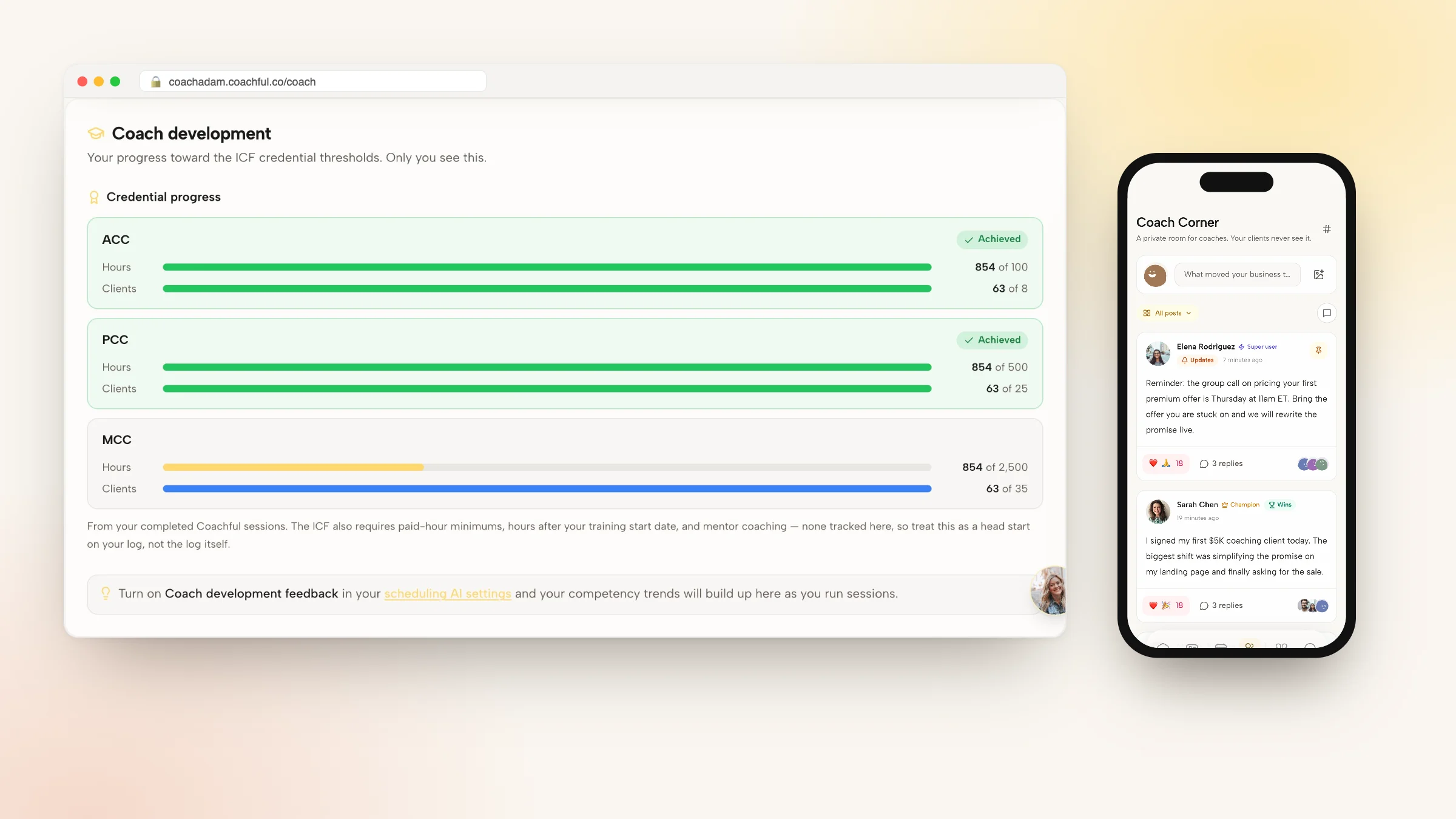
Psychologists can also train in coaching psychology through university programs. Whatever route you choose, a coaching credential from the ICF or another professional body is separate; see the ICF credentialing pages.
Running cognitive behavioral coaching inside Coachful
Cognitive behavioral coaching depends on homework: thought records filled in during the week, experiments carried out and reported back. This is how coaches run that in Coachful, all included in your membership.
Thought records ready to edit
Tools > Explore includes Situation, belief and response (trigger, belief, emotion, behavior), which is an ABC thought record, plus Fact versus story and Limiting beliefs. Edit the prompts, add a 0 to 100 belief rating, and assign it as a worksheet so the client keeps their saved copy.
Homework that arrives before the session
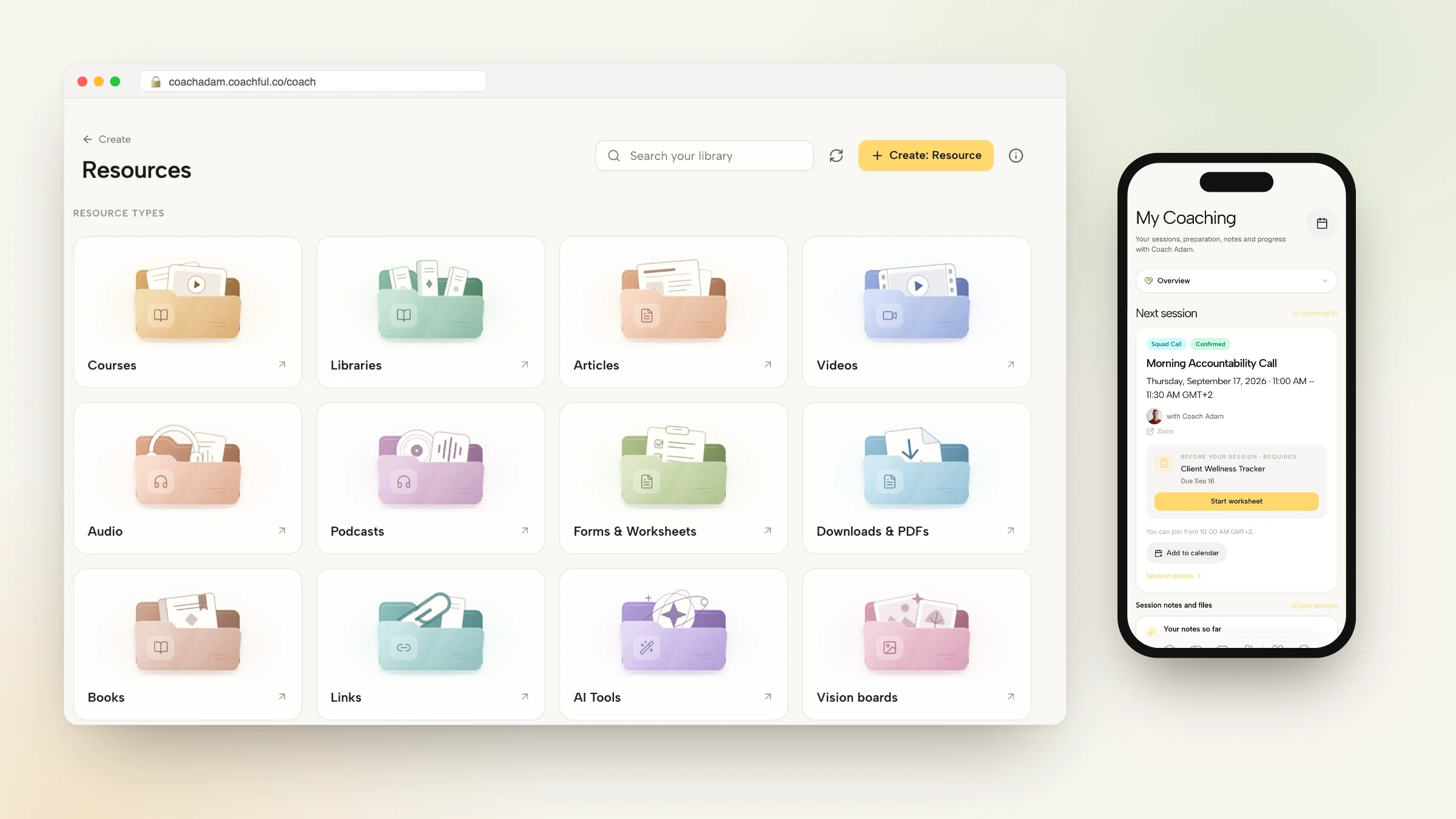
Attach the thought record to your session type as prep. It appears on the client's session card under Before your session, so you start the call with the week's situations already written down.

Experiments as habits or tasks
A one-off experiment ("send the draft Thursday") works as a task; a repeated one ("say what I think in the first ten minutes of each meeting") works as a habit with a reminder, so you both see whether it happened.

A short course on thinking traps
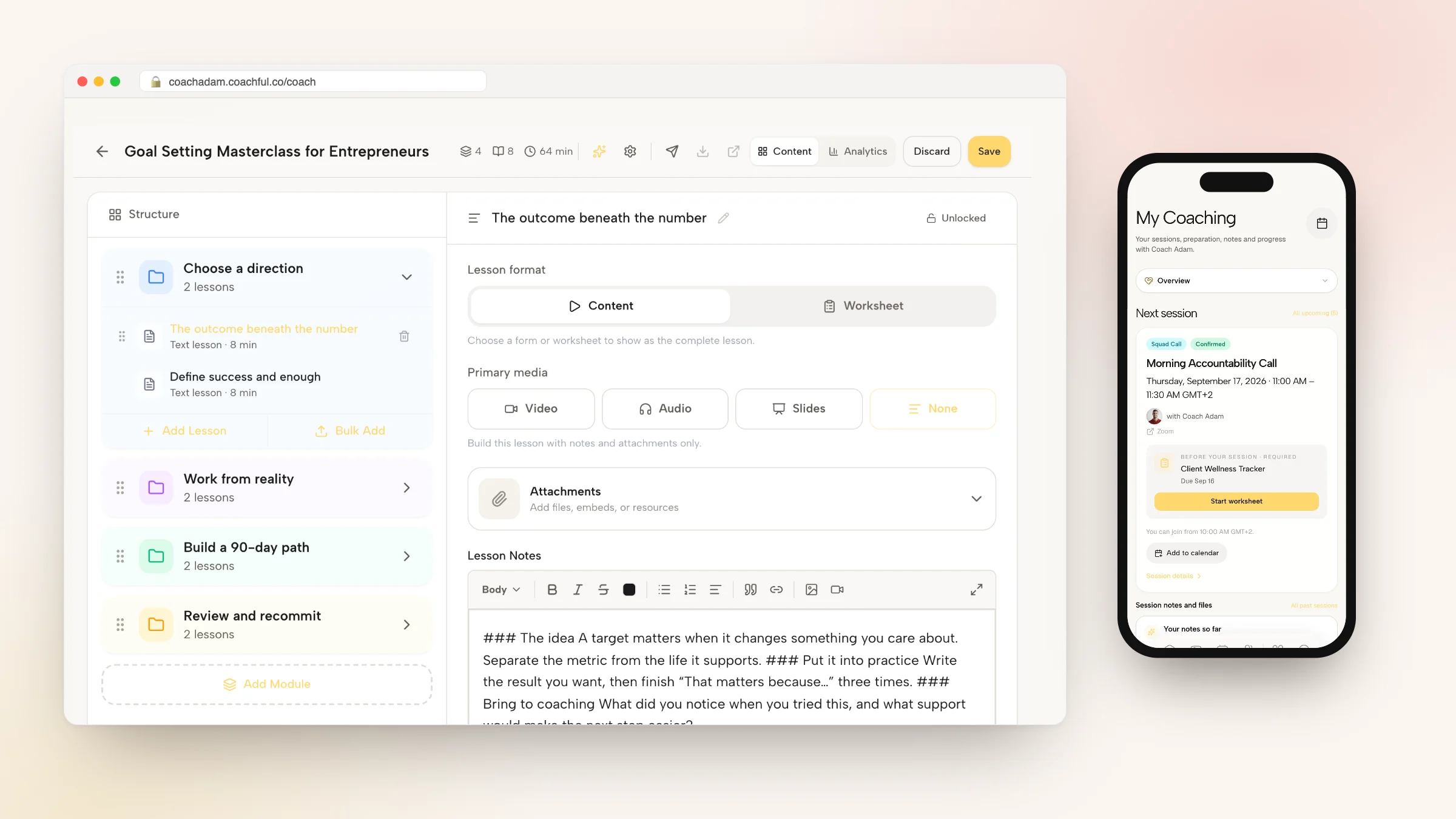
Many coaches teach the ABC model and thinking traps once, as a short course, rather than in every session. The course builder lets you write lessons with notes, add a worksheet lesson, and track progress.
A daily reframe check-in
A coaching flow can include a Reframe Input step where the client writes down a thought, plus a Mood Scale, so the habit of catching thoughts builds between sessions.

Notes that track belief ratings
Write belief ratings into your shared notes ("80 to 40 after reviewing evidence"). They roll up into Your notes so far on the client's My Coaching page, which makes progress visible.

Have the Coachful team build your CBC toolkit
Coachful's white-glove service is free on every plan. From Create > We'll build it for you, ask the team for thought records, a thinking-traps course (outline and written lessons; you record any videos), a daily reframe check-in or a full program. Attach your existing worksheets. The team replies by email, usually within about 24 hours, and builds it inside your account so you can edit it. Read what the free white-glove service includes and see our pages for confidence coaches and mindset coaches.

Related: NLP coaching compared honestly, and positive psychology coaching, which combines well with this approach.
Frequently asked questions
What is cognitive behavioral coaching?
It is coaching that uses cognitive behavioral methods to help clients identify unhelpful thoughts, test them against evidence and try new behavior. It is aimed at goals, performance and everyday stress in functioning people, not at treating mental health conditions.
What is the ABC model in coaching?
From Albert Ellis: A is the activating event, B is the belief about it, and C is the emotional and behavioral consequence. Coaches often add D (disputing the belief) and E (an effective new outlook). The point is that C comes mainly from B, not from A.
Is cognitive behavioral coaching the same as CBT?
No. It uses similar tools, but CBT is a clinical treatment delivered by licensed professionals for conditions such as anxiety disorders and depression. Cognitive behavioral coaching works with people who are not clinically unwell, on goals they want to reach.
Is cognitive behavioral coaching evidence-based?
More than most coaching approaches. Randomized trials have found improvements in goal attainment, resilience and well-being, and a 2021 meta-analysis of 20 studies found large effects on goal attainment (g = 1.29). Many trials are small, so effect sizes may shrink with better studies.
What is a behavioral experiment in coaching?
A small, planned action that tests a belief. The client writes a prediction ("if I say no, she'll be annoyed for weeks"), does the action, and records what actually happened. It usually changes a belief faster than arguing with it.
Can a life coach use CBT techniques?
Coaches can use cognitive behavioral techniques with clients who are not clinically unwell, as long as they don't present it as therapy and they refer clients showing signs of depression, anxiety disorders or other conditions to a licensed professional.
Will Coachful build a cognitive behavioral coaching toolkit for me?
Yes. The white-glove service is free on every Coachful plan. Ask from Create > We'll build it for you and the team will build thought records, a check-in or a full program in your account, usually within about 24 hours.